

Most ham antenna gain claims we checked are plausible, or close enough. We checked every antenna in our catalogue that states both a gain figure and a length, 31 of them, against what our model estimates that length can deliver. Twenty-six claims fall within tolerance. Five exceed it, and the worst, a five-centimetre stubby sold as "high gain long range", claims about 8 dB more than our estimate for its size.
The more useful finding is quieter. Antennas of similar length and style, which our model gives nearly identical gain estimates, ship with gain claims that differ by up to 1.5 dB depending on whose name is on the package. In our data those differences line up with the brand, not with anything the length tells us.
This page is the evidence behind our antenna rankings. If you just want to know which antenna to buy, our handheld antenna buying guide is the shorter read.
The short version
- 26 of 31 claims fall within a 2 dB tolerance of our estimate. That includes every Nagoya NA-771, every Comet and Diamond whip that states a figure, and every mobile antenna claim we could test.
- Five claims exceed our estimate by more than the tolerance: four from ABBREE and one from Nagoya. The Nagoya one is borderline.
- The worst is the ABBREE AR-805S, a 50 mm stubby claiming 3 dBi. At 2 meters it is 0.024 of a wavelength long.
- Same-size antennas get different numbers. The roughly 390 mm "771-class" whip is claimed at 3.0 dBi by Nagoya, 2.5 by HYS and 2.15 by Retevis, Baofeng, Diamond, TIDRADIO and ABBREE. Mirkit's listing states no figure at all.
- Mobile antenna claims fall below our estimate more often than above it. One NMO kit claims 2.15 dBi where our model estimates about 4.6.
- Nothing here was measured. We did not put these antennas on a range or a tape measure; lengths come from listings and manufacturer specifications. This is arithmetic plus a model, and the sections below say exactly where the model is weakest.
How we checked a claim
An antenna's gain is set mostly by its electrical length: its physical length expressed as a fraction of the wavelength it is working at. A 2 meter wave at 146 MHz is about 2,053 mm long, so a 396 mm whip is 0.193 of a wavelength there, a bit under a quarter wave. The same whip is 0.575 of a wavelength at 435 MHz on 70 centimeters, between a half wave and a five-eighths wave, which is a much better place to be. That is why our model rates most dual-band handheld whips well above their VHF figure on UHF, whatever the box says.
For each antenna we take three numbers we can verify, the length in millimetres, the bands it covers and the claimed gain, and do the following:
- Compute the electrical length at each band's design frequency: 146 MHz for 2 m, 223 MHz for 1.25 m, 435 MHz for 70 cm and 465 MHz for GMRS.
- Map electrical length to a realistic gain using a curve built from standard vertical-antenna behaviour. Electrically short elements lose badly, a quarter wave is the first useful size, a half wave is the sweet spot for a handheld, five-eighths wave is about the practical limit for a single element, and past that the pattern splits into lobes and gain toward the horizon falls.
- Use a different curve when the antenna has a ground plane. A mobile antenna on a car roof has an excellent one; a handheld whip has only the radio and your hand. The handheld curve is deliberately pessimistic about quarter-wave whips, because that is the size that suffers most without a counterpoise.
- Test the claim against the antenna's best band, because that is the band vendors quote. A claim counts as overstated only if it exceeds what the best band supports by more than 2 dB.
The 2 dB of slack is generous on purpose. A curve built from theory is not a measured pattern, real elements are loaded and tapered, and we would rather miss a modest exaggeration than accuse an honest one. If you want to run the arithmetic on your own antenna, the length test in our buying guide takes a tape measure and one division, and our methodology page explains how the same analysis feeds the antenna scores.
Where this method is weakest
Two places, and both affect the results below.
- Handheld quarter-wave whips. Without a ground plane, how a quarter wave performs depends heavily on the radio body and your hand. Our curve assumes the poor case. A short whip claiming 2.15 dBi can land just outside tolerance on that assumption alone.
- Long antennas that might be collinears. A collinear stacks elements with phasing sections and can make real gain at several wavelengths long. Physical length cannot prove whether an antenna is one. Past about one wavelength, our mobile and base curve rises again, which amounts to assuming those antennas are collinears. The ones we list beyond that length are from Comet, Diamond, Midland and Retevis, but only two of them, the Comet GP-3 and Diamond X50A, have published figures we test the curve against. On handheld whips we assume a single radiator. If a long handheld antenna were secretly a collinear, we would under-rate it.
One more honesty note: the long end of the base-antenna curve was fitted to the published figures for the Comet GP-3 and Diamond X50A. So when those two "agree with the model" below, that is by construction, not evidence.
A correction we made while writing this
Checking our own data turned up an error in it. We had the Nagoya NA-701 (SMA-Male) stored with a 5 dBi claim, which flagged it as overstated by 4.2 dB on its product page and its comparisons. Its current listing says 2.5 dBi, and Nagoya's own specification says 2.15. Our spec extractor re-reads claims only when it is run, so a seller's edit had left us holding a stale number. It is corrected, and the NA-701 now passes.
Five claims outside our model's tolerance
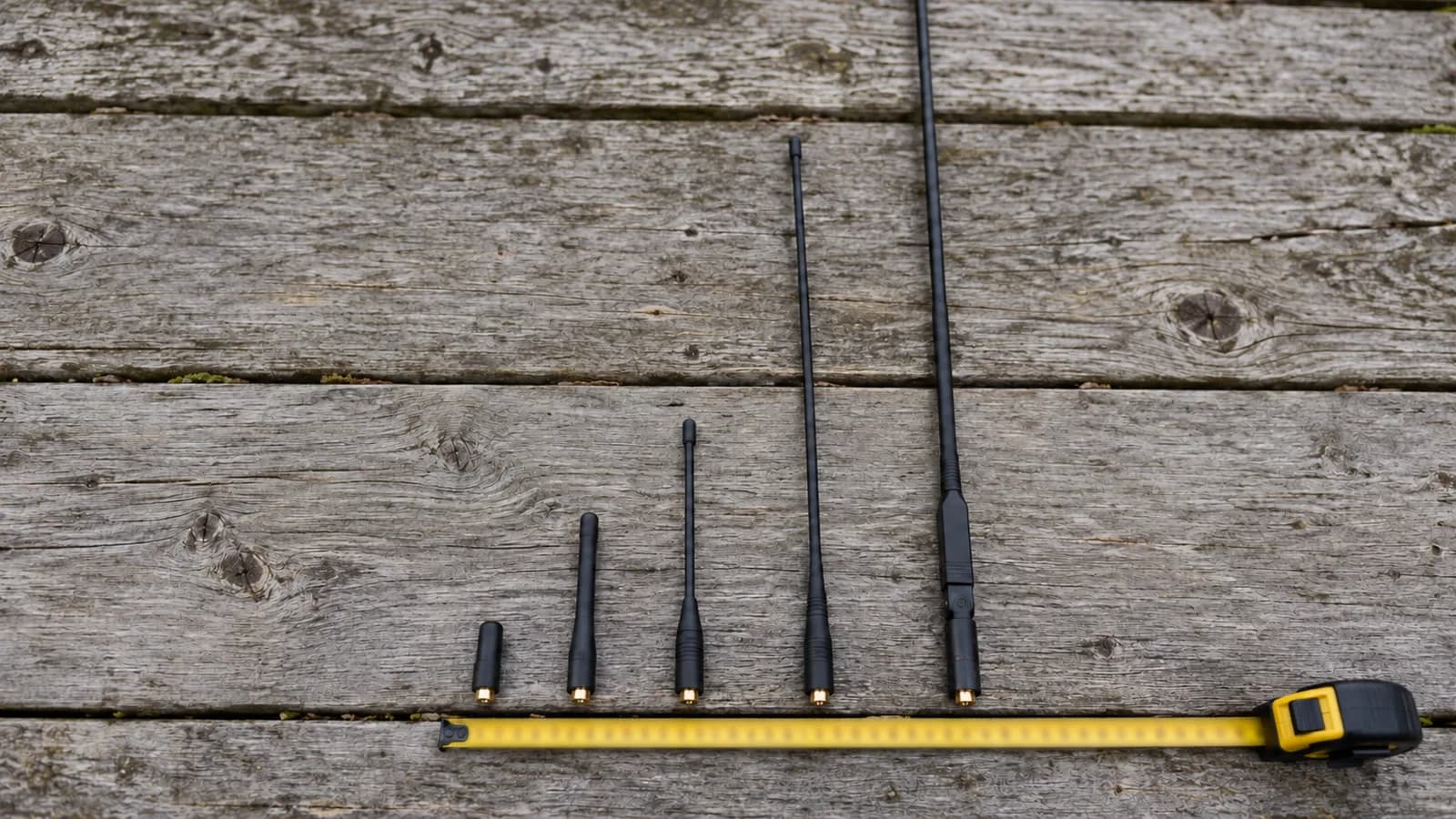
Sorted by how far each claim exceeds our model's estimate for its length.
ABBREE AR-805S stubby: 3 dBi claimed, 7.9 dB above our estimate
The AR-805S is 50 mm long and is sold with the words "High Gain Long Range Antenna to increase the communication distance". At 146 MHz it is 0.024 of a wavelength. At 435 MHz it is 0.073. Electrically short elements on this scale give up a lot; our curve puts its best case near -4.9 dBi on 70 cm and around -9 dBi on 2 m, against a claimed 3 dBi.
Stubbies exist for a real reason: they are small, tough and fine across a campsite. The Comet CH-32, at 44 mm, is the same kind of antenna, and Comet prints no gain figure for it at all. For an antenna this short, that is the figure our model would agree with.
ABBREE GMRS Tactical 42.5 in: 5 dBi claimed, 6.0 dB above our estimate
The ABBREE GMRS Tactical is 1,080 mm long and sold for GMRS at 462 to 467 MHz. At 465 MHz that length is 1.675 wavelengths. A single radiator that long breaks its pattern into lobes, and gain toward the horizon, which is where your contacts are, drops to around -1 dBi on our curve.
This is the claim where the collinear caveat matters most. If this antenna contains phasing sections, 5 dBi at GMRS is achievable and our flag is wrong. Its listing calls it "the GMRS AR-152", and it shares that 2 meter tactical's 1,080 mm length, but a listing's wording is not evidence of how an antenna is built. What we can say is narrower: a single radiator of this length would not make 5 dBi toward the horizon at GMRS. We would welcome a measured pattern either way.
ABBREE Tactical 48.8 in: 6 dBi claimed, 2.9 dB above our estimate
The ABBREE 48.8-inch Tactical is 1,240 mm, which is 0.604 wavelengths at 146 MHz: almost exactly a five-eighths wave, the best single-element length there is. Our curve gives it 3.1 dBi on 2 m, which is excellent for something you hold in your hand. The claim is 6.
Our model still rates it the strongest handheld antenna we list for 2 meters, and it scores 81 in our rankings. The claim is about double, in power terms, what the model estimates for that length.
Nagoya NA-701G GMRS: 2.15 dBi claimed, 2.6 dB above our estimate (borderline)
The NA-701G is a 140 mm GMRS whip, 0.217 of a wavelength at 465 MHz: just short of a quarter wave, with no ground plane. Our deliberately pessimistic handheld curve puts that at about -0.4 dBi.
We flag it because the rule flags it, but this is the weakest of the five. 2.15 dBi is the textbook gain of a half-wave dipole, and it is the most common figure in this dataset: 9 of the 31 antennas claim exactly 2.15 dBi, at lengths from 140 mm to 533 mm. A more forgiving quarter-wave assumption would bring this one inside tolerance.
ABBREE AR-152: 5 dBi claimed, 2.4 dB above our estimate
The AR-152 is the 1,080 mm folding tactical that a lot of hams buy for 2 meter reach, and our model rates it highly there. At 146 MHz it is 0.526 wavelengths, a true half wave, which our curve puts near 2.6 dBi. On 70 cm the same length is 1.567 wavelengths and gives up most of that advantage.
So the AR-152 models as a very good 2 meter antenna with a 5 dBi claim our estimate does not support. It still scores 82 in our rankings, because we score the length and not the claim.
Same length, different number
This is the part of the data that surprised us. The most common handheld upgrade is the roughly 390 mm dual-band whip that Nagoya made famous as the NA-771. Several brands sell an element of essentially the same length. Here is what each one claims:
| Antenna | Length | Claimed gain | Our length-based estimate (70 cm) | Price |
|---|---|---|---|---|
| Nagoya NA-771 (SMA-Female) | 396 mm | 3.0 dBi | 2.9 dBi | $20.98 |
| HYS 771N | 396 mm | 2.5 dBi | 2.9 dBi | $18.99 |
| HYS BNC dual-band | 396 mm | 2.5 dBi | 2.9 dBi | $11.99 |
| Mirkit dual-band whip | 396 mm | none stated | 2.9 dBi | $13.99 |
| Retevis RHD-771 | 391 mm | 2.15 dBi | 2.9 dBi | $9.99 |
| Baofeng dual-band whip | 389 mm | 2.15 dBi | 2.9 dBi | $6.99 |
| Diamond RH77CA | 381 mm | 2.15 dBi | 2.8 dBi | $24.99 |
Every one of these sits between 0.553 and 0.575 wavelengths on 70 cm and between 0.186 and 0.193 on 2 m. Our model gives them nearly the same estimate, 2.8 to 2.9 dBi. The claims run from 2.15 to 3.0 dBi, and one brand claims nothing at all. None of them is overstated; the most modest of them, the Retevis and the Baofeng, under-claim by the most.
The GMRS versions repeat the pattern. The Nagoya NA-771G claims 3.0 dBi; the TIDRADIO TD-771 and ABBREE AR-771C, within a few millimetres of the same length, claim 2.15. All three are about 0.6 of a wavelength at 465 MHz, and all three land around 3 dBi on our curve.
The 1,080 mm folding tactical shows the same thing at the other end of the size range. ABBREE claims 5.0 dBi for the AR-152. Bingfu claims 3.5 for its Tactical 42, which is the same length and the same folding-whip style. Bingfu's number is the one our model supports.
The practical point: do not pick between two antennas of the same length by their gain claims. The difference between their claims says more about the marketing than about the antennas. Compare the connector, the build and the price instead, which is exactly what the comparison between the AR-152 and the Bingfu Tactical 42 does.
Where the claims fall within tolerance
Most of the catalogue, and in some places the claim sits below our estimate.
- Mobile antennas. Every mobile antenna claim we could test is within tolerance, and several sit below our estimate. The HYS NMO antenna kit says 2.15 dBi; at 0.773 of a wavelength on 70 cm over a car roof, our curve supports about 4.6. The VFAN mag mount claims 3.0 against about 5.0. Mobile antennas work against a real ground plane, so the physics is on their side, and most of their claims sit at or below our estimate.
- The ABBREE 18-inch tactical. The same brand whose long tacticals land outside tolerance prints a modest 2.15 dBi on its 18-inch model, which our curve puts at about 2.5. So the pattern is specific to the long models, not to the brand.
- Comet and Diamond whips. The Comet SMA-24J and its SMA-Male sibling claim 3.5 dBi on 70 cm against an estimate of 2.9. That is inside tolerance and close to what Comet publishes per band.
- Base antennas. The Comet GP-3 and Diamond X50A claim 7.2 dBi on 70 cm and our model gives 7.1 and 7.0. As noted above, that agreement is built in, because their published figures are what the long end of the curve was fitted to.
The full table
Every antenna we could test, sorted by how far the claim exceeds the length-based estimate. A negative gap means the antenna claims less than our model estimates. "Best band" is the band the claim is tested against. "Outside" means the claim exceeds our estimate by more than the 2 dB tolerance; "Calibration" marks the two antennas the base-antenna curve was fitted to, so their agreement proves nothing.
| Antenna | Type | Length | Best band | Electrical length | Claimed | Estimate | Gap | Verdict |
|---|---|---|---|---|---|---|---|---|
| ABBREE AR-805S | Stubby | 50 mm | 70 cm | 0.073 wave | 3.0 dBi | -4.9 dBi | +7.9 | Outside |
| ABBREE GMRS Tactical 42.5 in | Folding | 1,080 mm | GMRS | 1.675 wave | 5.0 dBi | -1.0 dBi | +6.0 | Outside |
| ABBREE Tactical 48.8 in | Folding | 1,240 mm | 2 m | 0.604 wave | 6.0 dBi | 3.1 dBi | +2.9 | Outside |
| Nagoya NA-701G | Whip | 140 mm | GMRS | 0.217 wave | 2.15 dBi | -0.4 dBi | +2.6 | Borderline |
| ABBREE AR-152 | Folding | 1,080 mm | 2 m | 0.526 wave | 5.0 dBi | 2.6 dBi | +2.4 | Outside |
| Nagoya NA-701 (SMA-Male) | Whip | 203 mm | 70 cm | 0.295 wave | 2.5 dBi | 0.8 dBi | +1.7 | Plausible |
| Nagoya NA-701 (SMA-Female) | Whip | 203 mm | 70 cm | 0.295 wave | 2.15 dBi | 0.8 dBi | +1.3 | Plausible |
| Midland MXTA26 | Mobile | 813 mm | GMRS | 1.261 wave | 6.0 dBi | 4.9 dBi | +1.1 | Plausible |
| Bingfu Tactical 42 | Folding | 1,080 mm | 2 m | 0.526 wave | 3.5 dBi | 2.6 dBi | +0.9 | Plausible |
| Nagoya NA-320A | Whip | 450 mm | 70 cm | 0.653 wave | 3.5 dBi | 2.9 dBi | +0.6 | Plausible |
| Comet SMA-24J | Whip | 450 mm | 70 cm | 0.653 wave | 3.5 dBi | 2.9 dBi | +0.6 | Plausible |
| Comet SMA-24 | Whip | 450 mm | 70 cm | 0.653 wave | 3.5 dBi | 2.9 dBi | +0.6 | Plausible |
| HYS NMO mag mount kit | Mobile | 508 mm | 70 cm | 0.737 wave | 5.0 dBi | 4.7 dBi | +0.3 | Plausible |
| Retevis GMRS fiberglass | Mobile | 1,224 mm | GMRS | 1.899 wave | 6.5 dBi | 6.3 dBi | +0.2 | Plausible |
| Diamond X50A | Base | 1,707 mm | 70 cm | 2.477 wave | 7.2 dBi | 7.0 dBi | +0.2 | Calibration |
| Nagoya NA-771 (SMA-Female) | Whip | 396 mm | 70 cm | 0.575 wave | 3.0 dBi | 2.9 dBi | +0.1 | Plausible |
| Comet GP-3 | Base | 1,803 mm | 70 cm | 2.616 wave | 7.2 dBi | 7.1 dBi | +0.1 | Calibration |
| Nagoya NA-771 (SMA-Male) | Whip | 396 mm | 70 cm | 0.575 wave | 3.0 dBi | 2.9 dBi | +0.1 | Plausible |
| Nagoya NA-771G | Whip | 389 mm | GMRS | 0.603 wave | 3.0 dBi | 3.1 dBi | -0.1 | Plausible |
| ABBREE Tactical 18 in | Folding | 478 mm | 70 cm | 0.694 wave | 2.15 dBi | 2.5 dBi | -0.4 | Plausible |
| HYS BNC dual-band | Whip | 396 mm | 70 cm | 0.575 wave | 2.5 dBi | 2.9 dBi | -0.4 | Plausible |
| HYS 771N | Whip | 396 mm | 70 cm | 0.575 wave | 2.5 dBi | 2.9 dBi | -0.4 | Plausible |
| Diamond RH77CA | Whip | 381 mm | 70 cm | 0.553 wave | 2.15 dBi | 2.8 dBi | -0.6 | Plausible |
| Retevis RHD-771 | Whip | 391 mm | 70 cm | 0.567 wave | 2.15 dBi | 2.9 dBi | -0.7 | Plausible |
| Baofeng dual-band whip | Whip | 389 mm | 70 cm | 0.564 wave | 2.15 dBi | 2.9 dBi | -0.7 | Plausible |
| TIDRADIO TD-771 GMRS | Whip | 385 mm | GMRS | 0.597 wave | 2.15 dBi | 3.0 dBi | -0.8 | Plausible |
| ABBREE AR-771C GMRS | Whip | 389 mm | GMRS | 0.603 wave | 2.15 dBi | 3.1 dBi | -1.0 | Plausible |
| Comet SS-460SBNMO | Mobile | 470 mm | 70 cm | 0.682 wave | 3.8 dBi | 4.9 dBi | -1.1 | Plausible |
| HYS dual-band mag mount | Mobile | 435 mm | 70 cm | 0.631 wave | 3.5 dBi | 5.2 dBi | -1.7 | Plausible |
| VFAN dual-band mag mount | Mobile | 457 mm | 70 cm | 0.663 wave | 3.0 dBi | 5.0 dBi | -2.0 | Plausible |
| HYS NMO antenna kit | Mobile | 533 mm | 70 cm | 0.773 wave | 2.15 dBi | 4.6 dBi | -2.4 | Plausible |
Data from our live catalogue as of 2 October 2026. Lengths come from the listing or manufacturer specification. The estimate is a model output, not a measurement.
Claims we cannot check
Some numbers have nothing to test against.
- The Bingfu dual-band whip claims 8 dBi, the highest figure on any antenna in our catalogue that is not a beam, and its listing gives no length. We cannot say it is wrong. We can say that an antenna of this kind making 8 dBi would be extraordinary.
- The Retevis GMRS high-gain mobile claims 7.2 dBi, also without a stated length.
- The HYS dual-band Yagi claims 11.5 dBi. A beam gets its gain from director and reflector elements, not from the length of one radiator, so our model declines to judge it. A real Yagi of that size can make roughly that figure.
- Mounts, and antennas sold with no gain figure at all, have no claim to check.
What to do with this when you buy
Length and connector tell you most of what a listing can. Between antennas of similar length, the gain claim tells you very little.
- Match the connector first. Most Baofeng-style radios take SMA-Female antennas; Yaesu, Icom and many others take SMA-Male. Our buying guide covers how to check yours.
- Then pick a length you will actually carry. A 390 mm 771-class whip is the best all-round upgrade from a stock antenna, and it is a strong performer on 70 cm. A long folding tactical, around a metre or more, is the strongest 2 meter option our model rates for a handheld, at the cost of a lot of whip.
- Ignore the gain figure when comparing antennas of similar length. Two 390 mm whips get the same estimate from us whether the box says 2.15 or 3.0.
- Be suspicious of any short antenna sold for range. Short antennas are about convenience. Nothing 5 cm long is high gain on 2 meters.
These are the four we would buy, each a 771-class whip with a plausible claim:
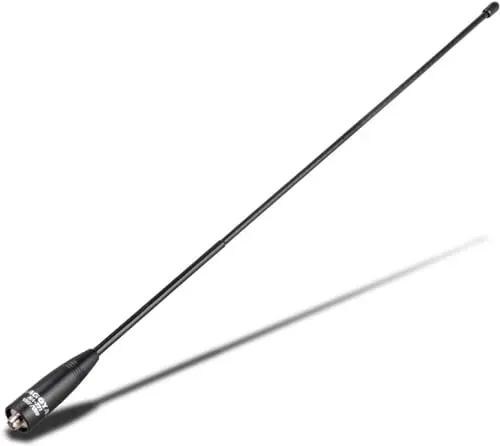
The NA-771 is the default upgrade for Baofeng-style radios, at $20.98. Its 3.0 dBi claim is the highest in its class and still within 0.1 dB of our estimate for its length.
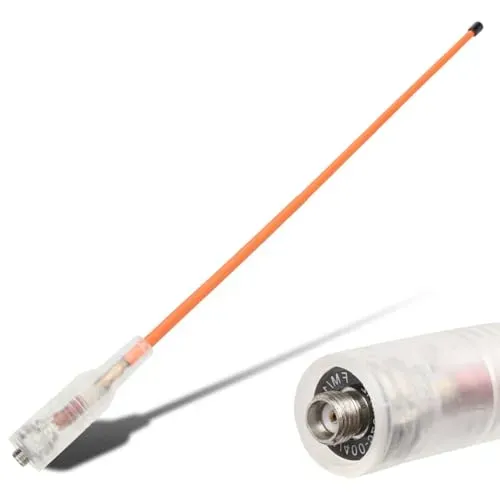
Baofeng's own dual-band whip is the same size and gets the same estimate, at $6.99, and it claims less. If you want the NA-771's size and our same estimate without the name, this is it.
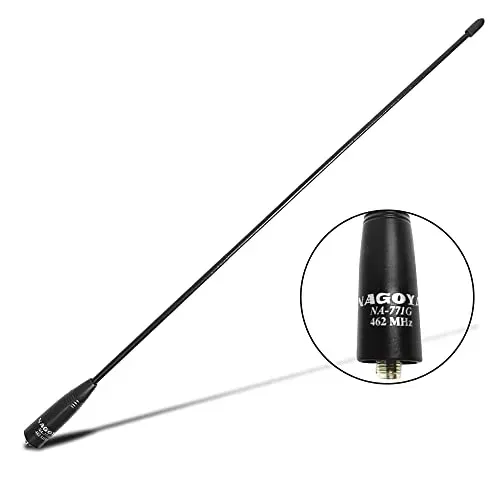
For GMRS, the NA-771G is cut for 462 to 467 MHz, which puts it at about 0.6 of a wavelength, one of the best lengths there is. As of this writing it is the highest-scoring antenna in our catalogue.
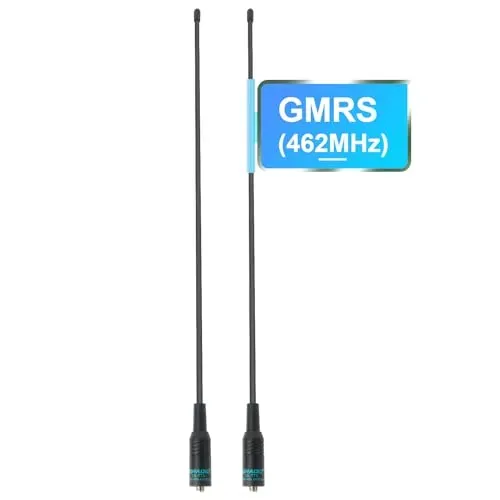
The TIDRADIO TD-771 is the same GMRS length with a more modest claim, at $8.99. More GMRS options are on our GMRS antenna page.
Better antennas also make more of every other part of the system. The range calculator shows how much antenna height matters next to antenna gain, the EIRP calculator turns a gain figure into effective radiated power, and the SWR calculator checks that the antenna is matched to your radio in the first place.