Mission briefing
Best QRP Radios in 2026
Amateur radio operators who want to take their hobby into the field need a portable, low-power transceiver capable of making contacts under real-world outdoor conditions. Parks on the Air and Summits on the Air activations put a premium on lightweight, battery-friendly gear that can still reach out across bands when it counts. A capable QRP radio makes the difference between a successful activation and a frustrating afternoon of near-misses.
When evaluating QRP radios for POTA and SOTA, output power and multiband HF coverage are the specs that matter most. More power gives you a better chance of completing contacts in challenging propagation conditions, while broad band coverage means you can shift frequencies to find an open frequency or a stronger signal path. Built-in GPS is also worth noting, since it can simplify logging and grid square reporting during an activation without requiring an extra device.
The Icom IC-705 earns the top spot here by pairing the full 10 watts of output power with an integrated GPS receiver, combining the features that matter most for field operation into a single portable package.
Ranked by our overall score, a weighted model of specs, features, value and Amazon review data, across 4 qualifying radios in this category.
#1 · Our Top Pick
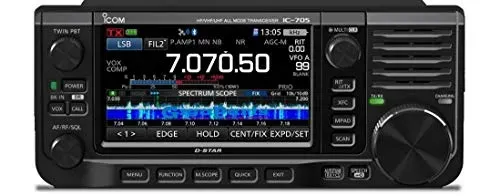
The IC-705 takes the direct-sampling SDR receiver design that made the IC-7300 a benchmark base radio and packs it into a 1.1 kilogram portable unit with a built-in 1880 mAh battery. It covers HF, 6 meters, VHF, and UHF, running SSB, CW, AM, FM, RTTY, and D-STAR digital voice, with a color touchscreen driving a real spectrum scope and waterfall in a package small enough to hold in one hand. Built-in GPS and Bluetooth support digital modes and remote control from a phone or tablet without extra cables, and general coverage receive extends up to 470 MHz. This is the radio most commonly seen at Parks on the Air and Summits on the Air activations among operators who want a genuine SDR receiver experience rather than a stripped-down field radio. The honest limitation is power. Ten watts maximum is a real constraint for working weak DX or breaking through a crowded pileup, and there is no built-in antenna tuner, so an external ATU is close to mandatory for anything but a resonant antenna. As a first and only base station, that combination will frustrate an operator who wants to run serious power. As a field radio built around genuine SDR capability, it is close to the best option available.
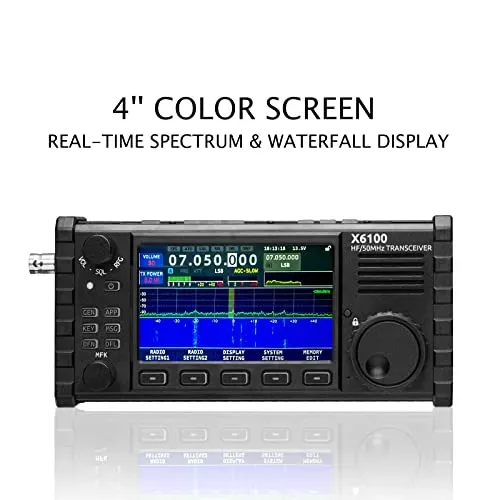
$595 · 10W · 3500mAh
The X6100 packs HF and 6 meter coverage, a direct-sampling SDR receiver, a built-in automatic antenna tuner, a color waterfall display, and a 3500 mAh internal battery into an 880 gram body, the lightest full-featured SDR HF radio in this lineup. It runs up to 10 watts on SSB, CW, AM, and FM, and receives from 0.5 to 54 MHz. What makes the X6100 stand out is how much it fits into that small, self-contained package. There is no external power supply to carry, no separate tuner box, and no laptop needed to see a waterfall, everything runs off the internal battery in a unit that fits in a jacket pocket. For SOTA summits and minimalist backpacking, that combination is hard to match at this size. The honest caveat is that Xiegu's build quality and firmware polish trail Icom's, and early units were known for rough edges in menu navigation and firmware stability that later updates improved but did not fully erase. Ten watts is also QRP-level power, meaning DX and pileups take real skill rather than raw output. If you want the most compact, self-contained SDR HF radio you can carry, this is it; if firmware polish matters more than shaving grams, the newer X6200 addresses some of those rough edges.
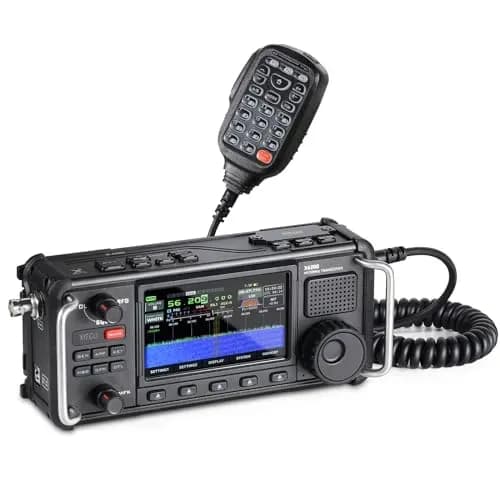
$749 · 8W · 3200mAh
The X6200 shares its 880 gram chassis with the X6100 but runs a slightly lower 8 watts maximum and, more importantly, an updated receiver front end that Xiegu refined after feedback on the X6100's earlier design. It covers HF and 6 meters on SSB, CW, AM, and FM, with a direct-sampling SDR receiver, built-in waterfall display, and built-in automatic antenna tuner, all backed by a 3200 mAh internal battery. For an operator choosing between Xiegu's two portable SDR radios, the X6200 represents the more mature version of the same idea: a complete, self-contained HF field station in a pocketable body, with incremental improvements to receiver performance and firmware stability layered on top of the X6100's original design. The waterfall, tuner, and battery all function the same way, just with fewer of the rough edges early X6100 adopters reported. The honest trade-off is that 8 watts is even less than the X6100's 10, a real constraint when trying to work through noise or a crowded pileup, and this is still a Xiegu radio, not an Icom, meaning the interface and menu structure reward patience more than Icom's touchscreen does. If a refined receiver and current firmware matter more to you than saving the last few grams, this is the newer and generally better-regarded of Xiegu's two portable SDR options.
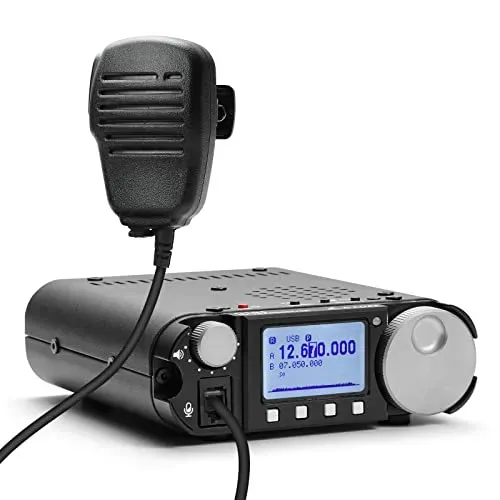
$249 · 5W
The G106 is the simplest radio in this lineup by a clear margin. It covers HF only, no 6 meters, running up to 5 watts on SSB, CW, and AM, with no FM mode at all. The receiver uses a direct-sampling SDR front end, but there is no color display, no waterfall, and no built-in antenna tuner. At 720 grams it is also the lightest radio here. This is a radio built around one thing: getting a signal on HF SSB or CW with minimal weight and complexity. The monochrome display shows frequency and basic status without the touchscreen menus or spectrum graphics found on every other radio here, keeping the learning curve short and current draw low for QRP-style operating. The honest trade-off is that the G106 gives up nearly every convenience this lineup otherwise offers. No tuner means a resonant antenna or an external matching solution is required, no waterfall means band scanning by ear and by turning the dial, and 5 watts is true QRP power demanding good antennas, good propagation, and patience. For an operator who wants the minimum radio needed to get on HF, or a genuinely ultralight backup rig, it does the job. For anyone who wants a waterfall, a tuner, or FM mode, look elsewhere in this lineup.
Head-to-head