Mission briefing
Best Handheld Ham Radios for Beginners in 2026
Getting into amateur radio can feel overwhelming at first, but a handheld transceiver is almost always the right place to start. These compact, battery-powered radios let new hams explore local repeaters, practice voice communications, and get comfortable with radio operation without a major financial commitment or a complicated setup.
When shopping for a beginner handheld, output power and frequency coverage are the two specs worth paying closest attention to. Higher wattage gives your signal better range and a stronger chance of hitting distant repeaters, while dual-band capability on both VHF and UHF frequencies opens up far more channels and clubs to connect with in your area. Battery life and build quality matter too, since a radio you can carry and depend on during a long day out will teach you far more than one sitting on a desk.
The Baofeng UV-26 earns our top spot by delivering 10 watts of output power at just $27, offering the strongest performance-to-price ratio in this roundup and giving beginners a genuinely capable radio without asking them to spend much to find out if the hobby is right for them.
Ranked by our beginner-friendliness score, a weighted model of specs, features, value and Amazon review data, across 5 qualifying radios in this category.
#1 · Our Top Pick
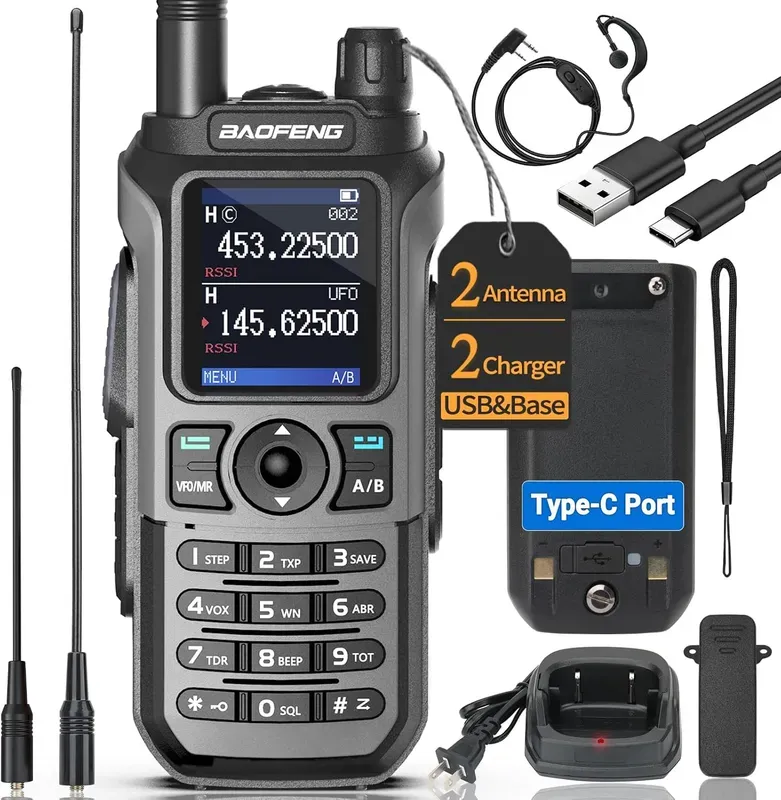
The UV-21R is built for newly licensed operators and budget-conscious buyers who need a functional VHF/UHF handheld for local repeater work and simplex without spending real money. It sits firmly in the same crowded tier as other Baofeng budget handhelds, and that context matters when setting expectations. At 6W max output on a 3.7V lithium-ion platform with 999 memory channels and CHIRP compatibility (via the UV-17Pro profile), the radio covers the practical basics for a Technician working a local linked repeater system or ARES net. IP54 weather resistance is a genuine differentiator at this price point, offering splash and light dust protection that most radios in this bracket skip. The feature set overall is thin beyond these fundamentals, which is worth noting if you need anything beyond analog FM. At $24.99 with no manufacturer warranty, this is a radio you buy knowing what it is. It scores well on value and beginner-friendliness, which makes it a reasonable first handheld or a low-stakes go-bag spare. Experienced operators expecting robust receive sensitivity or clean TX audio should look elsewhere.
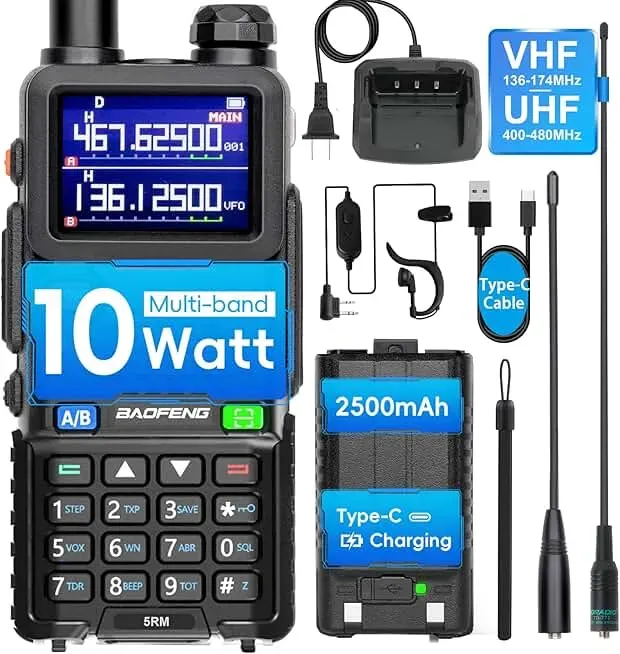
$26.99 · 10W · 2500mAh
The Baofeng 5RM is built for newly licensed Technicians and budget-conscious operators who want tri-band coverage without committing serious money to a first handheld. At $24.12, it sits firmly in the "learn the hobby before you invest in the hobby" tier, making it a sensible starting point for anyone still finding their footing on local repeaters. The headline spec here is tri-band operation across VHF, UHF, and 1.25m, which is genuinely uncommon at this price point. The 2500mAh lithium polymer battery is reasonable for day use, and 999 memory channels is more headroom than most operators will ever fill. CHIRP compatibility (listed under the UV-17Pro or 5RM profile) is the practical clincher; it means you can program this radio without wrestling the stock menu, which aligns with how well it scores on beginner-friendliness. Where it falls short: features depth is thin, with no stated IP rating despite the "water resistant" marketing language, and medium and low TX power figures are not published, which makes field comparisons harder than they should be. Buy this if you need an affordable entry point into tri-band operation; look elsewhere if you want a radio that will grow with your license.
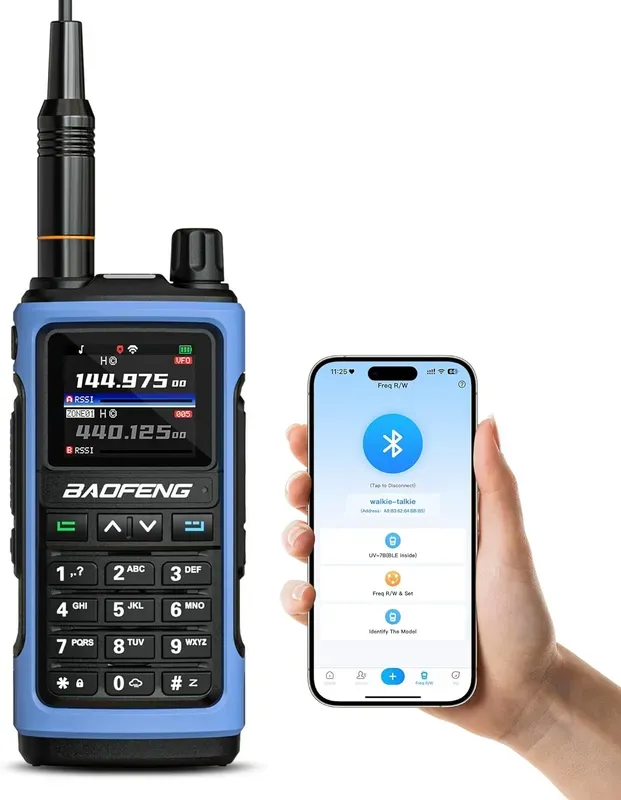
$25.49 · 1800mAh
The UV-7B is aimed squarely at newly licensed Technicians and budget-conscious operators who want a capable scanner and basic HT without committing serious money. It also makes a reasonable case for a throwaway go-bag radio or a loaner for a club's license exam graduates. The 1000-channel memory is genuinely generous at this price, and CHIRP compatibility means you can skip the notoriously fiddly stock software entirely. Bluetooth programming via a companion app (iOS and Android) is a legitimate convenience for quick field edits, though it is no substitute for CHIRP when you are doing bulk channel work. TX power specs are not published by Baofeng for this model, which is worth noting before you make assumptions about its RF output. At roughly $25, the value case is straightforward for a first radio or a backup HT. It is not water resistant, so field use in wet conditions is a real concern. If you need a rugged, feature-complete primary radio, look elsewhere; if you need an affordable first HT that gets out of the way and lets a new operator start learning, the UV-7B earns its spot.
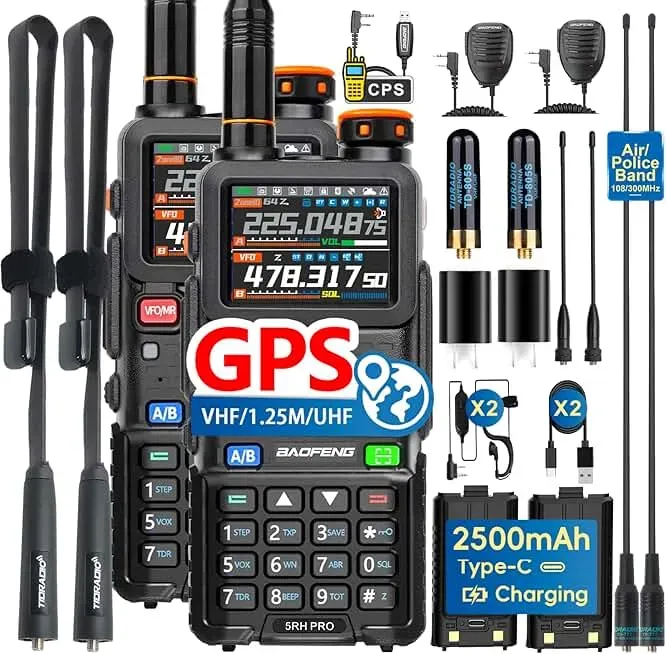
$71.69 · 10W · 2500mAh
The BF-5RH Pro is aimed squarely at newly licensed Technicians and budget-conscious General or Extra class operators who want triband VHF/1.25m/UHF coverage with APRS position reporting without committing to a Yaesu or Kenwood price point. It fits comfortably as a first serious handheld or a beater radio for public service events where you would rather lose a $70 radio than a $300 one. The 10W output and 2500mAh USB-C battery are the practical highlights here. Ten watts from a handheld gives you a meaningful edge hitting distant repeaters compared to the typical 5W class, and USB-C charging reduces the cable-drawer tax. The integrated GPS feeds APRS firmware 2.0.9 directly, which matters for ARES/RACES deployment or simplex direction finding. With 640 channels organized across 10 zones, scan-heavy operators will find the memory structure workable, and IP54 dust and splash resistance is adequate for field use without claiming full submersion protection. Worth noting clearly: despite what some listings imply, this radio does not support CHIRP or Bluetooth programming. You will need Baofeng's own CPS software and the included CH340 cable. For a ham who is comfortable with CPS workflows and wants triband APRS capability at this price, the value proposition is genuine. If CHIRP compatibility is non-negotiable for your workflow, look elsewhere.
$69.99 · 10W · 2400mAh
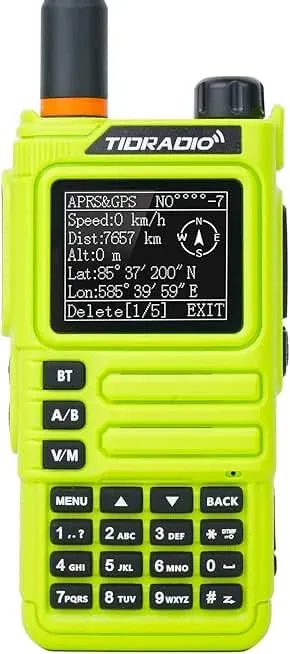
The TD-H9 is aimed at newly licensed operators and budget-conscious Technicians who want APRS capability without spending Yaesu money. It sits in a crowded corner of the Chinese HT market, but the combination of triband coverage (VHF, UHF, and 1.25m) with onboard GPS and APRS at this price point is genuinely uncommon. Ten watts on a handheld is a reasonable output for local simplex and repeater work, and the integrated GPS means your APRS position reports are sourced from the radio itself rather than a paired phone or external module. Programming runs through the TIDRADIO phone app over Bluetooth, Windows CPS, or the browser-based OdMaster tool; CHIRP is not supported, so plan your initial 199-channel setup around one of those three paths. Firmware had a rocky launch, a buggy CPS that could erase channels and some APRS quirks, but updates through 1.0.29 (April 2026) and 1.0.32 (July 2026) have resolved most of it. A few things still linger: switching between ham and GMRS modes wipes your programming, there is no smart beaconing, and APRS configuration is keypad-only. The Amazon listing advertises IP54 splash resistance, but that rating does not appear on TidRadio's own spec sheet, so treat the radio as splash-resistant rather than weatherproof. On value, this radio holds up well for what it costs. Amazon buyers rate it 4.2 stars across 450 reviews, with roughly 8 percent landing at one star, mostly display failures and dead-on-arrival units rather than a systemic design flaw. If you are eyeing the marketed GMRS version, look twice first: TidRadio's only located FCC grant (2A4FB-H9, April 2026) is a Part 95B FRS certification under half a watt ERP, and we could not find a Part 95E GMRS grant to back the GMRS branding. Ham use is unaffected, since Part 97 requires no transmitter certification. If you want triband APRS and GPS on a tight budget and do not mind CPS-style programming, the TD-H9 delivers; if you need CHIRP support or a documented IP rating, look elsewhere.
Head-to-head
Compare Top Picks
This list and the full guide
This page is the ranked list: every handheld in our database ordered by its beginner score, which weighs how simple the menus are, whether free programming software supports it, how much owner documentation exists, and price. The numbers update as prices and reviews change. If you want the reasoning behind each pick, the tiers, and a realistic plan for your first six months, read the long-form best ham radios for beginners guide; this list is the data it draws on.
You can buy and listen without a license, but transmitting on these radios needs at least a Technician class ticket. The exam is 35 questions from a published pool and most people pass after a weekend of study; our licensing guide covers the whole process, including what it costs.
What makes a radio beginner friendly
Two things matter more than any spec. The first is programming: a radio that works with the free CHIRP software lets you load your local repeaters from a computer in minutes instead of through a 40-item menu, and our Baofeng programming walkthrough shows how that goes. The second is documentation. A radio with a thousand owner reviews and a hundred YouTube walkthroughs is easier to learn than a better radio nobody has written about, which is why the well-known budget models score so highly here.
Price is the third factor, deliberately. A first radio should cost little enough that you will not mind replacing it once you know what you actually want. Every pick near the top of this list is under $75, and the under $50 list narrows it further if budget is the constraint.
Handheld first, then decide
Nearly every new ham starts with a dual band handheld, and that is the right call: it reaches the local repeaters where the activity is, runs off a battery, and costs less than the exam study guide in some cases. Once you know whether you want to chase distance, go digital, or set up a home station, the next radio is an informed purchase. Our dual band rankings and the mobile radio rankings are where most people go next.
Frequently Asked Questions
What is the best ham radio for a beginner?
The radio at the top of this list has the highest beginner score in our database right now: simple to program, well documented, and cheap enough to learn on. For the reasoning and the alternatives at each price, the full beginners guide walks through every pick.
Do I need a license before I buy a ham radio?
No. You can buy a radio and listen with no license at all. You need a Technician class license before you transmit on the amateur bands. Many people buy the radio first and use it as a scanner while they study; our licensing guide explains the exam and the $35 FCC fee.
Should a beginner start with a handheld or a base station?
A handheld. It costs a tenth as much, needs no antenna installation, and works the local repeaters where new hams spend their first months. A base station makes sense once you have a General class license and want HF; our base station guide covers that step.
How much should a first ham radio cost?
Between $20 and $75 buys a capable dual band handheld from the top of this list. Spending more on a first radio rarely buys an easier start; it buys features you cannot judge yet. Add a better antenna for $15 to $25 before you add anything else.