Mission briefing
Best HAM Radios Under $100 in 2026
Handheld radios under $100 have become a serious option for amateur radio operators who want reliable communication without a major investment. New Technician licensees getting started on local repeaters, ARES and CERT volunteers needing a dependable go-bag radio, and experienced hams looking for an affordable backup unit all find strong value in this price range. The sub-$100 market has matured considerably, and you no longer have to sacrifice meaningful features to stay within budget.
When evaluating handhelds at this price point, output power, digital mode support, and integrated features like GPS and APRS are the specs worth paying closest attention to. Higher wattage improves your ability to hit distant repeaters from poor locations, while DMR support opens up a dramatically larger network of digital repeaters and talk groups that analog-only radios simply cannot access. GPS and APRS capability adds real practical value for emergency communications and event support, where tracking and position reporting can matter as much as voice.
The Baofeng DM32 earns the top spot because it combines DMR, APRS, and GPS into a compact package for $54, giving operators a genuinely capable digital radio at a price that undercuts most competing options by a wide margin.
Ranked by our overall score, a weighted model of specs, features, value and Amazon review data, across 5 qualifying radios in this category.
#1 · Our Top Pick
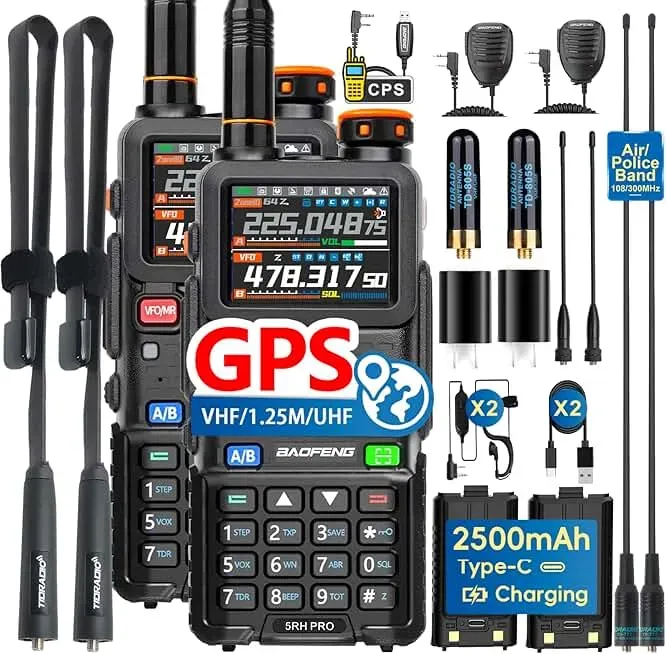
The BF-5RH Pro is aimed squarely at newly licensed Technicians and budget-conscious General or Extra class operators who want triband VHF/1.25m/UHF coverage with APRS position reporting without committing to a Yaesu or Kenwood price point. It fits comfortably as a first serious handheld or a beater radio for public service events where you would rather lose a $70 radio than a $300 one. The 10W output and 2500mAh USB-C battery are the practical highlights here. Ten watts from a handheld gives you a meaningful edge hitting distant repeaters compared to the typical 5W class, and USB-C charging reduces the cable-drawer tax. The integrated GPS feeds APRS firmware 2.0.9 directly, which matters for ARES/RACES deployment or simplex direction finding. With 640 channels organized across 10 zones, scan-heavy operators will find the memory structure workable, and IP54 dust and splash resistance is adequate for field use without claiming full submersion protection. Worth noting clearly: despite what some listings imply, this radio does not support CHIRP or Bluetooth programming. You will need Baofeng's own CPS software and the included CH340 cable. For a ham who is comfortable with CPS workflows and wants triband APRS capability at this price, the value proposition is genuine. If CHIRP compatibility is non-negotiable for your workflow, look elsewhere.
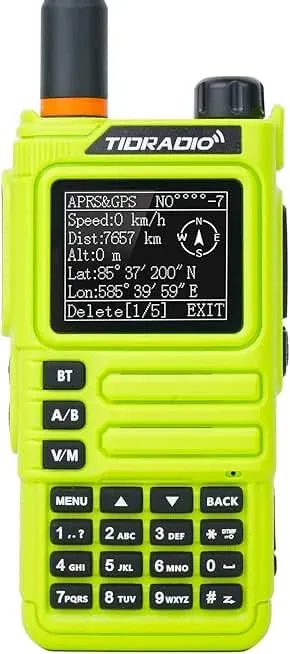
$69.99 · 10W · 2400mAh
The TD-H9 is aimed at newly licensed operators and budget-conscious Technicians who want APRS capability without spending Yaesu money. It sits in a crowded corner of the Chinese HT market, but the combination of triband coverage (VHF, UHF, and 1.25m) with onboard GPS and APRS at this price point is genuinely uncommon. Ten watts on a handheld is a reasonable output for local simplex and repeater work, and the integrated GPS means your APRS position reports are sourced from the radio itself rather than a paired phone or external module. Programming runs through the TIDRADIO phone app over Bluetooth, Windows CPS, or the browser-based OdMaster tool; CHIRP is not supported, so plan your initial 199-channel setup around one of those three paths. Firmware had a rocky launch, a buggy CPS that could erase channels and some APRS quirks, but updates through 1.0.29 (April 2026) and 1.0.32 (July 2026) have resolved most of it. A few things still linger: switching between ham and GMRS modes wipes your programming, there is no smart beaconing, and APRS configuration is keypad-only. The Amazon listing advertises IP54 splash resistance, but that rating does not appear on TidRadio's own spec sheet, so treat the radio as splash-resistant rather than weatherproof. On value, this radio holds up well for what it costs. Amazon buyers rate it 4.2 stars across 450 reviews, with roughly 8 percent landing at one star, mostly display failures and dead-on-arrival units rather than a systemic design flaw. If you are eyeing the marketed GMRS version, look twice first: TidRadio's only located FCC grant (2A4FB-H9, April 2026) is a Part 95B FRS certification under half a watt ERP, and we could not find a Part 95E GMRS grant to back the GMRS branding. Ham use is unaffected, since Part 97 requires no transmitter certification. If you want triband APRS and GPS on a tight budget and do not mind CPS-style programming, the TD-H9 delivers; if you need CHIRP support or a documented IP rating, look elsewhere.
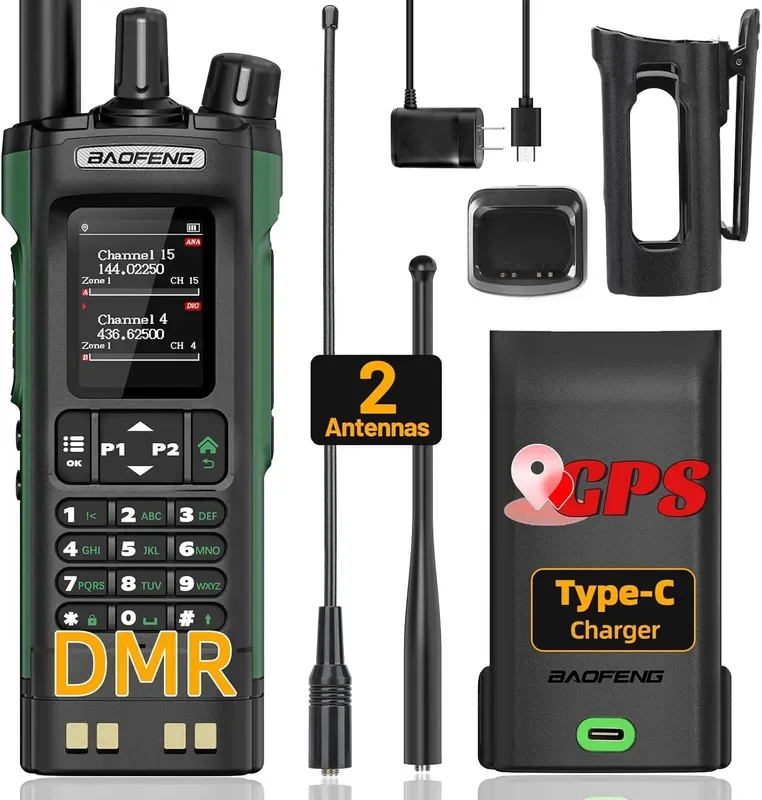
$49.99 · 8W · 2500mAh
The Baofeng DM32 is aimed squarely at newly licensed operators and budget-conscious hams looking to step into DMR without committing to a Tier II radio at three times the price. It sits in a crowded field of entry-level dual-banders, but the addition of GPS and APRS support gives it a meaningful edge over comparably priced analog-only handhelds. At 8W output across VHF and UHF, the RF performance is adequate for most repeater work. The 4000-channel memory is generous for the price point, and CHIRP compatibility means you are not locked into Baofeng's programming software. DMR dual-mode operation lets you run digital talkgroups alongside conventional analog nets without carrying a second radio, which is the practical case for buying this over a simpler HT. Where the DM32 gives ground is portability: at 350g it is noticeably heavier than lighter competing handhelds, and it carries no water resistance rating at all, so field use in variable weather is a real consideration. At $54, this is a reasonable first step into digital for hams who want DMR and APRS without a serious financial commitment. Operators who need field durability or a refined DMR implementation should look higher up the price ladder.
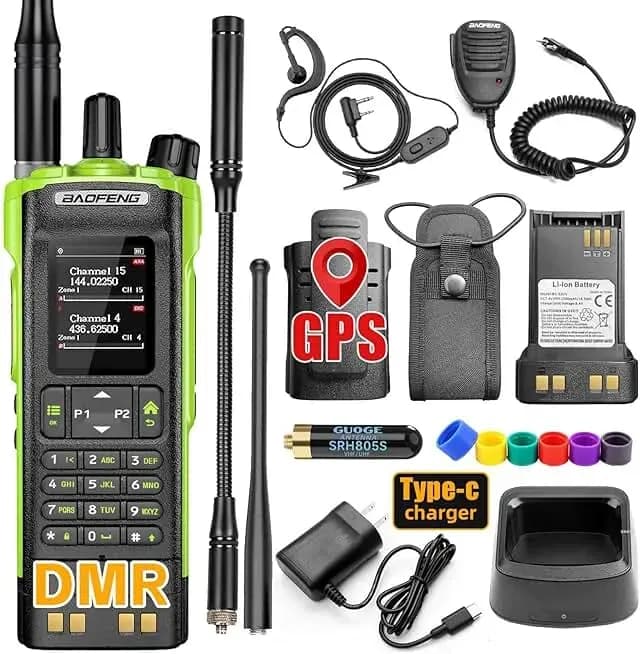
$63.99 · 10W
The Baofeng DM-32UV Pro is aimed at Technician and General class operators who want a foot in the DMR world without committing to a Tier II radio at twice the price. It fits between a basic analog HT and a purpose-built DMR portable, which makes it a reasonable first digital radio rather than a replacement for one. The feature set scores well for this price bracket: DMR digital mode, APRS, and integrated GPS give you text messaging, position reporting, and talkgroup access on a single device. The 4000-channel memory is generous, and 10W output on VHF/UHF is competitive at this tier. The beginner-friendliness score is middling, so expect a learning curve if this is your first DMR rig; CHIRP support will help on the analog side, but DMR codeplug management is a separate task entirely. There is no water resistance rating here, which limits its appeal for portable outdoor use. At $99.99, this is a value-oriented buy for operators who want to experiment with DMR and APRS without significant financial risk. Those needing field-durable gear or a polished out-of-box experience should look elsewhere.
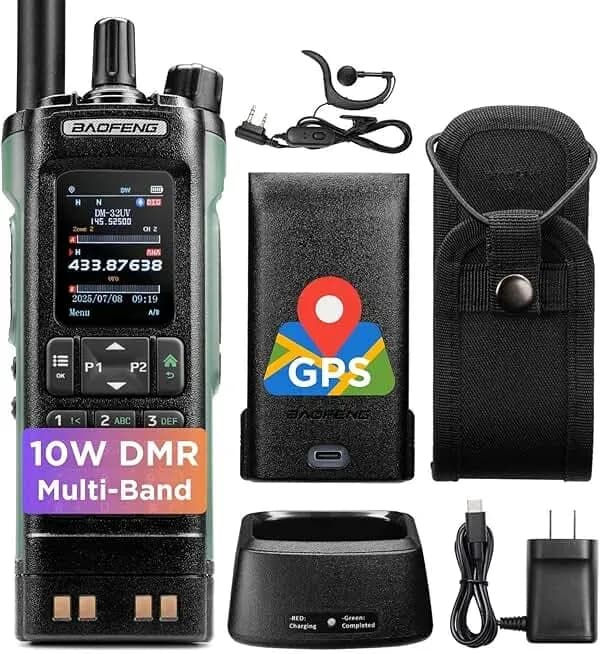
$59.99 · 10W · 2500mAh
Operators looking to step into DMR without committing to a mid-range budget will find the DM-32UV GPS APRS a credible entry point. It sits squarely between a basic analog HT and a purpose-built digital radio, making it a reasonable first DMR rig or a low-risk addition to a go-bag. The headline specs hold up under scrutiny. Ten watts on VHF and UHF is genuinely useful for hitting distant repeaters, and DMR Tier I and II with dual time slot support means you can operate on most DMR infrastructure without workarounds. The integrated GPS and APRS capability adds real practical value for portable ops and public service events, and 4000 memory channels is generous headroom for anyone running multiple band plans or DMR talk group lists. Features score well for the price bracket, though beginner-friendliness is middling, so expect a learning curve if DMR is new territory. At $59.99, the value case is straightforward for a technically literate buyer who knows what they are getting into. The radio is not water resistant, which matters for field use, and medium and low power output figures are unspecified. If you need a ruggedized digital HT, look elsewhere; if you want affordable DMR plus APRS in one chassis, this deserves a close look.
Head-to-head