

Three ham radio license levels are issued in the United States today: Technician, General and Amateur Extra. Each adds frequencies to the ones below it, and none of them changes what your radio is or how you operate it. So the practical question is not "which license is best" but "which bands do I actually want to transmit on."
This page answers that by privilege and by equipment. If you are earlier in the funnel, start with what ham radio is; for the exam process itself, see how to get your ham radio license.
The three ham radio license levels at a glance
The FCC recognizes five operator classes, but only three are still granted. Novice and Advanced remain valid for the people who hold them, and no new grant is issued for either one (47 CFR 97.9(a), 97.17(a)). Everyone starts at Technician, because Technician is the only class whose exam has no prerequisite.
| License level | Exam element | Questions / to pass | What opens up | Who it suits | Can administer exams |
|---|---|---|---|---|---|
| Technician | Element 2 | 35 / 26 | All amateur bands above 50 MHz, plus four narrow HF segments | Anyone buying a handheld or a mobile radio | None |
| General | 2 + 3 | 35 / 26 | Most of every HF band, worldwide contacts without infrastructure | Anyone who wants an HF rig | Technician exams |
| Amateur Extra | 2 + 3 + 4 | 50 / 37 | The remaining bottom-of-band slices on five HF bands | Contesters, DXers, volunteer examiners | All three exams |
Question counts and pass marks are set in the rules themselves, not just by the question-pool committee: Element 2 and Element 3 are 35 questions with 26 correct to pass, and Element 4 is 50 questions with 37 correct (97.503). Each pool has to hold at least ten times the questions in one exam, so the published pools run to at least 350, 350 and 500 questions, and in practice a little larger than the floor (97.523). Exam credit is cumulative, so upgrading means sitting only the new element (97.501). Who may administer which exam follows the volunteer examiner's own class, and a Technician cannot serve as one at all: a General can run Technician sessions, an Advanced can run Technician and General, and only an Extra can administer the Extra exam (97.509(b)(3)).
Technician: everything above 50 MHz, at the full legal limit
The single most repeated mistake about the Technician license is that it is the crippled one. It is not, above 50 MHz. Every class above Novice holds identical privileges on 6 meters (50 to 54 MHz), 2 meters (144 to 148 MHz), 1.25 meters (219 to 220 and 222 to 225 MHz), 70 centimeters (420 to 450 MHz), 33 centimeters, 23 centimeters and every allocation above that (97.301(a)). A Technician and an Extra on 2 meters have exactly the same rights.
That includes power. Part 97 sets a general ceiling of 1.5 kW PEP and imposes no Technician-specific limit above 50 MHz, so on 2 meters, 70 centimeters and 6 meters a Technician may run exactly what an Extra may, up to the 1.5 kW ceiling (97.313(b)). The handful of further caps in 97.313(f) to (h), which cover 219-220 MHz and a few named geographic areas, bind every class alike. The 25-watt and 5-watt figures you will see repeated on forums are Novice limits on 1.25 meters and 23 centimeters, not Technician ones (97.313(d), (e)).
Technicians also get four narrow HF segments (97.301(e)):
- 80 meters: 3.525 to 3.600 MHz
- 40 meters: 7.025 to 7.125 MHz
- 15 meters: 21.025 to 21.200 MHz
- 10 meters: 28.000 to 28.500 MHz
The first three are CW only. That restriction is worth sourcing carefully, because it is the detail most articles get slightly wrong: it does not appear in 97.301 at all, it comes from 97.307(f)(9) read through the emission table in 97.305(c). On 10 meters a Technician gets RTTY and data from 28.000 to 28.300 MHz and SSB phone from 28.300 to 28.500 MHz (97.305(c), 97.307(f)(10)). Output on all four segments is capped at 200 watts (97.313(c)(2)). Technicians hold no privileges on 630 meters or 2200 meters.
In practice a Technician can work local and regional repeaters, simplex, amateur satellites and the ISS, APRS, digital voice, ARES and RACES emergency nets, and VHF or UHF activations for Parks on the Air and Summits on the Air. Our interactive band chart shows the allocation for every class side by side, and the free practice quiz runs the current NCVEC Technician pool if you want to see where you stand before booking a session.
For a first radio to go with the license, start with our beginner radio guide or the ranked best radios for beginners list; if it is a cheap Chinese handheld, whether the Baofeng UV-5R is legal covers the certification question that trips people up.
General: the HF bands and worldwide contacts
General is the upgrade that changes what the hobby is, because it opens HF. Below roughly 30 MHz, signals refract off the ionosphere and come back down hundreds or thousands of miles away. No repeater, no internet, no infrastructure of any kind. That is the difference: VHF and UHF are line-of-sight plus whatever machine someone else put on a hill, and HF is a radio, an antenna and physics.
A General license adds most of every HF band: 160, 80 and 75, 40, 30, 20, 17, 15, 12 and 10 meters, plus 630 meters and 2200 meters, and a small General-and-above band near 5.3 MHz with special rules of its own. Our bands explained guide covers what each one is actually good for.
What General does not get is the bottom slice of several bands. The cleanest illustration is 75 meters: a General's 75 meter allocation starts at 3.800 MHz, while an Extra can work down to 3.600 MHz (97.301(d) versus 97.301(b)). Output on 30 meters is capped at 200 watts for every class (97.313(c)(1)).
Operators in the forum threads that rank for this query mostly land in the same place: General is the practical destination, and Extra is optional. Treat that as widely held opinion rather than fact, but it is close to consensus.
Amateur Extra: the last slices of each band
Extra grants every amateur frequency allocated in the United States. Differenced against a General license in ITU Region 2, which is where the US sits, what it actually adds is a set of segments at the edges of five bands (97.301(b) against 97.301(d)):
- 80 meters: 3.500 to 3.525 MHz
- 75 meters: 3.600 to 3.800 MHz
- 40 meters: 7.000 to 7.025 and 7.125 to 7.175 MHz
- 20 meters: 14.000 to 14.025 and 14.150 to 14.225 MHz
- 15 meters: 21.000 to 21.025 and 21.200 to 21.275 MHz
The honest framing is the list of bands with no Extra-only slice at all: 160 meters, 60 meters, 30 meters, 17 meters, 12 meters and 10 meters are identical for a General and an Extra. If the bands you operate are on that list, the Extra ticket buys you nothing on the air.
What it does buy is the bottom edge of 20 and 40 meters during a contest or a DX opening, where crowding is worst and the Extra segments are quieter by construction, plus full volunteer examiner authority (97.509(b)(3)(iii)). Element 4 is 50 questions with 37 to pass, and it leans on circuit theory rather than operating practice. Whether that is worth your evenings is your call, and you now have the two facts you need to make it.
Which license do you actually need for the radio you want?
Here is the part no other page on this topic will tell you, because no other page looks at equipment. We track live product data, so we can just check.
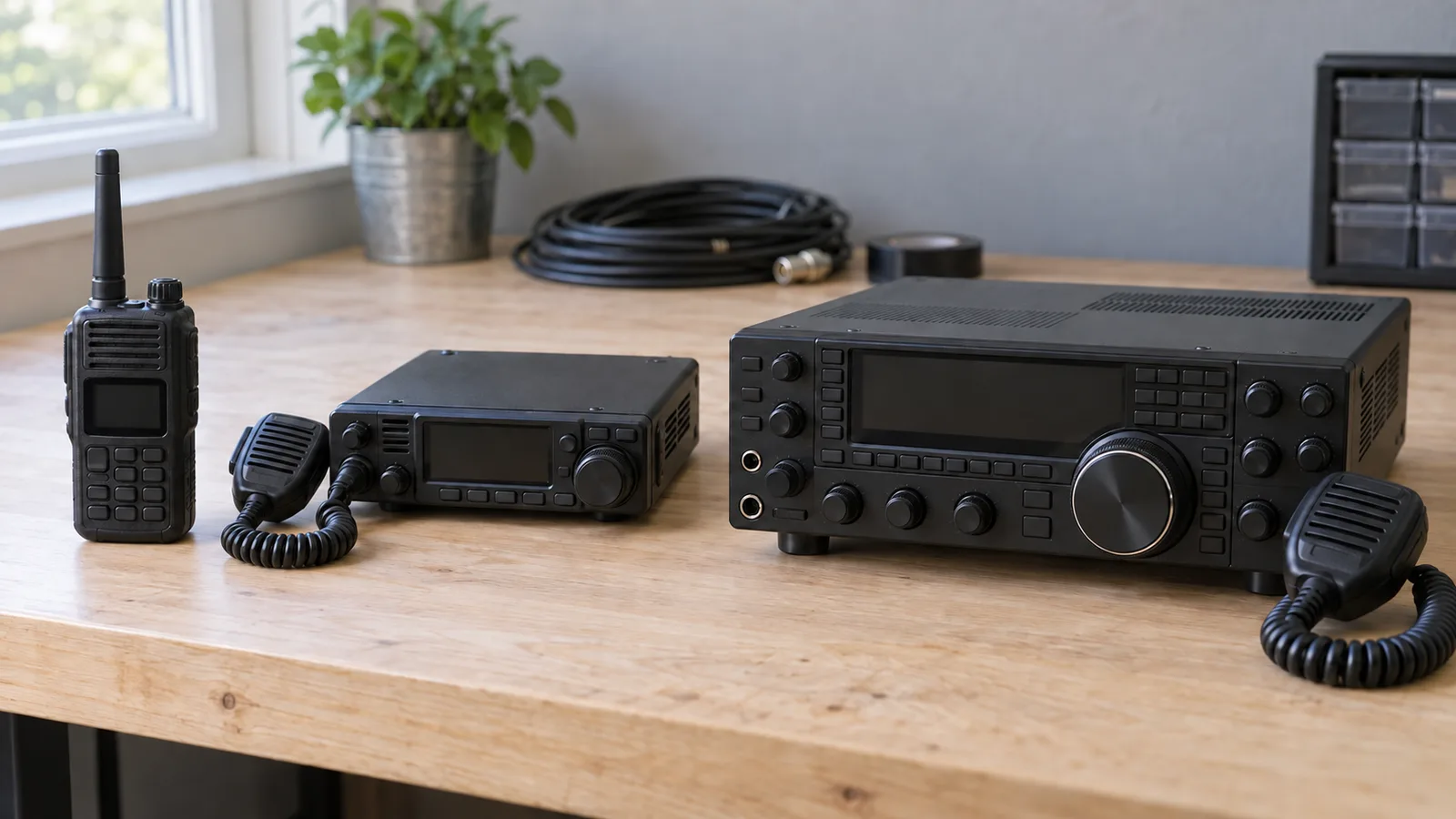
Queried against our catalog on 2026-09-13, counting active products by the amateur bands they transmit on:
| Category | Active products | Fully usable on a Technician license |
|---|---|---|
| Handheld radios | 74 | 74 (100%) |
| Mobile radios | 19 | 18 |
| HF radios | 11 | 0 |
Every single handheld we track operates only above 50 MHz, where a Technician holds exactly the privileges an Extra does. So does every mobile radio except one, the TYT TH-9800, which adds a 10-meter segment. Meanwhile all 11 HF transceivers in the catalog need a General license for the bands they are built for.
The conclusion follows directly: the upgrade question has nothing to do with the handheld you are shopping for. It is entirely a question of whether you want an HF rig. In our catalog those run from $236.55 for the Xiegu G106 to $4,699.95 for the Kenwood TS-890S as of September 2026, so it is a real spending decision as well as a study decision.
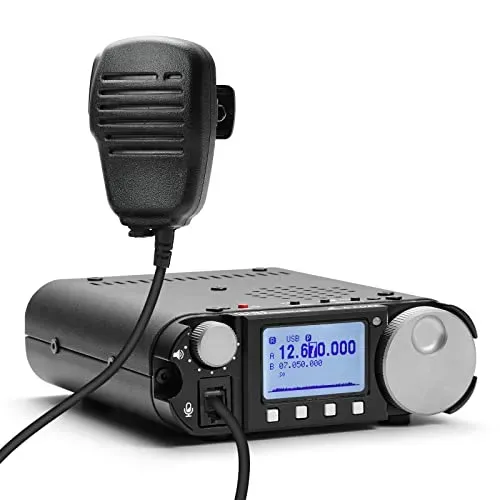
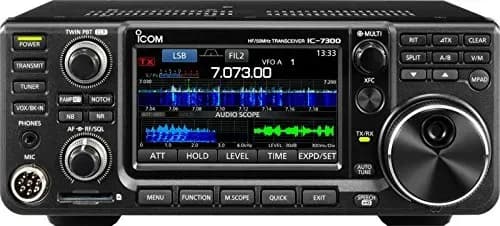
There is a loophole worth knowing, and it is the reason a Technician is not locked out of buying an HF radio at all. Nine of those 11 HF transceivers also cover 6 meters, where a Technician already holds full privileges. Buy an IC-7300 as a Technician and you have a legal, working 6-meter station plus a general-coverage receiver you can listen to the rest of HF on while you study for General. The radio is not wasted; it is waiting.
How you move up, and what it costs
Upgrading means sitting one more element. You keep credit for the elements you already passed, so a Technician takes Element 3 for General and a General takes Element 4 for Extra (97.501). Nothing expires in between as long as your license is current.
The cost is the part nobody states plainly. The FCC charges $35 for a new license and $35 for a renewal (47 CFR 1.1102(c)). An upgrade costs $0 to the FCC, because it is filed as a license modification and the FCC's fee guide states there are no fees for personal service license modifications. What you do pay is the volunteer examiner session fee, which is set by the coordinating VEC, not by the FCC. The rules allow VEs to be reimbursed for out-of-pocket expenses and set no dollar cap (97.527); in practice the range is small and some VECs charge nothing at all.
Two practical points. You can sit more than one element in a single session, so passing Technician and General on the same afternoon is routine and costs no extra FCC fee. And once you pass, the Certificate of Successful Completion of Examination lets you use the higher privileges immediately, for up to 365 days, while the grant catches up (97.9(b), 97.505(b)). For the full process, including finding a session and getting an FRN, see how to get your ham radio license.
Novice and Advanced: the two classes you cannot get
You will see five classes on any complete band chart, including ours. Novice and Advanced are still valid licenses and their holders can still renew them, but the FCC stopped issuing new grants for both (97.9(a), 97.17(a)). That is why they appear in the regulations and on the charts while nobody you meet at a hamfest got one recently.
Advanced privileges sit between General and Extra: more of the phone segments than a General gets, but none of the bottom-edge slices at 3.500, 7.000, 14.000 and 21.000 MHz that stay Extra-only (97.301(c)). Novice is the most restricted class of the five, and it is the source of two numbers that get misattributed to Technicians constantly: the 25-watt limit on 1.25 meters and the 5-watt limit on 23 centimeters are Novice limits (97.313(d), (e)).
What happens if your license expires
An amateur license is normally granted for a 10-year term (97.25). After it expires there is a two-year grace period, and the wording matters: the grace period lets you file a renewal, not transmit. The rule says that unless and until the license grant is renewed, no privileges in Part 97 are conferred (97.21(b)). A lapsed license is a silent one.
Past the grace period you have to re-examine, and the credit you keep is asymmetric. A former Extra keeps credit for Elements 3 and 4 and retakes Element 2. A former Technician licensed after 1987 gets no exam credit at all and starts over (97.505(a)). If your ticket is anywhere near its expiry, our license renewal guide walks through filing in CORES before it becomes an exam problem.