Mission briefing
Best Dual Band Handheld Ham Radios in 2026
Dual band handheld radios are a natural choice for amateur radio operators who want flexibility without carrying multiple devices. Being able to operate on both VHF and UHF frequencies means you can hit local repeaters, participate in nets, and communicate across a wider range of conditions with a single radio. For hams who are active in the field, at events, or just getting started and want room to grow, a capable dual bander covers a lot of ground.
When evaluating radios in this category, output power and digital mode support tend to matter most. Higher wattage gives you better range and more reliable communication in challenging environments, while DMR support opens up a large network of digital repeaters and talk groups that analog-only radios simply cannot access. Features like APRS and GPS add meaningful utility for operators who want to track their position, participate in APRS networks, or coordinate during emergency communication exercises.
The ranking below is live: it re-orders itself as scores, prices, and stock change, so the radio at the top earned its spot in the current market rather than on the day this page was written. Use the score breakdown on each card to see what a pick is actually good at, and the head-to-head links to put any two of them side by side.
Ranked by our overall score, a weighted model of specs, features, value and Amazon review data, across 5 qualifying radios in this category.
#1 · Our Top Pick
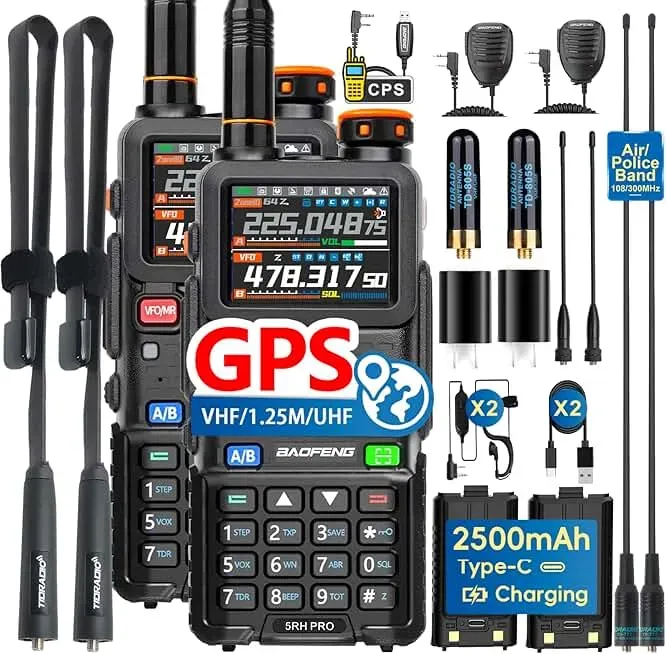
The BF-5RH Pro is aimed squarely at newly licensed Technicians and budget-conscious General or Extra class operators who want triband VHF/1.25m/UHF coverage with APRS position reporting without committing to a Yaesu or Kenwood price point. It fits comfortably as a first serious handheld or a beater radio for public service events where you would rather lose a $70 radio than a $300 one. The 10W output and 2500mAh USB-C battery are the practical highlights here. Ten watts from a handheld gives you a meaningful edge hitting distant repeaters compared to the typical 5W class, and USB-C charging reduces the cable-drawer tax. The integrated GPS feeds APRS firmware 2.0.9 directly, which matters for ARES/RACES deployment or simplex direction finding. With 640 channels organized across 10 zones, scan-heavy operators will find the memory structure workable, and IP54 dust and splash resistance is adequate for field use without claiming full submersion protection. Worth noting clearly: despite what some listings imply, this radio does not support CHIRP or Bluetooth programming. You will need Baofeng's own CPS software and the included CH340 cable. For a ham who is comfortable with CPS workflows and wants triband APRS capability at this price, the value proposition is genuine. If CHIRP compatibility is non-negotiable for your workflow, look elsewhere.
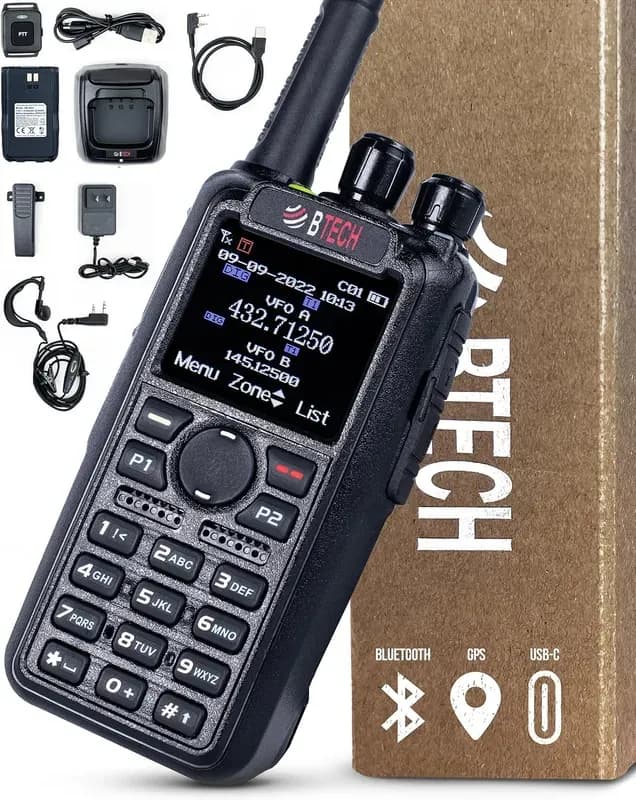
$249.89 · 7W · 3100mAh
The BTECH DMR-6X2 PRO is aimed at the digitally curious ham who wants to step beyond basic FM repeater work without committing to a top-shelf Kenwood or Motorola price tag. It fits best in the hands of a General or Extra class operator who already understands DMR fundamentals and wants a versatile field radio rather than a primary shack piece. The feature set is genuinely strong for the price point. DMR Tier I and II support with MOTOTRBO compatibility means this radio can operate on most North American DMR networks, and the inclusion of both analog and digital APRS (transmit and receive) paired with integrated GPS makes it a capable platform for position reporting and mesh coordination. The Talker Alias display adds practical clarity on busy talkgroups. Bluetooth opens options for wireless programming and audio accessories without a cable hunt. At $249.89, the value proposition is harder to defend once you factor in the lack of a stated IP rating and the missing medium and low power output figures, details that matter in the field. This one rewards buyers who are already comfortable with CPS programming tools like CHIRP; newcomers may find the learning curve discouraging.
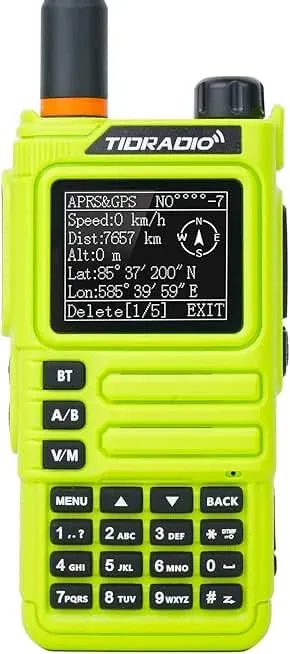
$69.99 · 10W · 2400mAh
The TD-H9 is aimed at newly licensed operators and budget-conscious Technicians who want APRS capability without spending Yaesu money. It sits in a crowded corner of the Chinese HT market, but the combination of triband coverage (VHF, UHF, and 1.25m) with onboard GPS and APRS at this price point is genuinely uncommon. Ten watts on a handheld is a reasonable output for local simplex and repeater work, and the integrated GPS means your APRS position reports are sourced from the radio itself rather than a paired phone or external module. Programming runs through the TIDRADIO phone app over Bluetooth, Windows CPS, or the browser-based OdMaster tool; CHIRP is not supported, so plan your initial 199-channel setup around one of those three paths. Firmware had a rocky launch, a buggy CPS that could erase channels and some APRS quirks, but updates through 1.0.29 (April 2026) and 1.0.32 (July 2026) have resolved most of it. A few things still linger: switching between ham and GMRS modes wipes your programming, there is no smart beaconing, and APRS configuration is keypad-only. The Amazon listing advertises IP54 splash resistance, but that rating does not appear on TidRadio's own spec sheet, so treat the radio as splash-resistant rather than weatherproof. On value, this radio holds up well for what it costs. Amazon buyers rate it 4.2 stars across 450 reviews, with roughly 8 percent landing at one star, mostly display failures and dead-on-arrival units rather than a systemic design flaw. If you are eyeing the marketed GMRS version, look twice first: TidRadio's only located FCC grant (2A4FB-H9, April 2026) is a Part 95B FRS certification under half a watt ERP, and we could not find a Part 95E GMRS grant to back the GMRS branding. Ham use is unaffected, since Part 97 requires no transmitter certification. If you want triband APRS and GPS on a tight budget and do not mind CPS-style programming, the TD-H9 delivers; if you need CHIRP support or a documented IP rating, look elsewhere.
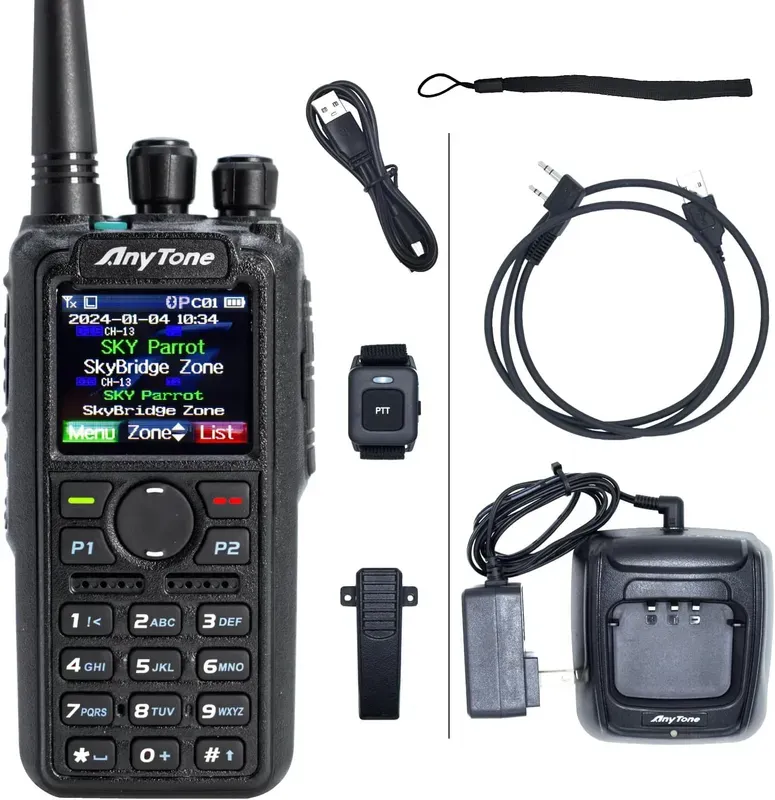
$249.99 · 7W · 3100mAh
This radio is aimed squarely at the intermediate-to-advanced operator who wants a full-featured DMR HT without stepping into commercial-tier pricing. It is not a first radio, and it does not pretend to be. If you are already comfortable with codeplug workflows and want GPS, APRS, and Bluetooth in a single handheld under $250, this is a credible option to evaluate. The 4000-channel memory and integrated GPS make it genuinely useful for operators active on DMR talkgroups across multiple regions, and the APRS implementation runs independently without needing a separate TNC. At 7W on VHF, output is competitive for a handheld, though the 280g weight and IP54 splash resistance mean it is better suited to structured field use than prolonged outdoor exposure. Beginner-friendliness scores toward the lower end of the scale, which is an honest reflection of the codeplug-centric programming model. At $249.99, the feature-to-price ratio is reasonable for what the hardware delivers, though buyers who will not use DMR or APRS are paying for modes they will never touch. Buy it if you are ready to invest time in configuration; pass if you want something to program in an afternoon.
$49.99 · 8W · 2500mAh
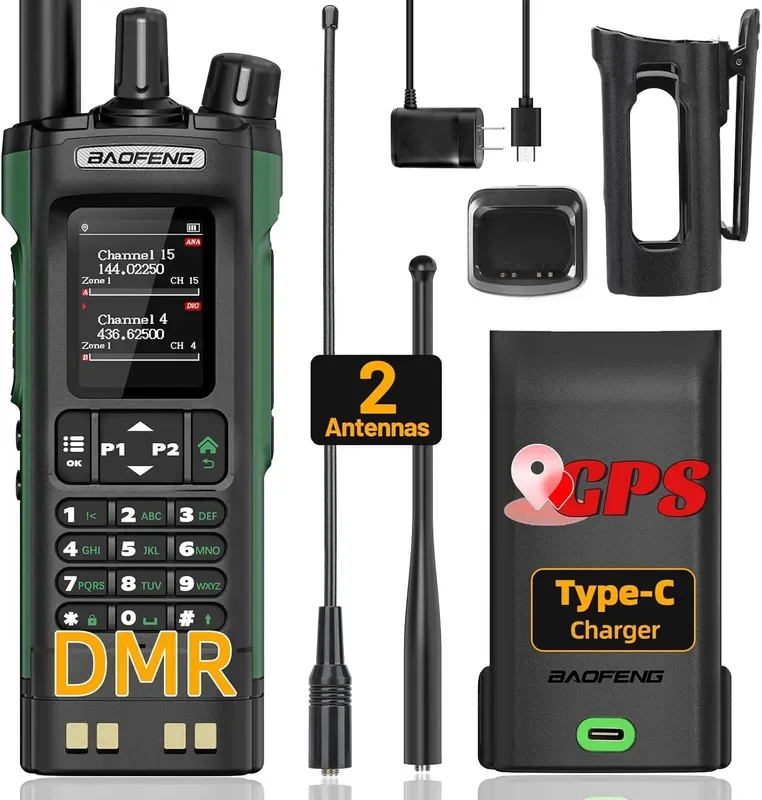
The Baofeng DM32 is aimed squarely at newly licensed operators and budget-conscious hams looking to step into DMR without committing to a Tier II radio at three times the price. It sits in a crowded field of entry-level dual-banders, but the addition of GPS and APRS support gives it a meaningful edge over comparably priced analog-only handhelds. At 8W output across VHF and UHF, the RF performance is adequate for most repeater work. The 4000-channel memory is generous for the price point, and CHIRP compatibility means you are not locked into Baofeng's programming software. DMR dual-mode operation lets you run digital talkgroups alongside conventional analog nets without carrying a second radio, which is the practical case for buying this over a simpler HT. Where the DM32 gives ground is portability: at 350g it is noticeably heavier than lighter competing handhelds, and it carries no water resistance rating at all, so field use in variable weather is a real consideration. At $54, this is a reasonable first step into digital for hams who want DMR and APRS without a serious financial commitment. Operators who need field durability or a refined DMR implementation should look higher up the price ladder.
Head-to-head
Compare Top Picks
What dual band actually means
A dual band radio transmits and receives on two amateur bands: 2 meters (VHF, 144 to 148 MHz in the US) and 70 centimeters (UHF, 420 to 450 MHz). The pairing is the practical one. VHF carries further across open terrain and is where most rural repeaters sit, while UHF gets into buildings better and dominates urban repeater networks and DMR systems. One radio that does both covers nearly every local repeater you will ever want to hit.
Some current handhelds are actually tri-band, adding 1.25 meters (220 MHz) on top. The band is quiet in most areas, but it costs nothing to have when the radio is priced like a dual bander. If you are still sorting out what the bands are used for, our VHF vs UHF guide covers the practical differences.
Handheld or mobile
This page ranks handhelds: radios you can carry, running 5 to 10 watts from a battery into a rubber duck antenna. If the radio is going to live in a vehicle, a mobile rig is the better tool, with 20 to 50 watts into a proper roof-mounted antenna and a far better receiver. Browse our mobile radio rankings or read the best mobile ham radios roundup if that is your use case.
How much power you actually need
Five watts is the handheld standard and it is enough to work any repeater you can hear. The 8 and 10 watt radios on this list are real, but the gain is smaller than the numbers suggest: doubling transmit power buys you about half an S-unit at the receiving end. The upgrade that actually moves range is the antenna. A $15 aftermarket whip does more than five extra watts, which is why our antenna rankings exist, and you can sanity-check any setup with the range calculator.
Analog or DMR
Several of the top dual banders now include DMR, which opens up digital repeaters and worldwide talkgroups that analog FM cannot reach. Whether that is worth anything depends entirely on whether there is a DMR repeater near you, so check coverage before paying for the mode. If there is, see the dedicated best DMR radio guide; if you are not sure what the mode even is, what is DMR explains it from zero.
Frequently Asked Questions
What is a dual band radio?
A dual band radio operates on both the 2 meter VHF band (144 to 148 MHz) and the 70 centimeter UHF band (420 to 450 MHz). That combination covers the overwhelming majority of amateur repeaters and simplex activity in the US, which is why dual band is the default recommendation for a first ham radio.
Can I use a dual band ham radio on GMRS or FRS?
Legally, no. Transmitting on GMRS requires a radio with FCC Part 95E certification, and dual band handhelds sold for amateur use almost never carry it, even when they can physically tune the frequencies. Listening is fine. If you want GMRS for family or off-road use, buy from our GMRS radio rankings, where every radio's certification status is shown.
How far can a dual band handheld reach?
VHF and UHF are line-of-sight bands, so terrain matters far more than wattage. Handheld to handheld at ground level, expect a few miles. Through a well-sited repeater, 25 to 50 miles is routine. From a summit or with a roll-up antenna in a tree, much more. Our range calculator estimates it for your antenna heights.
Do I need a license to use a dual band radio?
Yes. Transmitting on the 2 meter and 70 centimeter amateur bands requires at least a Technician class license in the US. The exam is 35 questions from a published pool and most people pass after a weekend of study. Our licensing guide walks through the whole process. Owning the radio and listening require no license at all.