Mission briefing
Best Emergency HAM Radios in 2026
Emergency preparedness demands reliable communication when conventional infrastructure fails, making a capable handheld radio an essential part of any go-bag or home emergency kit. Preppers, survivalists, first responders, and everyday households in disaster-prone areas all benefit from having a radio that can function independently of cell towers and internet connections.
Output power and radio protocol support are the two specs that matter most when evaluating radios for emergency use. Higher wattage extends your range in open terrain and helps penetrate obstacles like buildings and dense vegetation, while support for digital protocols like DMR gives you access to a broader range of repeater networks and cleaner audio in weak signal conditions.
The Radtel RT-4D DMR earns the top spot by combining DMR digital capability and built-in GPS into an affordable package, giving emergency communicators meaningful advantages in coordination and range without a significant investment.
Ranked by our portability score, a weighted model of specs, features, value and Amazon review data, across 5 qualifying radios in this category.
#1 · Our Top Pick
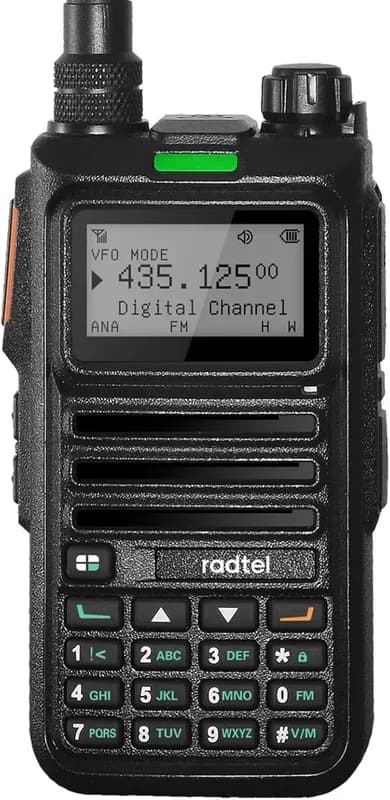
The Radtel RT-4D is aimed squarely at Technician-class operators stepping into DMR for the first time, or budget-conscious hams who want digital capability without committing to a Tier I brand price point. It sits in a crowded sub-$60 bracket, but the addition of GPS and Bluetooth gives it a feature profile that punches noticeably above that price. The 3500mAh battery and 198g weight combine to make this one of the more carry-friendly dual-band DMR handhelds available, and portability is a genuine strength here. DMR Tier II support with dual time slot operation means it will work on most repeater networks, and AES-256 encryption support is a legitimate spec at any price. The 1024-channel memory is more than adequate for regional programming, and CHIRP-compatible workflows apply to the analog side. Where the RT-4D earns caution is in its complete lack of water resistance and a feature set that scores only middling overall, suggesting some rough edges in implementation. At under fifty dollars it represents solid value for a ham who wants a DMR exploration tool or a lightweight backup HT; it is not the radio for anyone who works in wet conditions or needs a polished daily driver.
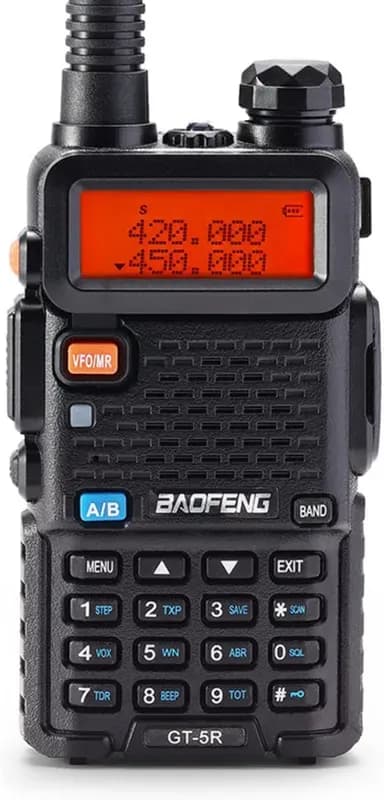
$19.99 · 6W · 3800mAh
The GT-5R is aimed squarely at newly licensed Technicians and entry-level operators who want a functional dual-band HT without committing serious money to the hobby. At $21.59, it sits at the floor of the market and makes no pretense of competing with Yaesu or Kenwood offerings. Think club loaner radio, go-bag backup, or first HT while you decide whether VHF/UHF operations are worth a deeper investment. The 3800mAh battery is a genuine bright spot for a radio at this price, offering respectable runtime for portable ops or simplex use during events. CHIRP compatibility is non-negotiable for sane channel management, and the GT-5R covers that base without issue. The 128-channel memory is adequate for most repeater-heavy metro areas, though the feature set beyond that is thin, and the specs sheet does not include mid or low TX power figures, which limits how precisely you can assess power step behavior. There is no IP rating here, so keep it out of the rain. For a new licensee who wants a legal, CHIRP-programmable dual-bander under $25, this delivers reasonable value. Operators expecting any digital modes, build quality, or weather resistance above baseline should look elsewhere.
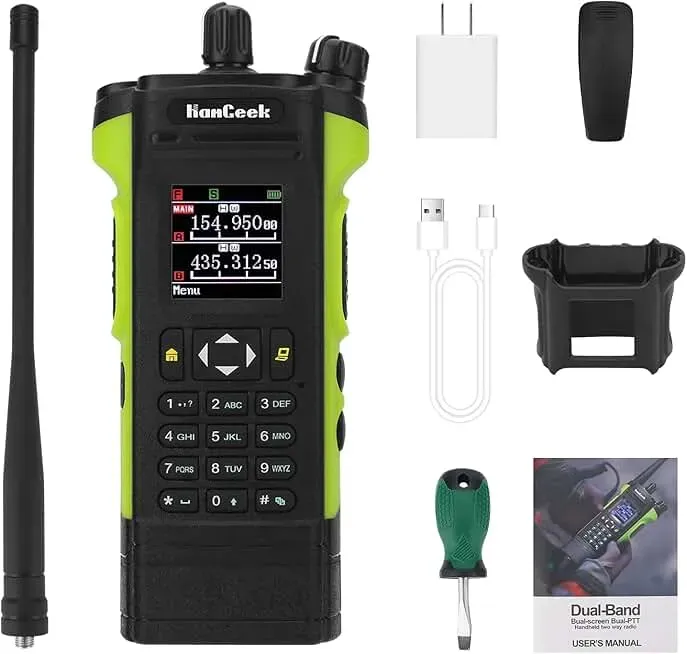
$129.99 · 12W · 8800mAh
The APX-8000 sits at the entry-level end of the dual-band handheld market, best suited to Technician-class operators who need basic VHF and UHF FM coverage without a significant outlay. It is not a digital radio; there is no DMR, D-STAR, or Fusion support here, so operators looking to get onto a digital repeater network will need to look elsewhere. Where this radio does make a reasonable case for itself is runtime. The 8800mAh lithium-ion cell is notably large for a $129.99 handheld, and 12W of TX power on VHF is a legitimate figure for simplex range in open terrain. With 128 memory channels, it handles a reasonable number of repeater entries, and CHIRP compatibility (verify before purchase) would make programming less painful. Portability scores reasonably well given the battery size, though the feature set overall is on the thin side. No customer feedback data was available at time of writing. At $129.99, the APX-8000 is a straightforward FM-only handheld with a strong battery argument and no digital frills. Buy it if FM simplex and local repeater access is all you need; pass on it if you anticipate any digital mode work.
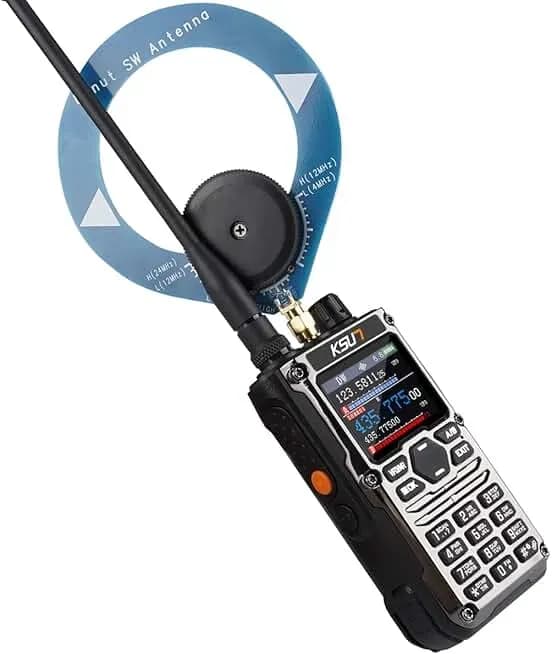
$55.8 · 4000mAh
The KSUN HF123D sits squarely at the entry point of the handheld market, aimed at newly licensed Technicians who want to get on the air for local repeater work without committing serious money to a first radio. It is not designed for operators who need digital modes, wide-band coverage, or field-deployable durability. Spec transparency is limited on this one. TX power output, battery capacity, and memory channel count are unconfirmed, which makes direct comparisons difficult and complicates programming decisions if you intend to use CHIRP. The radio covers VHF and UHF FM, which covers most Technician-class operating, but nothing beyond that. Beginner-friendliness scores in the middling range, which is about right for a basic FM-only handheld with no advanced menu complexity to navigate. At $55.80 with thin spec documentation and a feature set that scores at the very bottom of the RadioRanked index, this radio is a hard sell even as a starter option. Better-documented alternatives exist at or near this price. If you need a throwaway loaner radio and have zero expectations beyond basic FM simplex or repeater operation, it may fill that narrow role, but most buyers will find more value elsewhere.
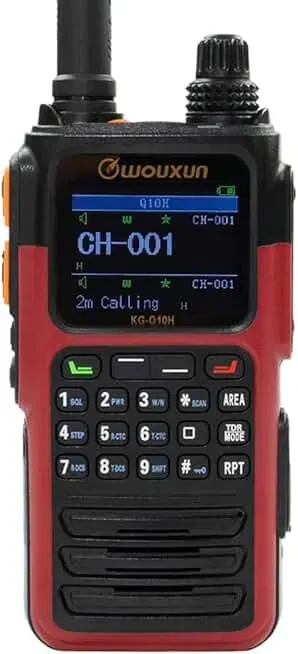
$219.99 · 6W · 3000mAh
The Wouxun KG-Q10H targets the operator who wants maximum band coverage in a single HT: VHF, UHF, 1.25m, and 6m transmit capability in one IP67-rated body with USB-C charging and a 3000mAh cell. That profile fits a newly licensed Technician looking to experiment across bands, or a portable operator who wants consolidated gear without carrying multiple radios. Where it earns its keep is in breadth. Quad-band transmit, 999 memory channels, cross-band repeat, simultaneous dual receive, GPS display, airband AM receive, and NOAA weather alerts with notifications cover a lot of ground for a sub-$220 price point. The IP67 rating is legitimately useful in field conditions, not just a checkbox. Programming is PC-compatible, which matters when you are managing that many channels. The value proposition is where this radio struggles. At $219.99, the KG-Q10H sits in a competitive tier where its feature-to-dollar ratio scores poorly compared to alternatives. Medium and low power output levels are unlisted in the official specs, which is a minor but telling gap. Operators who primarily work 2m and 70cm and want a refined, well-documented radio should look elsewhere; this one rewards the experimenter who specifically needs those extra bands.
Head-to-head