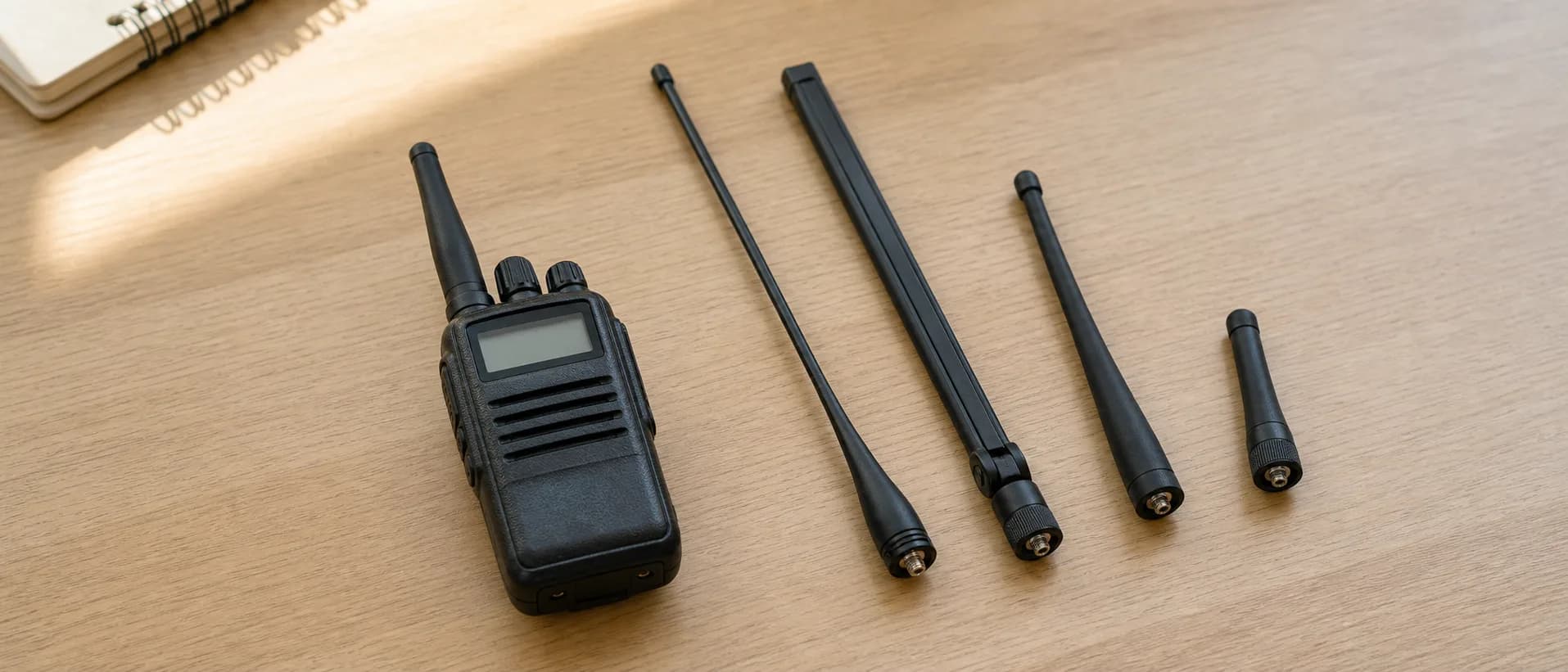

The stubby antenna that came with your handheld is the first thing worth upgrading, and the cheapest. Stock "rubber duck" antennas are built for one thing, fitting in the box, and they leave real range on the table. For about $20 you can swap on an antenna that noticeably improves how far you reach and how well you hear.
If you only remember one thing: the Nagoya NA-771 is the upgrade most hams make first, and for good reason. Just match the connector to your radio (more on that below) and you are done. This guide covers the antennas worth buying, how to pick the right connector, and how to read gain numbers without falling for the marketing. Browse the full lineup any time on our antennas page.
One honest caveat up front: an antenna upgrade helps, but it is not magic. Expect a meaningful improvement, not a doubling of your range. Where you stand and how high you hold the radio matter at least as much as which antenna is screwed on top.
Quick Picks
| Antenna | Best for | Price | Connector |
|---|---|---|---|
| Nagoya NA-771 (SMA-F) | Most Baofeng-style radios | ~$20.98 | SMA-Female |
| Nagoya NA-771 (SMA-M) | Yaesu / TYT / Wouxun | ~an unlisted price | SMA-Male |
| Nagoya NA-771G | GMRS radios | ~$20.98 | SMA-Female |
| Abbree AR-152 | Maximum reach (folding) | ~$9.99 | SMA-Female |
| Nagoya NA-320A | Tri-band radios (1.25m) | ~$20.98 | SMA-Female |
Prices reflect the last figures we pulled from Amazon and move around; check the live antenna pages for current numbers.
How We Score Antennas
Antennas used to be the one category on RadioRanked without a score, because antenna spec sheets are notoriously unreliable: a $10 whip will happily claim numbers a lab-grade product cannot hit. Scoring off those sheets would be false precision dressed up as data.
They are scored now, because there is a way around the problem. We ignore the advertised gain entirely and score the one thing a listing cannot fake: physical length, expressed in wavelengths at each band the antenna covers. That ratio is what actually governs how an antenna radiates.
The rules of thumb it produces are simple. Below about a fifth of a wavelength an antenna is electrically short and genuinely lossy. Around half a wavelength it stops needing a ground plane, which matters enormously on a handheld, because your hand and the radio body are a poor substitute for one. Near five eighths of a wavelength a single element hits its practical ceiling, and past three quarters the pattern breaks into lobes and gain toward the horizon starts falling again.
We still record the manufacturer's claimed gain, but only so we can check it against what the length can support. You can see the full catalog, including the claims that do not hold up, on our antenna listings.
Match the Connector First
This is the step that trips up almost every newcomer, so do it before anything else. The antenna has to physically match your radio's jack, and "almost right" doesn't screw on.
For handhelds there are two common SMA variants, and the easiest way to get it right is by radio brand:
- Baofeng, BTECH, and most clones take the antenna sold as SMA-Female. That's the NA-771 SMA-Female. If you own a Baofeng UV-5R, this is your version.
- Yaesu, TYT, Wouxun, and Vertex take the antenna sold as SMA-Male. That's the NA-771 SMA-Male.
Get this backwards and the antenna simply won't thread on. Adapters exist, but every adapter adds a little loss and a lot of bulk, so it's better to buy the right one. When in doubt, check your radio's manual or search your exact model plus "antenna connector." Larger SO-239 connectors (the chunky screw-on type) are for mobile and base antennas, not handhelds, and BNC bayonet connectors show up on some older or commercial radios.
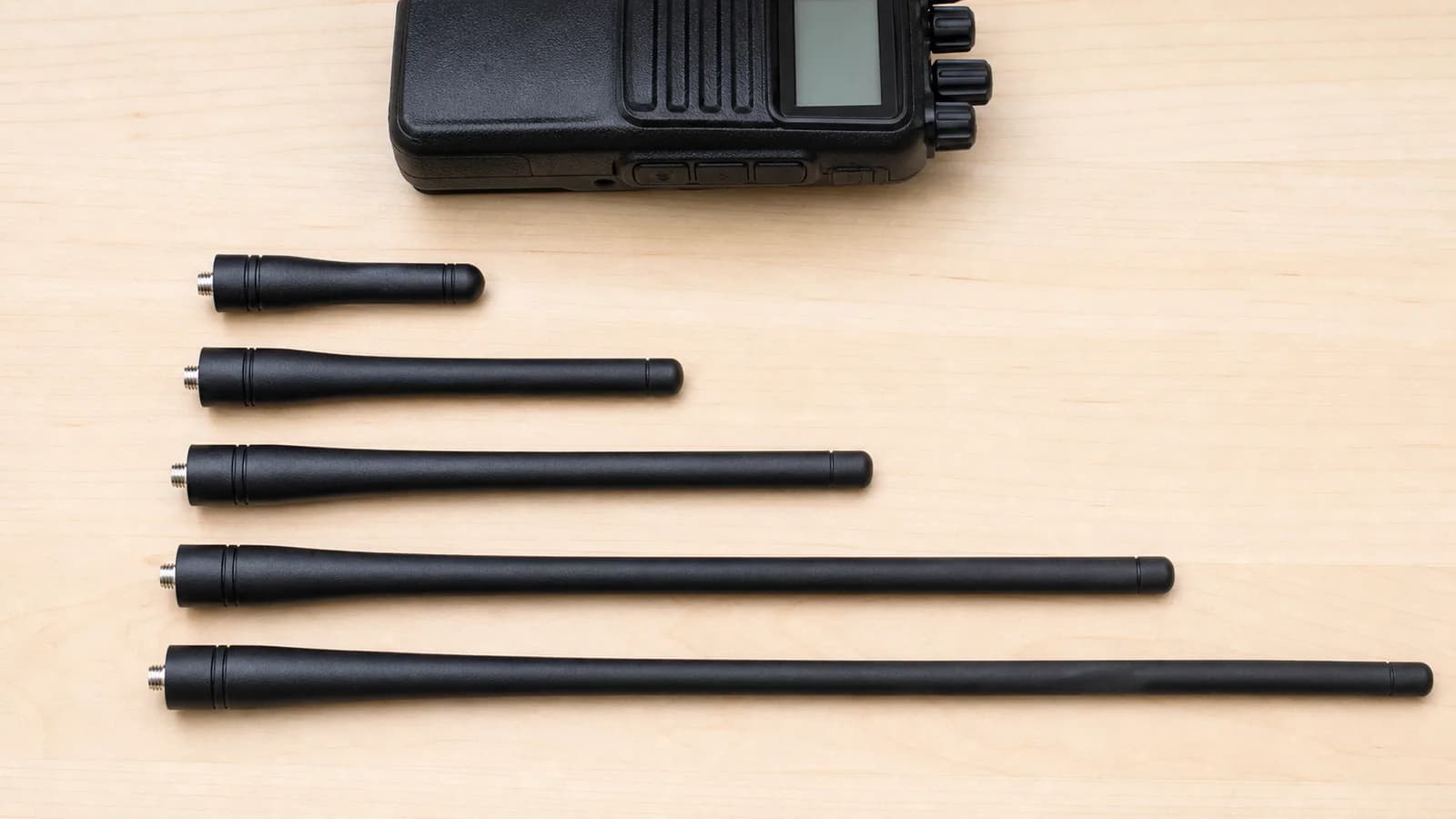
The Antennas Worth Buying
Nagoya NA-771: the default upgrade
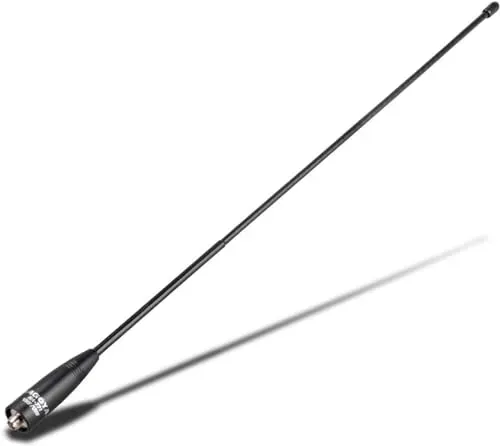
The NA-771 is the antenna more new hams buy than any other, and it earns the reputation. It's a 15.6-inch flexible dual-band whip that meaningfully outperforms a stock rubber duck on both 2 meters and 70 centimeters. The published gain is a modest 2.15 dBi, so think of it as a solid, reliable improvement rather than a transformation. At around $21 it's close to an impulse buy.
Two things to know. First, get the connector right: the SMA-Female version is for Baofeng-style radios, the SMA-Male version is for Yaesu and friends. Second, counterfeits are everywhere, so buy from a reputable seller; a genuine Nagoya is worth the couple of extra dollars.
Who it's for: anyone with a stock antenna who wants more range for the least money and effort. It's the first accessory I tell new licensees to buy, and our Baofeng UV-5R review makes the same point.
Nagoya NA-771G: the GMRS version
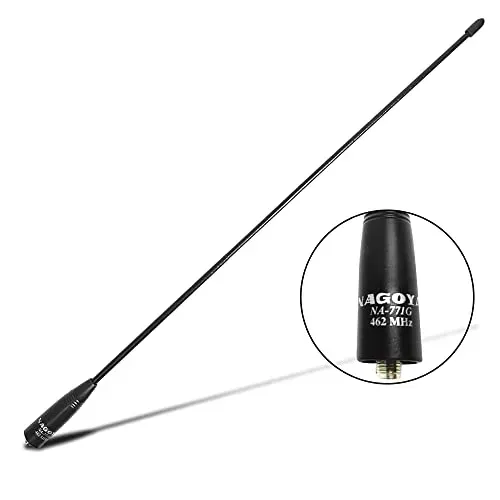
If your handheld is a GMRS radio rather than a ham radio, the NA-771G is the better match. It uses the same flexible build as the standard NA-771, but the element is cut for the GMRS frequencies around 462 to 467 MHz instead of the broad 2m/70cm ham range. That targeted tuning gives better performance on GMRS than a generic dual-bander would. It ships with an SMA-Female connector to fit Baofeng-style GMRS handhelds. If you operate both ham and GMRS, see how the two services differ in our broader coverage of the brands that straddle them.
Abbree AR-152: maximum reach when you need it
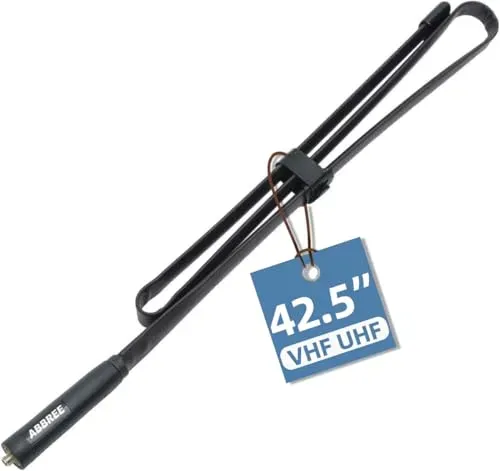
The Abbree AR-152 is the antenna you clip on when range matters more than convenience. Fully extended it's about 42 inches, and that long element genuinely helps on 2 meters, where antenna size has the biggest payoff. It folds down and clips out of the way when you're moving. At around $10 it's the cheapest pick here.
The trade-offs are real. At 42 inches it's impractical for everyday carry and can feel top-heavy on a small radio. And the listing's roughly 5 dBi gain claim is optimistic; judge it by the reach you actually get, not the number on the box. It's ideal for stationary use, a pack antenna for POTA or SOTA, or stretching simplex range in the field. It uses an SMA-Female connector for Baofeng-style radios.
Nagoya NA-320A: for tri-band radios
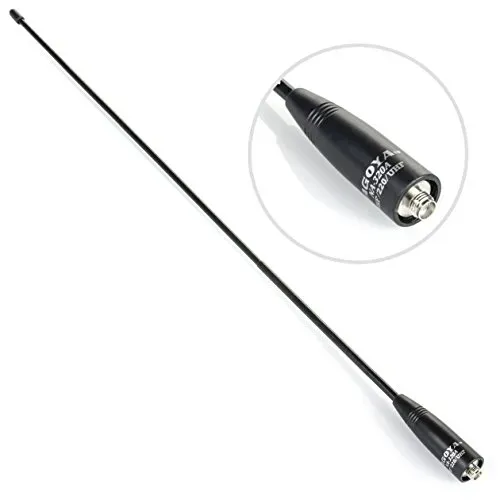
Most handhelds are dual-band (2m and 70cm), but a few also cover the 1.25-meter band. If yours does, the NA-320A is a 17.7-inch tri-band whip that matches that coverage. The tri-band radio we see most often is the Radioddity GS-10B, and this is the antenna built to go with it.
The honest caveat: this antenna only makes sense if your radio actually transmits on 1.25m. On a plain dual-bander it offers no advantage over the cheaper, simpler NA-771, because the extra band tuning is a compromise. Buy it for the band, not for general use.
Gain Ratings, Demystified
"High gain" is the most over-marketed phrase in antennas, so here's what the numbers actually mean.
Antenna gain doesn't create power out of nothing. An antenna is passive; it can only shape where the energy goes. "Gain" measures how much an antenna concentrates your signal toward the horizon (where other stations are) instead of wasting it straight up into space. More gain means a flatter, more focused radiation pattern.
The unit you'll see is dBi, decibels relative to a theoretical isotropic radiator (a perfect point that radiates equally in all directions). You'll occasionally see dBd, relative to a reference dipole; dBd figures are about 2.15 lower than the dBi figure for the same antenna, which is exactly why so many cheap antennas quote "2.15 dBi" (it's a dipole, 0 dBd, relabeled to sound bigger).
What does a few dB buy you in practice? Every 3 dB is roughly a doubling of effective radiated power in the favored direction, but power and range are not the same thing. A 2.15 dBi whip over a stock rubber duck typically feels like a 30 to 50 percent improvement in reliable range, not a doubling. And you can't cheat physics on a handheld: very high gain requires either a long antenna or a pattern so flat it stops working when you tilt the radio, so handheld antennas top out modestly.
The length test anyone can apply
You can check a gain claim yourself with one division. A full wavelength in millimetres is 299,792 divided by the frequency in MHz, which comes out at 2,053 mm on 2 meters, 689 mm on 70 centimeters, and 645 mm on GMRS. Divide the antenna's length by that number and you have its electrical length.
The stock antenna on a UV-5R is about 155 mm. On 2 meters that is 0.08 of a wavelength, which is why handhelds are so disappointing on VHF out of the box. On 70 centimeters the same antenna is 0.22 of a wavelength, close enough to a quarter wave to work reasonably, which is why the same radio feels better on UHF.
Run the same arithmetic on a 15.6-inch NA-771 and you get 0.19 wavelengths on 2 meters and 0.58 on 70 centimeters. That is the honest picture of the most popular antenna in ham radio: a very good 70cm antenna and a merely adequate 2m one.
Now apply it to a marketing claim. A 3.5-inch stub advertised at 3 dB of gain is 0.14 wavelengths on GMRS. Nothing that short produces gain; it radiates at a loss. The claim is not a lie about the antenna so much as a number nobody checked.
SWR, Impedance, and the Specs That Actually Matter
Two more terms worth a plain-English definition:
SWR (standing wave ratio) measures how well the antenna is matched to your radio at a given frequency. A low SWR (under about 1.5 to 1) means most of your power leaves the antenna; a high SWR means power reflects back into the radio, wasting it and, at higher power, stressing the transmitter. For a handheld at five watts it's rarely dangerous, but a well-matched antenna simply works better. If you want to understand the math, our SWR calculator lays it out.
Impedance is why antennas and radios are both built around 50 ohms; matching impedance is what keeps SWR low. You don't need to do anything about this with a commercial antenna (they're already 50 ohm), but it's the reason you can't just attach any random wire and expect it to work.
The practical takeaway: a properly tuned antenna at the right frequency beats a "high gain" antenna that's poorly matched. Frequency tuning is also why the GMRS-specific NA-771G outperforms a general dual-bander on GMRS, and why a tri-band antenna is a compromise on any single band.
When a Handheld Antenna Isn't Enough
An antenna swap is the best cheap upgrade, but it has a ceiling. If you consistently need more range, the next steps leave the handheld behind:
- A mobile antenna mounted on your vehicle (mag-mount or permanent) with a proper ground plane will dramatically outperform any handheld whip, often two to five times the usable range. It connects through coax to a mobile radio or, with an adapter, your handheld.
- A base or external antenna mounted up high at home does even more. Height beats gain almost every time; getting an antenna onto a roof or mast matters more than its rated gain. If you go this route, factor in coax cable loss, which quietly eats signal on long runs, and use a dipole calculator if you build your own.
The honest framing: a $20 whip and a good location will outperform a premium antenna in a bad one. Before spending more, try operating from higher ground or near a window and see how much the location alone changes things. Our guide to ham radio range goes deeper on what actually determines how far you reach.
Durability and Care
Handheld antennas are cheap and easy to replace, which is the good news, because they do wear out. The flexible Nagoya-style whips are durable in normal use but can be damaged by sharp bends or by yanking on the antenna instead of the connector. Folding tactical antennas like the Abbree add a hinge that's another potential failure point over years of use.
A few habits extend their life: hand-tighten the connector only (never use pliers, and never cross-thread it), grip the base rather than the tip when removing, and keep the threads clean. Modern antennas shrug off rain, but none of these are submersible. If an antenna does fail, it's a $10 to $20 swap rather than a damaged radio, which is part of why upgrading is so low-risk.
At a Glance
| Antenna | Gain | Length | Connector | Bands | Price |
|---|---|---|---|---|---|
| NA-771 SMA-F | 2.15 dBi | 15.6 in | SMA-Female | 2m / 70cm | ~$20.98 |
| NA-771 SMA-M | 2.15 dBi | 15.6 in | SMA-Male | 2m / 70cm | ~an unlisted price |
| NA-771G | ~3 dBi | 15.3 in | SMA-Female | GMRS | ~$20.98 |
| Abbree AR-152 | ~5 dBi (claimed) | 42.5 in, folds | SMA-Female | 2m / 70cm | ~$9.99 |
| NA-320A | ~3 dBi | 17.7 in | SMA-Female | 2m / 1.25m / 70cm | ~$20.98 |
Gain figures are manufacturer-published; treat the Abbree's claim in particular as optimistic. All five use a flexible build and fit handheld radios with the matching connector.
Which Antenna Should You Buy?
- You own a Baofeng or similar and want one upgrade: the NA-771 SMA-Female. Done.
- You own a Yaesu, TYT, or Wouxun: the NA-771 SMA-Male. Same antenna, correct jack.
- You run a GMRS radio: the NA-771G.
- You want the most reach and don't mind the size: the Abbree AR-152 for stationary and field use.
- You have a tri-band radio that does 1.25m: the NA-320A.
For the radios these antennas bolt onto, start with our best radios for beginners and the Baofeng UV-5R review. New to all of this? Our guide to getting your ham radio license is the place to begin.
The Verdict
The stock antenna is fine for your first afternoon and nothing more. The single best dollar-for-dollar upgrade in the hobby is a $20 antenna, and for most operators that means the Nagoya NA-771 in the connector that fits their radio. Step up to the folding Abbree AR-152 when you want reach over convenience, and match the NA-771G or NA-320A to your radio if it's GMRS or tri-band.
Just keep the bigger picture in mind: the antenna helps, but where you stand and how high you get it help more. Buy the cheap upgrade, then go find some high ground.