Mission briefing
Best HAM Radios Under $50 in 2026
Handheld radios are a practical choice for amateur radio operators who want reliable two-way communication without being tethered to a base station or vehicle. They're especially useful for outdoor activities like hiking and camping, participating in public service events, or simply staying connected with other hams in your local area. For newcomers to the hobby in particular, finding a capable radio at an affordable price point makes getting on the air far less intimidating.
When shopping in this price range, output power and supported modes deserve the most attention. Higher wattage directly affects how far your signal travels, which is why the 10-watt options in this category stand out for general use. Beyond raw power, digital mode support like DMR can be a meaningful upgrade, opening access to a much wider network of repeaters and contacts compared to analog-only radios.
The Radtel RT-4D earns the top spot by offering something the other radios here simply cannot match at this price: DMR digital capability paired with built-in GPS, making it a genuinely versatile radio for operators who want to grow into more advanced operating without immediately outgrowing their equipment.
Ranked by our overall score, a weighted model of specs, features, value and Amazon review data, across 5 qualifying radios in this category.
#1 · Our Top Pick
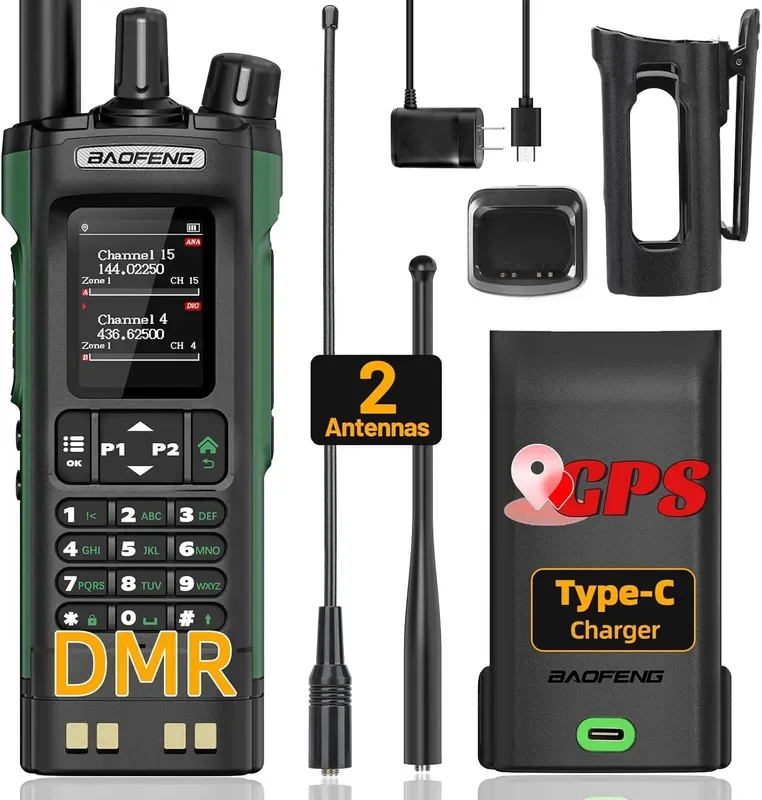
The Baofeng DM32 is aimed squarely at newly licensed operators and budget-conscious hams looking to step into DMR without committing to a Tier II radio at three times the price. It sits in a crowded field of entry-level dual-banders, but the addition of GPS and APRS support gives it a meaningful edge over comparably priced analog-only handhelds. At 8W output across VHF and UHF, the RF performance is adequate for most repeater work. The 4000-channel memory is generous for the price point, and CHIRP compatibility means you are not locked into Baofeng's programming software. DMR dual-mode operation lets you run digital talkgroups alongside conventional analog nets without carrying a second radio, which is the practical case for buying this over a simpler HT. Where the DM32 gives ground is portability: at 350g it is noticeably heavier than lighter competing handhelds, and it carries no water resistance rating at all, so field use in variable weather is a real consideration. At $54, this is a reasonable first step into digital for hams who want DMR and APRS without a serious financial commitment. Operators who need field durability or a refined DMR implementation should look higher up the price ladder.
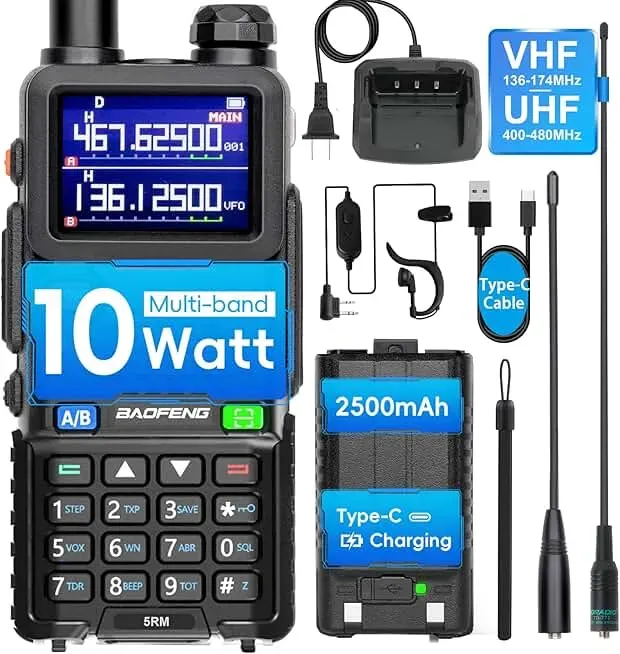
$26.99 · 10W · 2500mAh
The Baofeng 5RM is built for newly licensed Technicians and budget-conscious operators who want tri-band coverage without committing serious money to a first handheld. At $24.12, it sits firmly in the "learn the hobby before you invest in the hobby" tier, making it a sensible starting point for anyone still finding their footing on local repeaters. The headline spec here is tri-band operation across VHF, UHF, and 1.25m, which is genuinely uncommon at this price point. The 2500mAh lithium polymer battery is reasonable for day use, and 999 memory channels is more headroom than most operators will ever fill. CHIRP compatibility (listed under the UV-17Pro or 5RM profile) is the practical clincher; it means you can program this radio without wrestling the stock menu, which aligns with how well it scores on beginner-friendliness. Where it falls short: features depth is thin, with no stated IP rating despite the "water resistant" marketing language, and medium and low TX power figures are not published, which makes field comparisons harder than they should be. Buy this if you need an affordable entry point into tri-band operation; look elsewhere if you want a radio that will grow with your license.
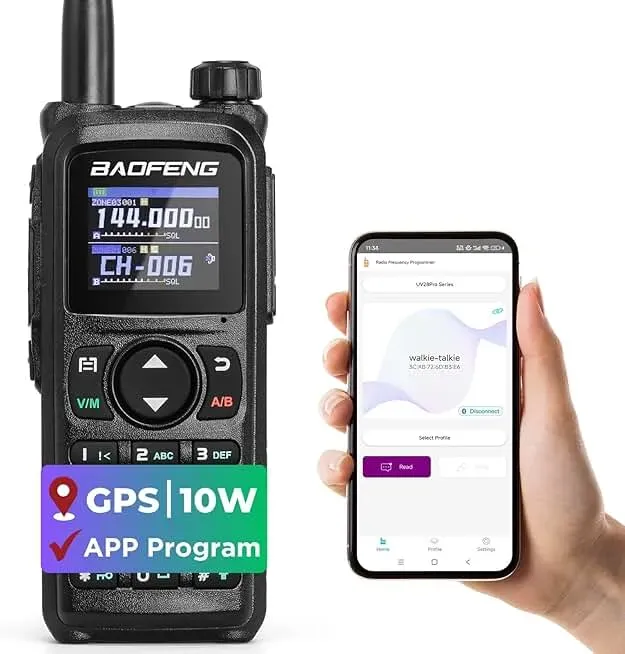
$43.99 · 10W · 2200mAh
The Baofeng UV-28 is aimed squarely at newcomers and budget-conscious operators who want a dual-band VHF/UHF handheld with GPS capability without spending serious money. At under fifty dollars, it sits in a crowded field of entry-level Chinese handhelds, but the integrated GPS gives it a modest edge for those interested in position reporting or field coordination on a tight budget. The 1000-channel memory is genuinely useful, giving operators room to store repeater banks across multiple regions without constantly reprogramming. The GPS implementation supports real-time latitude, longitude, and altitude readout and allows coordinate sharing with teammates, which has practical value for SOTA activators, ARES/RACES deployment, or any scenario where position awareness matters. Where this radio falls short is in overall feature depth; it lacks digital mode support such as DMR or APRS integration, which limits its ceiling for operators looking to grow. With no stated IP rating and explicit confirmation that it is not water resistant, this is not a radio for wet-weather field work. For a Technician just getting started who wants GPS on a shoestring, the value here is hard to argue with; seasoned operators with more demanding requirements should look further up the product ladder.
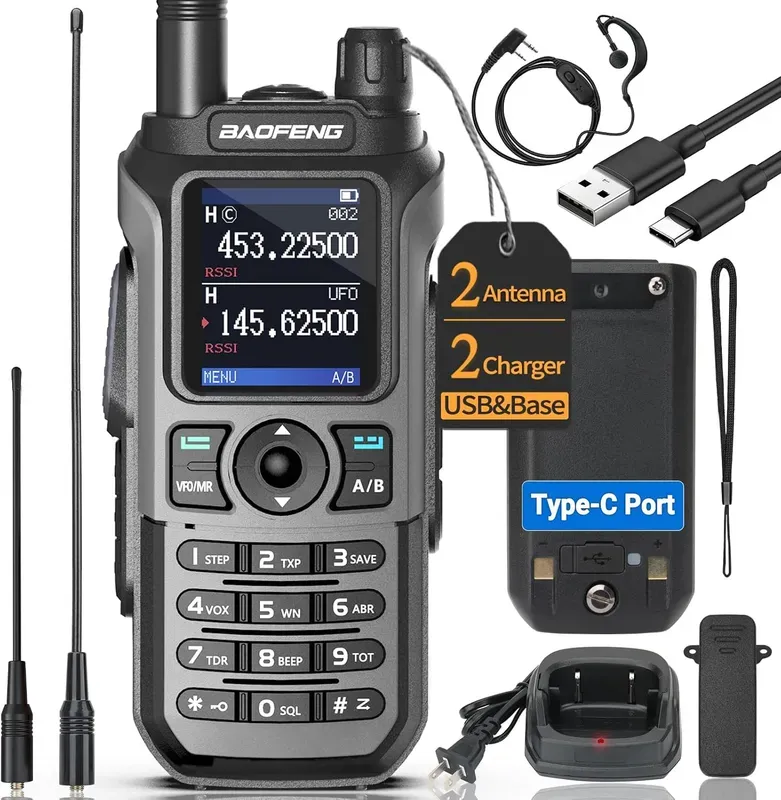
$26.99 · 6W · 1800mAh
The UV-21R is built for newly licensed operators and budget-conscious buyers who need a functional VHF/UHF handheld for local repeater work and simplex without spending real money. It sits firmly in the same crowded tier as other Baofeng budget handhelds, and that context matters when setting expectations. At 6W max output on a 3.7V lithium-ion platform with 999 memory channels and CHIRP compatibility (via the UV-17Pro profile), the radio covers the practical basics for a Technician working a local linked repeater system or ARES net. IP54 weather resistance is a genuine differentiator at this price point, offering splash and light dust protection that most radios in this bracket skip. The feature set overall is thin beyond these fundamentals, which is worth noting if you need anything beyond analog FM. At $24.99 with no manufacturer warranty, this is a radio you buy knowing what it is. It scores well on value and beginner-friendliness, which makes it a reasonable first handheld or a low-stakes go-bag spare. Experienced operators expecting robust receive sensitivity or clean TX audio should look elsewhere.
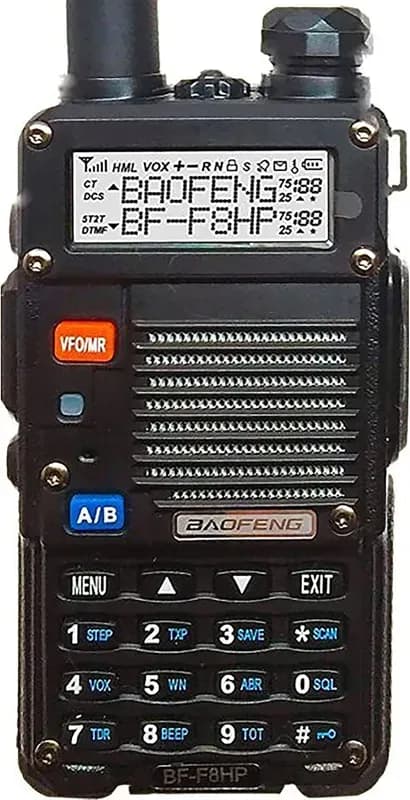
$45 · 8W · 2000mAh
The BF-F8HP sits squarely in the entry-level dual-band market, aimed at newly licensed Technicians and budget-conscious operators who need a programmable VHF/UHF FM handheld without spending serious money. It's also a reasonable shout as a beater radio for experienced hams who don't want to risk a primary rig in the field. Transmit power tops out at a claimed 8W (closer to 7-8W measured in most independent tests), with three selectable levels covering roughly 1W, 4-5W, and high. Coverage spans VHF 136-174 MHz and UHF 400-520 MHz, and the 2100mAh Li-Po battery is a genuine improvement over earlier UV-5R variants. With 128 memory channels and full CHIRP compatibility, basic repeater programming is straightforward. The radio scores reasonably well for beginner-friendliness and delivers solid value at its price point, though its feature set is thin by modern standards. No stated IP rating means treat waterproofing claims with caution in the field. At $45, the BF-F8HP makes sense as a first HT or a sacrificial spare; operators who need any digital modes, a verified environmental rating, or a reliable stock antenna should budget higher.
Head-to-head