

Quick answer: Get GMRS to talk to your own group and family. One $35 FCC license, no exam, covers your immediate family for 10 years; mobiles run up to 50 watts, repeaters stretch the range, the antennas are small and real handhelds exist. Get CB to hear truckers and anyone already on CB: no license, 4 watts on AM or FM, 12 watts peak envelope power (PEP) on single sideband, and a big antenna. Plenty of trail rigs run both.
Most people asking this are not radio hobbyists. They have a trail ride, a convoy or a family trip coming up, and, as one Expedition Portal poster put it, they "just need to be able to push a button and say 'Can you hear me now?'" So this guide sticks to what changes that outcome: power, antennas, terrain, cost, and above all who is on the other end. If GMRS itself is new to you, our GMRS explainer covers the basics first.
Every regulatory number below comes from the current text of 47 CFR Part 95 and the FCC's fee schedule. The antenna numbers come from the same electrical-length model that scores every antenna on RadioRanked. I have not bench-tested CB gear for this piece; where a claim is forum experience rather than rule or arithmetic, I say so.
GMRS vs CB at a Glance
| GMRS | CB | |
|---|---|---|
| Band | 462 to 467 MHz (UHF) | 26.965 to 27.405 MHz |
| Channels | 30: 22 shared with FRS plus 8 repeater inputs (channel map) | 40 |
| Power | Up to 50 W output from a mobile on the main channels | 4 W on AM or FM; 12 W peak (PEP) on SSB |
| License | $35, 10 years, no exam, 18+ to apply, covers immediate family | None; authorized by rule |
| Repeaters | Yes, provided for in the rules | None; the CB rules define no repeater station |
| Quarter-wave antenna | 6.3 in at 465 MHz | 108.5 in on channel 19 |
| Handhelds | Normal | Uncommon |
| Antenna height rule | Only the general air-navigation rule | 60 ft above ground, or 20 ft above its structure, whichever is higher |
| Who is on it | Families; many newer trail groups, per recent forum threads | Truckers, logging roads, longer-established groups |
GMRS and CB share nothing on that table except the "personal radio service" label: different bands, different rules, different antennas, and different people listening.
Power: 50 Watts vs 4, and Why It Matters Less Than It Sounds
Start with the CB numbers, because almost every comparison gets them wrong. Under 47 CFR 95.967, a CB transmitter may put out 4 watts mean carrier power on AM or FM, and 12 watts peak envelope power on single sideband (SSB). FM became a permitted CB mode in a 2021 FCC order, so "CB is AM only" is out of date. External amplifiers are prohibited outright; the rule (95.939) says "There are no exceptions to this rule," which covers every "200 watt" CB you will read about in forum threads.
GMRS allows a mobile radio up to 50 watts of transmitter output on the main channels (95.1767), including the 467 MHz channels it uses to reach a repeater. Base and repeater stations get the same 50 watts, but transmit only on the eight 462 MHz main channels (95.1763). That is output at the radio, not radiated power. The interstitial channels are far lower: 5 watts ERP on the 462 MHz ones and half a watt ERP on the 467 MHz ones.
More than twelve times the power sounds decisive, but power does not move the horizon. UHF travels close to line of sight, and the radio horizon sits at roughly the square root of twice the antenna height in feet, in miles. An antenna on a truck roof about 6 feet up sees about 3.5 miles; two trucks see each other at roughly 7 miles over flat, open ground. That is the same figure whether the radio makes 5 watts or 50. The extra watts buy margin at the edge of that path, through brush and over a partial obstruction, which is what our GMRS range guide walks through. Plug your own heights into the range calculator.
GMRS's real range multiplier is the repeater. The same formula gives an antenna 500 feet up a ridge a horizon of about 32 miles on its own, assuming nothing in between, and a repeater there relays you to everyone else who can see it.
Antennas: The Difference You Will Actually Notice
This is where CB and GMRS feel most different in a vehicle, and it comes down to wavelength. A CB signal on channel 19 (27.185 MHz) has a wavelength of about 36 feet. A GMRS signal at 465 MHz has a wavelength of about 25 inches. An antenna's behavior depends on its length as a fraction of that wavelength, so here is that arithmetic for real antennas, computed with the electrical-length model behind our antenna gain claims analysis:
| Antenna | Physical length | Frequency | Electrical length |
|---|---|---|---|
| 3 ft CB whip | 36 in | 27.185 MHz (ch 19) | 0.083 wavelength |
| 4 ft CB whip | 48 in | 27.185 MHz (ch 19) | 0.111 wavelength |
| 5 ft CB whip | 60 in | 27.185 MHz (ch 19) | 0.138 wavelength |
| Full-size steel CB whip | 102 in | 27.185 MHz (ch 19) | 0.235 wavelength |
| Midland MXTA25 Ghost | 3.5 in (89 mm) | 465 MHz | 0.138 wavelength |
| Midland MXTA26 | 32 in (813 mm) | 465 MHz | 1.261 wavelengths |
| Retevis fiberglass GMRS | 48 in (1,224 mm) | 465 MHz | 1.899 wavelengths |
The 3 and 4 foot whips people bolt to a Jeep are a twelfth to a ninth of a wavelength. Even a full 102 inch whip falls just short of a quarter wave, which is 108.5 inches on channel 19. Antennas that short have to be electrically lengthened with a loading coil, which is why short CB whips carry one, and why CB installs get tuned with an SWR meter after they go on. Our SWR calculator explains what that reading means.
On GMRS, a quarter wave is 6.3 inches, so an ordinary 32 inch whip is more than a full wavelength long. As one r/gmrs poster put it: "GMRS is MUCH easier than CB to setup properly. The antenna is a fraction of the size and you don't need to spend a bunch of time tuning everything."
There is a twist. The 3.5 inch Ghost is 0.138 wavelength, exactly the same fraction as a 5 foot CB whip, and our model puts it at about -0.9 dBi. A low-profile antenna makes the same compromise on GMRS that a short whip makes on CB.
For a vehicle, the Midland MXTA26 at $69.99 is the sensible default: our model gives it about 4.9 dBi against Midland's 6 dB claim, inside the allowance we give every vendor. The taller Retevis fiberglass at $79.99 models at 6.3 dBi against a 6.5 dBi claim. Both use an NMO mount; if you will not drill the roof, the HYS NMO magnetic base runs $27.99. The full ranked list lives on our GMRS antennas page.
Range in the Real World: Terrain, Skip and Repeaters
Over flat ground, the horizon decides. In hills and mountains, the band starts to matter. GMRS at 462 to 467 MHz is blocked by a ridge between you. A 36 foot CB wave bends around terrain more readily, and the most direct warning in a 2024 r/gmrs thread about mountain driving spells out the consequence: "If you don't have a good repeater in the area GMRS is going to be fairly useless in the mountains and CB will work much better."
CB also has skip: long-distance openings on 27 MHz that come and go with the 11-year solar cycle. NASA and NOAA announced in October 2024 that the Sun had reached its solar maximum period. Skip is not range you can plan on; for a convoy it mostly means distant stations landing on your channel. The FCC dropped CB's old long-distance restriction in its 2017 reform, but you still may not talk with stations in other countries, except Canada's General Radio Service (95.933(d)).
GMRS answers terrain with repeaters, which the rules allow to run unattended (95.1747). Before you buy, look up your route on myGMRS.com's repeater map. A repeater on the right ridge changes the answer completely; no repeater, in steep country, is the one case where CB genuinely wins on reach. Our GMRS repeaters guide covers access and tones.
Which One Should You Get? By Situation
The most repeated advice across years of forum threads is to run whatever your group runs, and it is right: the most capable radio in the convoy is useless if nobody else can hear it.
| Your situation | Get |
|---|---|
| Your club or trail group already runs one | That one |
| Family trips, kids, spotters on foot | GMRS (handhelds work; one license covers family) |
| Convoy or trail ride with a new group | GMRS mobile |
| Highway, trucker traffic, logging roads | CB, at least to listen |
| Mountains, no GMRS repeater on the route | CB, or GMRS only after checking repeaters |
| You will not file a license | CB |
| You want both | Both; they share no frequencies |
The trend in the threads points one way. A 2019 Wrangler Forum post called CB "the most common communication platform for jeepers"; a 2023 reply in the same thread said "GMRS is quickly becoming the standard for trail comms"; a 2026 one said that in Colorado "the Jeep Crowd have migrated from CB to GMRS." That is forum opinion, not a survey, and it varies by region: a Missouri poster on r/gmrs called CB "far more useful," adding: "That's what the locals have." Ask before you buy.

What Each One Costs to Set Up
| Item | GMRS | CB |
|---|---|---|
| Mobile radio | Radioddity DB20-G at $99.99 | A 40-channel mobile (we do not track CB prices) |
| Antenna | Midland MXTA26 at $69.99 | A loaded whip plus its mount |
| Mount | HYS NMO magnetic base at $27.99 | Included with many whips, or bought separately |
| Tuning | An SWR check is good practice | An SWR meter, or someone who has one |
| Handhelds for two | Two Baofeng UV-5G Plus at $32.99 each | Rarely practical |
| License | $35 for 10 years, new or renewal, whole immediate family | None |
The license is the line people overthink. It is $35 for 10 years, which works out to $3.50 a year, there is no exam, and you must be 18 to apply. It covers your immediate family, which the rule defines generously: spouse, children, grandchildren, stepchildren, parents, grandparents, stepparents, siblings, aunts, uncles, nieces, nephews and in-laws (95.1705). It does not cover friends: in a convoy, every driver who is not your immediate family needs a license of their own, or their own family's, to transmit. Transmitting on GMRS without one is not allowed. Our GMRS license guide walks through the FCC application.
CB has no fee at all, but a CB setup is not free of work: the antenna is bigger, it needs a solid mount, and it needs tuning.
The GMRS Radios We Would Put in a Vehicle
GMRS radios must be FCC-certified for the service (95.1761(a)). Every radio below holds a Part 95E grant, verified in the FCC registry, and we list the FCC ID so you can check it yourself.
Midland MXT275: Simplest Install
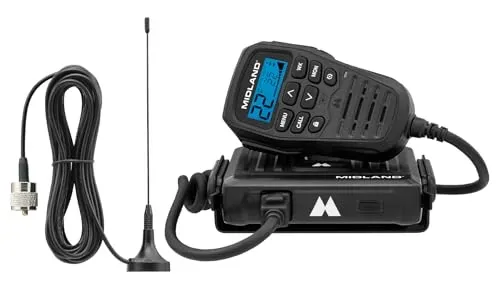
$199.99 · 15.00W
Fifteen watts, with the controls built into the microphone. It is the default trail-convoy mobile, with more than 2,000 Amazon ratings, and 15 watts is enough for the horizon-limited paths a convoy actually works. FCC ID MMAMXT275.
Radioddity DB20-G: Budget First Mobile
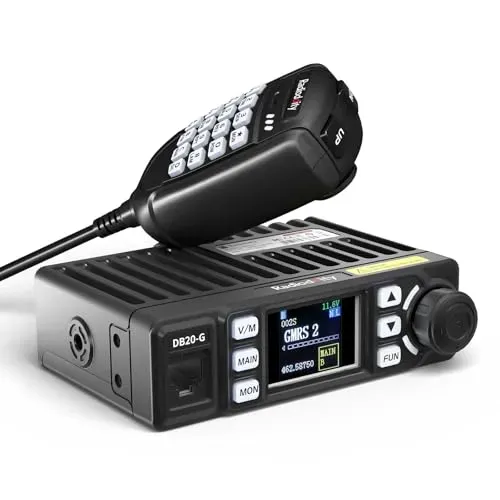
$99.99 · 20.00W · VHF/UHF
Twenty watts, compact enough to run without a permanent install, and the radio our GMRS mobile roundup recommends for most first-time buyers. FCC ID 2AN62-DB20G. If you want more headroom, the Radioddity DB40-G steps up to 40 watts (FCC ID 2AN62-DB40G).
Midland MXT575: 50 Watts for the Trail Leader
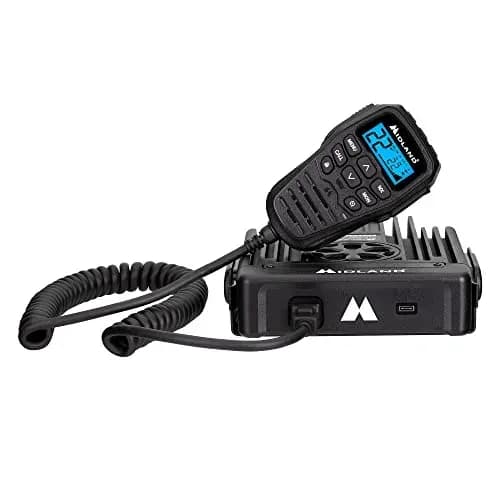
$439.99 · 50.00W
The full 50 watts the rules allow on the main channels, for the lead or tail vehicle that has to reach a distant repeater or hold the group together on a long spread. FCC ID MMAMXT575.
Baofeng UV-5G Plus: Handhelds for Spotters and Family
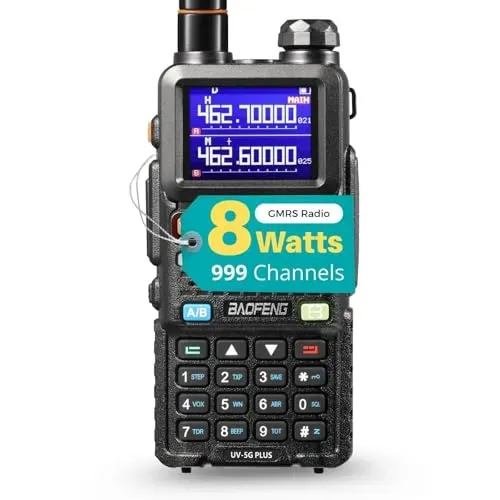
$32.99 · 5.00W
Five watts in a handheld, cheap enough to buy several. This is where GMRS pulls clearly ahead of CB: a family member spotting on foot or a kid at camp carries one, and your license covers your immediate family. A spotter from outside the family needs their own license. FCC ID 2AJGM-5GPLUS. For more options, see our ranked GMRS handhelds or browse every GMRS radio we track.
Where Ham Radio Fits
Ham radio is the third option people mention in every one of these threads. It offers more bands, more modes and more range, but it needs an exam, and each operator needs their own license. It is a hobby as much as a tool.
It is also a separate service: a GMRS radio cannot be certified if it can transmit on ham bands (95.1761(c)), and GMRS stations may not talk to ham stations except in an emergency (95.1733(a)(9)). For the full comparisons, see GMRS vs ham radio, ham radio vs CB and FRS vs GMRS.