

The box says 36 miles. Owners of that same radio report about three.
Both numbers are real. The 36 is not invented, it is just measured under conditions you will never have, and once you see where it comes from the whole question gets simpler. Range on GMRS is set by how high your antenna is, not by how many watts you paid for.
The Short Answer
| Situation | Realistic range |
|---|---|
| Two handhelds, dense urban or indoors | A few hundred yards to half a mile |
| Two handhelds, suburban | Half a mile to 2 miles |
| Two handhelds, open flat ground | 2 to 5 miles |
| Handheld to a vehicle with a roof antenna | 3 to 8 miles |
| Two vehicles, both with roof antennas | 5 to 10 miles |
| Anything, through a hill | Zero |
| Through a repeater on high ground | 20 to 40 miles |
If you only take one thing: the jump from the first row to the last is not a power upgrade. It is a height upgrade.
Those rows are not guesses. Each one sits at or below what the geometry in the next section allows for antennas at that height, with the rest of the gap being terrain, buildings and foliage.
Why 7 Miles Is The Geometric Ceiling For Two Handhelds
GMRS runs at 462 and 467 MHz, which mostly behaves like light. It travels in straight lines, and the geometric horizon is the first limit it runs into. Signals do reach somewhat past it, by diffraction around obstacles and by bending in the atmosphere, so treat the horizon as the number to plan around rather than a wall.
The radio horizon for an antenna sits at roughly the square root of twice its height in feet, which is the formula behind our range calculator. A handheld held at head height, call it 6 feet, reaches a horizon about 3.5 miles away. Two of them, each seeing 3.5 miles to the same point, gives you a theoretical maximum near 7 miles.
That is on perfectly flat, empty ground, with nothing in between and no allowance for trees, buildings, or the curve of a road. It is the planning ceiling, not the expectation, and not an absolute limit: on a good day you may hear someone past it.
Now put a number next to it: Amazon's own summary of what buyers report for a well-reviewed 5-watt handheld is "about 3-mile range." That is not a defective radio. That is 7 miles of geometry minus a real landscape.
Watts Do Not Extend The Horizon
Here is the part the marketing gets backwards. Power does not push your signal past the horizon. It fills the path you already have.
A 50-watt mobile radio with its antenna on a car roof at 6 feet has exactly the same horizon as a 5-watt handheld held at 6 feet. Both see about 3.5 miles. The 50-watt rig will punch through foliage better, hold a cleaner signal at the edge, and cope with a hill that only partly blocks the path. It will not reliably talk to someone 20 miles away over flat ground without extra height, because the Earth is in the way.
What changes the answer is height, and it changes it fast, because the horizon grows with the square root of elevation:
| Antenna height | Radio horizon |
|---|---|
| 6 ft (handheld) | 3.5 miles |
| 12 ft (roof rack) | 4.9 miles |
| 30 ft (mast) | 7.7 miles |
| 100 ft (hilltop) | 14 miles |
| 500 ft (repeater) | 32 miles |
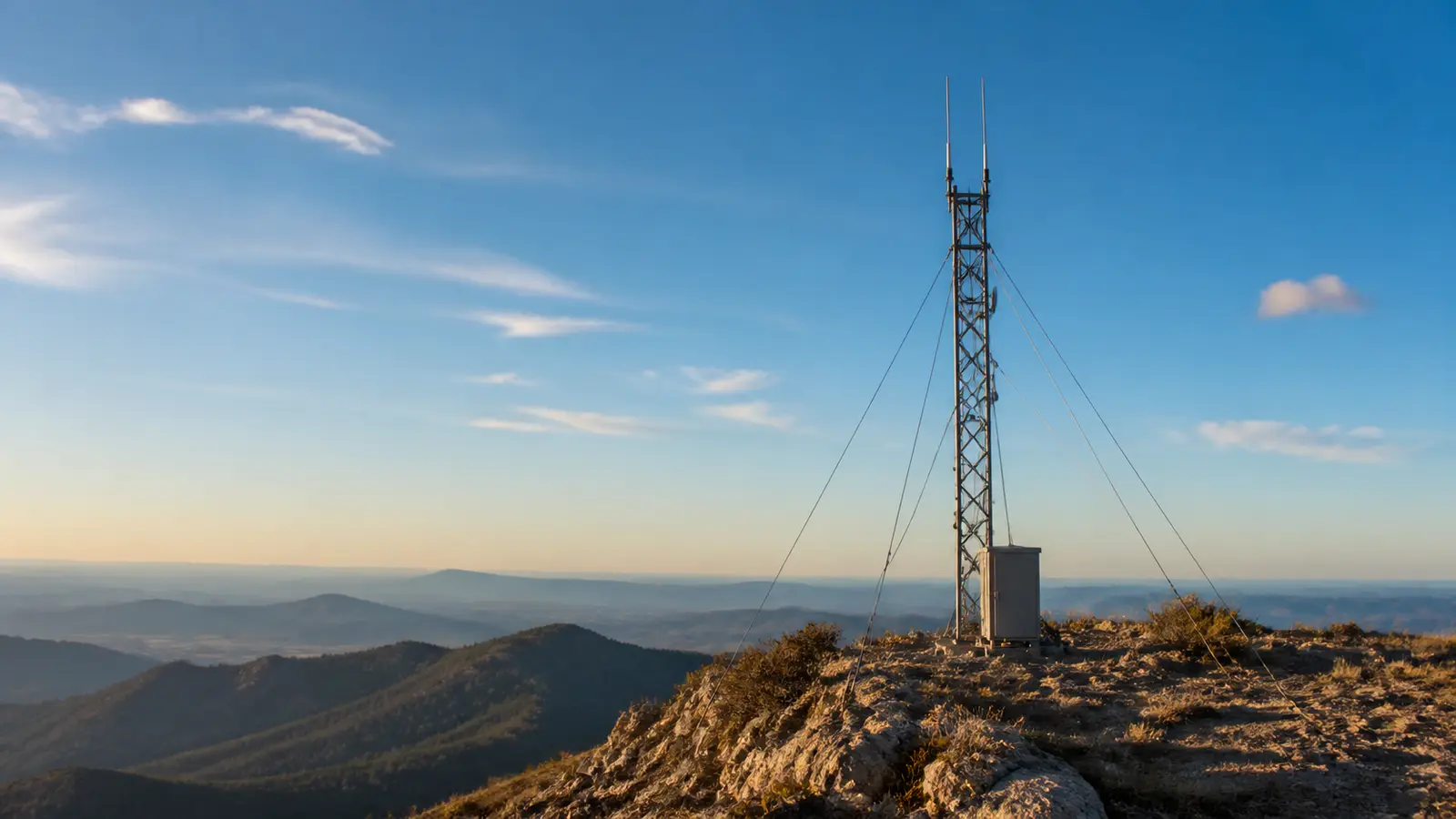
A repeater sitting 500 feet up sees 32 miles. Add your own 3.5 and you are at roughly 35 miles.
That is where the number on the box comes from. Thirty-six miles is not a lie about the radio, it is the elevated number presented as though it were the radio-to-radio number.
The Cap Nobody Mentions: Your Channel
Every range chart online talks about radios. None of them mention that the FCC caps power by channel, so the same radio transmits at wildly different power depending on which one you are on.
| Channels | Maximum power | What that means |
|---|---|---|
| 1 to 7 | 5 watts | Shared with FRS, fine for short range |
| 8 to 14 | 0.5 watts | Handhelds only, deliberately tiny |
| 15 to 22 | 50 watts | The main GMRS channels |
| Repeater inputs (467 MHz pairs) | 50 watts | Where the distance lives |
Channels 8 to 14 are limited to half a watt by rule, no matter what you bought. If your family is on channel 11 and wondering why a 5-watt radio is disappointing, that is why. Move to a channel in the 15 to 22 range and you have ten times the power available, from the identical radio, for free.
Our GMRS frequency chart lists all 30 channels with their pairs, and the GMRS explainer covers what the service is for.
What Actually Buys You Range
In order of how much difference they make.
1. Get the antenna higher. Nothing else is close. A magnetic-mount antenna on a car roof beats a handheld in your hand, every time, at any power.
2. Use a repeater. This is the only way to get past 10 miles reliably on GMRS, and it is why repeater capability is worth paying for. Our repeater guide covers finding and programming them.
3. Upgrade the antenna itself. A better antenna on the same radio often beats more watts, because a stock rubber duck is a compromise for size.
4. Then add power. Last, not first. Watts help at the margins of a path you can already almost make.
The ladder, with real prices
A certified handheld is where most people start, and $33 is a genuinely low bar for something with a current Part 95E grant.
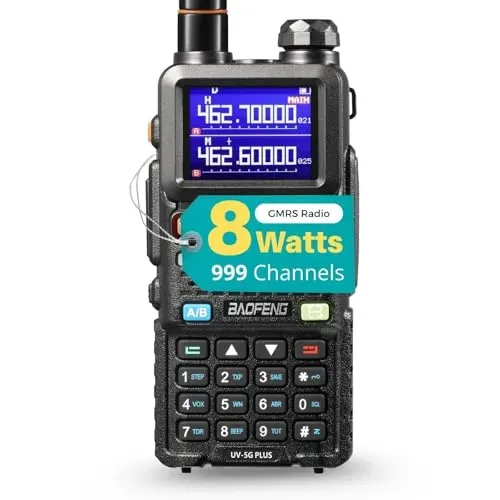
$31.34 · 5.00W
The single biggest upgrade is not a better handheld, it is getting an antenna onto a vehicle roof. This one runs off a cigarette lighter, so there is no permanent install to commit to.
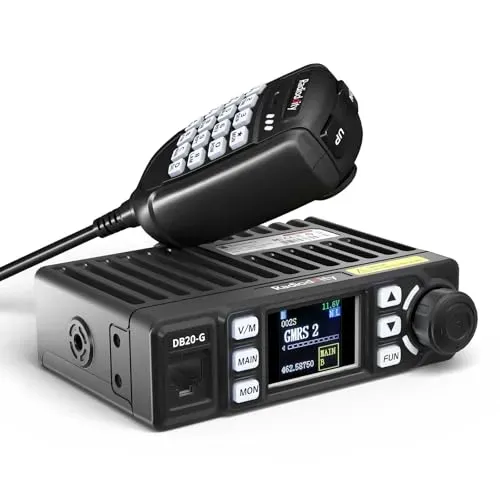
$94.99 · 20.00W · VHF/UHF
If the radio is staying in the truck, the 15-watt tier is the community's default for a reason: 2,272 owner ratings at 4.7 stars is an unusually strong record for any radio we track.
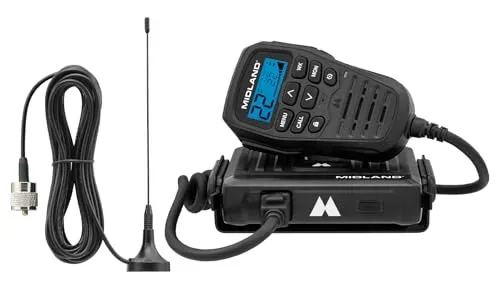
$199.99 · 15.00W
Fifty watts is real, but understand what you are buying. It is margin on a marginal path, not a longer horizon.
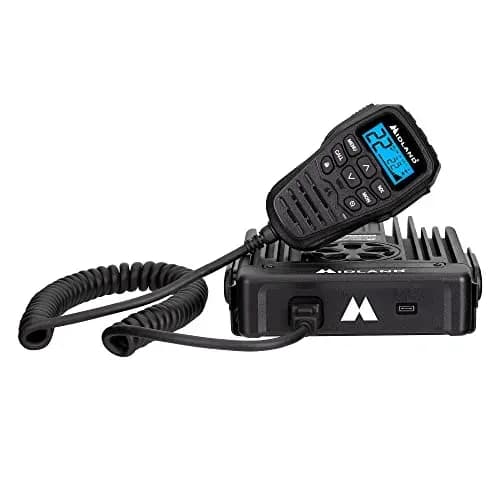
$439.99 · 50.00W
For the full field see our best GMRS radios guide and the GMRS mobile roundup.
Why The Box Says 36 Miles
Every consumer radio brand quotes range the same way, and the figure is technically defensible: it is measured with nothing in the way and maximum useful elevation, which in practice means mountaintop to mountaintop or across open water.
It is worth knowing which radios lean hardest on it. The best-selling GMRS pair on Amazon, with more than 13,000 ratings, advertises 36 miles, and when we searched the FCC registry we could not find a grant on file under that model number. We wrote that up separately in our GXT1000VP4 review.
A radio that quotes a smaller number is usually being more honest, not selling you less.