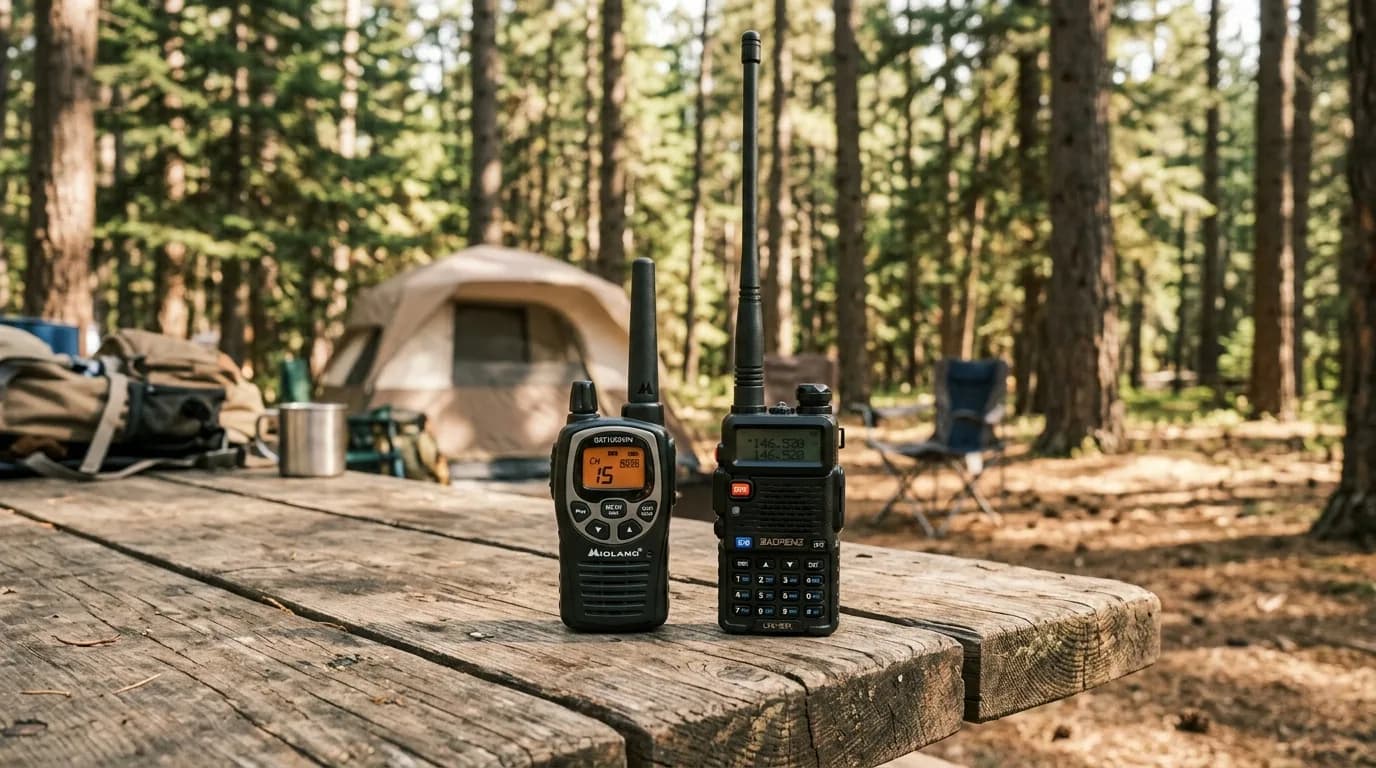

If you're considering two-way radio but aren't sure which direction to go, you've probably landed on the same question most people ask: should I get a GMRS license or a ham radio license? Both let you transmit legally on designated frequencies, but they serve different purposes, different budgets, and different levels of commitment.
I actually got my GMRS license before I got into ham radio. My hiking group needed reliable communication on trails outside cell range, and GMRS was the fastest path to legal, functional two-way radio. A year later I passed my Technician exam, then upgraded to General, and the two worlds turned out to be more complementary than competitive.
This guide breaks down the real differences, with actual costs, range numbers, and use cases, so you can pick the right license for how you'll actually use radio.
Quick Comparison
| GMRS | Ham Radio | |
|---|---|---|
| License cost | $35 (FCC filing fee) | ~$50 ($35 FCC fee + ~$15 exam fee) |
| License term | 10 years | 10 years |
| Exam required? | No | Yes (35-question multiple choice) |
| Family coverage | Yes, one license covers household | No, each person needs own license |
| Frequencies | 22 channels (462/467 MHz UHF) | Multiple bands (HF, VHF, UHF, microwave) |
| Max power | 50W (mobile/base), 5W (handheld) | 1,500W (depending on license class) |
| Typical range | 1-5 miles handheld, 15-30 miles with repeater | 5-15 miles VHF/UHF, worldwide on HF |
| Digital modes | No | DMR, D-STAR, C4FM, APRS, FT8, and more |
| Starter radio cost | $25-$80 | $16-$120 |
| Learning curve | Minimal | Moderate to steep |
GMRS Explained
GMRS (General Mobile Radio Service) is an FCC-licensed radio service that operates on 22 designated channels in the UHF band around 462 and 467 MHz. Think of it as a step up from the walkie-talkies you used as a kid, those were FRS (Family Radio Service), and GMRS shares many of the same frequencies but with higher power limits and access to repeaters.
Licensing is straightforward. You fill out an application on the FCC's Universal Licensing System, pay $35, and you're licensed for 10 years. No exam, no study, no Morse code. Your immediate family members (spouse, children, parents, siblings living in the same household) can also operate under your single license, which makes GMRS particularly cost-effective for families.
Power and range are practical. Handheld GMRS radios can transmit up to 5W, and mobile/base stations up to 50W. In open terrain with a handheld, expect 1 to 5 miles depending on topography. With a GMRS repeater (and there are thousands across the U.S.), you can extend that to 15 to 30 miles. That's more than enough for hiking groups, off-road convoys, campground coordination, and neighborhood emergency communication.
The limitation is scope. GMRS gives you 22 fixed channels on a single UHF band. You can't experiment with antennas on different bands, access digital modes, or talk to anyone outside GMRS repeater range. It's a focused tool for a focused job, and it does that job well.
For a comparison of GMRS with the license-free alternative, see our FRS vs GMRS guide.

Ham Radio Explained
Amateur radio (ham radio) is a licensed radio service that grants access to dozens of frequency bands from 1.8 MHz (160 meters) all the way to microwave frequencies. It's governed by FCC Part 97 rules and requires passing an exam, but the scope of what you can do is dramatically wider than any other personal radio service.
Licensing has three tiers. Technician is the entry level: a 35-question multiple-choice exam covering basic electronics, regulations, and operating practices. Most people pass after 10 to 20 hours of study. General adds HF (long-distance) band access. Amateur Extra opens all frequencies. Each upgrade requires another exam, but Technician alone gives you full access to VHF and UHF, which is where most handheld operation happens.
The FCC charges a $35 application fee, and most Volunteer Examiner Coordinators (VECs) charge $5 to $15 for the exam session itself. Total cost: around $50, and your license is good for 10 years (free to renew).
Capability is the selling point. With a Technician license and a $16 Baofeng UV-5R, you can hit local VHF/UHF repeaters with a 5-mile to 15-mile range. Upgrade to General and you can work HF bands with a base station and wire antenna, reaching stations thousands of miles away. Add digital modes like DMR, APRS, or FT8 and you're sending digital data, tracking positions, and making contacts worldwide.
The tradeoff is effort. You need to study for and pass an exam. You need to learn operating procedures, band plans, and etiquette. Programming a ham radio, even with CHIRP, takes more time than turning on a GMRS walkie-talkie. But if you're the kind of person who enjoys learning how things work, that effort is part of the appeal.
For a full walkthrough on getting licensed, read our ham radio license guide.
Head-to-Head: The Details That Matter
Licensing
GMRS wins on simplicity. Fill out a form, pay $35, done. No study, no test, no scheduling an exam session. And your whole household operates under one license.
Ham radio requires study and an exam, but the barrier is lower than most people expect. The Technician exam covers basic concepts, and free study resources (HamStudy.org, practice apps) make it manageable in a week or two of casual study. Our ham radio practice quiz lets you test yourself before the real thing.
The cost difference is small: $35 for GMRS vs. ~$50 for ham. Over a 10-year license term, neither amount is significant.
Equipment Cost
Both services can start cheap. A basic GMRS handheld runs $25 to $80. A Baofeng UV-5R ham handheld costs $17.16. At the entry level, ham radio is actually cheaper.
The difference emerges as you grow. GMRS gear tops out at maybe $200 to $400 for a quality mobile rig. Ham radio has no ceiling: HF base stations, amplifiers, antenna towers, and satellite equipment can run into the thousands. But for handheld VHF/UHF use (which is what most beginners do), the cost is comparable.
Frequency Access and Range
This is where the gap is widest.
GMRS gives you 22 channels on a single UHF band. Every GMRS radio talks to every other GMRS radio on the same channel. Simple, predictable, reliable within its range.
Ham radio gives you access to dozens of bands spanning 1.8 MHz to 275 GHz (depending on license class). On VHF/UHF, the experience is similar to GMRS: handheld to repeater, 5 to 15 miles typical. But add HF and you can bounce signals off the ionosphere to reach other continents. Add digital modes and you can send text, GPS positions, and email over radio. The ham radio band chart shows the full picture.
For a deeper look at what determines radio range, see our ham radio range guide.
Digital Modes
GMRS: none. It's analog FM voice, period.
Ham radio: DMR for digital voice networks, APRS for position tracking and messaging, D-STAR and C4FM for manufacturer-specific digital ecosystems, FT8 for weak-signal digital contacts that bounce off the ionosphere, and dozens of other modes. If you're interested in the technical side of radio or want to do anything beyond voice communication, ham radio is the only option. Check our best DMR radios roundup if digital is appealing.
Community and Culture
GMRS has a growing community, especially among off-road groups, preppers, and families. Local GMRS repeater groups exist in most metro areas. The culture is practical and low-ceremony.
Ham radio has one of the oldest and most active hobbyist communities in existence. Local clubs, volunteer exam sessions, field days, contests, emergency response organizations (ARES/RACES), Parks on the Air, and a strong online presence across forums, Discord, and Reddit. The community can be a draw or an obstacle depending on your personality; some newcomers find it welcoming, others find it intimidating. In my experience, most local ham clubs are glad to see new faces.
Emergency Preparedness
Both services have emergency utility, but different strengths.
GMRS is excellent for short-range group coordination: neighborhood watch, family evacuation communication, off-grid trips. The simplicity means anyone in your household can grab a radio and use it without training.
Ham radio offers broader emergency capability. ARES and RACES organizations provide structured disaster communication. HF bands can reach hundreds of miles when local infrastructure is down. Digital modes can pass traffic (messages) over compromised links. Many emergency-focused hams keep a go-bag with a dual-band handheld and a wire antenna for exactly this scenario.
If preparedness is your primary motivation, starting with GMRS for immediate family communication and adding ham for expanded capability is a common and practical approach.
The Decision Matrix
Choose GMRS If You:
- Want quick, reliable family or group communication
- Don't want to study for an exam
- Need your whole household covered under one license
- Use radio primarily for outdoor recreation (off-road, hiking, camping)
- Prefer simple, turn-on-and-talk operation
- Live in an area with active GMRS repeaters
Recommended next step: Read our Best GMRS Radios guide for buying recommendations.
Choose Ham Radio If You:
- Are curious about how radio works and want to learn
- Want access to digital modes, long-distance HF, or satellite communication
- Plan to make radio a long-term hobby
- Are interested in emergency communications organizations
- Want to experiment with antennas, propagation, and radio engineering
- Like the idea of a global community of operators
Recommended next step: Start studying for the Technician exam. Our license guide has everything you need.
Consider Getting Both
This isn't an either/or decision. Plenty of operators hold both licenses. I did GMRS first for group hikes, then got my Technician a year later when I wanted more. The two services complement each other well: GMRS for simple family communication, ham radio for everything else.

Starter Radios for Ham Radio
Since RadioRanked's database focuses on ham equipment, here are the entry points we'd recommend for new hams. For GMRS recommendations, see our Best GMRS Radios roundup.
Baofeng UV-5R: The Starting Point
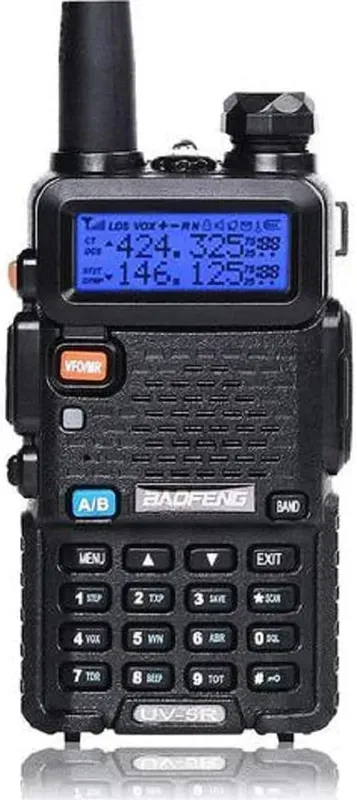
The UV-5R is the best-selling ham radio in history for a reason. At $17.16, it costs less than most GMRS handhelds. You get dual-band VHF/UHF, 5W output, CHIRP compatibility, and a radio that 10,158 Amazon reviewers have collectively rated 4.5 stars. The feature set is bare-bones (no GPS, no Bluetooth, no color display), but it receives and transmits exactly as well as it needs to.
Best for: Testing the waters. If you're not sure ham radio is for you, the UV-5R lets you find out for the cost of a fast food meal. Read our full Baofeng UV-5R legality guide to understand the FCC certification nuances.
Baofeng BF-5RH PRO: Best Value Upgrade
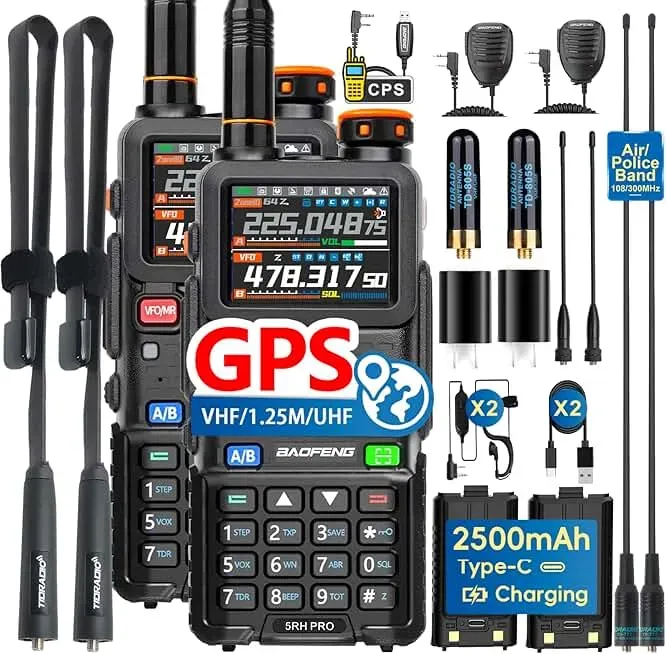
If you want more capability without leaving budget territory, the BF-5RH PRO at $71.69 is our highest-scoring beginner-friendly radio (overall: 86, beginner: 94). You get tri-band coverage (VHF, UHF, 1.25m), 10W output, IP54 weather resistance, CHIRP compatibility, and a 2,500 mAh battery. The 4.6-star Amazon rating across 286 reviews backs up the spec sheet.
Best for: Operators who know they're committed and want a radio that won't need upgrading for a while. The IP54 rating also makes it a good choice for outdoor use. See how it compares: BF-5RH PRO vs UV-5R.
Yaesu FT-65R: Japanese Quality Alternative
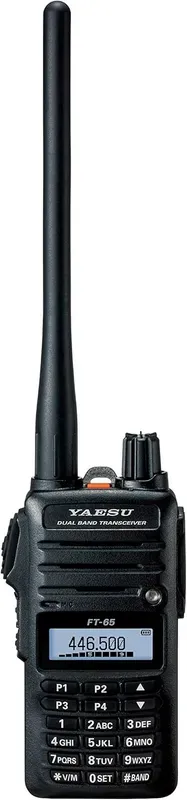
At $194.96, the FT-65R costs more than any Baofeng, but you're paying for Yaesu's build quality, audio clarity, and IP54 water resistance. The 4.6-star rating from 461 reviews reflects consistently positive experiences. It's a dual-band 5W handheld with CHIRP support and a reputation for outlasting budget radios by years.
Best for: Operators who plan to keep their first radio for a long time and value build quality over raw specs. If you've already decided ham radio is your thing, the FT-65R is a solid investment. Compare it directly: Baofeng UV-5R vs Yaesu FT-65R.
For more options, browse our best handheld ham radios or best radios for beginners.
Cost Breakdown: First Year
Here's what each path actually costs from zero to on-the-air, assuming you buy one handheld radio and the minimum accessories.
| Cost | GMRS | Ham (Technician) |
|---|---|---|
| License | $35 | ~$50 |
| Radio | $40-$80 (GMRS handheld) | $16-$70 (Baofeng UV-5R to BF-5RH PRO) |
| Antenna upgrade | $15-$30 (optional) | $15-$30 (optional) |
| Programming cable | Not needed | $8-$15 (for CHIRP) |
| Study materials | None | Free (HamStudy.org) |
| Total | $55-$145 | $39-$165 |
The floor is actually lower for ham radio thanks to $16 Baofengs. The ceiling is lower for GMRS because there's less to buy. In practice, most people starting either service spend $75 to $120 all-in for the first year.
What About CB Radio?
If you're also considering CB (Citizens Band), we cover that comparison in our Ham Radio vs CB Radio guide. The short version: CB requires no license and no fee, but the 27 MHz band is noisy, range is limited, and the community is smaller than it used to be. GMRS and ham are both better choices for most use cases in 2026.
And if you're not sure whether you even need a license, our FRS vs GMRS article explains the license-free FRS option that shares frequencies with GMRS.