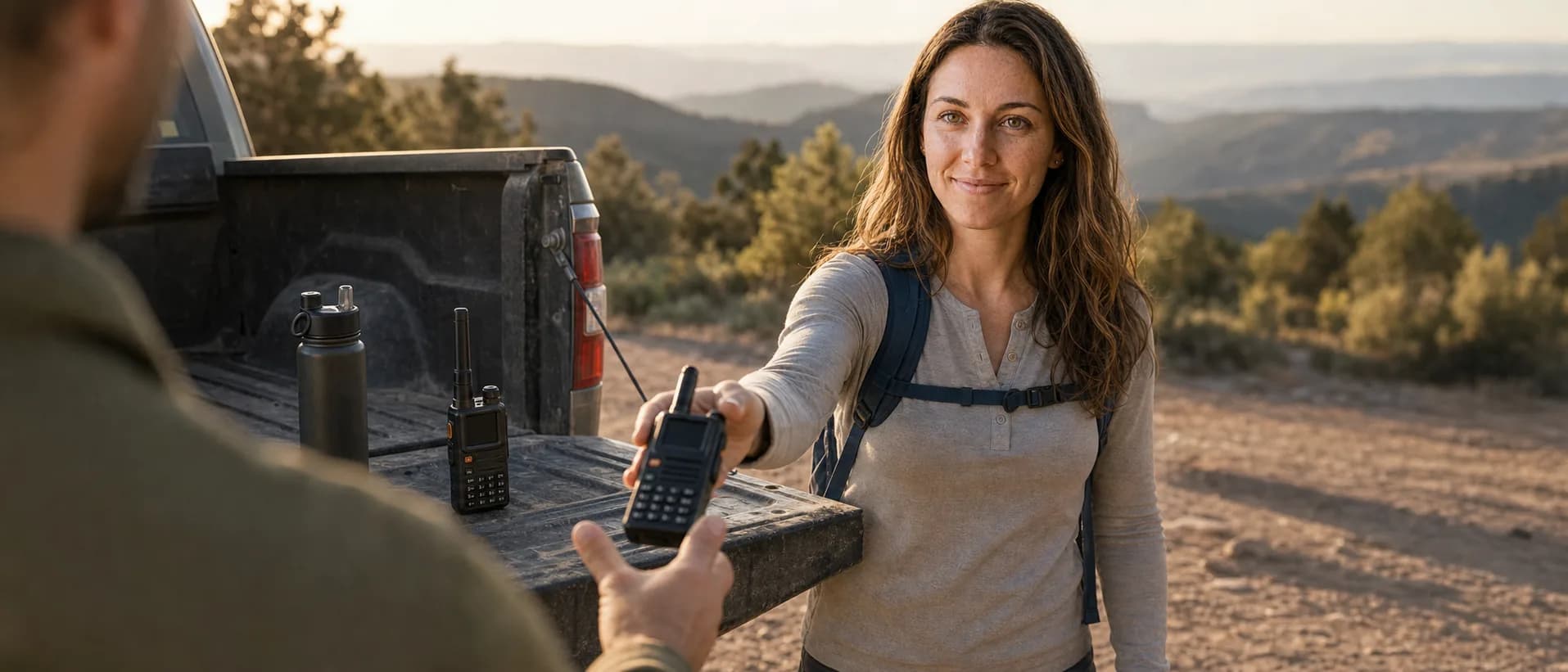

GMRS, the General Mobile Radio Service, is the FCC's radio service for families and small groups who want real two-way radio range without taking an exam. One $35 license covers your entire family for ten years, and it unlocks radios that legally run up to 50 watts, use real antennas, and reach through repeaters that cover entire counties. If FRS walkie-talkies are the bubble-pack toys and ham radio is the licensed hobby, GMRS is the practical middle: serious capability, minimal paperwork.
This guide explains what GMRS actually is, how its channels and power limits work, what the license requires, and how it compares to every other service you could put in your family's hands. If you already know you want one, our best GMRS radios and best GMRS mobile radios guides rank the certified options with live data.
GMRS in One Paragraph
GMRS is a licensed personal radio service on UHF frequencies between 462 and 467 MHz, defined by FCC Part 95 Subpart E. It shares 22 of its 30 channels with the license-free FRS service (the other 8 are repeater inputs), but a GMRS license raises the power ceiling from 2 watts to as much as 50, allows detachable and roof-mounted antennas, permits mobile and base stations, and opens the eight repeater channels that extend range from "across the campground" to "across the county." It has existed for decades; until 1987 it was literally called the Class A Citizens Band, and the FCC renamed it the General Mobile Radio Service.
The Channels: One Band, Two Services
Every GMRS radio in the US uses the same channel plan, which it shares with FRS. The overlap is why a $30 GMRS handheld can talk to the bubble-pack radios your cousins brought: same frequencies, different power privileges.
| Channels | Frequencies | FRS (no license) | GMRS (licensed) |
|---|---|---|---|
| 1-7 | 462 MHz interstitial | 2 W | 5 W |
| 8-14 | 467 MHz interstitial | 0.5 W | 0.5 W, handheld only |
| 15-22 | 462 MHz main | 2 W | Up to 50 W |
| Repeater inputs (8) | 467 MHz main | Not allowed | Up to 50 W |
Two practical takeaways. First, channels 15 to 22 are where GMRS earns its keep: 50 watts from a mobile or base station versus 2 from an FRS handheld. Second, the eight 467 MHz main channels exist only as repeater inputs, which is the subject of our GMRS repeaters explainer; FRS radios cannot use repeaters at all.
Counting the 462 mains, the interstitials, and the repeater inputs, the service spans 30 frequencies between 462 and 467 MHz. You never need to memorize them; certified radios ship with the channel plan locked in, which is exactly the point of a channelized service.
The License: No Exam, Whole Family
The GMRS license is the easiest license in American radio. There is no test and no study material; you file online with the FCC, pay $35, and receive a call sign, usually within a couple of business days. It is valid for ten years, renewal costs the same $35, and under FCC rule 95.1705 it covers your immediate family: spouse, children, grandchildren, stepchildren, parents, grandparents, stepparents, siblings, aunts, uncles, nieces, nephews, and in-laws. They do not even need to live in your household. Everyone shares your call sign and tells stations apart with unit numbers.
The rules that matter day to day are few: identify with your call sign at the end of a conversation and every 15 minutes during one, keep transmissions personal rather than commercial (no advertising, no business dispatch), and use equipment certified for the service. Our step-by-step license guide walks the FCC's two-system website, the full cost breakdown, and the privacy note about your address in the public license database.
The requirement people trip over: the license is required to transmit at GMRS power levels at all. Since the FCC's 2017 rules, any "walkie-talkie" with a detachable antenna or more than 2 watts is a GMRS radio, and using one without a license is a violation even if it came from a big-box store.
The Radios: Certified and Channel-Locked
Legal GMRS equipment carries an FCC Part 95E certification, which you can verify yourself: every grant is public, and our FCC ID lookup tool reads the registry directly. We track the certification status of every radio in our GMRS catalog, and all fourteen currently hold verified Part 95E grants.
The certification comes with a design constraint that beginners should actually welcome: GMRS radios are channel-locked appliances. You pick channel numbers; you do not type in frequencies. That is the practical difference from ham equipment, where the radio is wide open and the operator is responsible for staying legal. It is why you can hand a GMRS radio to a twelve-year-old (legally covered under your family license) without a briefing on band plans.
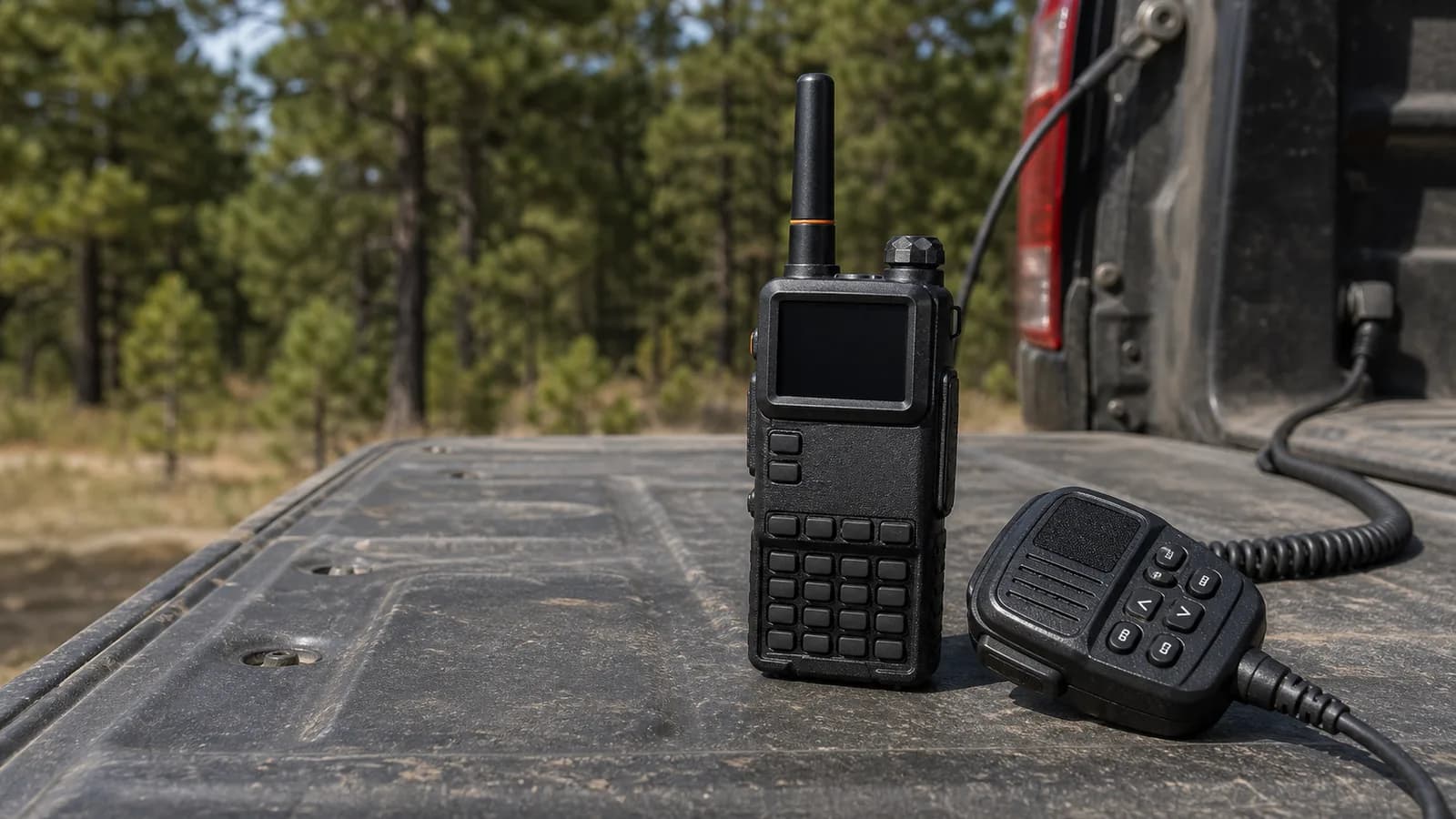
What does the hardware look like? Three tiers. Handhelds from $30 to $200, like the Baofeng UV-5G Plus (the budget default) or the Rocky Talkie 5 Watt (the rugged-outdoors pick). Mobile radios from $85 to $440 that mount in a vehicle and use a roof antenna, like the Midland MXT275; the antenna alone typically doubles real-world range. And base stations and repeaters for fixed installations. Our handheld and mobile roundups cover the field, and the Midland brand guide decodes the biggest brand's lineup. If you just want the ranked shortlist, our handheld picks rank the certified handhelds by transmit power and owner ratings, and our rugged picks list only the ones with a published IP67 rating.
What Range Can You Actually Expect?
Manufacturers print numbers like "36-mile range" on packaging. Treat those as fiction. UHF radio is line-of-sight, and real range is set by terrain, antenna height, and obstructions far more than by wattage.
Honest expectations, drawn from the same real-world reports the radio community gives beginners: handheld to handheld in forests or neighborhoods, expect a half mile to two miles. Handheld to a vehicle with a roof-mounted antenna, several miles. Mobile to mobile on open terrain, five to ten miles. With true line of sight, distances get dramatic (operators have logged 25+ mile handheld contacts from mountaintops on less than a watt), which is the clue to the real physics: height beats power, every time.
Repeaters are how GMRS escapes those limits. A repeater on a hill or tower rebroadcasts your signal at up to 50 watts from its high vantage point, and a single well-placed machine can cover a metro area or a whole valley, extending handheld range to 20 miles or more. The repeater explainer covers how they work and how to find one near you.
GMRS vs Everything Else
The question behind "what is GMRS" is usually "which service should my group use?" Here is the honest one-row-each version.
| Service | License | Power | Best for |
|---|---|---|---|
| FRS | None | 2 W max, fixed antenna | Kids, casual campground use |
| GMRS | $35, no exam, covers family | Up to 50 W, real antennas, repeaters | Families and groups wanting real range |
| MURS | None | 2 W, VHF (5 channels) | Niche; farm and property use |
| CB | None | 4 W AM or FM (12 W PEP SSB) | Highway truckers; noisy and fading (vs GMRS) |
| Ham | $35 + exam, per person | 1,500 W ceiling, all modes | The technical hobby |
The deeper comparisons live in their own guides: FRS vs GMRS for the family-radio decision, and GMRS vs ham for the licensing crossroads. The short version we give beginners: if the goal is putting working radios in the hands of a group of non-hobbyists this weekend, GMRS is almost always the right answer, because one license covers everyone and the radios are appliances. If the goal is radio as a hobby, get the ham ticket; it opens vastly more spectrum but licenses only you.
Who Actually Uses GMRS
The service's center of gravity is groups that need coordination: overlanding and off-road convoys (where GMRS has largely displaced CB), families at campgrounds and ski hills, farms and rural properties, neighborhood emergency-preparedness networks, and hunting parties. The common thread is that GMRS solves the "everyone needs to hear everyone" problem with cheap hardware, no exams, and enough legal power to actually work.
The Bottom Line
GMRS is the FCC's best deal for practical group communication: $35, no test, ten years, the whole family, and hardware that ranges from $30 handhelds to 50-watt mobiles with county-wide repeater reach. Start with the license (it is genuinely a fifteen-minute errand), then pick hardware from the certified GMRS radios we track, every one of them registry-verified.