

A GMRS license costs $35, requires no test, lasts 10 years, and covers your entire immediate family. The catch is that you apply through the FCC's website, which splits the process across two separate systems with two separate logins. The only real test is surviving that website, and this guide is the cheat sheet.
| GMRS license quick facts | |
|---|---|
| Fee | $35, one time |
| Term | 10 years |
| Exam | None |
| Covers | You plus your immediate family |
| Application | FCC Form 605, filed online through ULS |
| Call sign arrives | Typically 1 to 3 business days, by email |
| Time investment | About 30 minutes |
One note on the fee, because old forum posts still cause confusion: the FCC dropped it from $70 to $35 in April 2022. If a page quotes $70 or $85, it is out of date, and you should question everything else it says too.
Do You Actually Need a GMRS License?
If you want to transmit on GMRS channels at GMRS power levels, yes. GMRS (General Mobile Radio Service) gives you up to 50 watts, repeater access, and real range; the FCC requires a license for all of it.
The exception is FRS (Family Radio Service). FRS radios, the fixed-antenna walkie-talkies limited to 2 watts or less, require no license at all. If your radios came in a blister pack and the antennas do not detach, you are probably fine without one. Our FRS vs GMRS guide walks the line in detail.
The wrinkle: before 2017, manufacturers sold combo "FRS/GMRS" radios, and lots of people used them unlicensed. The FCC's 2017 reorganization ended that. Radios above 2 watts or with detachable antennas are now classified as GMRS, and transmitting on them requires the license. If you own a Midland GXT-series or similar 5-watt "walkie-talkie," that is a GMRS radio.
What happens if you skip it? FCC enforcement is complaint-driven, and the agency is not staking out campgrounds. But civil fines are legally on the table, and at $35 for 10 years, the license costs $3.50 a year for your whole family. It is the cheapest legal certainty in radio; just get it.
What You'll Need Before You Start
Gather these before you open the FCC website:
- Your Social Security Number (or Taxpayer Identification Number). The FCC requires it to issue an FRN.
- A permanent personal email address. Not a work or school address; your license correspondence goes here for 10 years.
- A credit or debit card for the $35 fee.
- About 30 minutes, ideally on a computer rather than a phone. The FCC's forms behave badly on mobile browsers.
Eligibility is simple: you must be 18 or older and not a representative of a foreign government. GMRS licenses go to individuals, not businesses; your kids do not need to be 18 because they operate under your license.
And here is the trap nobody warns you about: you are about to create two different logins. A CORES account (email address plus password) and an FRN (a 10-digit number plus its own password). The application happens in one system, the payment in the other. Keep both sets of credentials written down; you will need each of them within the next half hour.
Step 1: Create a CORES Account and Get Your FRN
CORES is the FCC's registration system, and the current version lives at apps.fcc.gov/cores. Some older guides link the legacy CORES site, which the FCC retired in 2022; if the page you land on looks like it predates smartphones but does not ask you to create a username, you are in the wrong place.
- Go to the CORES login page and click Register to create a new account.
- Enter your email and set a password, then check your inbox and click the verification link.
- Log back in to CORES with your new account.
- Choose Register New FRN and select that you are an individual, not a business.
- Fill in your name, address, and SSN or TIN, then submit.
Your FRN (FCC Registration Number) is issued immediately on screen. Write it down along with the password you set for it. This 10-digit number is your identity for everything that follows, including the license application and the payment.

Step 2: Apply in the ULS License Manager
The application itself happens in a different FCC system, the Universal Licensing System (ULS). These steps match the FCC's own official instructions, with the GMRS specifics filled in:
- Log in to the ULS License Manager using your FRN and its password (not your CORES email).
- On the left side of the screen, click Apply for a New License.
- From the radio service drop-down, select ZA - General Mobile Radio Service (GMRS).
- Click Continue and work through the application questions. For a typical individual applicant, the honest answers to the certification questions are all straightforward; there is nothing technical here.
- Review the Summary page, then choose Continue to Certify.
- Sign the application by typing your first and last name in the signature fields. Typing your name is the legal signature; there is no printing or scanning.
- Click Submit Application.
That is FCC Form 605, filed. ULS will calculate your fee ($35) and show you a payment option immediately. You can pay right from the confirmation flow, but if you get bounced, redirected, or logged out, which happens, do not panic. The payment lives in CORES, and you can get to it directly.
Step 3: Pay the Fee
Payment happens back in the first system, CORES, not in ULS. This is the step where most people get lost.
- Log in to CORES with your email and password (not the FRN this time).
- Choose Manage Existing FRNs and FRN Financial and select your FRN.
- Click View/Make Payments.
- Your $35 GMRS application fee will be listed. Click Make Payment and pay by card.
You have 10 calendar days from filing to pay, and the FCC dismisses unpaid applications after that. Do not test the deadline; pay while you have both logins fresh.
If you made it here, congratulations, you passed the only test GMRS has.
Step 4: Get Your Call Sign
The FCC typically grants GMRS applications in 1 to 3 business days, and your call sign arrives by email. You can also check status anytime by logging back into the ULS License Manager and looking at your application.
To get the official license document, log in to ULS and use Download Electronic Authorizations to save the PDF. That PDF is the license; the FCC stopped mailing paper copies back in 2015 (public notice DA 15-72). Any guide promising a printed license in your mailbox is a decade out of date.
Two caveats on timing. First, applications filed on weekends or federal holidays take an extra business day or two to appear in the system. Second, government shutdowns halt FCC licensing entirely; if Washington is in a budget standoff, your application waits until it ends.
If something goes sideways, the FCC Licensing Support Center is reachable at (877) 480-3201, Monday through Friday, 8am to 6pm Eastern. They are genuinely helpful with stuck applications and forgotten FRN passwords.
GMRS License Cost: The Full Breakdown
Search results still disagree about this number, so here is the current FCC fee schedule (per the commission's fee filing guide, last updated May 2025):
| Item | Cost |
|---|---|
| New GMRS license (10-year term) | $35 |
| Renewal (another 10 years) | $35 |
| License modification (name or address) | $0 |
| Exams, study materials, testing fees | None |
| Annual or recurring fees | None |
That is the entire cost structure. One $35 payment covers the full 10-year term, which works out to $3.50 a year, and because the license covers your whole immediate family under one call sign, a family of five is paying 70 cents per person per year. The fee was $70 until April 2022, when the FCC halved it; any page quoting $70 (or the even older $85) is out of date.
Two cost comparisons worth knowing before you pay. If everyone in your group is happy with 2-watt bubble-pack radios, FRS is free and needs no license at all; the $35 buys you higher power, detachable antennas, and repeater access. And if you are choosing between this and an amateur license, ham costs the same $35 per person plus an exam, and it never covers your family.
One privacy note that almost nobody mentions: your license record in the FCC's ULS database is public, and anyone can look up your name and address from your call sign. If that bothers you, use a P.O. box or business address when you create your FRN in Step 1; changing it later is free.
Who Your License Covers
This is the best part of GMRS. Under FCC rule 95.1705, your license covers your immediate family: your spouse, children, grandchildren, stepchildren, parents, grandparents, stepparents, brothers, sisters, aunts, uncles, nieces, nephews, and in-laws.
Everyone operates under your single call sign. The convention for telling stations apart is unit numbers: you are Unit 1, your spouse is Unit 2, your kid on the far side of the campground is Unit 3. No extra fees, no per-person paperwork, no age minimums for family members.
The one thing your license does not cover is business use. GMRS is for personal and family communications; companies cannot license it (a small number of pre-1987 grandfathered business licenses still exist, but no new ones).
The Rules That Actually Matter
GMRS is governed by Part 95, Subpart E of the FCC rules. That exact citation matters more than it should: GMRS moved to Subpart E in the FCC's 2017 reorganization, and some widely read guides still cite the old Subpart A. Here is the short version of what Subpart E asks of you:
- Identify with your call sign at the end of a conversation and every 15 minutes during one. Saying it once when you wrap up a family net is not a burden.
- No prohibited traffic: no music, no advertising, no false or deceptive messages, and no coded messages intended to hide their meaning. Plain-language brevity codes like 10-4 are fine because everyone knows what they mean.
- Make your station available for inspection if the FCC ever asks. In practice this never comes up for family users, but it is part of the deal.
That is really it. There is no logging requirement and no technical exam material. GMRS is designed to be usable by your entire family without anyone studying anything.
Is Your Radio Actually GMRS-Legal? (Part 95E Certification)
Here is the part almost every licensing guide skips: the license covers you, not your radio. To be legal on GMRS, the radio itself must hold an FCC equipment authorization under Part 95E. That certification is printed into the radio's FCC ID grant, and you can verify any radio by finding the FCC ID on its label and running it through the FCC's equipment authorization search.
This is where a lot of new GMRS licensees get an unpleasant surprise. We track FCC equipment authorization data (FCC ID, grant status, and rule parts) for all 79 handheld radios in our database, and among the 50 with granted equipment authorizations on file, not a single one holds a Part 95E grant. These are ham radios, certified for other services.
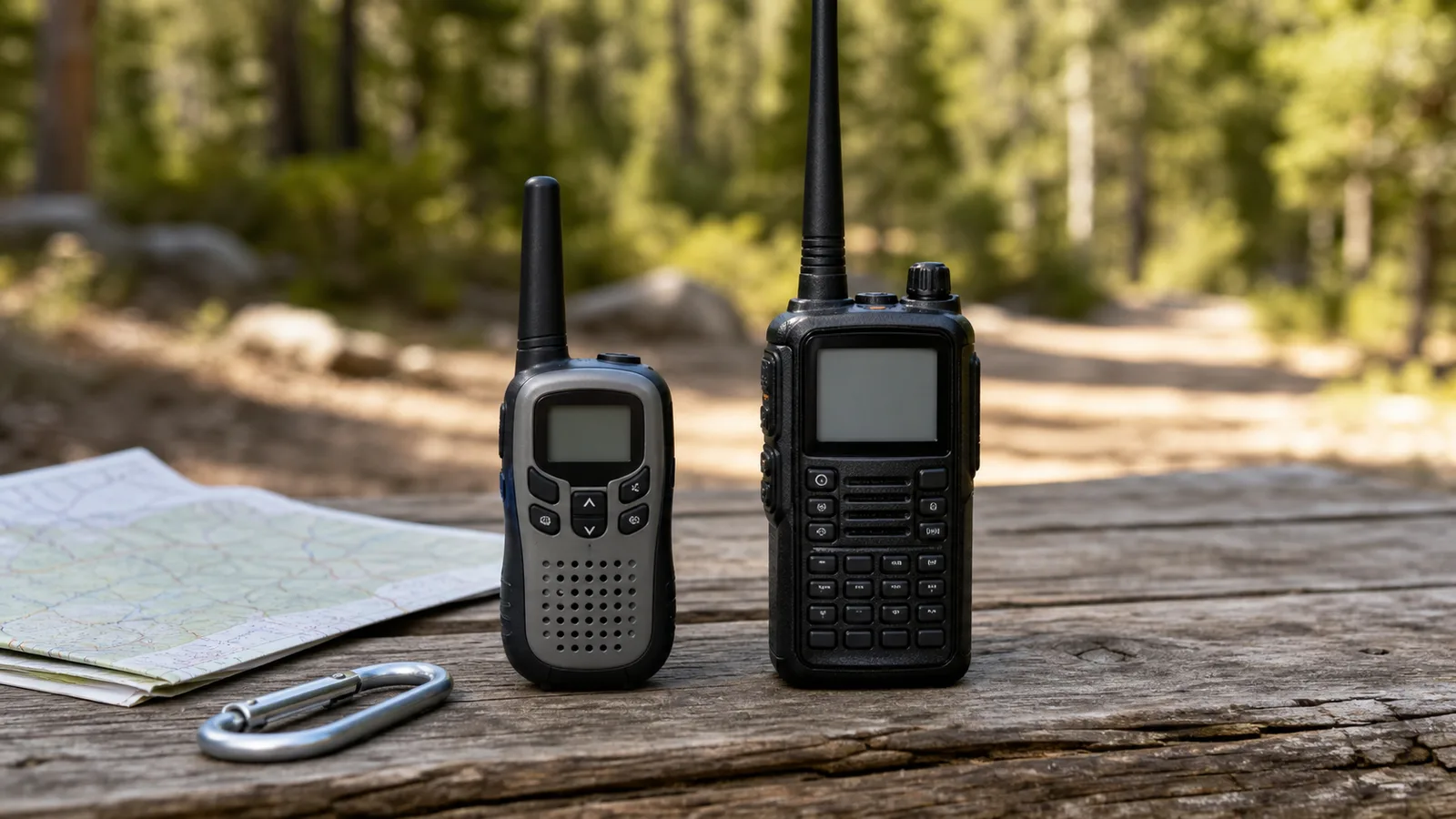
The Baofeng UV-5R is the classic example. It can be programmed to transmit on GMRS frequencies, and thousands of people do exactly that, but its equipment authorization (FCC ID 2AJGM-UV5R) is not a Part 95E grant, so it is not legal to transmit on GMRS even if you hold a GMRS license. The same goes for essentially every popular ham handheld. We cover the UV-5R's legal status in depth in Is the Baofeng UV-5R legal?
If you want a legal GMRS setup, buy a radio sold specifically as a GMRS radio; Wouxun, Midland, Radioddity, Baofeng, and Rocky Talkie all sell Part 95E certified handhelds, and the label or manual will state the certification. Budget-wise, getting on the air legally is cheap: $35 for the license plus roughly $30 to $80 per certified handheld, so a family of four can be fully set up for under $200. Do not own a radio yet? Our ranked handheld GMRS picks rank the certified handhelds by transmit power and owner ratings.
These two are the cheapest certified handhelds we track, and both carry a Part 95E grant we have verified against the FCC register rather than taken from the listing:
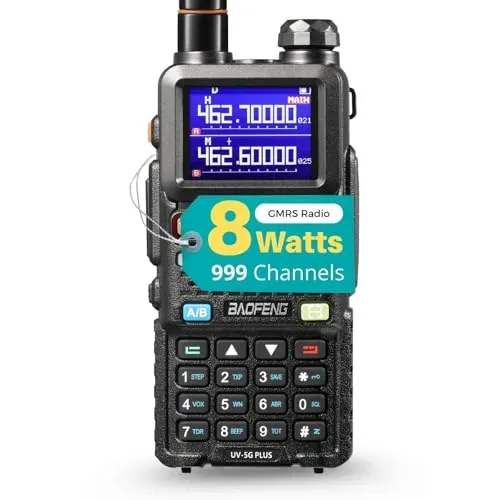
$32.99 · 5.00W
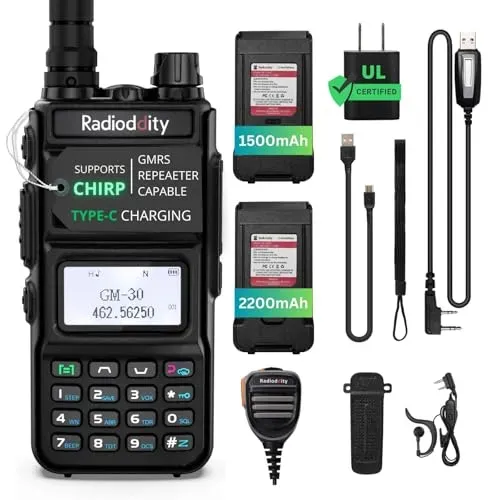
$42.99 · 5.00W · VHF/UHF
The GM-30 costs a little more and has by far the largest review sample in the category, which is the main reason to pick it over the cheaper Baofeng. Neither is rugged; if the radios are going hiking or into a work truck, the IP67-rated options and the full field are in our best GMRS radios guide, which covers the ham-radio gray area honestly. If the radio is going into a vehicle, the best GMRS mobile radios roundup covers the 15 to 50 watt options the same way.
Renewing Your GMRS License
Your license runs 10 years, and you can renew it in ULS within 90 days before it expires. Renewal costs $35 again; there is no discount and still no test.
Do not let it lapse. An expired GMRS license cannot be renewed; you have to file a brand-new application, and you may not get your old call sign back. Set a calendar reminder for nine and a half years from now, seriously.
GMRS License vs Ham License
If you are choosing between the two, the honest framing from operators who hold both: amateur radio is a hobby, GMRS is a tool.
| GMRS | Ham (Technician) | |
|---|---|---|
| Exam | None | 35-question test |
| Cost | $35 total | $35 FCC fee + ~$15 exam, per person |
| Covers | Whole immediate family | Individual only |
| Max power | 50 watts | 1,500 watts |
| Best for | Family, convoy, campground | Experimentation, range, community |
GMRS gets your family talking this weekend. Ham radio gets you repeater networks across every band, digital modes, and a lifetime hobby, but every operator needs their own license and their own exam. Many hams hold both licenses for exactly this reason: ham for themselves, GMRS for the household.
The full breakdown is in our GMRS vs ham radio comparison, and if the exam does not scare you, our ham radio license guide covers that path end to end.