
A GMRS handheld talking to another handheld manages a mile or two in real terrain. The same handheld talking through a well-placed repeater covers a county. Repeaters are the single biggest range upgrade in GMRS, they are free to use once you are licensed and welcomed by the owner, and yet the pages that rank for this topic mostly want to sell you hardware without explaining how any of it works.
This is the explainer we wished existed: the actual frequencies, the offset, the tones, how to find repeaters near you, and which of the radios we track can actually use them.
What a Repeater Is
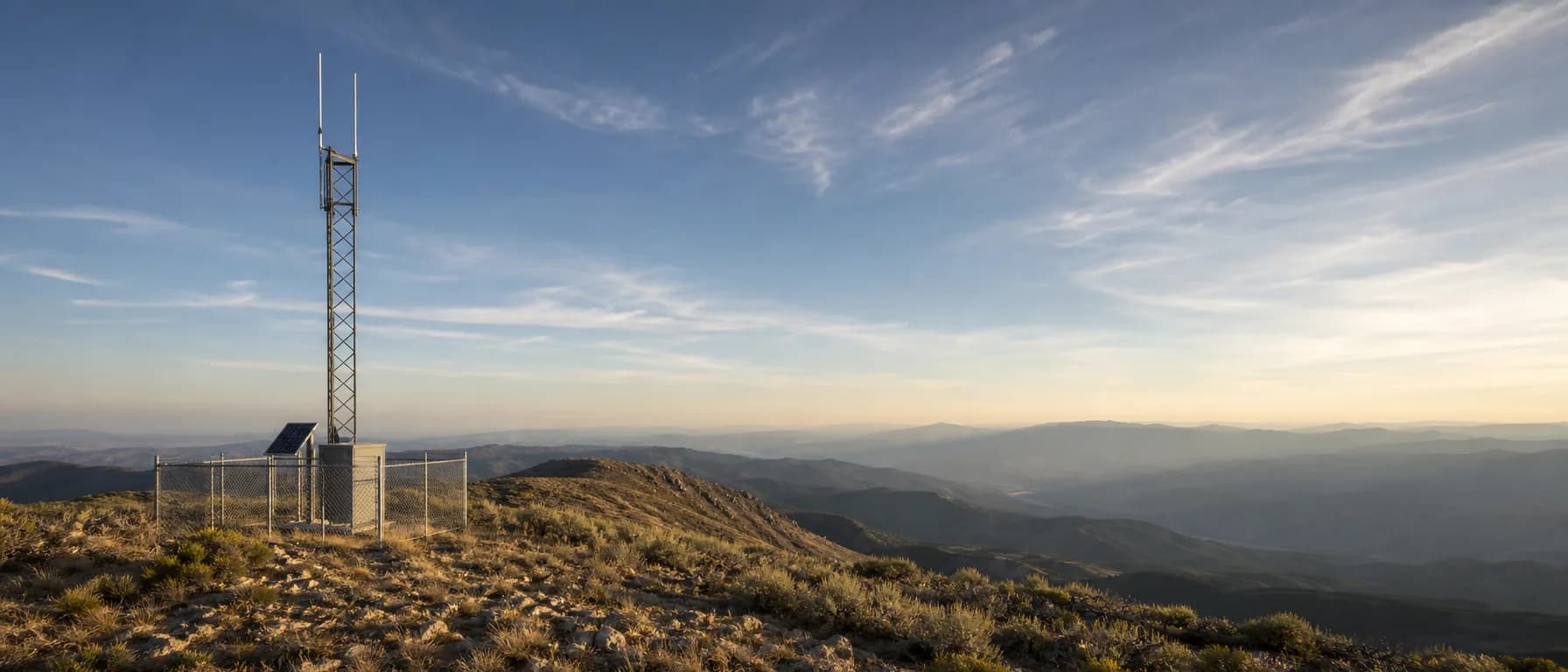
A repeater is a radio station, usually on a hilltop, tower, or tall building, that listens on one frequency and simultaneously rebroadcasts what it hears on another, at up to the GMRS maximum of 50 watts. Because it sits high with a good antenna, it has line of sight to places your handheld never will. Two radios that cannot hear each other directly can both hear the repeater, so the conversation flows through it.
That is the whole trick. Radio at these frequencies is line-of-sight, and the repeater's job is to be the one station with a view of everyone. Height is why a repeater transforms range: the same 5-watt handheld that struggles past two miles on its own can work a repeater 20 miles away if the repeater can see both ends.
The Frequencies: Eight Pairs and a +5 MHz Offset
GMRS reserves eight channel pairs for repeater use, and the arithmetic is the same for every one of them: your radio transmits on a 467 MHz input, and the repeater retransmits on the matching 462 MHz output, exactly 5 MHz lower. Your radio listens on the 462 side, which is the same frequency as regular channels 15 through 22.
| Repeater channel | Your radio transmits (input) | You listen (output) |
|---|---|---|
| RPT15 (550) | 467.550 MHz | 462.550 MHz |
| RPT16 (575) | 467.575 MHz | 462.575 MHz |
| RPT17 (600) | 467.600 MHz | 462.600 MHz |
| RPT18 (625) | 467.625 MHz | 462.625 MHz |
| RPT19 (650) | 467.650 MHz | 462.650 MHz |
| RPT20 (675) | 467.675 MHz | 462.675 MHz |
| RPT21 (700) | 467.700 MHz | 462.700 MHz |
| RPT22 (725) | 467.725 MHz | 462.725 MHz |
You will see these labeled RPT15 to RPT22 on some radios and by their kilohertz endings (550, 600, "the 700 machine") in repeater directories; both refer to the same eight pairs. On a repeater-capable radio you simply select the repeater channel and the +5 MHz transmit offset is handled for you; that is what the "8 repeater channels" line on a spec sheet means. These are registry-level facts: the FCC grants for 50-watt GMRS mobiles we track explicitly certify the 462.550-462.725 outputs and 467.550-467.725 inputs.
Tones: The Key That Opens the Repeater
Almost every repeater requires a tone, a low-frequency CTCSS tone or a DCS code transmitted underneath your voice, before it will rebroadcast you. Tones exist so a repeater does not retransmit every stray signal on the frequency; they are an access key, not encryption. Anyone with a scanner can still hear you, which is why the GMRS community keeps repeating that "privacy codes" offer no privacy.
Two configurations matter when you program a repeater channel. Standard setups use the same tone on input and output. Some machines instead use split tones, a different tone on the input than the output, and this is where budget radios divide: many entry-level GMRS radios can only set one tone for both directions, so they work on standard repeaters but cannot access split-tone machines. The repeater's directory listing tells you which tones it wants.
Real-World Range Through a Repeater
The honest numbers, from the same community experience we cited in the range section of our GMRS explainer: a repeater on a modest 33-foot home mast reaches handhelds about 10 miles out and mobiles about 20. A machine on a genuine hilltop or commercial tower covers far more; a single repeater can serve an area 20+ miles across, and the limiting factor is almost always whether the repeater can see you, not your wattage. One operator's demonstration says it all: 28 miles handheld-to-handheld on half a watt, because a mountaintop gave him line of sight. Altitude beats power. A repeater is how you rent altitude.
Finding Repeaters Near You
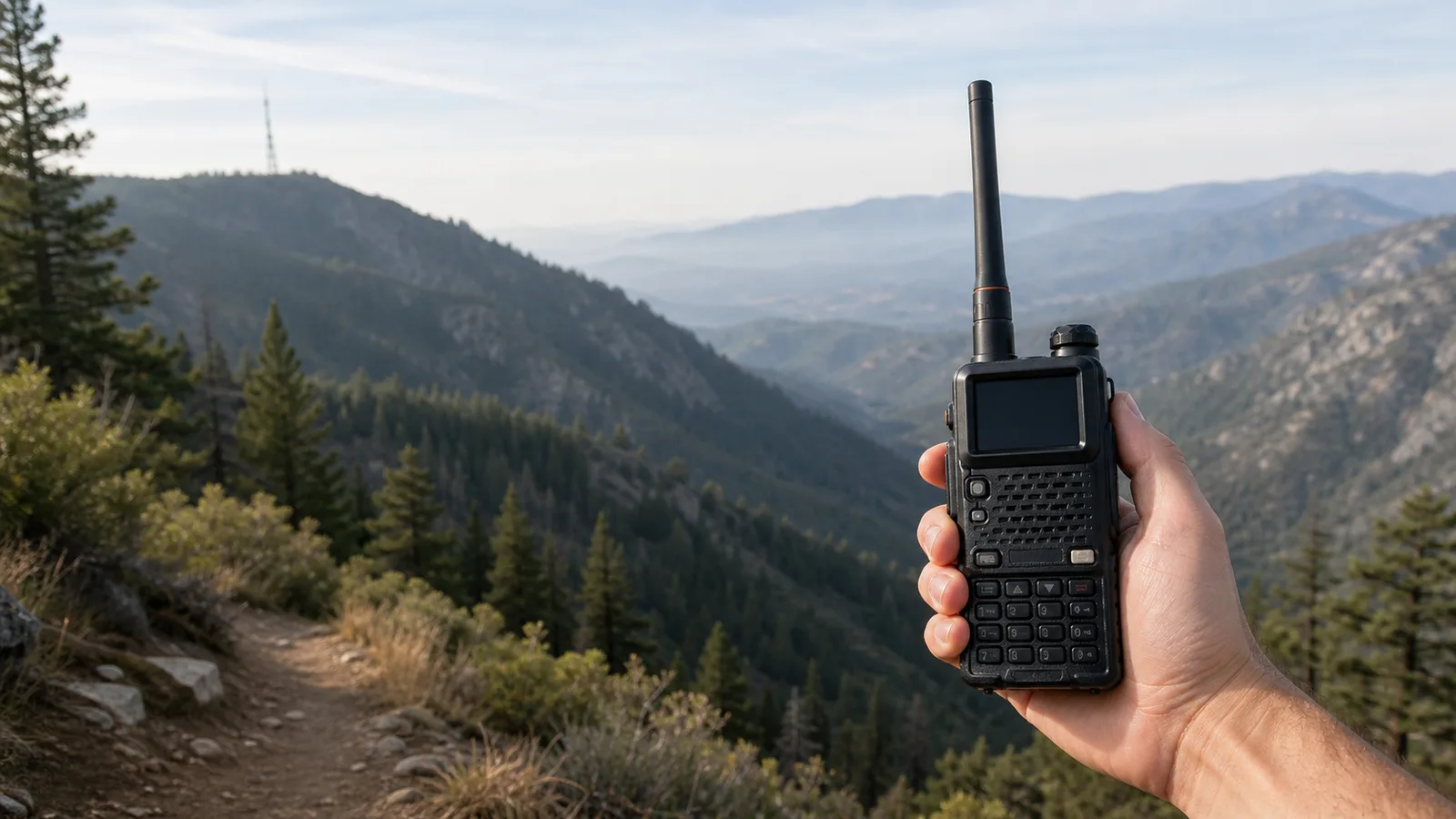
The community's directory is myGMRS.com, the established hub where owners list their machines with frequencies, tones, coverage notes, and access policies; a free account lets you search by location and request access. RepeaterBook also maintains a GMRS section. Between them you will find whether your area has an open machine, a permission-required club repeater, or nothing yet.
The etiquette matters more in GMRS than in ham radio: many GMRS repeaters are privately owned, built and maintained at the owner's expense, and listed as permission-required. Request access before you key up (directory listings include how), identify with your call sign as the rules require, and remember every user of a repeater must hold their own GMRS license; your family license covers your family, not your friends.
Which Radios Actually Support Repeaters
Spec sheets bury this, so here is the honest capability map for the GMRS radios we track, based on our catalog data and the community consensus from our GMRS mobile roundup:
| Radio | Repeater channels | Split tones |
|---|---|---|
| Midland MXT105 | None (simplex only) | No |
| Midland MXT115 / MXT275 | 8 | Yes, on the revised version with a USB-C port |
| Midland MXT115P | 8 | Yes |
| Midland MXT500 / MXT575 | 8 | Yes |
| Radioddity DB20-G / DB35-G | Yes | Yes |
| Wouxun KG-1000G | Yes, most flexible | Yes |
| Baofeng UV-5G Plus | 8, pre-programmed | Yes |
The pattern to notice: if repeaters are central to how you will use GMRS, the cheap seats in a lineup often cannot follow you there. The classic example is a used Midland MXT115 or MXT275 without the USB-C device-charging port (Midland's split-tone guide tells the versions apart that way): perfectly good radios whose standard-tone channels cover most public machines but not the split-tone configurations some networks run; the Midland brand guide covers that line in detail. Check your local repeater's listed tones first, then buy the radio that can match them.
Running Your Own Repeater
You do not need anything beyond your existing GMRS license to put up a repeater; the FCC allows any licensee to operate one on the eight pairs, subject to the usual equipment-certification and antenna rules. The realistic paths, in ascending order of commitment: a portable "repeater in a box" (the Retevis RT97-class machines around $340 to $400 that the community recommends for family and neighborhood coverage), a purpose-built home unit like Midland's MXR10 ($769.99), or commercial-grade builds from used equipment. The classic first-timer trap, straight from the builders' threads: the duplexer (the filter that lets one antenna listen and transmit simultaneously) must be precisely tuned, and even a factory-tuned one should be checked after shipping.
For most people the honest advice is: join an existing machine first. A well-sited community repeater will outperform anything you can mount on your roof.
The Bottom Line
Repeaters are GMRS's superpower, and they run on arithmetic anyone can learn in a minute: transmit on 467, listen on 462, 5 MHz apart, with a tone as the key. Get licensed, find your local machine on myGMRS, and make sure the radio you buy can actually follow you onto it; the capability table above is the checklist.