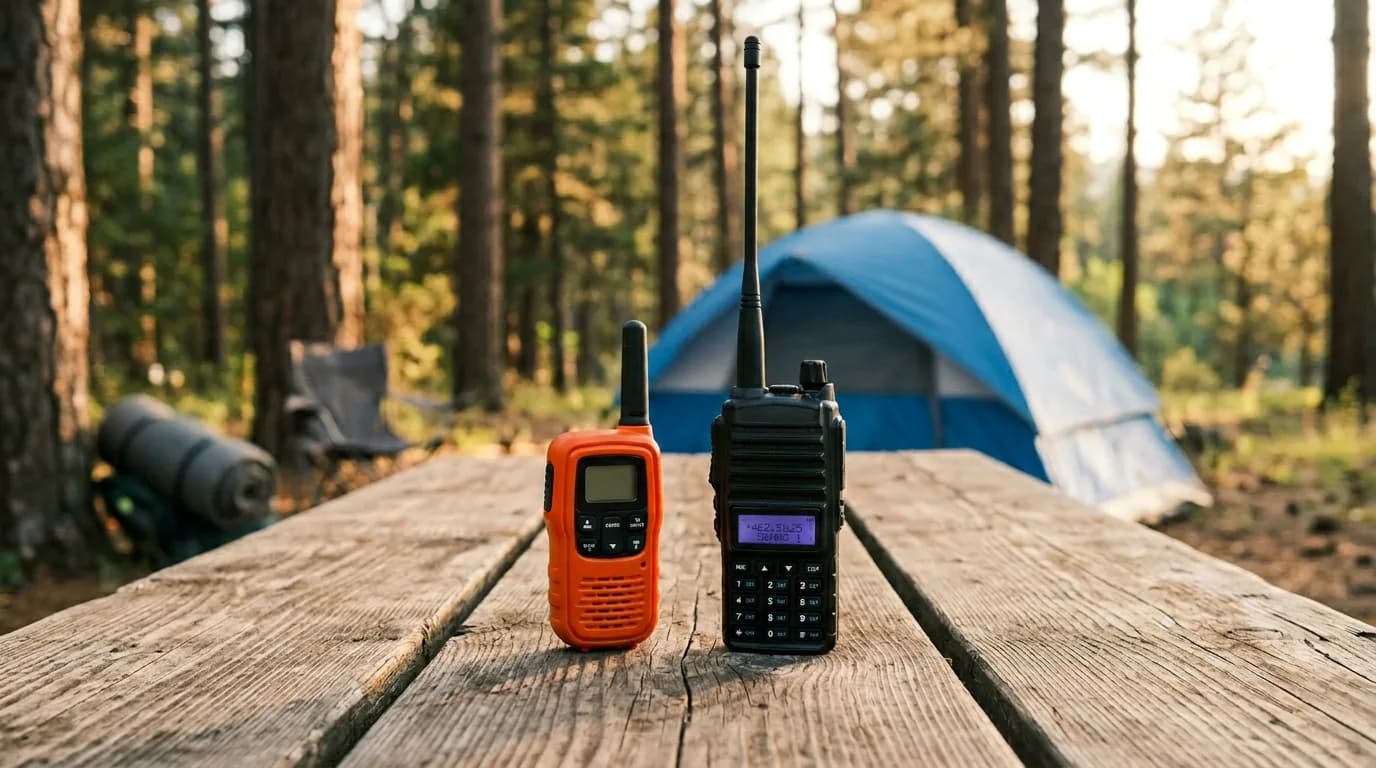

Quick answer: FRS (Family Radio Service) is license-free with up to 2 watts of power, fixed antennas, and 1 to 2 miles of typical range. GMRS (General Mobile Radio Service) requires a $35 FCC license that covers your entire family for 10 years, allows up to 50 watts of power, removable antennas, and repeater access for 5 to 25 miles of range. Both services share 22 channels and can talk to each other. Pick FRS for casual hikes; GMRS when you actually need range.
If you've ever stood in the walkie-talkie aisle trying to figure out why some radios cost $25 and others cost $150, the answer usually comes down to three letters: FRS or GMRS. Both use the same chunk of UHF spectrum around 462 MHz. Both work right out of the box for short-range communication. But they differ sharply in power limits, licensing requirements, and how far they'll actually reach when you need them.
Here's the short version: FRS (Family Radio Service) is license-free, limited to 2 watts, and realistically covers 1 to 2 miles. GMRS (General Mobile Radio Service) requires a $35 FCC license, allows up to 50 watts, and can reach 20+ miles through repeaters. Which one you need depends on how far apart you'll be and how much you care about reliability.
Quick Comparison
| FRS | GMRS | |
|---|---|---|
| License | None required | $35 for 10 years, no exam |
| Who's covered | Anyone | Your entire immediate family |
| Max power (handheld) | 2W | 5W |
| Max power (mobile/base) | N/A | 50W |
| Channels | 22 | 30 (22 shared + 8 repeater) |
| Repeater access | No | Yes |
| Typical range | 0.5 to 2 miles | 2 to 5 miles (20+ with repeaters) |
| Radio cost | $20 to $60 per pair | $30 to $200 per radio |
| Best for | Day trips, theme parks, short hikes | Camping, off-road, emergency prep |
If you only came here for one number, this is probably it: the power limit per channel range, which is what actually determines range on any given channel.
| Channels | FRS limit | GMRS limit | Notes |
|---|---|---|---|
| 1-7 | 2W | 5W | Shared meeting channels; a GMRS mobile or base station is capped at 5W here too, same as a handheld |
| 8-14 | 0.5W | 0.5W, handheld only | Narrowband interstitials for both services; GMRS mobile radios can't even access these channels |
| 15-22 | 2W | 50W | GMRS main channels; only here do mobiles, base stations, and repeaters reach the full 50W ceiling |

What Is FRS (Family Radio Service)?
FRS is the "buy it, open it, use it" radio service. The FCC created it in 1996 specifically for families and casual users who wanted simple two-way communication without paperwork. No license, no registration, no callsign. You charge the batteries, pick a channel, and talk.
How FRS works
FRS radios share 22 channels in the 462/467 MHz UHF band. Every FRS radio sold in the US uses the same frequencies, which means any FRS radio can talk to any other FRS radio on the same channel. That simplicity is the whole point.
The FCC caps FRS power at 2 watts on channels 1 through 7 and 15 through 22. Channels 8 through 14 are limited to 0.5 watts. There's no way around these limits; FRS radios are manufactured with fixed antennas that can't be swapped for something better.
Real-world FRS range
Ignore the "35-mile range" claims on the packaging. In practice, FRS radios reach about 0.5 to 2 miles depending on terrain. In flat, open desert with clear line of sight, you might push 3 miles. In a forest, a building, or a hilly neighborhood, expect closer to half a mile.
The physics aren't complicated: 2 watts at UHF frequencies don't penetrate obstacles well, and without a removable antenna, you can't improve the signal. FRS works great when your group is spread across a campsite or a theme park. It struggles once you're separated by hills, dense trees, or more than a mile of distance.
Who should use FRS
FRS is ideal when you want zero friction. Family day trips, kids playing in the neighborhood, coordinating at a festival or ski resort, warehouse or event staff communication. If your use case is "we need to talk within a mile for a few hours," FRS handles it fine. The radios are cheap ($20 to $30 per pair), disposable enough to hand to kids, and require no setup beyond picking a channel and a privacy code.
FRS limitations
The fixed antenna is the biggest constraint. You can't improve range with a better antenna or external mount. You can't connect to repeaters. And because FRS channels are shared with GMRS users (who may be running higher power), you'll occasionally get stepped on in crowded areas like national parks or ski resorts.
What Is GMRS (General Mobile Radio Service)?
GMRS is the next step up from FRS. It uses many of the same frequencies but allows significantly more power, removable antennas, mobile and base station setups, and access to repeater networks. The tradeoff is a license, though it's one of the easiest radio licenses to get. For the complete picture beyond this head-to-head, see our What Is GMRS? guide.
The GMRS license
A GMRS license costs $35 from the FCC and lasts 10 years. There's no exam. You fill out an online application on the FCC Universal Licensing System, pay the fee, and receive your callsign within a few days. One license covers you and your entire immediate family (spouse, children, grandchildren, stepchildren, and in-laws), so a household of six people can all legally operate on one $35 license.
Compare that to ham radio, which requires passing a written exam but costs nothing for the license itself. Or CB radio, which is license-free but limited to 4 watts AM on a completely different band. GMRS sits in a sweet spot: minimal paperwork, reasonable cost, and significantly more capability than FRS.
How GMRS works
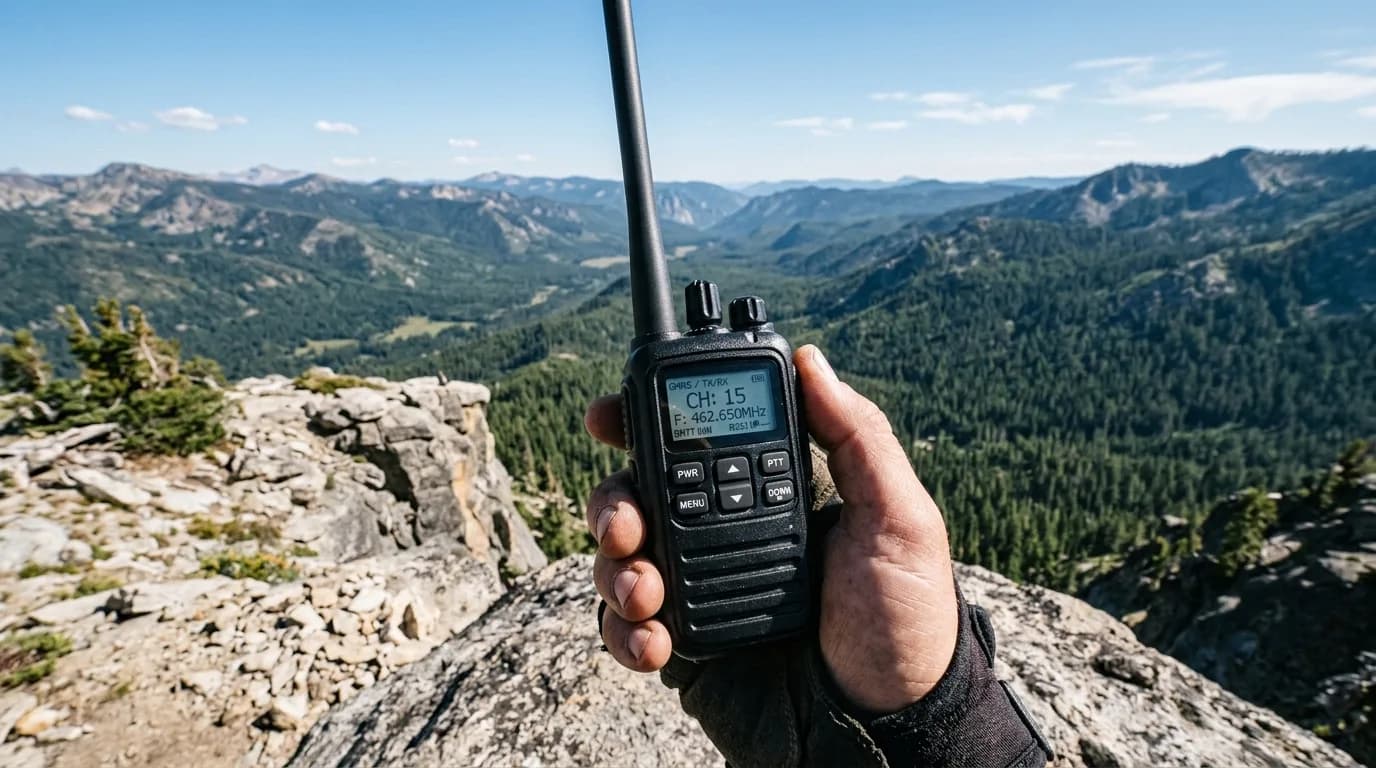
GMRS operates on 30 channels in the 462/467 MHz UHF band. Twenty-two of those channels overlap with FRS (so GMRS and FRS radios can communicate on shared channels). Eight additional channels are designated for repeater use only.
Power limits scale with equipment type:
- Handhelds: up to 5W
- Mobile radios (vehicle-mounted): up to 50W
- Base stations: up to 50W
- Repeater output: up to 50W
The removable antenna is a game-changer. Unlike FRS, GMRS radios let you swap the stock antenna for a higher-gain option, mount an external antenna on your vehicle's roof, or connect to a base station antenna at home. Better antenna equals better range, period.
One nuance worth knowing: before the FCC's 2017 Part 95 reform, manufacturers sold combo "FRS/GMRS" radios that ran GMRS power (above 2 watts) but still shipped with a fixed antenna, so "fixed antenna means FRS" was never a foolproof rule even before the reform closed that loophole. The rule that holds today, no exceptions: a removable antenna always means GMRS, never FRS. If you can unscrew the antenna, the radio needs a license.
Repeater access
This is where GMRS pulls far ahead of FRS. GMRS repeaters are towers (often on mountaintops or tall buildings) that receive your signal and retransmit it at higher power and elevation. A 5-watt handheld that might reach 3 miles on its own can hit a repeater and effectively communicate 20 to 30 miles or more.
There are thousands of GMRS repeaters across the US, and the network keeps growing. The myGMRS.com repeater directory lists active repeaters by area. In most populated regions, you'll find at least a few within range.
Real-world GMRS range
Without a repeater, a GMRS handheld at 5 watts realistically reaches 2 to 5 miles depending on terrain. With a good antenna and a vehicle-mounted mobile radio at 50 watts, direct range extends to 5 to 15 miles. Through a repeater, 20 to 50 miles is common, and some repeater networks link together for even greater coverage.
In my testing around the Denver front range, a 5-watt GMRS handheld consistently reached 3 to 4 miles in hilly terrain without a repeater. Hitting a repeater on Lookout Mountain extended that to over 25 miles into the plains. FRS couldn't make it past the first ridge.
Who should use GMRS
GMRS fits anyone who needs more range than FRS but doesn't want to study for an exam. Overlanders and off-road groups coordinating across a trail system. Families on multi-day camping trips. Preppers building a neighborhood communication plan. Small farms or ranches. If your use case involves more than a mile or two of separation, especially in terrain that isn't flat, GMRS is worth the $35 license. Ready to buy? Our GMRS handheld picks rank every certified radio we track by transmit power and owner ratings.
Head-to-Head: FRS vs GMRS in Detail
Licensing and setup time
FRS wins on simplicity. Open the package, charge the batteries, talk. There is genuinely zero paperwork.
GMRS requires about 15 minutes of effort: create an FCC account, fill out the application, pay $35. Your callsign typically arrives within a week, though you can legally start transmitting as soon as the FCC grants your license (you'll see it in the system before the physical document arrives). The license covers your whole immediate family, so you only do this once.
Power and range
This is the biggest practical difference. FRS tops out at 2 watts with a fixed antenna. GMRS allows 5 watts handheld and 50 watts mobile, with removable antennas you can upgrade.
In real-world terms: FRS gives you reliable communication across a campsite or theme park. GMRS gives you reliable communication across a valley or between vehicles spread across a trail system.
Channels and interference
Both services share 22 channels in the same frequency range. When an FRS radio and a GMRS radio are on the same channel, they hear each other. In practice, this means FRS users in busy areas (think Yellowstone or a popular ski resort) may hear GMRS users with stronger signals bleeding into their conversations.
GMRS has 8 additional repeater-input channels that FRS can't access. These provide a cleaner communication path since only licensed GMRS users can transmit on them.
Equipment cost
FRS radios typically cost $20 to $60 for a pair. They're often sold in blister packs at big-box stores. Motorola Talkabout, Midland X-Talker, and Cobra are the common brands.
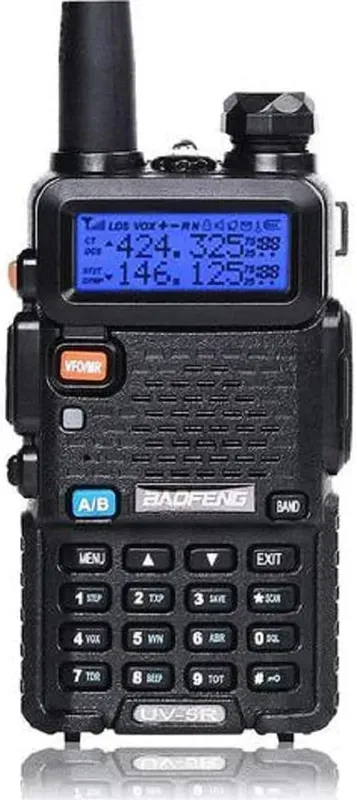
GMRS radios range from $30 to $200 per unit. Budget GMRS handhelds like the Baofeng UV-5R (which is technically a ham radio but widely used on GMRS) start under $20, while dedicated GMRS handhelds from Midland or Wouxun run $50 to $120. Mobile units for vehicles cost $100 to $300.
Expandability
FRS is a dead end. The radio you buy is the radio you get. No antenna upgrades, no mobile rigs, no repeater access, no path to more capability.
GMRS has a clear upgrade path. Start with a handheld, add a vehicle-mounted mobile, set up a base station at home, connect through repeaters. And if you find yourself wanting even more capability (HF long-distance, digital modes, satellite communication), the jump from GMRS to ham radio is a natural progression. Many hams started exactly this way.
Real-World Performance
I've carried both FRS and GMRS radios on trails around Colorado's front range, and the performance gap is wider than the spec sheets suggest.
Terrain kills FRS first
On a flat, open road, FRS and GMRS handhelds perform closer than you'd expect. I've gotten 1.5 miles out of an FRS radio on a straight stretch of highway with clear line of sight. But add one hill, a stand of dense pines, or a building between you and the other radio, and FRS drops to crackling, partial copy within half a mile. GMRS at 5 watts punches through those same obstacles with usable audio at a mile or more.
The repeater advantage
The most dramatic difference isn't power; it's repeater access. On a GMRS repeater south of Denver, I've maintained clear conversations from downtown to Castle Rock, roughly 30 miles apart. With FRS, I couldn't reach someone across a parking lot at Red Rocks if the amphitheater was between us (slight exaggeration, but the point stands).
For emergency preparedness, this matters. If cell towers go down, an FRS radio connects you to your immediate household. A GMRS radio on a repeater connects you to your neighborhood, your town, or your county.
Interference in crowded areas
At a busy trailhead in Rocky Mountain National Park, FRS channels 1 through 3 were nearly unusable on a summer Saturday. Multiple families, tour groups, and ranger teams all competing on the same frequencies at the same power level. Switching to a GMRS repeater channel cleared the congestion entirely.
Which One Should You Choose?
Choose FRS if:
- You need radios for a single day trip, theme park visit, or short hike
- Everyone in your group will be within 1 mile of each other
- You don't want any paperwork or licensing
- Your budget is under $50 total for a pair
- You want to hand radios to kids without worrying about regulations
Choose GMRS if:
- You camp, hike, or go off-road for multiple days
- Your group spreads out beyond 1 to 2 miles
- You want a reliable communication backup if cell service fails
- You're building an emergency preparedness plan
- You might want to upgrade your setup over time (better antennas, mobile radios, base station)
- The $35 license fee for 10 years doesn't bother you
Start with FRS, upgrade later
If you're not sure, start with FRS. A $25 pair of Motorola Talkabout radios will tell you quickly whether you actually use two-way radio communication. If you find yourself wishing for more range, better audio, or repeater access, that's your signal to get a GMRS license.
Many GMRS users eventually look at ham radio once they hit the ceiling of what GMRS can do. The progression from FRS to GMRS to ham is one of the most common paths in the hobby. Our GMRS vs ham radio comparison breaks down the decision in detail.
Getting Started
Getting started with FRS
- Buy a pair of radios. Motorola Talkabout T-series and Midland X-Talker series are the most popular. Expect to pay $25 to $50 for a pair.
- Charge the batteries. Most come with rechargeable NiMH packs or take AA batteries.
- Pick a channel. Avoid channels 1, 2, and 3 in busy areas since everyone defaults to those. Channel 7 or higher tends to be quieter.
- Set a privacy code (CTCSS/DCS). This doesn't encrypt your signal, but it filters out other conversations on your channel so you only hear your group.
- Talk. Hold the radio 2 to 3 inches from your mouth, press PTT, speak clearly, release.
Getting started with GMRS
- Get your license. Go to the FCC Universal Licensing System, create an account, apply for a GMRS license, and pay the $35 fee. No exam required.
- Buy a radio that is actually certified. GMRS requires the radio itself to hold an FCC Part 95E grant, which most ham handhelds do not have. Budget $30 to $120 for a solid certified handheld; our Best GMRS Radios guide covers the full field, and these two are the cheapest we track with a Part 95E grant verified against the FCC register:
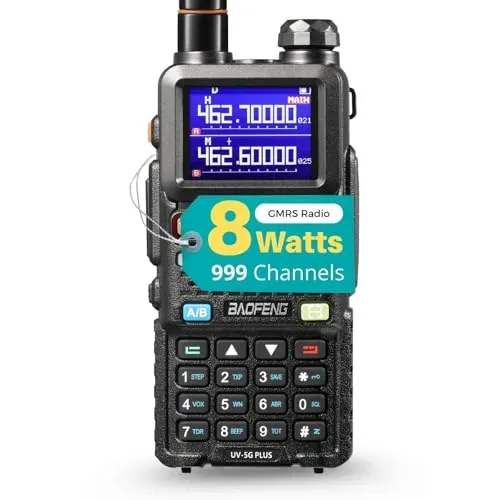
$32.99 · 5.00W
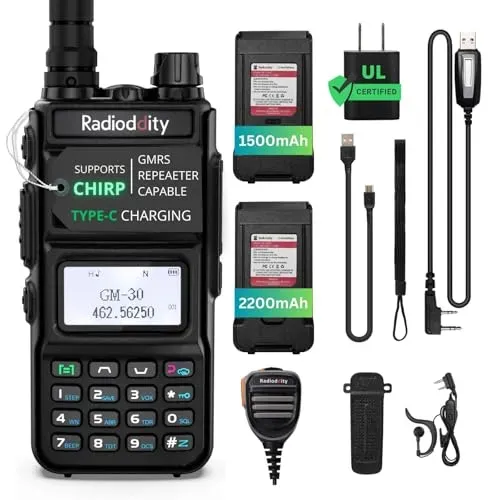
$42.99 · 5.00W · VHF/UHF
- Find local repeaters. Search myGMRS.com for repeaters in your area. Program their frequencies into your radio.
- Test before you need it. Don't wait for an emergency to find out your radio works. Do a range test with a friend or family member on a weekend afternoon.
- Consider upgrading your antenna. Even a $15 aftermarket antenna on a GMRS handheld noticeably improves range compared to the stock rubber duck.
When you outgrow GMRS
If you find yourself wanting HF long-distance communication, digital modes like DMR, satellite contacts, or the ability to build and experiment with your own antennas, it's time to look at ham radio. The Technician exam is 35 multiple-choice questions, and you can study for it in a week using our practice quiz.
One thing to be clear about before you buy: a ham handheld is not a GMRS radio with extra features. The Baofeng UV-5R can be programmed to transmit on GMRS frequencies and plenty of people do it, but it holds no Part 95E grant, so doing so is not legal even with a GMRS license. We cover that in detail in is the Baofeng UV-5R legal. Buy it for the ham bands, and keep a certified radio for GMRS.
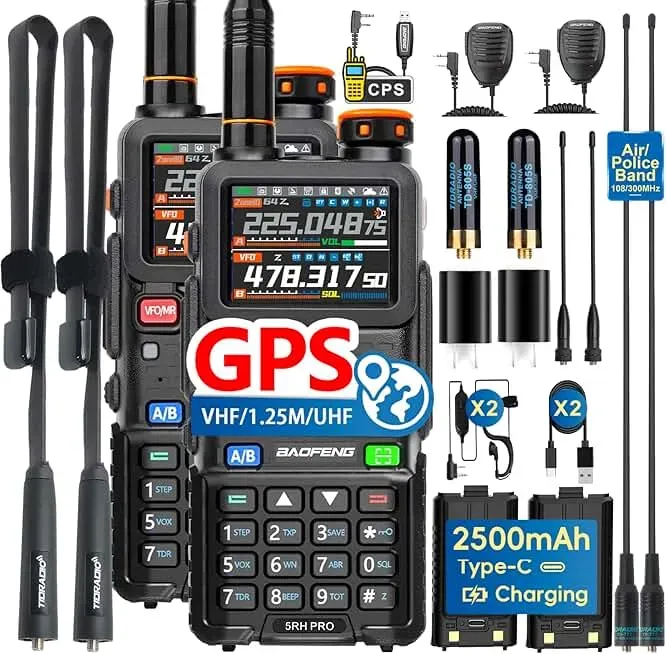
For something with more features and better build quality, the Baofeng BF-5RH PRO adds tri-band coverage, APRS, GPS, and IP67 waterproofing while keeping the price under $70.
Check our beginner buying guide when you're ready to pick your first ham radio.