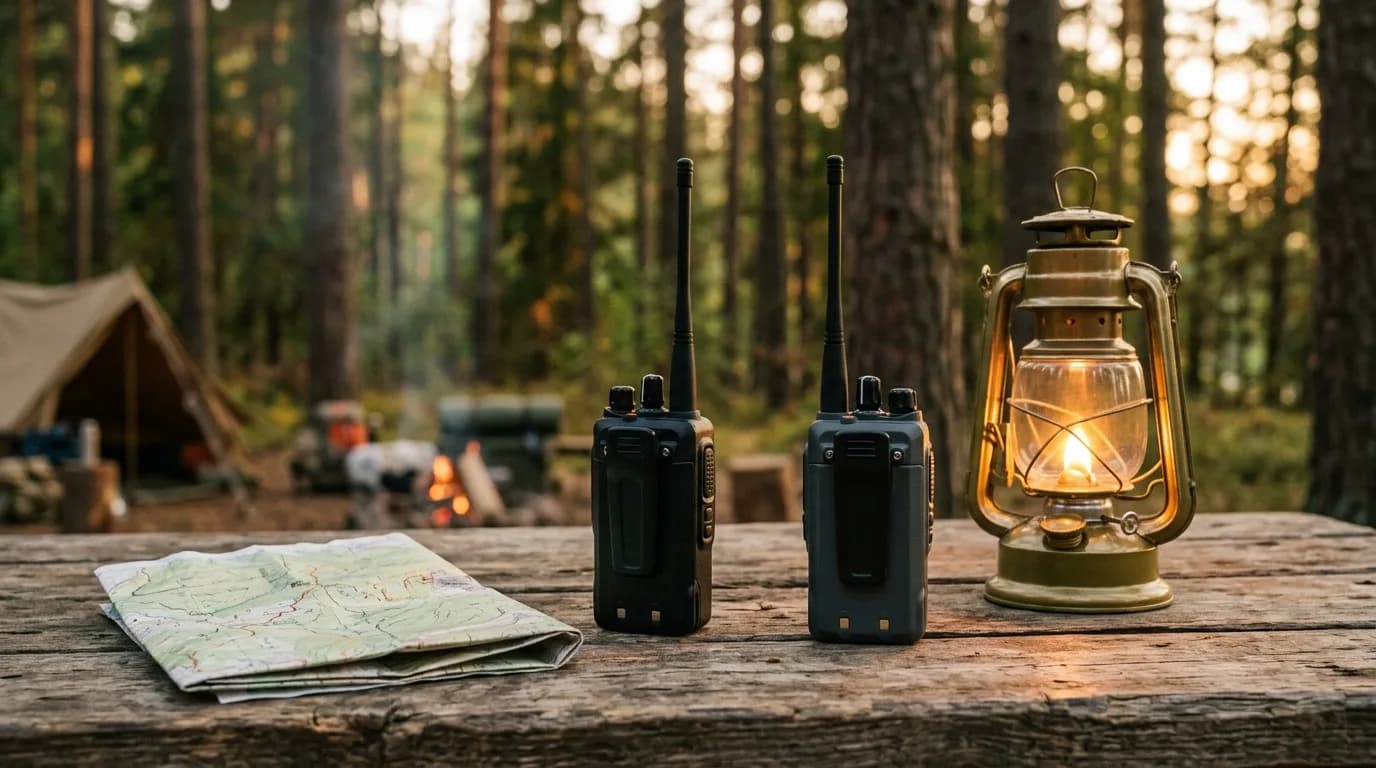

Quick answer: The best GMRS radio for most people is the Wouxun KG-935G (about $110): Part 95E certified, superb receive audio, and the build quality owners keep praising years in. On a budget, the Radioddity GM-30 (about $25) covers a family for the price of a pizza. For vehicles, the 50-watt Midland MXT575 is the upgrade that actually changes your range. Every pick below includes its FCC certification status, because several popular "GMRS" radios are not as legal as their listings suggest.
GMRS (General Mobile Radio Service) is the middle ground between toy walkie-talkies and full ham radio. No exam. Up to 50 watts of power. A single $35 license covers your whole family for 10 years. If you want reliable radio communication for camping, road trips, off-roading, or emergency preparedness without studying for a test, GMRS is where to look.
This guide names specific picks, verifies each one's FCC Part 95E certification against the actual equipment authorization database, and synthesizes what owners on r/gmrs, myGMRS, and the overland forums report after months of real use. RadioRanked is a ham radio site, so I will also be honest about when ham radio is the better choice, and which ham radios can do double duty on GMRS frequencies.
Top GMRS Radio Picks
| Pick | Radio | Price | Power | Why |
|---|---|---|---|---|
| Best overall | Wouxun KG-935G | ~$110 | 5.5W | Certified, best build and audio in class |
| Most popular | Baofeng UV-5G Plus | $32.99 | 5W | Huge community, but read the caveat |
| Budget | Radioddity GM-30 | unavailable | 5W | Cheapest certified radio worth owning |
| Easiest to use | Wouxun KG-905G | ~$90 | 5W | Channels by number, zero menus to learn |
| Rugged upgrade | Rocky Talkie 5W GMRS | $195.00 | 5W | IP67, multi-day battery, built for cold |
| Mobile / 50W | Midland MXT575 | $439.99 | 50W | All controls on the mic, real repeater power |
Most of these picks now live in our new GMRS radios catalog, with daily-refreshed Amazon pricing and each radio's FCC certification on its product page. For ranked short lists by form factor, see our best GMRS handhelds and the rugged GMRS picks. The two Wouxun handhelds are the exception: Wouxun does not sell them on Amazon, so those links go to Buy Two Way Radios, their primary US retailer, and we earn nothing on them. They stay on this list anyway because they belong here. The picks are editorial, built from the FCC equipment authorization registry, published bench tests, and aggregated owner reports.
Best overall: Wouxun KG-935G
The KG-935G is the radio the GMRS community recommends when someone asks for "the good one." It is Part 95E certified, puts out a legal 5.5 watts, and the receive audio is noticeably better than anything in the Baofeng price class. The screen shows channel names in plain English, the scan speed is quick, and it monitors two channels at once.
What owners report: build and audio praise is the consistent theme on myGMRS and r/gmrs; multi-year owners describe it as the radio that ended their upgrade cycle. The main complaint is the price relative to the $30 Baofeng tier, which is fair, and the answer is equally fair: this one is certified, clean, and durable.
Most popular, with a catch: Baofeng UV-5G Plus
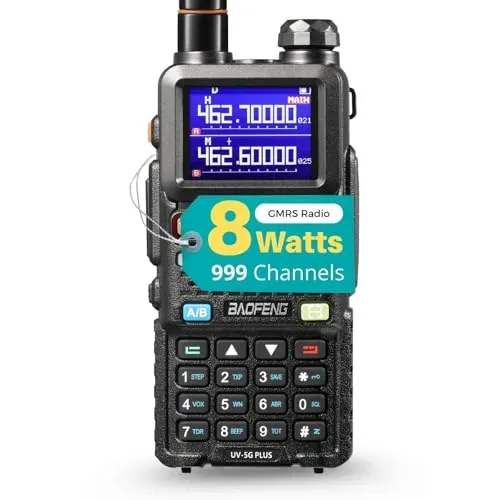
$32.99 · 5.00W
The UV-5G Plus is Baofeng's GMRS-certified line, pre-programmed with all 30 GMRS channels plus the 8 repeater channels. It is the most recommended entry radio on Reddit's r/gmrs, and at $32.99 it is easy to see why: USB-C charging, big battery, and the entire Baofeng accessory ecosystem fits it.
The catch: TruePrepper's bench test measured its output at roughly 10 watts, which is double the 5 watt ERP limit that applies on channels 1 to 7 and far beyond what its certification grant covers. An overpowered transmitter is not a bonus; it is a compliance problem the manufacturer shipped. In practice enforcement against individuals is unheard of, but if legality is the reason you chose a certified radio, know that this one has an asterisk on its numbers.
What owners report: great value, great battery, and the occasional unit with drifting squelch. Buyers who want set-and-forget simplicity tend to move to the Wouxuns; tinkerers stay happy here.
Budget: Radioddity GM-30
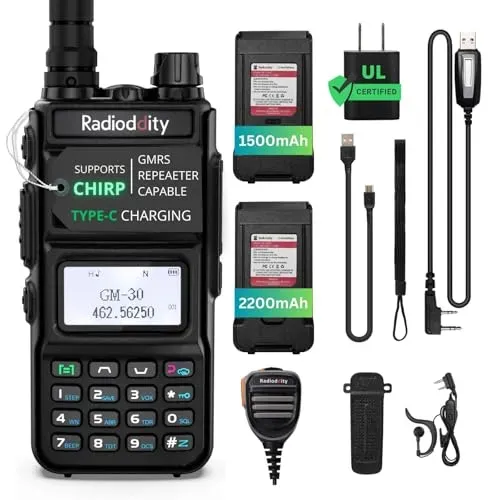
$42.99 · 5.00W · VHF/UHF
The GM-30 is the cheapest Part 95E certified handheld we would actually hand a family member. It displays channels by number, ships pre-programmed, supports repeater channels, and regularly sells in two-packs for about $40, which outfits a family for less than one Wouxun.
What owners report: beginner friendliness is the recurring theme; several r/gmrs threads recommend it specifically for kids and non-technical spouses. Power users note the receiver is average and the programming software is clunky, both reasonable at the price.
Easiest to use: Wouxun KG-905G
The KG-905G is the KG-935G's simpler sibling: a channelized radio with no frequency display at all. Channel 1 through channel 30, a volume knob, and nothing to misconfigure. myGMRS forum testing found its transmitter among the cleanest in the class, with none of the spurious emissions that plague the cheap tier.
What owners report: this is the radio people buy for parents and teams. The most common note is that it is "boring in the best way." If you never want to explain what a CTCSS tone is to a relative, this is the pick.
Rugged upgrade: Rocky Talkie 5W GMRS
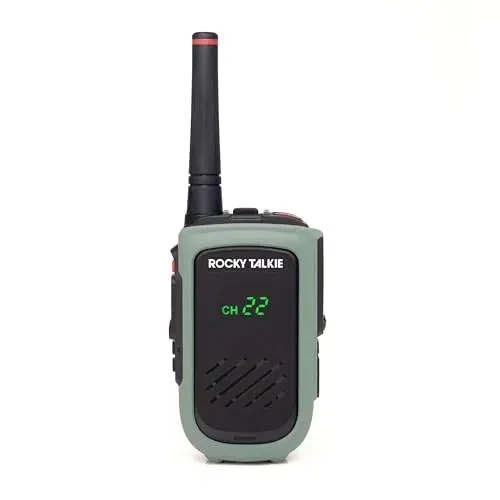
$195.00 · 5.00W
Built by a Colorado company for backcountry use: IP67 waterproofing, a shatterproof screen, a five-day battery in real backcountry duty cycles, and cold-weather performance rated to well below zero Fahrenheit. TruePrepper scored it the highest of every GMRS radio they tested. It is also Part 95E certified.
What owners report: ski patrols and canyon guides are the loud fans; the battery claims hold up. The price is the only consistent criticism. If that is too steep but you need durability, the Retevis HA1G (~$71.99, IP67) is the budget-rugged alternative; one forum reviewer's unit survived a 30-foot drop onto rock. The Baofeng UV-9G ($39.99) splits the difference: IP67 and GMRS-certified in the familiar Baofeng shape.
Mobile / 50W: Midland MXT575
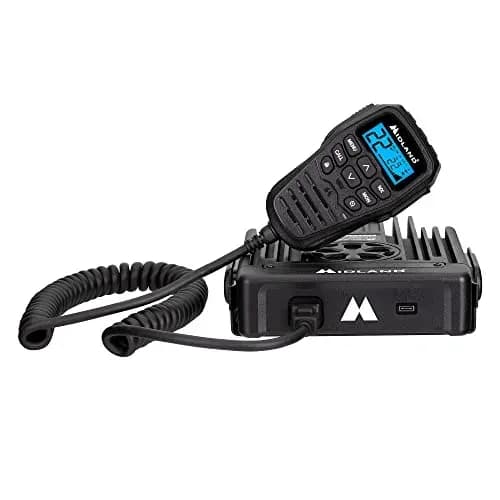
$439.99 · 50.00W
Handhelds top out around 5 watts. The MXT575 puts the full legal 50 watts into a roof-mounted antenna, which is the single biggest range upgrade available in GMRS. Every control lives on the microphone, so the radio body can hide under a seat, and it supports split-tone repeater access, which cheaper Midland models historically lacked.
What owners report: overlanders and road-trip families are the core user base; the mic-mounted control scheme is either loved (clean install) or tolerated (small buttons). Pair it with a proper NMO roof mount, not a mag mount on a plastic roof, and the installed cost lands around $500 all in.
FCC Certification, Verified
To transmit on GMRS legally, a radio must hold an FCC equipment authorization under Part 95E. Retailers assert this loosely; the grants are public record, so we checked. Certification status below is pulled from the FCC equipment authorization registry for each model.
| Radio | FCC ID | Part 95E | Grant date |
|---|---|---|---|
| Wouxun KG-935G | WVTWOUXUN26 | Certified | 2021-08-03 |
| Baofeng UV-5G Plus | 2AJGM-5GPLUS | Certified | 2024-02-21 |
| Radioddity GM-30 | 2AN62-GM30 | Certified | 2021-04-19 |
| Wouxun KG-905G | WVTWOUXUN18 | Certified | 2021-02-19 |
| Rocky Talkie 5W GMRS | 2ATSN-RT5WV1 | Certified | 2023-06-07 |
| Retevis Ailunce HA1G | 2A3OO-HA1G | Certified | 2023-06-29 |
| Midland MXT575 | MMAMXT575 | Certified | 2021-04-20 |
All seven grants were checked against the FCC equipment authorization registry (fcc.report filings, rule parts cross-checked on fccid.io) in July 2026: every one is an approved Part 95E grant covering the GMRS frequency ranges. You can confirm any of them yourself by searching the FCC ID; it is printed on the radio's label. Note that certification covers the design the manufacturer filed, which is exactly why the UV-5G Plus bench-testing at roughly double its rated power is worth knowing about.
Why this matters: an uncertified radio on GMRS is a rule violation even with a valid license, and an overpowered "certified" radio undermines the point of buying certified gear. No other GMRS roundup we could find verifies any of this; treat any "GMRS certified" claim on a retail listing as marketing until you have seen the FCC ID.
GMRS Power Limits by Channel
"50 watts" is the headline GMRS number, but the limit depends on the channel, and this is exactly the trap the overpowered budget radios fall into:
| Channels | Type | Power limit |
|---|---|---|
| 1-7 | 462 MHz interstitial (shared with FRS) | 5 W ERP |
| 8-14 | 467 MHz interstitial (shared with FRS) | 0.5 W ERP |
| 15-22 | 462 MHz main | 50 W |
| 15R-22R | 467 MHz repeater inputs | 50 W |
Handhelds are designed and certified around the 5 watt tier; the 50 watt allowance is what mobile and base stations use. So "what is the most powerful GMRS radio" has a two-part answer: among handhelds, anything honestly rated near 5 watts is at the practical and legal ceiling, and real power comes from a 50 watt mobile like the MXT575 or the Wouxun KG-1000G feeding a properly mounted antenna.
GMRS vs FRS vs Ham: A Quick Decision
Before buying a radio, make sure GMRS is the right service for you.
| GMRS | FRS | Ham Radio | |
|---|---|---|---|
| License | Yes, $35, no exam | None | Yes, $35-50, exam required |
| Power | Up to 50W | 2W max | Up to 1,500W |
| Range (simplex) | 2-25 miles | 0.5-2 miles | 1-15+ miles |
| Range (repeater) | 10-50+ miles (where available) | None | 10-50+ miles (extensive network) |
| Channels | 30 (8 shared with FRS) | 22 (8 shared with GMRS) | Hundreds across multiple bands |
| Best for | Family, camping, off-road | Kids, short range | Hobby, emergency, technical |
| Exam | None | None | 35-question test |
Want family comms with no test? GMRS. Want a hobby with technical depth and community? Ham radio. Just need short-range walkie-talkies? FRS.
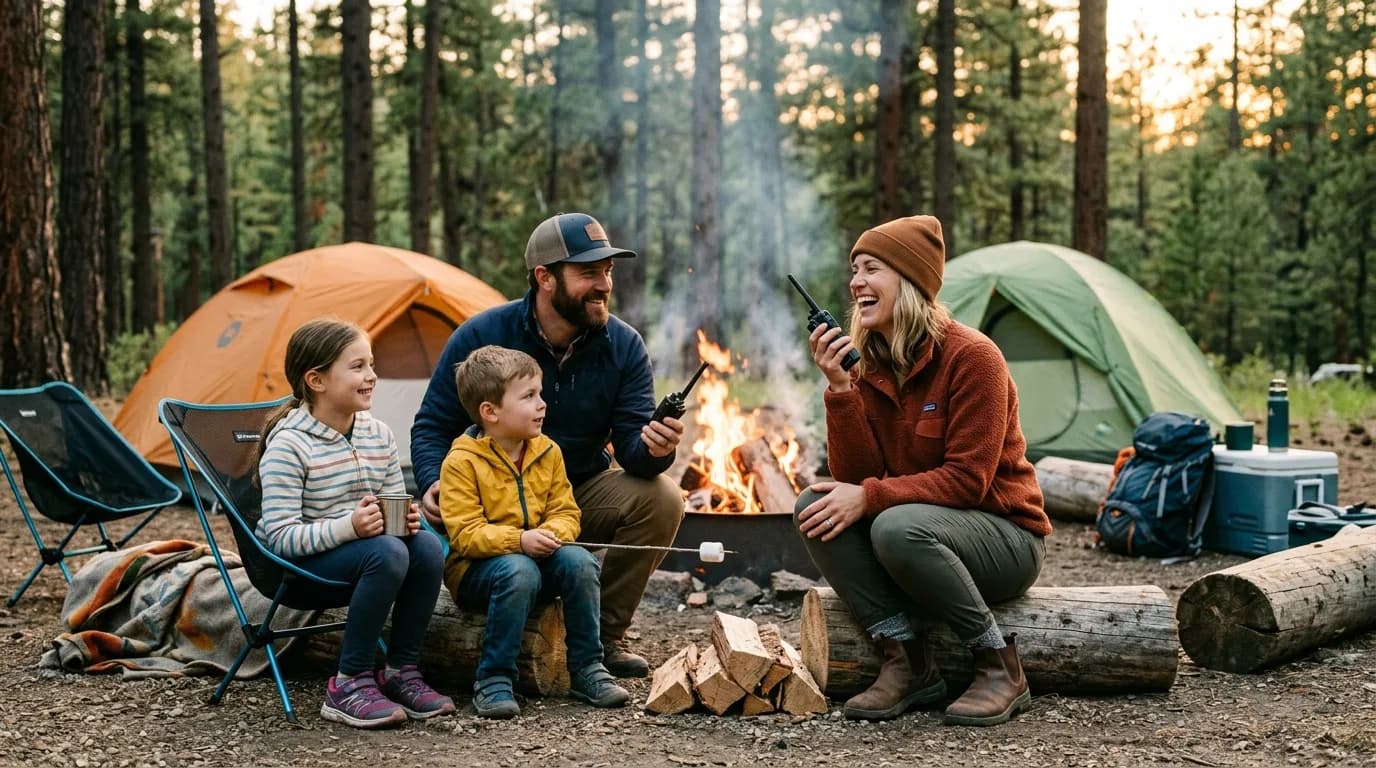
GMRS Licensing Explained
GMRS licensing is dramatically simpler than ham licensing. Here's the entire process:
- Go to the FCC Universal Licensing System
- Create an account and get an FRN (FCC Registration Number)
- Apply for a GMRS license
- Pay $35
- Receive your call sign, usually within a few days
That's it. No exam, no study materials, no testing center. The $35 fee covers a 10-year license, and it applies to your entire immediate family (spouse, children, parents living in your household). Everyone in the family can transmit under your call sign.
Important change: The FCC reduced the GMRS license fee from $70 to $35 on April 19, 2022. If you see older articles quoting $70 or $85, they're outdated. Full walkthrough in our GMRS license guide.
What you get: 30 GMRS channels on UHF frequencies (462/467 MHz), with 8 channels shared with FRS. You can use up to 50 watts on certain channels (repeater input channels) and up to 5 watts on the FRS-shared channels. Most handheld GMRS radios operate at 1 to 5 watts; mobile/base stations can push higher.
Your call sign. Your GMRS call sign will look like WQXX123 or WRXX1234: a W prefix, two letters that track the issuance batch, and three or four digits. You announce it once per transmission or at least every 15 minutes during a conversation. The same call sign covers every family member operating under your license, so you do not need to recite a different identifier for each person; one ID per family per conversation is the standard practice.
Who counts as "family." The FCC's definition is generous and includes spouses, children, grandchildren, parents, grandparents, siblings, aunts, uncles, nieces, nephews, in-laws, and step-relations. Adult children who have moved out, in-laws, and grandparents living elsewhere are all covered. Roommates, neighbors, friends, and coworkers are not, regardless of how close they feel.
Renewal and moving. The license auto-renews online for $35 every 10 years; the FCC sends a reminder, but it is on you to renew before the expiration. If you move, you update your address in the FCC's ULS but you keep the same call sign. GMRS licenses are tied to the operator, not the address, so a cross-country move does not trigger a new license.
GMRS Range: Set Realistic Expectations
GMRS operates on UHF frequencies (around 462 MHz), which means the same line-of-sight physics that govern ham radio apply here. Your range depends on terrain, antenna height, and obstructions, not just the number on the spec sheet.
Realistic handheld-to-handheld range:
- Open terrain, flat: 3 to 10 miles
- Suburban with trees and buildings: 1 to 5 miles
- Dense urban: 0.5 to 2 miles
- From elevation (hill, mountain): 10 to 25 miles
Via GMRS repeater: 15 to 50+ miles, depending on the repeater's antenna height. However, GMRS repeater infrastructure is far less developed than ham radio's. Many areas have no GMRS repeaters at all. Check myGMRS.com for repeaters near you. If range is your top priority across any radio service, see our long-range picks.
Those "36-mile range" claims on Amazon? Same story as with ham radios: theoretical maximum under ideal conditions that essentially never happen in practice.
GMRS Repeaters: How They Work and Where to Find Them
GMRS allocates 8 of its 30 channels as "repeater" channels, paired with 8 input channels on the 467 MHz side. A GMRS repeater listens on the 467 MHz input and retransmits on the matching 462 MHz output, exactly like a ham repeater. The big practical difference is that GMRS allows up to 50 watts on those repeater input channels, which is what makes the long reach possible from a handheld.
Open versus closed. Unlike ham repeaters, which are almost always open to any licensed amateur, GMRS repeaters are privately owned and split roughly in half between open repeaters (anyone with a GMRS license is welcome) and closed repeaters (you need the owner's permission or a sponsorship to use them). The closed ones are usually maintained by families, clubs, or off-road groups and tend to be the better-quality machines on the best mountaintops. Joining a local GMRS club is the standard path in.
How access works. Almost every GMRS repeater requires a CTCSS or DCS tone on the input. The repeater's owner publishes the tone on its myGMRS.com listing or its club page. You program your radio with the repeater's input frequency, the 5 MHz positive offset (input is 5 MHz higher than output on GMRS), and the access tone. Wrong tone, no contact. Right tone, you are on a 50W repeater with regional coverage.
Finding them. myGMRS.com is the canonical database. It is less complete than ham radio's RepeaterBook, but it is the best public resource. Local off-road and overland clubs are the other reliable source, particularly out west, where mountaintop GMRS repeaters run by jeep clubs are common. Reddit's r/gmrs has region-by-region threads worth searching before you buy a radio for a specific area.
Why a repeater changes the math. Without a repeater, two GMRS handhelds reach 2 to 10 miles in normal terrain. Through a well-placed repeater, you can routinely hit family members 30 to 50 miles away on the same handhelds. For a family spread across a metro area or working a large property, one repeater can stitch the whole group together.
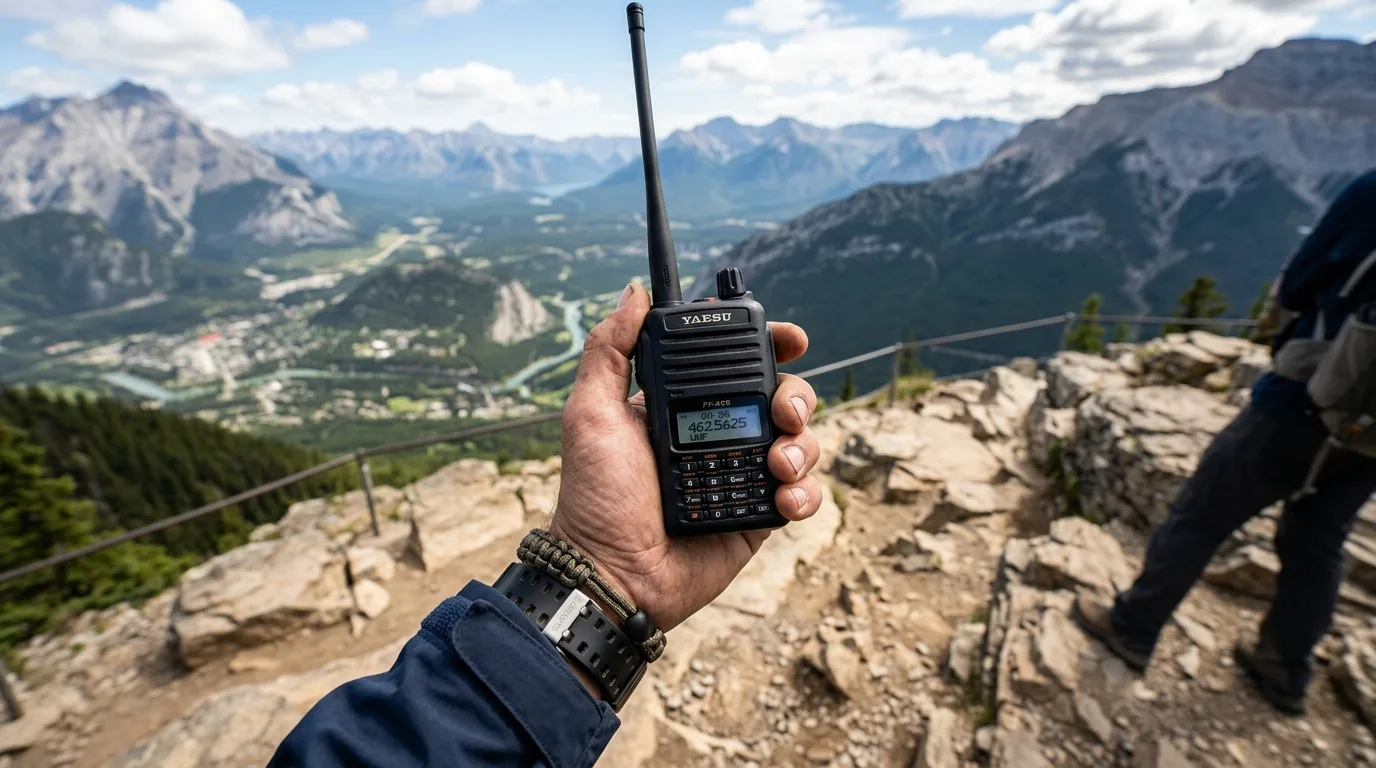
The Antenna Upgrade Nobody Mentions
Before you spend more on a radio, spend $20 on the antenna. Every stock GMRS handheld ships with a short "stubby" antenna tuned for convenience, not performance, and swapping it is the best range-per-dollar move in this hobby.
For handhelds: a 15-inch whip in the Nagoya 771G class, tuned for 462 to 467 MHz, typically adds a noticeable margin in fringe areas: contacts that were static become readable, and readable contacts become clear. Two gotchas. First, check your radio's connector polarity before ordering; most Baofeng-pattern GMRS radios use SMA-female on the radio body (so the antenna is SMA-male), while Wouxun and several others are the reverse. Second, buy the GMRS-tuned version, not the ham 771; the ham version is tuned for 144/430 MHz and gives up performance at 462 MHz.
For a fixed spot: a roll-up J-pole or a small base antenna hung in a window or attic, fed to a handheld, will outperform any handheld antenna because height beats wattage on UHF.
For vehicles: the antenna matters more than the radio. A quarter-wave whip on an NMO roof mount uses the metal roof as a ground plane and will double or triple the effective range of the same radio on a mag mount or a lip mount. If you buy a 50W mobile and put it behind a $25 mag mount on a plastic roof, you paid for watts you are throwing away.
Vehicle and Base-Station GMRS
Most GMRS users start with handhelds, but the service is built for higher power. The FCC allows up to 50 watts on GMRS, which is impossible from a handheld but easy from a mobile (vehicle) or base (home) station. If you have decided GMRS is your service, a 50W mobile rig is the upgrade that actually changes what you can do with it.
Mobile GMRS radios. The Midland MXT575 (our mobile pick above), Midland MXT500, Wouxun KG-1000G, and BTech GMRS-50V2 are the popular picks. Output runs 20 to 50 watts and prices land between $200 and $400. You install them in a vehicle, connect them to a 12V outlet or hardwire to the battery, and run an external antenna on a roof or trunk mount.
Base stations. Take the same radio, add a 12V power supply, and put an antenna on a mast or roof at home. Total cost ends up around $300 to $600 for a complete station. From elevation, base-to-base contacts of 25 to 50 miles are routine. Pair a base station at home with a mobile rig in the family vehicle and a couple of handhelds, and a single $35 license now covers a real family communication network.
When to step up to mobile. Frequent road trips with family, off-road or overland groups that need vehicle-to-vehicle comms in canyons and mountains, property monitoring on a ranch or large lot, or an emergency-communication setup that does not depend on cell coverage. None of these are well-served by handhelds alone.
What it actually costs to install. A simple mag-mount antenna and a cigarette-lighter power tap is a $50 weekend project. A proper NMO permanent mount with coax routed through the firewall to a hidden radio is a $200 project, half of which is labor at a car-audio shop unless you do it yourself. The radio is the easy part.
If You Also Want Ham Radio Later
Many amateur radio handhelds can transmit on GMRS frequencies (462/467 MHz falls within their UHF range), and this crossover is exactly why a lot of GMRS users end up with a ham license eventually. It is also where the legal picture gets murky.
The legal reality: to transmit on GMRS, a radio must be FCC Part 95E certified. Ham radios (Baofeng, Yaesu, Kenwood, AnyTone) are certified under Part 90 or operate under Part 97, not Part 95E. Using one on GMRS is technically a violation even with a GMRS license. The practical reality: thousands of people do it, and the FCC has never, to public knowledge, pursued an individual over it. But if legal certainty is why you got the license, stick to the certified picks above.
The community's other crossover trick runs the opposite direction: several dedicated GMRS radios (the UV-5G Plus and GM-30 among them) can be unlocked into full ham transceivers with a keypad sequence or firmware flash, which matters once you pass the ham exam. The cautionary tale is BTECH's GMRS-PRO line, which owners on r/gmrs repeatedly regret buying because its locked-down software allows no such path.
These are the ham radios from our scored catalog most commonly used by people who want both services in one radio; none are Part 95E certified, so the gray area above applies to all of them.
Best Dual-Purpose: Baofeng BF-5RH PRO (Score: 86)
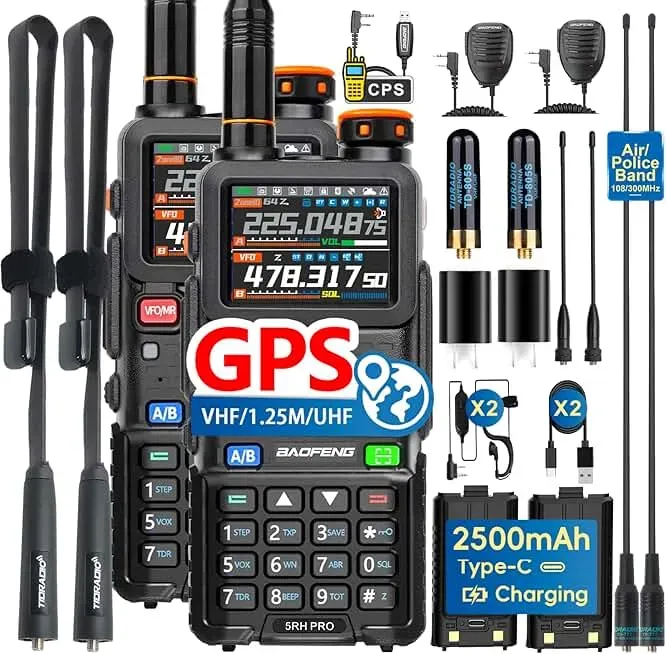
Our highest-scoring handheld overall. Triband (VHF/UHF/1.25m), 10 watts, APRS, GPS, IP54 weather resistance, and CHIRP-compatible. It ships as a two-radio kit, which is ideal for GMRS use with a partner or family member. Programming GMRS channels takes five minutes with CHIRP, and once you get your ham license this radio is already capable across multiple amateur bands.
Budget GMRS Option: Baofeng UV-5R (Score: 69)
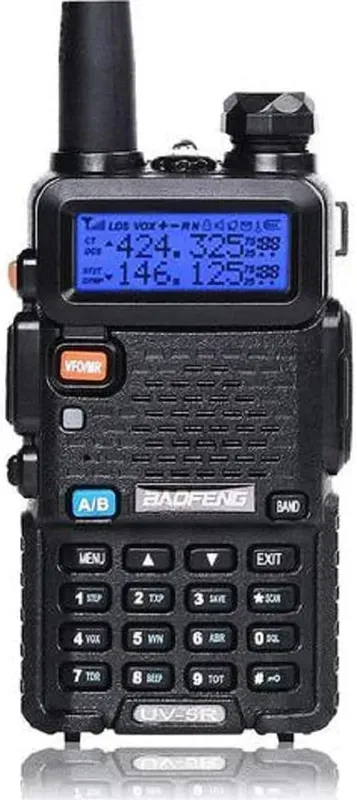
The cheapest way to get on GMRS frequencies. At $17.16, it's cheaper than many dedicated GMRS radios. Dual-band VHF/UHF, 5 watts, CHIRP-compatible, and backed by the largest community of any handheld radio. The stock antenna is weak; a $15 aftermarket upgrade makes a real difference for range. And yes, it's legal on ham frequencies with a ham license, though the GMRS certification question applies.
Best Weather-Resistant Budget: Baofeng UV-21R (Score: 74)
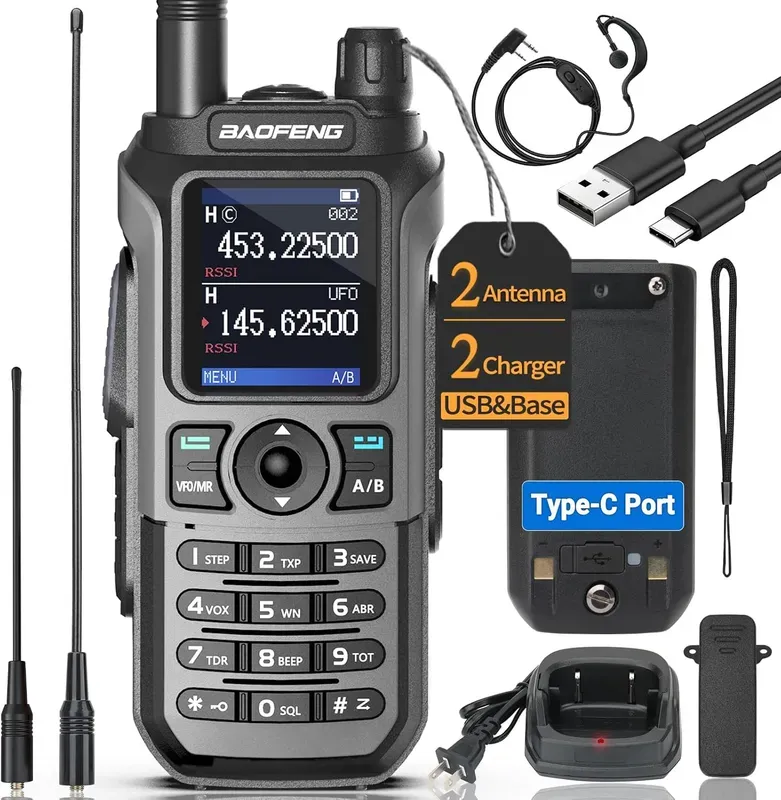
The cheapest IP-rated handheld worth taking outside. IP54 dust and splash resistance, 6 watts, dual-band VHF/UHF, CHIRP-compatible. At under $30, it sits in the rare spot of being both genuinely cheap and genuinely weather-resistant, which is exactly what most camping and off-road buyers actually want.
Tri-Band with Bluetooth Programming: Radioddity GS-10B (Score: 73)
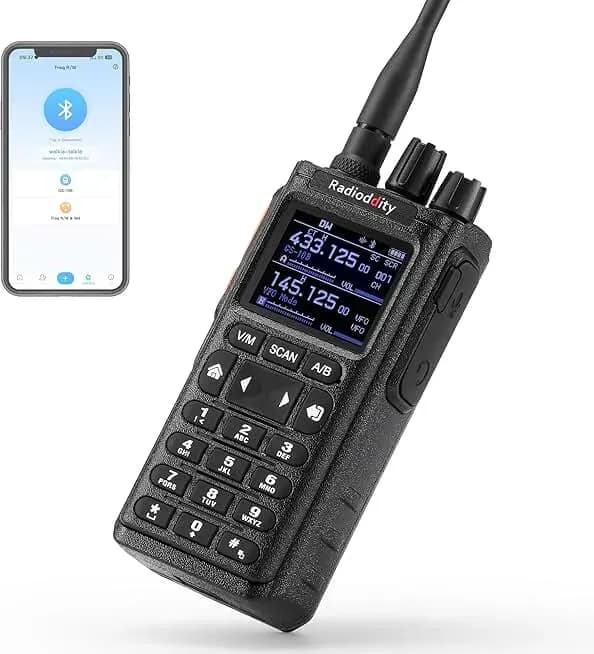
The GS-10B is the most beginner-friendly Baofeng-class handheld we have tested. Triband (VHF, UHF, 1.25m), 8 watts, CHIRP-compatible, and the Radioddity mobile app programs the radio over Bluetooth, so you can add a repeater without ever digging out a USB programming cable.
Ergonomic Alternative: Baofeng UV-82 (Score: 67)
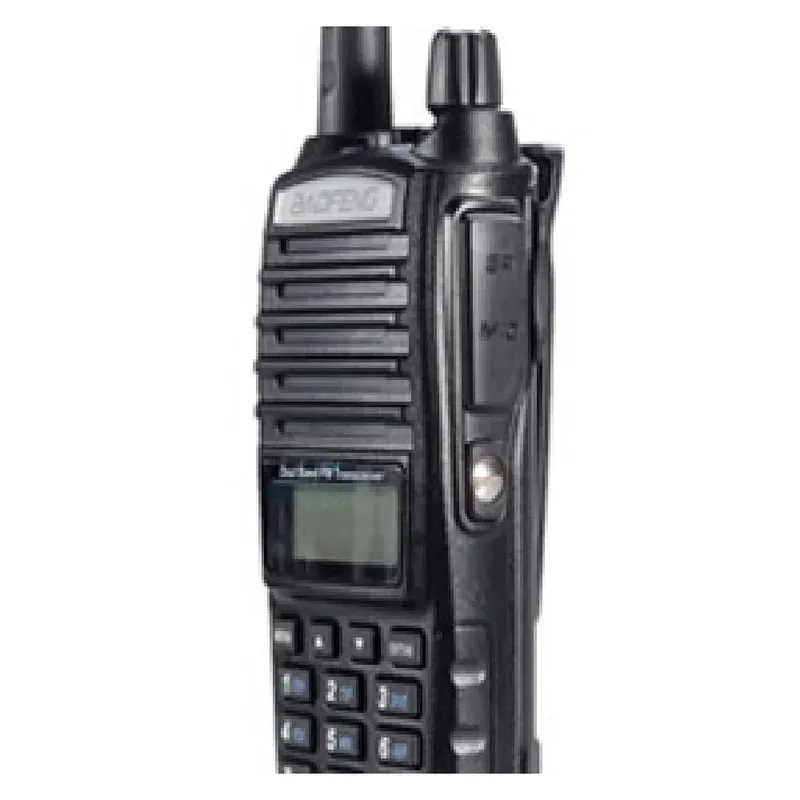
If the UV-5R feels too small, the UV-82 offers a larger body, bigger buttons, and a dual PTT design for better grip. 8 watts, 2,800 mAh battery, CHIRP-compatible. Same UHF GMRS capability, more comfortable form factor.
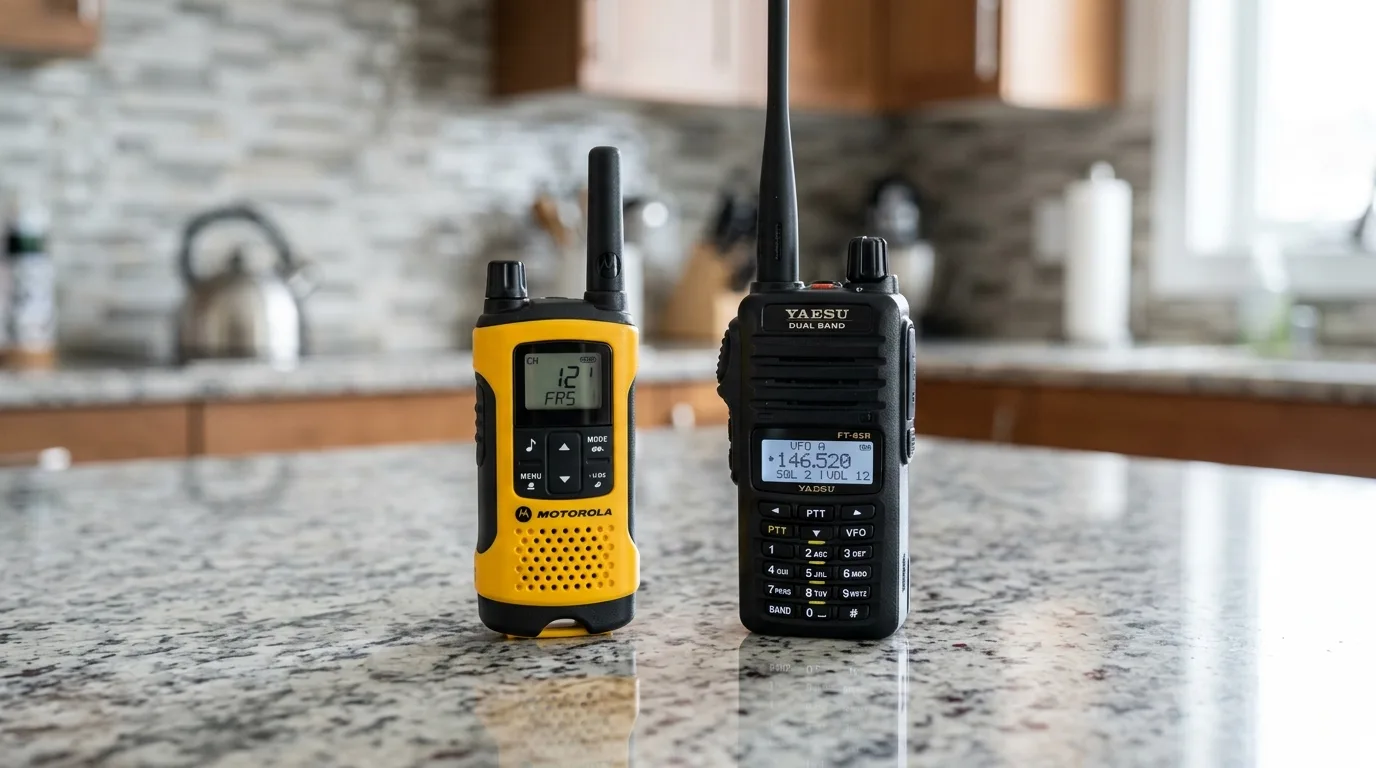
Comparison Table
| Radio | Price | Power | Part 95E | Owner consensus | Best For |
|---|---|---|---|---|---|
| Wouxun KG-935G | ~$110 | 5.5W | Yes | Build and audio praise, ends upgrade cycles | Best overall |
| Baofeng UV-5G Plus | ~$33 | 5W rated | Yes, but bench-measured ~10W | Best-value favorite, compliance asterisk | Most popular |
| Radioddity GM-30 | ~$25 | 5W | Yes | Beginner friendly, average receiver | Budget / family |
| Wouxun KG-905G | ~$90 | 5W | Yes | Clean transmitter, "boring in the best way" | Easiest to use |
| Rocky Talkie 5W | ~$195.00 | 5W | Yes | Battery claims hold up in backcountry use | Rugged upgrade |
| Tidradio TD-H3 (GMRS) | ~$35 | 5W | Sold as certified, not registry-checked by us | Loved for features; reliability and spurious-emission complaints | Tinkerers only |
| Midland MXT575 | ~$400 | 50W | Yes | Overlander staple, mic controls divide opinion | Mobile / 50W |
| BF-5RH PRO | $71.69 | 10W | No | Our top-scored ham handheld | Dual GMRS+ham |
| UV-21R | $26.99 | 6W | No | Cheapest IP-rated | Ham crossover, outdoors |
| GS-10B | $47.99 | 8W | No | Bluetooth programming | Ham crossover, beginners |
| UV-82 | $24.99 | 8W | No | Ergonomic | Ham crossover, comfort |
| UV-5R | $17.16 | 5W | No | Ultra-budget standard | Ham crossover, budget |
Certification status for the dedicated GMRS models reflects the FCC registry check in the table above; the Tidradio TD-H3's reliability line reflects multiple owner reports of early failures and one forum lab's spurious-emission measurements. Prices for catalog radios are current as of our last refresh; non-catalog prices are approximate.
GMRS vs Ham Radio: When to Choose Each
Choose GMRS if:
- You want family communication with no exam
- Your primary use is camping, road trips, or off-roading
- Simplicity matters more than features
- You don't want a long-term hobby; you want a tool
Choose ham radio if:
- You want a hobby with progression, community, and depth
- You need access to a large repeater network (ham has far more)
- You're interested in digital modes, APRS, or satellite
- Emergency communications involvement matters to you (ARES/RACES)
- You want to understand how radio actually works
Can you have both? Absolutely. A GMRS license ($35) plus a ham Technician license ($35 to $50) gives you access to both services. Many operators carry a dedicated GMRS radio for family use and a ham handheld for the hobby. See our GMRS vs ham radio guide for a deeper comparison, or our ham radio vs CB guide if you're also considering CB.
Programming GMRS Channels
Dedicated GMRS radios (all six picks above) come pre-programmed. Turn them on and go; at most you will add a local repeater's tone from its myGMRS.com listing.
Ham radios need GMRS frequencies loaded manually. With CHIRP, this takes about five minutes:
- Connect your radio to your computer with a programming cable
- Open CHIRP and download your radio's current configuration
- Add the 30 GMRS channels (462.5625 to 467.7125 MHz) with the correct offsets
- Upload to your radio
GMRS channel lists are widely available online and in CHIRP's community-shared files. You can also check the band chart for reference on frequency allocations.
Bottom Line
Buy the Wouxun KG-935G if you want the best certified GMRS handheld and the Radioddity GM-30 if you want the cheapest one worth owning. Go Midland MXT575 the moment vehicle range matters more than pocketability.
If you want one radio that does GMRS now and ham radio after you pass the exam, the Baofeng BF-5RH PRO at $71.69 is the better long-term investment, with the Part 95E gray area disclosed above.
Whatever you choose, get the $35 GMRS license first. It covers your family for a decade and keeps you legal. And if you find yourself wanting more range, more community, and more capability, the path to a ham license is only a few weeks of study away; try our practice quiz to see how ready you are. Browse our best radios for beginners when you're ready.