

QRP is ham radio at low power: 5 watts of output or less for Morse code (CW) and digital modes, with 10 watts peak envelope power (PEP) commonly accepted for SSB voice. Below 1 watt it gets its own name, QRPp. Whether 5 watts is enough has a numerical answer: 5 W is 13 dB below a typical 100 W station, which works out to a little over two S-units on a properly calibrated meter. For FT8 and CW on an open band, that gap usually costs you nothing you would notice. For SSB voice, it costs you margin, and you will feel it on a marginal band.
Most QRP explainers stop at "it works better than you think." This one does the arithmetic: how much weaker 5 watts really is, why the mode you pick matters more than the last 95 watts, where an antenna buys back what power gave up, and which situations 5 watts does not cover. If you are already shopping, our ranking of QRP radios lists every HF rig we track at 10 watts or less.
What QRP means, and who sets the number
QRP started as a Q-code, the three-letter shorthand hams use on CW. Sent as a question, QRP means "Shall I decrease transmitter power?" (our Q-code reference has the rest of the list). Over the decades it became the name for deliberately running low power.
What surprises people is that there is no single QRP rule. The familiar "5 watts CW, 10 watts SSB" line is a convention, and the organizations that actually award points or certificates mostly use 5 watts for everything:
| Source | What it counts as QRP |
|---|---|
| ARRL November Sweepstakes rules | 5 watts PEP output or less, any mode |
| ARRL QRP DXCC award | 5 watts output or less, measured at the antenna system input, for contacts with 100 DXCC entities |
| ARRL Field Day, 2026 rules | 5 watts or less on every contact, on a power source other than mains or a generator, earns a power multiplier of 5 |
| ARRL "Why QRP?" (reprint of a February 1990 QST piece) | "5 W or less output for CW, or 10 W PEP output or less for SSB" |
| RSGB (UK national society) | No more than 5 watts for Morse or data, 10 watts PEP for voice |
| Hobbyist usage | QRPp means 1 watt and below |
So if you are entering a contest or chasing an award, read that event's rules; 5 watts is the safe number. In everyday conversation, a 10 W SSB station is QRP and nobody will argue. Our QRP buying guide uses the 10-watt ceiling for the same reason.
Two things QRP is not. It is not an FCC category: there is no QRP license or band. The closest rule is 47 CFR 97.313(a), which says an amateur station "must use the minimum transmitter power necessary to carry out the desired communications," so in a sense the FCC already leans your way. And it is not a Parks on the Air requirement. POTA's rules say plainly that "Parks on the Air does not have a power limit." Plenty of activators run QRP anyway, for reasons that come down to weight and batteries, covered below.
How much weaker is 5 watts? The decibel arithmetic
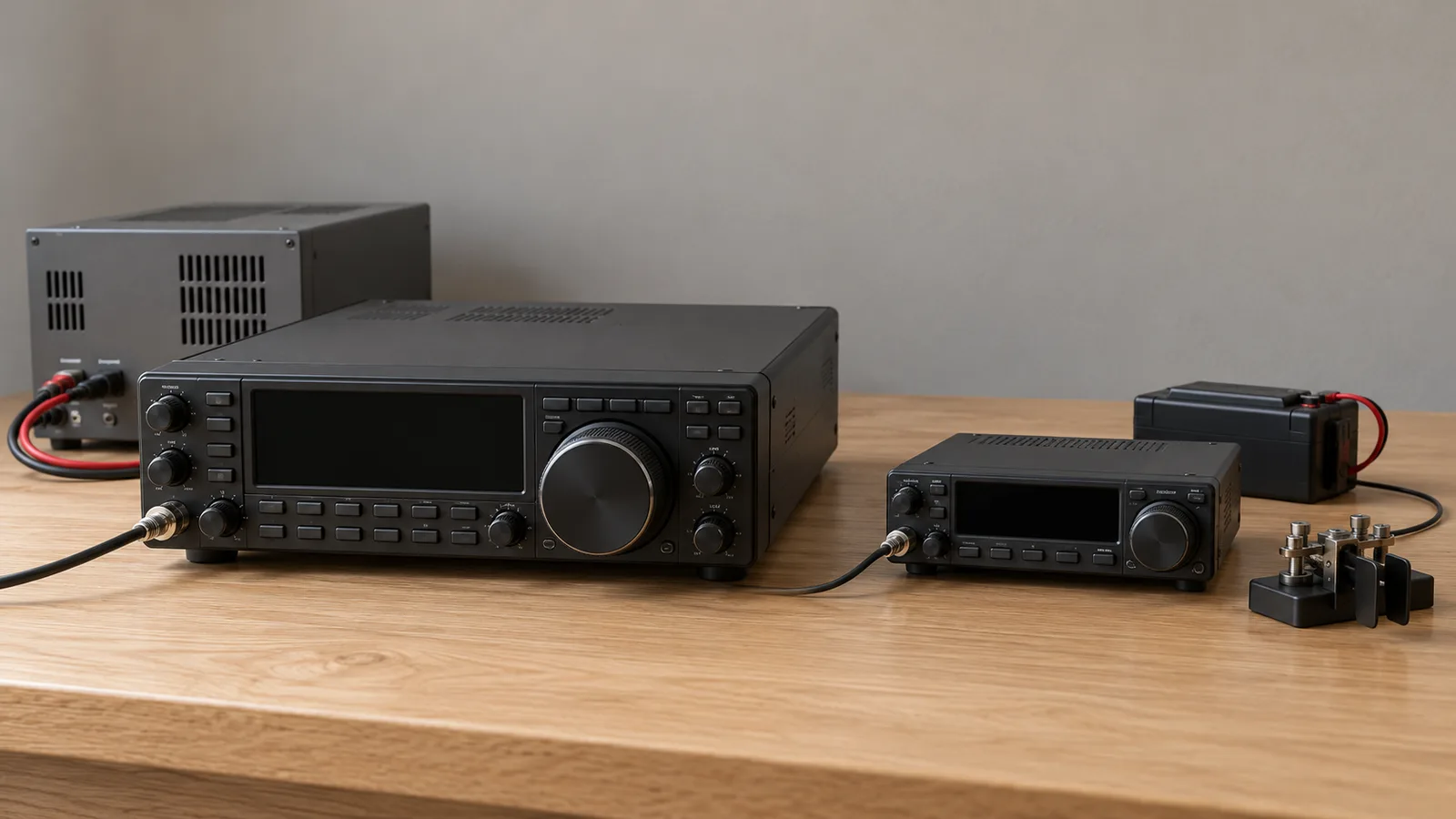
Signal strength works on a logarithmic scale, which is why cutting power by 95% does not cut your signal by 95% in any way a listener perceives. The power ratio in decibels is 10 × log10(P1 / P2). From 100 watts down to 5 watts is a ratio of 20, and 10 × log10(20) = 13.0 dB.
To turn decibels into something you can picture, use the S-meter. The IARU Region 1 technical recommendation that defines it sets one S-unit at 6 dB, with S9 at -73 dBm on HF. Here is the whole ladder, starting from a 100 W signal that a distant station reads at S9:
| Your power | dB below 100 W | S-units below 100 W | An S9 signal at 100 W arrives at |
|---|---|---|---|
| 100 W | 0 | 0 | S9 |
| 50 W | 3.0 | 0.5 | S8.5 |
| 20 W | 7.0 | 1.2 | S7.8 |
| 10 W | 10.0 | 1.7 | S7.3 |
| 5 W | 13.0 | 2.2 | S6.8 |
| 1 W | 20.0 | 3.3 | S5.7 |
| 0.1 W | 30.0 | 5.0 | S4 |
Three things stand out once the numbers are laid out.
Doubling power buys half an S-unit. Going from 5 W to 10 W is 3 dB. Going from 50 W to 100 W is also 3 dB. Every doubling is the same small step, which is why the jump from a 10 W portable to a 20 W one is less dramatic than the spec sheet suggests.
The ARRL's 1990 figure holds up. The QST piece the ARRL still hosts says a 1 W signal "is only a little more than three S-units weaker than a 100-W signal." The table agrees: 3.3 S-units.
Real S-meters are not that tidy. Most radio meters are not calibrated to 6 dB per S-unit, so treat the table as arithmetic, not as what your rig's needle will show.
The more important point is what power does not change. Power decides how far above the noise your signal lands at the other end. It does not decide where the ionosphere sends it. If the band is open between you and Ohio, it is open at 5 W and at 100 W; the 5 W signal just arrives 13 dB weaker. If that leaves it comfortably above the noise, the contact happens. If 100 W was already barely readable, 5 W is gone. QRP takes away margin. It does not take away the path. Our guide to the ham bands covers which bands open when.
Mode matters more than the last 95 watts
Because QRP spends margin, the useful question is how much margin each mode starts with. The answer separates FT8, CW and SSB by more than 13 dB.
FT8 has the most to spare. The WSJT-X user guide puts FT8's decoding threshold around -20 dB signal-to-noise ratio, measured in a 2,500 Hz bandwidth (the 2020 protocol paper gives about -21 dB). The same guide says a signal becomes audible to someone with very good hearing at around -15 dB. In other words, FT8 decodes signals you cannot hear at all. Run the arithmetic on a typical case: a station that would decode your 100 W signal at 0 dB will decode your 5 W signal at -13 dB, still about 7 dB above the threshold. That is why FT8 and QRP get along so well, and our FT8 explainer covers how to get started.
CW is next, and the reason is bandwidth. Receiver noise power scales with bandwidth. An SSB filter is typically about 2,400 Hz wide; a CW filter can be 250 Hz. Narrowing from 2,400 Hz to 250 Hz lets in 10 × log10(2400 / 250) = 9.8 dB less noise, while a CW signal, a single carrier, fits inside the narrow filter whole. That arithmetic is the basis for the common rule of thumb that CW gets through roughly 10 dB better than SSB. It is also why most QRP operating, and most of the QRP tradition, is CW.
SSB has the least. Voice needs your signal well above the noise to be understood at all, and there is no decoder digging it out for you. A 5 W SSB signal works fine on an open band with a decent antenna at both ends. On a marginal band, it is the first thing to fall below readability. The 10-watt voice convention exists because SSB needs those extra 3 dB more than CW does.
If you want to try QRP and you only have time for one mode, make it FT8 or CW. If you want voice, plan on good antennas, good band conditions, and patience. Our overview of ham radio digital modes covers the wider digital landscape.
The antenna is worth more than the amplifier
A 3 dB improvement anywhere in the system is worth exactly as much as doubling transmit power. That is the most useful sentence in QRP. Every dB you recover at the antenna end is a dB you did not need to buy with watts, and it works on receive too, which no amplifier does.
The usual advice is to save feedline loss, so it is worth checking how much there is to save on HF. These are matched-line figures for a 50-foot run, calculated with the same model our coax cable loss calculator uses:
| Cable | 40 m (7.074 MHz) | 20 m (14.074 MHz) | 10 m (28.074 MHz) |
|---|---|---|---|
| RG-174 | 0.82 dB | 1.16 dB | 1.64 dB |
| RG-58 | 0.44 dB | 0.62 dB | 0.87 dB |
| RG-8X | 0.34 dB | 0.48 dB | 0.68 dB |
| LMR-400 | 0.15 dB | 0.21 dB | 0.30 dB |
On a short run at HF, coax is rarely where your signal goes. Swapping 50 feet of RG-58 for LMR-400 on 20 m buys about 0.4 dB, a fraction of an S-unit, for a lot more weight in the pack. The exceptions are thin RG-174 on the higher bands (on 10 m, 50 feet of it delivers about 69% of your power, so 5 W in becomes roughly 3.4 W out) and any line run at a high SWR, which raises loss above these matched figures. Our SWR calculator shows what a mismatch costs.
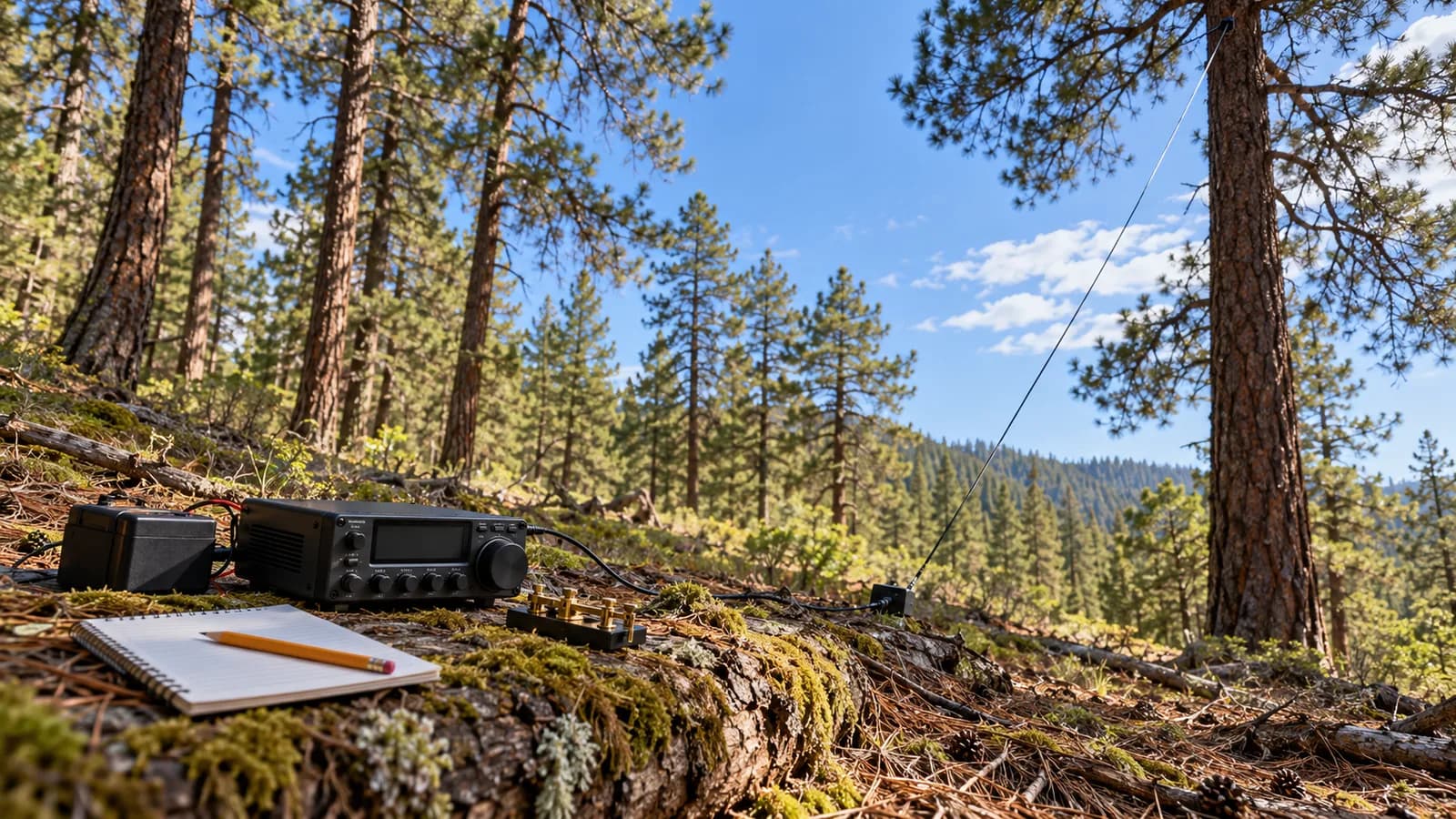
The bigger wins are the antenna itself:
- Full size where you can. A half-wave dipole for 20 m is about 33 feet long (468 divided by the frequency in MHz; our dipole calculator does the arithmetic for any band). An antenna that is physically short for its band has to be loaded or matched, and a tuner that makes the radio happy does not make the antenna efficient.
- Height and clearance. Getting a wire up and away from the ground, vehicles and buildings matters more on HF than any coax choice.
- Skepticism about gain claims. We checked advertised gain against antenna length for every antenna in our catalogue that states both; our antenna gain claims study explains the method, and the same length-versus-wavelength logic applies to HF wires.
The antenna cuts both ways. A badly compromised one, such as a short loaded whip with poor efficiency, can throw away 10 dB or more, so swapping it for an efficient full-size wire can recover most of the gap on its own. Once you are already on an efficient wire, though, the remaining 13 dB would take a directional beam with that much gain over a dipole, which is a tower project, not something you carry to a park. QRP in the field is still a compromise, just a smaller one than the raw watts suggest.
When 5 watts is enough, and when it is not
Put the margin arithmetic together and the answer depends on what you are trying to do:
| Situation | Is 5 W enough? |
|---|---|
| FT8 on an open band, any reasonable antenna | Usually, with margin to spare |
| CW, calling CQ or answering on 20 m or 40 m | Usually; the QRP tradition is built on it |
| A POTA activation (hunters are listening for you) | Usually; you need 10 contacts, and spots bring the callers to you |
| SSB on a good band with a full-size antenna | Workable; expect more repeats |
| SSB into a pileup, or chasing weak DX | Marginal; you are competing with 100 W and amplifiers |
| A noisy suburban location or a compromised indoor antenna | The hardest case; the antenna, not the radio, is the limit |
| Nets or emergency traffic where the contact must get through | Bring more power if you have it; QRP is a choice, not a virtue, when it really counts |
The pattern: QRP is at its best when the other station is actively listening for you and the mode digs into the noise. It is weakest when you have to be louder than everyone else.
Band conditions matter too. NASA and NOAA announced in October 2024 that the Sun had reached the maximum period of its 11-year cycle. As the cycle declines, the higher HF bands open less often, and marginal paths are where QRP's missing 13 dB costs the most.
Why operators choose QRP anyway
If 100 watts gets through more often, why does anyone run 5? Three practical reasons and one personal one.
Weight and batteries. A 100 W HF rig needs a heavy power supply or a big battery. A QRP rig can run from a small pack, and several have one built in. That is why QRP and portable operating grew up together, and why you see so many small HF rigs at park activations. Our beginner's guide to POTA covers what a field station needs, and the POTA radio guide covers the handheld side.
Contest and award rules. ARRL Field Day multiplies a station's contact points by 5 when every contact is made at 5 W or less on battery, solar or other power that is neither commercial mains nor a motor-driven generator, against 2 for stations up to 100 W. The ARRL also offers a QRP DXCC award for 100 DXCC entities worked at 5 W or less, with no QSL cards required.
Less to go wrong. Low power means less heat, less interference with your own electronics and the neighbors', and smaller, simpler gear.
The challenge. Making a contact across the country on the power of a flashlight is satisfying in a way that 100 watts is not. Many operators run QRP for the same reason people climb mountains on foot.
Where QRP operators gather
There are conventional QRP calling frequencies, used mostly by CW operators and listed consistently by long-running QRP references:
| Band | CW | SSB (US) |
|---|---|---|
| 40 m | 7.030 MHz | 7.285 MHz |
| 20 m | 14.060 MHz | 14.285 MHz |
These are meeting points, not reserved channels. FT8 operators use the standard FT8 frequencies regardless of power; our FT8 article lists them, and our band chart shows where each license class may transmit.
Which QRP rig fits, if you are buying
You do not need a QRP radio to operate QRP. Any HF rig with an adjustable power control counts once you turn it down to 5 watts, so if you already own a 100 W radio, start there. A dedicated QRP rig earns its place when you want to carry the station somewhere. These are the four HF radios we track at 10 watts or less. The full side-by-side, with scores and specs, is on our QRP radio ranking.
One footnote applies to three of them: the advertised power assumes an external 13.8 V supply. On their internal batteries, the Icom IC-705, Xiegu X6100 and Xiegu X6200 all transmit 5 watts, per their spec sheets. For QRP purposes that is a feature, but plan on 5 W in the field unless you carry external power.
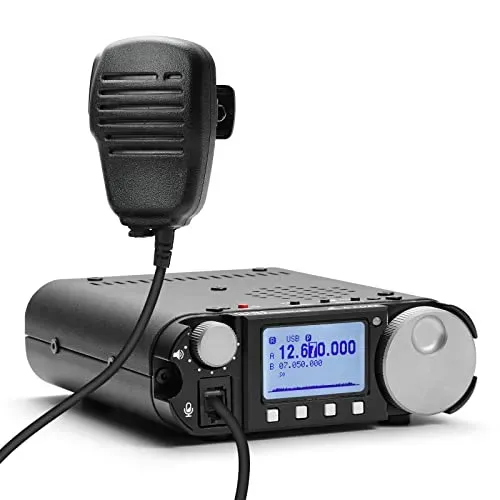
The Xiegu G106 is the cheapest way into dedicated QRP, at $249.00. It puts out about 5 watts on SSB, CW and AM on the bands from 80 m to 10 m. Its spec page lists no internal battery and says wideband antennas need an external tuner, so it is a radio for someone who will bring a battery and a resonant antenna. FT8 needs a computer and an optional adapter. Our overall score: 67.
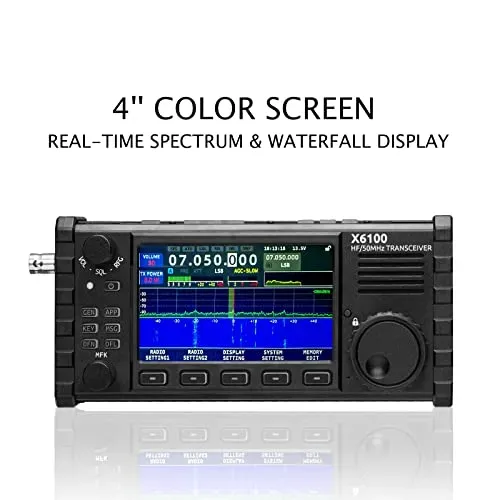
The Xiegu X6100 ($595.00) is the self-contained middle ground: 10 W on external power, 5 W on its built-in battery, and an automatic antenna tuner inside the case. That combination means one box, a wire and a pole make a complete station. Our overall score: 83.
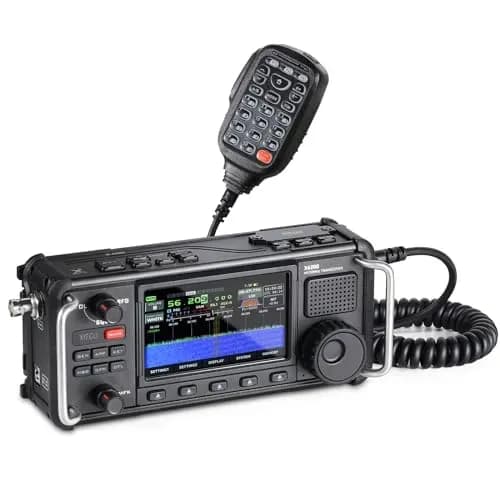
The Xiegu X6200 ($749.00) is Xiegu's newer portable. It is rated at 8 W on external power and 5 W on its replaceable battery, and it also has a built-in tuner. Compare it directly with the X6100 on our X6100 vs X6200 page. Our overall score: 79.
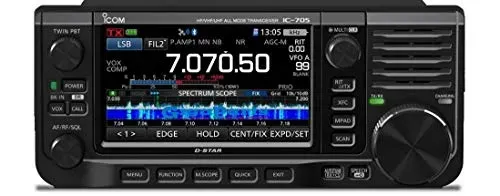
The Icom IC-705 ($1609.94) costs the most of the four. It transmits 10 W on external power and 5 W on its battery pack, and unlike the Xiegus it also covers 6 m, 2 m and 70 cm, with D-STAR digital voice. It sits a receiver tier above the Xiegus in our HF model, which matters most when the band is crowded. Our overall score: 85.
If you mostly operate from home and want headroom, a 100 W radio turned down to 5 W gives you QRP when you want it and power when you need it. Our base station guide and the full HF radio listing cover those, and our methodology explains how every radio here is scored.