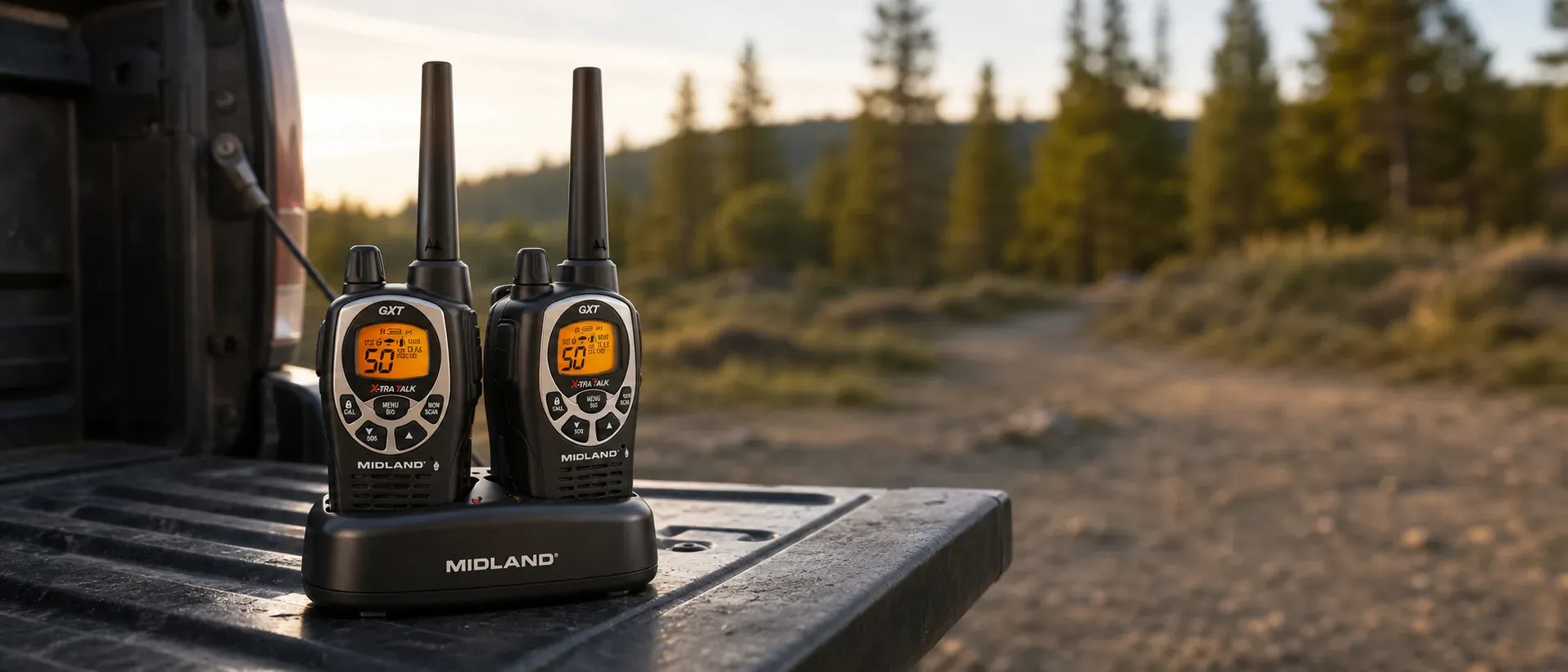

Search for the Midland GXT1000VP4 and Google gives you the Midland store page, four retailer listings, an owner's manual, and a Reddit thread. The AI Overview at the top quotes a forum post titled "Midland GXT1000VP4 Terrible Range" and a YouTube video called "The Good, The Bad, and The Ugly." Nobody has written the straight answer, which is a strange gap for a radio with more than 13,000 Amazon ratings.
Here is that answer. The GXT1000VP4 is a genuinely popular, genuinely useful pair of GMRS handhelds for about $89.99, and it is also the radio most likely to disappoint someone who believed the number on the box. Two things drive that gap: the 36-mile range claim, and a licensing question the packaging never raises.
The Snapshot
| Price | About $90 for a rechargeable pair |
| Owner rating | 4.4 stars across 13,187 Amazon ratings |
| Channels | 50, with 142 privacy codes |
| Service | GMRS, license required |
| FCC grant on file | None found under GXT1000 or GXT1030 |
| Weather | NOAA reception with alerts |
What You Are Actually Buying
The VP4 in the name means "value pack": two radios, a desktop charging cradle, rechargeable battery packs, belt clips, an AC adapter, a DC adapter, and a pair of boom mic headsets in one box. It is not a different radio from the GXT1000. Midland's naming is genuinely confusing here, and we untangle the whole catalog in our Midland GMRS radio guide. The short version is that GXT means a full-power GMRS handheld, and a trailing VP4 or X3VP4 tells you how many radios are in the carton, not what the radio does.
That matters when you shop. The GXT1000X3VP4 and the GXT1030VP4 you will see alongside it carry the same specifications; they are pack-count and accessory variations. Buying "the better one" by picking the higher model number gets you the same radio and a different bundle.
What you get is a competent analog GMRS handheld: 50 channels covering the GMRS mains and interstitials, 142 CTCSS and DCS codes, NOAA weather reception with severe-weather alerting, and a case Midland rates for splash resistance rather than submersion. The charging cradle is the underrated part. Families lose radios to dead alkaline batteries far more often than to hardware failure, and a cradle by the door solves that.
About Those 36 Miles
The box says up to 36 miles. You will not get 36 miles.
This is not Midland being uniquely dishonest. Every consumer radio brand quotes range this way, and the figure is measured in the only conditions where it is achievable: two radios in line of sight with nothing between them, which in practice means mountaintop to mountaintop over water. UHF at these power levels travels in a straight line and is stopped by terrain, buildings and foliage.
Real expectations for a GMRS handheld like this one:
| Environment | Realistic range |
|---|---|
| Dense urban, inside buildings | A few hundred metres to half a mile |
| Suburban neighbourhood | Half a mile to two miles |
| Open countryside, flat | Two to five miles |
| Hilltop to valley, clear line of sight | Well beyond five miles |
| Through a ridge | Zero, at any wattage |
The last row is the one that produces angry reviews. No amount of transmit power gets a signal through a hill; it gets you a slightly stronger signal that still cannot go through the hill. This is why GMRS repeaters exist, and it is the single biggest upgrade available to anyone frustrated by handheld range. A repeater on high ground turns two miles into twenty.
If you want more detail on how the service works and what the frequencies do, our GMRS explainer and frequency chart cover it properly.
The Licence Nobody Mentions
GMRS requires a licence. It costs $35, covers your entire immediate family for ten years, and there is no exam: you fill in a form and pay. Our GMRS licence guide walks through it.
Plenty of GXT1000VP4 buyers do not know this, because the packaging leads with range and channel count. If you were looking for radios that need no licence at all, you want FRS gear instead, and our FRS versus GMRS explainer covers the trade-off. FRS is lower power with a fixed antenna, but it is licence-free and legal for anyone.
What the FCC Registry Says, and Does Not
Here is the part no other review covers, and the reason we would hesitate before calling this radio "FCC certified" the way most listings do.
We searched the FCC equipment authorization registry for a grant covering the GXT1000. There is no filing under the GXT1000 or GXT1030 model numbers. Midland's grantee code is MMA, and its GXT-family grants on file are GXT67, GXT3000, GXT1050R, GXT1050G, GXT1050P, GXT2000, GXT5000 and GXT860. The nearest handheld sibling, the GXT1050P, was granted in May 2015 under Parts 95A and 95B at about 3 watts, and its filing names only the GXT1050P, with no variant models listed.
We want to be careful about what that does and does not mean. It is not evidence that the radio is unauthorised. Older equipment can be certificated under model designations that never appear on retail packaging, and the pre-2017 rule parts were reorganised into today's Part 95E. What it does mean is that we cannot show you the paperwork. For a category whose entire value proposition is "this radio is legal to use on GMRS," being unable to point at the grant is worth saying out loud.
Contrast that with the Midland GXT67 PRO, where the grant is unambiguous: FCC ID MMAGXT67, certified under Part 95E on 30 October 2023, covering the 462 MHz mains and interstitials and the 467 MHz repeater inputs at just under 5 watts. Same brand, same product family, completely documented.
What Owners Actually Report
13,187 ratings at 4.4 stars is a large and mostly happy sample, and the pattern in it is consistent.
The praise is about practicality: the charging cradle, the weather alerts, battery life that gets through a weekend, and the fact that a family can hand one to a ten-year-old without a tutorial. The complaints are almost entirely about range, and they cluster around buyers who expected the box number. A smaller, more legitimate complaint concerns the belt clips and the battery door, which are the parts that break first on a radio in this class.
Read the one-star reviews closely and most of them are range disappointment rather than defect reports. That is a marketing problem more than a hardware problem, but it is worth knowing before you buy.
GXT1000VP4 vs the Alternatives We Track
| Radio | Price | Certified Part 95E? | Best for |
|---|---|---|---|
| Midland GXT1000VP4 | ~$89.99 per pair | No grant found | Families wanting two working radios in one box |
| Midland GXT67 PRO | ~$399.99 each | Yes, MMAGXT67 | Documented certification, IP67, real repeater access |
| Baofeng UV-5G Plus | Under $50 | Yes | The cheapest certified way to put GMRS in every car |
| Retevis HA1G | Budget | Yes | IP67 sealing for wet and dusty use |
| Midland MXT275 | ~$199.99 | Yes | A vehicle install, where range actually improves |
The honest framing: the GXT1000VP4 wins on convenience and on being one purchase instead of two. The Baofeng UV-5G Plus beats it on price and on documented certification, but you buy two and they arrive as two separate radios with no shared cradle. The GXT67 PRO beats it on everything except price.
If range is the actual goal, none of these handhelds is the answer. A mobile radio with a roof antenna, like the MXT275, will outperform any handheld by a margin that no amount of shopping between handhelds can close. Our GMRS mobile roundup covers that path.
Who Should Buy It
Buy the GXT1000VP4 if you want two rechargeable GMRS radios in one box for family use around a campsite, a neighbourhood, a worksite or a ski hill, you will get the licence, and you understand that useful range is measured in single-digit miles at best.
Look elsewhere if you specifically need documented Part 95E certification, in which case buy the GXT67 PRO or a certified budget handheld. Look elsewhere too if your problem is range, in which case a mobile radio or a repeater will help and a different handheld will not.
The Verdict
The GXT1000VP4 has sold in the numbers it has because it solves a real problem well: it puts two charged, working, weather-aware radios in a family's hands for about $90, with nothing to configure. On that job it earns its 4.4 stars.
It is let down by a range claim that sets buyers up to be disappointed, and it sits in a category where we could not produce the certification paperwork we can produce for its siblings. Neither is a reason to avoid it. Both are reasons to buy it knowing what it is: a good, convenient, short-range family radio, not the 36-mile link the box implies. If the documentation matters to you, the GXT67 PRO is the same brand with the grant on file.