

Radioddity is the brand a lot of new hams meet right after their first Baofeng, when they want something a step up but aren't ready to spend Yaesu money. It sits in the middle of the market: more polished than the bottom-shelf clones, cheaper than the Japanese names, and willing to put genuinely interesting features into radios that cost under $150. And the lineup is more consistent than the budget prices suggest: every Radioddity radio we track scores 65 or higher, from cheap analog handhelds to feature-loaded DMR radios. The catch isn't a lemon in the range, it's uneven software polish and a total lack of water resistance.
If you only remember one thing: Radioddity makes two credible budget DMR handhelds, the GD-88 and the GD-168, for around $140 to $150, which is uncommon at that price. For a first analog radio on a budget, the GS-10B is the better-value pick. The rest of this guide walks through all four radios we track, where each one fits, and how Radioddity compares to the brands you're cross-shopping.
Quick Picks
| Radio | Best for | Price | Overall | Why |
|---|---|---|---|---|
| Radioddity GD-88 | DMR on a budget | $154.99 | 65 | DMR Tier II, APRS, and GPS in one sub-$160 package |
| Radioddity GS-10B | First analog radio | $47.99 | 73 | Tri-band 8W with CHIRP and Bluetooth app programming |
| Radioddity GA-510 | Cheap 10W workhorse | $39.99 | 65 | 10W output, CHIRP support, and two batteries for forty dollars |
| Radioddity GD-168 | Budget DMR | $129.99 | 71 | DMR and APRS with a color screen, newer but less proven |
Prices reflect the last figures we pulled from Amazon and move around; check the live product pages for current numbers.
How We Score
Every radio on RadioRanked gets a 0 to 100 score across four dimensions: value, features, beginner-friendliness, and portability, blended into an overall score. The numbers come from manufacturer specs and aggregated owner ratings, not a five-minute hands-on. That means a radio can post a strong value score and a weak feature score at the same time, which is exactly what happens across the Radioddity line. You can read the full scoring methodology and dig into any individual radio's breakdown on its product page.
Who Is Radioddity?
Radioddity is one of the younger names in budget amateur radio. It built its reputation in the mid-2010s on affordable GMRS and DMR handhelds, and it operates partly as a house brand: some models are Radioddity's own designs, others are curated or rebadged radios sold under the Radioddity label with their own firmware and support. That model is common in this corner of the market, where AnyTone, TYT, Retevis, and Radioddity all draw from an overlapping pool of hardware.
The brand's pitch is "good quality at accessible prices," and the market position it's chasing is the middle ground. Baofeng owns the under-$30 floor, where you accept rough edges in exchange for a price that makes a second radio a non-decision. Yaesu, Icom, and Kenwood own the premium tier, where you pay two to four times as much for build quality, receiver performance, and resale value. Radioddity is trying to live in between, alongside AnyTone, by offering more features and more refinement than the cheapest radios without crossing into premium pricing.
Whether it succeeds depends entirely on which model you pick. That's the honest version of the Radioddity story, and it's the thread running through the rest of this guide. The brand does two things well: it makes cheap analog radios that punch above their price, and it crams advanced features into affordable DMR radios. Where it stumbles is consistency of polish, with buggy programming software on the digital models and no water resistance anywhere in the range, rather than any single bad radio.
The Lineup, Radio by Radio
We track four active Radioddity models. Here's where each one lands.
Radioddity GD-88: the do-it-all DMR handheld
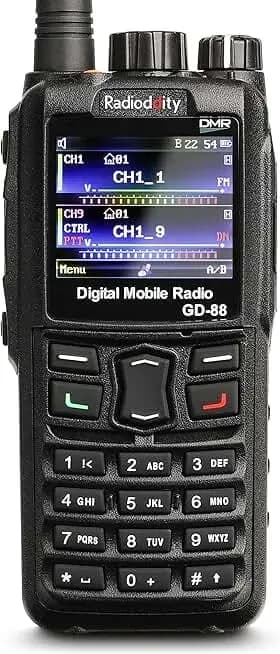
The GD-88 is the most fully equipped radio Radioddity makes, with GPS and cross-band repeat that nothing else in the line offers. It combines DMR Tier II, APRS, and integrated GPS in a dual-band (VHF/UHF) handheld that lists at $154.99. That trio of features at that price is genuinely uncommon; you usually pay more, or give something up. It also does cross-band repeat and dual standby across two independent VFOs, so you can monitor an analog repeater and a digital talkgroup at the same time without flipping modes.
It scores a 65 overall, with a strong value score of 84 and a feature score of 54. The weak spot, and it's a real one, is usability. The beginner score sits at 39 because DMR codeplug management is a steep climb on any radio at this price, and the GD-88 does little to flatten it. Owner feedback backs this up: people love the hardware and the feature set, but the programming software draws consistent criticism for being clunky, and a few report buggy firmware behavior and quirky analog tone decoding. Its Amazon rating is a middling 3.9 across 92 reviews, which is the lowest customer rating in the lineup despite the best feature set.
Who it's for: a Technician or General operator who already understands DMR, or is willing to learn it through CHIRP and community codeplugs, and wants GPS and cross-band repeat in a sub-$150 DMR handheld. If you don't need GPS, the cheaper GD-168 covers similar DMR and APRS ground for less. Who it's not for: anyone who wants plug-and-play. If a smooth out-of-box experience matters more than features, look at the AnyTone AT-D878UVII Plus instead and pay the difference. We put them head to head in our GD-88 vs AnyTone 878 comparison.
Radioddity GS-10B: the best first analog radio
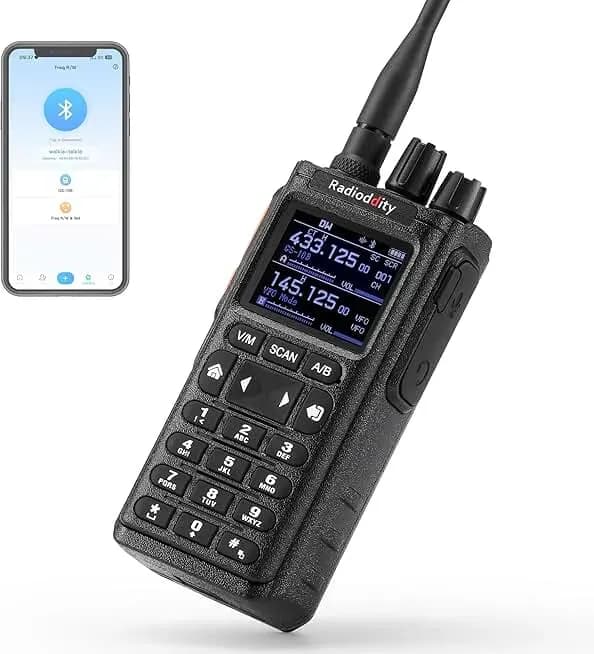
The GS-10B is the value standout of the line and our pick for a first analog handheld. At $47.99 it gives you tri-band coverage (VHF, UHF, and the 1.25m band) with 8W of output, which is credible RF for the price, plus a 2,500mAh battery that holds up for casual field use. It earns the highest overall score of any Radioddity radio we track at 73, driven by a near-perfect value score of 95 and a beginner score of 90, the highest in the line.
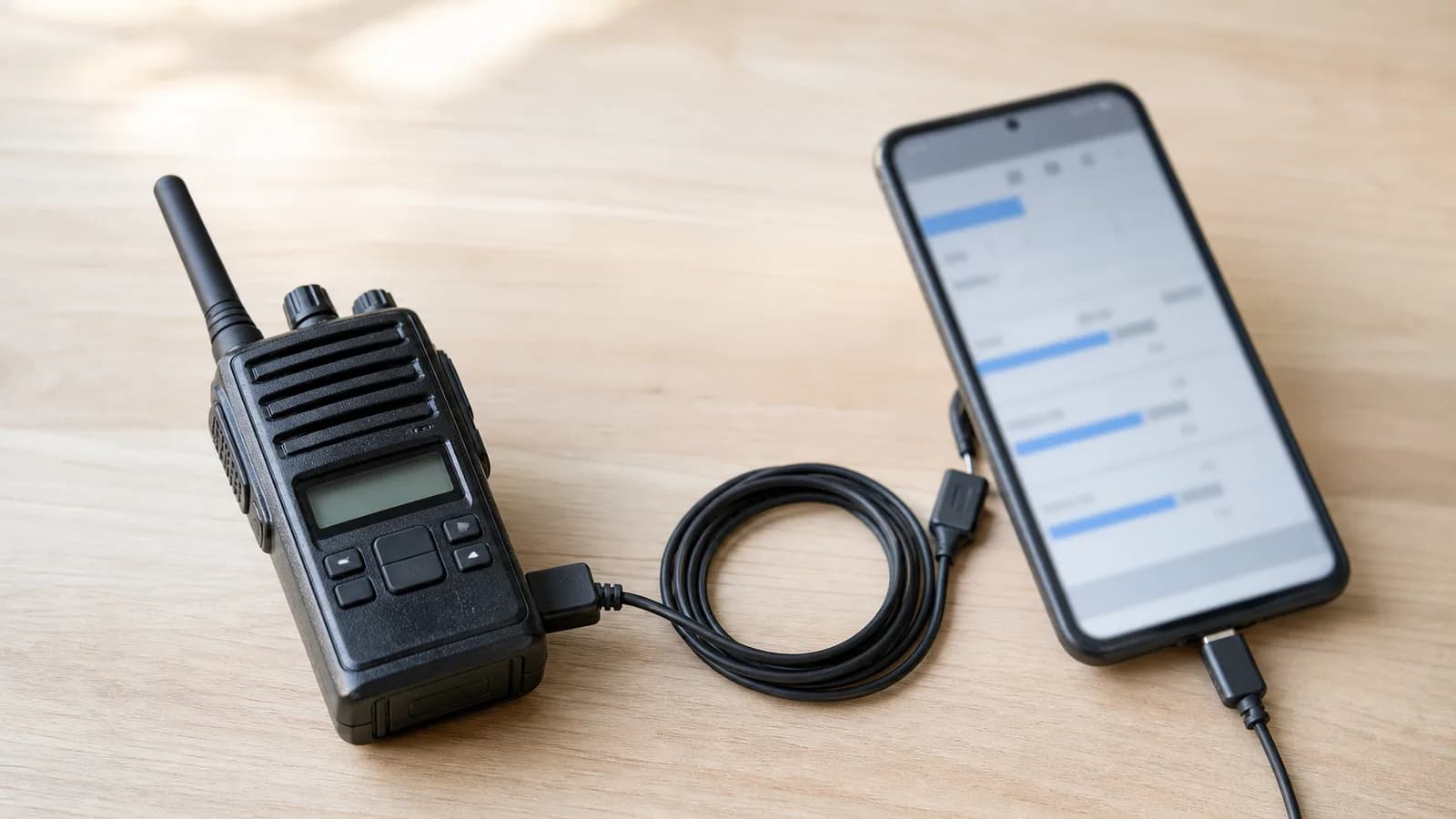
The headline convenience is Bluetooth programming through Radioddity's app. That matters more than it sounds. The single biggest hurdle for new hams is the programming-cable-and-software ritual, and being able to set channels from your phone removes the most common point where beginners get stuck. It also supports CHIRP over a cable, so the free software most hams already use is on the table if you prefer the desktop workflow. The trade-offs are honest ones for the price: the feature set is thin (no digital modes, no APRS), there's no water-resistance rating, and quality control on radios this cheap can be inconsistent. Some owners have also flagged spurious-emission concerns, which is worth knowing if you care about clean transmit performance.
Who it's for: a newly licensed Technician who wants a low-stakes first radio, or anyone building a budget emergency kit who wants tri-band simplex coverage without spending real money. See it ranked against the field on our best radios for beginners and best radios under $50 pages.
Radioddity GA-510: the ten-watt budget workhorse
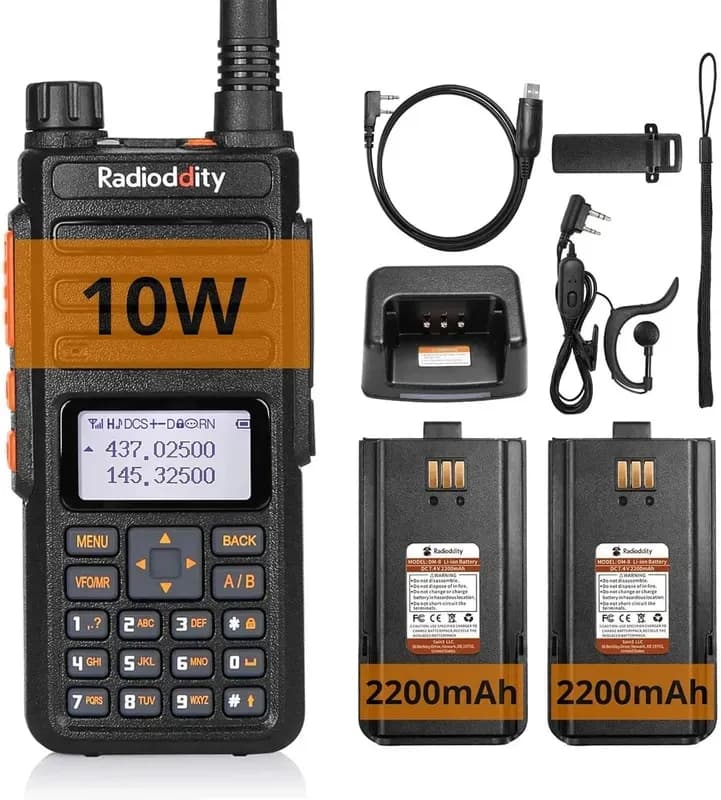
The GA-510 is the simplest radio here and, at $39.99, the cheapest. It's a no-frills VHF/UHF FM handheld whose one standout spec is 10W on high power, which is genuinely useful for stretching simplex range or reaching a repeater from the fringe of its coverage. It ships with two 2,200mAh batteries and a programming cable, and it's CHIRP-compatible, so you can run it through a full day, swap packs, and program channels with the same free software most hams already use. It carries the largest review base in the lineup by far at 602 ratings and a solid 4.3 average, which tells you a lot of people have bought one and mostly been happy.
It scores 65 overall: a value score of 94, but a feature score of just 21 that reflects exactly what it is. No DMR, no APRS, no digital anything. Owners note a couple of ergonomic quirks, namely a volume knob that's easy to bump and an LCD backlight that runs bright, but the core complaint is simply that it's basic. That's the point.
Who it's for: a new Technician building a first kit, or an experienced operator who wants a cheap, disposable handheld for a go-bag where 10W of analog reach matters more than features. It's a natural cross-shop against the Baofeng UV-5R, and the extra wattage is the GA-510's main argument; see the GA-510 vs UV-5R comparison and our Baofeng UV-5R review for the other side. If you're torn between the two cheapest Radioddity radios, the GA-510 vs GS-10B comparison lays out the tri-band-and-Bluetooth versus raw-power trade.
Radioddity GD-168: the budget DMR surprise
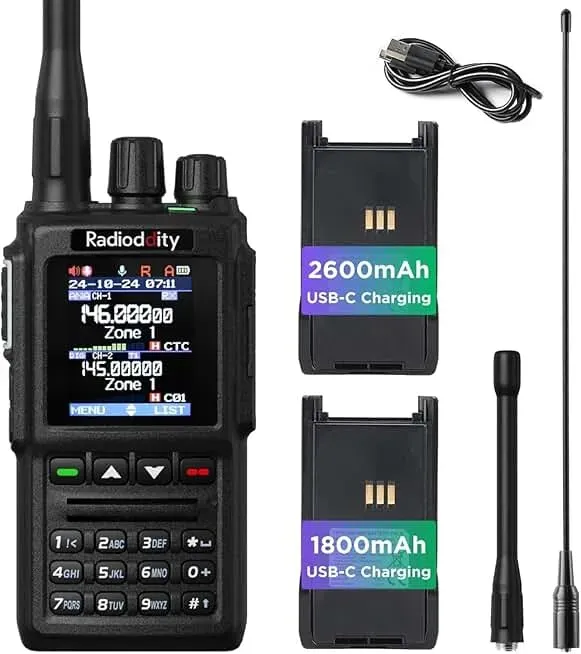
The GD-168 is the radio that surprised us most in this lineup. It's a dual-band DMR Tier I and II handheld with APRS (digital and analog), 5W of output, a 1.77-inch color TFT display, USB Type-C charging, and a deep 4,000-channel memory, all for $129.99. That's a similar feature set to the GD-88 for less, with the main omissions being the GD-88's built-in GPS and cross-band repeat.
It scores 71 overall, second only to the GS-10B in the Radioddity line and ahead of the GD-88. The value score of 89 and feature score of 59 both lead the brand's digital radios, helped by the color screen, the 5W rating, and the lower price. The catch is the one that hits every DMR radio at this tier: the beginner score is 46 because DMR programming has a learning curve, and you'll be using Radioddity's CPS software rather than CHIRP. The review base is also thin, just 12 Amazon ratings averaging 4.2 stars, so there's less long-term owner data than the better-established GD-88 has.
Who it's for: a budget-minded operator who wants DMR and APRS with a modern color screen and Type-C charging, and who doesn't need GPS. Who it's not for: anyone who wants GPS position reporting or cross-band repeat, where the GD-88 is the better buy, or anyone who'd rather trust a proven track record than a newer release. See how it ranks against other digital handhelds on our best DMR radios page.
Head-to-Head: The Radioddity Lineup
Here is the whole line side by side. The pattern is easy to read once it's laid out: the two analog radios win on price and simplicity, while the two DMR radios, the GD-168 and GD-88, carry the features. Every model lands at 65 or higher, so this is more about matching a radio to your needs than avoiding a dud.
| Spec | GD-88 | GS-10B | GA-510 | GD-168 |
|---|---|---|---|---|
| Price | $149.99 | $47.99 | $39.99 | $139.99 |
| Bands | VHF/UHF | VHF/UHF/1.25m | VHF/UHF | VHF/UHF |
| High power | Not listed | 8W | 10W | 5W |
| Digital modes | DMR, APRS, GPS | None | None | DMR, APRS |
| Programming | CPS software | CHIRP, BT app | CHIRP, cable | CPS software |
| Display | Color | Color LCD | Monochrome LCD | 1.77" color TFT |
| Memory channels | 200 | 256 | 128 | 4,000 |
| Overall score | 65 | 73 | 65 | 71 |
| Value score | 84 | 95 | 94 | 89 |
| Amazon rating | 3.9 (92) | 4.5 (23) | 4.3 (602) | 4.2 (12) |
A quick decision tree from that table:
- Want DMR with GPS? GD-88. It's the only one with built-in GPS, plus cross-band repeat.
- Want DMR for less, with a color screen? GD-168 at $139.99, if you can live without GPS.
- First analog radio, tight budget? GS-10B for tri-band and easy programming, or GA-510 if you'd rather have 10W and a second battery.
- Want maximum transmit power for the money? GA-510 at 10W.
Radioddity vs the Competition
Most people researching Radioddity are really asking "should I buy this instead of a Baofeng, an AnyTone, or a Yaesu?" Here's how it shakes out.
Versus Baofeng. This is the closest fight and the one that matters most for the GA-510 and GS-10B. Baofeng owns the rock-bottom price, but Radioddity's budget radios add things Baofeng often doesn't: the GA-510's 10W output beats the UV-5R's typical 5W, and the GS-10B's Bluetooth programming sidesteps the cable hassle entirely. For a true throwaway second radio, Baofeng still wins on price. For your one main first radio, the extra ten or twenty dollars for a Radioddity buys real convenience or power. Our best Baofeng radios guide covers the other side of that decision.
Versus AnyTone. This is the GD-88's fight, and it's the brand comparison that comes up most for DMR buyers. AnyTone's AT-D878UVII Plus is the more refined DMR handheld: better software, smoother programming, a more polished out-of-box experience, and a larger community. It also costs more. The GD-88 undercuts it and throws in APRS and GPS, but you pay for that value in setup friction and buggier firmware. The rule of thumb: if you value your time and want it to just work, AnyTone. If you value features per dollar and don't mind tinkering, Radioddity.
Versus Yaesu and the Japanese brands. This isn't really a feature fight, it's a philosophy fight. A Yaesu FT-70DR or FT-65R costs more and does less on the spec sheet, but you're paying for receiver quality, durability, and a radio that will still be worth something in five years. Radioddity competes on value and features, not on build pedigree or resale. If longevity and a premium feel matter to you, that's a different budget and a different brand.
The short version: Radioddity wins on features-per-dollar and on cheap-radio convenience. It loses on software polish, water resistance, and the kind of long-term reliability that the premium names are known for.
Build Quality, Software, and Support
Build quality across the Radioddity line is what you'd expect for the price: polycarbonate chassis, rubberized grips on the better models, and standard SMA antenna connectors that make antenna upgrades easy. None of the four radios we track carries a published IP water-resistance rating, which is the single most important durability caveat for this brand. Treat every one of these as a fair-weather radio. If you need a handheld that survives rain or a dunk, none of the current Radioddity lineup is built for it, and you should look at radios with a stated IP67 rating instead.
The ecosystem is where Radioddity is more uneven than the premium brands. Programming splits cleanly by model. The two analog handhelds, the GA-510 and GS-10B, are both CHIRP-compatible, so you can program them with the same free, open-source software most hams already use; the GS-10B adds Bluetooth app programming on top, which is the brand's best idea. The GD-88 and GD-168 are not CHIRP-compatible and rely on Radioddity's own CPS software instead, which on the GD-88 is the most common owner complaint. CHIRP does not program DMR radios like the GD-88 at all, so the manufacturer software is the only path there. Accessory availability is good: standard batteries, chargers, and aftermarket antennas are easy to find because Radioddity uses common connector standards. Firmware updates do happen, and there's an active enough owner community that codeplugs and setup guides for the popular models are usually a search away.
Customer support gets mixed but generally fair reviews. Radioddity has a US-facing presence and a stated warranty, which puts it ahead of buying an anonymous radio from a marketplace listing, but response quality varies and it isn't on par with the established names.
Common Radioddity Myths
A few things get repeated about Radioddity that are worth correcting.
"Radioddity radios are illegal." No. The amateur (ham) models are legal to operate with the appropriate license, the same as any other ham radio. The confusion usually comes from people transmitting on frequencies they aren't licensed for, or from GMRS-versus-ham mix-ups, which is an operator issue, not a brand issue. Get your Technician license and operate within your privileges and you're fine.
"They're cheap, so they'll break." Price and durability aren't the same thing. The GA-510's 602 owner ratings averaging 4.3 stars don't describe a radio that falls apart. The real durability caveat isn't fragility, it's the lack of any water-resistance rating across the line.
"They're just rebadged clones." Partly true, and not the insult it's framed as. Like several brands in this tier, some Radioddity models share hardware lineage with other manufacturers. What you're buying is Radioddity's selection, firmware, support, and warranty wrapped around that hardware. Whether that's worth it depends on the model, which is the whole point of this guide.
"DMR on a Radioddity is inferior." The GD-88's DMR audio and Tier II implementation are competent. The friction is the software and the setup, not the on-air digital quality. Once a GD-88 is programmed correctly, it holds its own.

Which Radioddity Is Right for You?
- You want DMR with GPS and cross-band repeat: GD-88. It does the most for $154.99, and you should be ready to learn the software.
- You want DMR for less: GD-168 at $129.99 covers DMR and APRS with a color screen, if you can skip GPS.
- You want your first analog radio and easy setup: GS-10B. Tri-band, 8W, and Bluetooth programming for under $50.
- You want the most transmit power for the least money: GA-510. 10W and two batteries for forty dollars.
- You're building an emergency or go-bag kit: GS-10B for tri-band coverage and price, or a pair of GA-510s for power and battery swaps. Either way, see our best radios for emergency preparedness.
- You're DMR-curious and want the smoothest experience, budget allowing: cross-shop the AnyTone 878 before committing to the GD-88.
For broader context on where these radios land against the whole field, our best handheld ham radios and best DMR radios pages rank them alongside everything else we track. If you want to sanity-check power and antenna math before you buy, the antenna length calculator and band chart are quick references, and the practice quiz is there if you're still working toward your license.
The Verdict
Radioddity is not a brand to recommend or dismiss as a whole, and anyone who tells you otherwise hasn't looked at the individual radios. But the lineup is more consistent than its budget prices suggest. All four radios we track land at 65 or higher: two strong-value analog handhelds and two capable DMR radios. The recurring weaknesses are shared ones, namely clunky programming software on the digital models and no water resistance anywhere in the range, rather than a single bad radio.
If you take the brand at its best, it's a strong middle-ground choice. The GD-88 gives DMR, APRS, and GPS to operators who want GPS and cross-band repeat and don't mind earning it through the setup. The GS-10B is one of the easiest first radios to recommend at $47.99, and the GA-510 is a legitimately good cheap workhorse with more power than its rivals. The GD-168 rounds out the line as a surprisingly strong budget DMR option, newer and less proven than the GD-88 but cheaper and higher-scoring on our board.
So is Radioddity the goldilocks brand the marketing implies? For the value-driven GS-10B and the two DMR radios, close to it; the GA-510 is more of a straight budget play. Buy the model that matches your needs, and Radioddity earns its place between the bargain bin and the premium shelf.