

Ask a room of DMR operators what handheld they actually carry and the AnyTone AT-D878UVII Plus comes up before anyone mentions a second brand. AnyTone has quietly become the default answer for amateur digital voice in the US, and it earned that position the unglamorous way: radios that pass their emissions testing, software that works more often than the competition's, and a distributor network that answers email. This guide covers all five AnyTone radios we track, three handhelds and two mobiles, plus the company behind the brand, how to decode its confusing model names, and where it falls short.
If you only remember one thing: the AT-D878UVII Plus is the radio to beat in amateur DMR handhelds, and as of October 2026 it sits near the top of our DMR handheld board. The rest of the lineup is a mixed bag, and one model is genuinely hard to recommend at its current price.
Quick Picks
| Radio | Best for | Price | Overall | Why |
|---|---|---|---|---|
| AnyTone AT-D878UVII Plus | DMR done right | $249.99 | 83 | DMR, APRS, GPS, and Bluetooth in the most polished package at this tier |
| AnyTone AT-D168UV | Budget DMR entry | $139.99 | 68 | DMR and APRS with a color screen for a hundred dollars less |
| AnyTone AT-D578UVIII PLUS | DMR in the vehicle | $494.99 | 75 | Tri-band 50W mobile with the full digital feature stack |
| AnyTone AT-778UV | Simple analog mobile | $124.00 | 68 | 25W dual-band basics, and the only CHIRP-friendly AnyTone here |
| AnyTone AT-D890UV | Wait for a price drop | $299.00 | 49 | Newest handheld, but it costs more than the 878 and does less |
Prices reflect the last figures we pulled from Amazon and move around; check the live product pages for current numbers.
How We Score
Every radio on RadioRanked gets a 0 to 100 score built from manufacturer specs and aggregated owner ratings, not a five-minute hands-on. Handhelds are scored across value, features, beginner-friendliness, and portability; mobile radios run through a mobile-specific version of the engine that drops portability and expects more transmit power. That means the handheld and mobile numbers in this guide aren't perfectly interchangeable, but within each category they rank cleanly. You can read the full methodology on our about page and dig into any radio's breakdown on its product page.
Who Is AnyTone?
AnyTone is the consumer brand of Qixiang Electron Science & Technology Co., Ltd, a radio manufacturer based in Quanzhou, in China's Fujian province. That's not a guess: Qixiang is the registered grantee behind AnyTone's FCC equipment authorizations, filing under grantee code T4K. The company builds two-way radios across the amateur, commercial, and export markets, and unlike some budget labels, it manufactures its own hardware rather than rebadging someone else's.
So the answer to "is AnyTone a Chinese company" is yes. The reason it sometimes feels American is BridgeCom Systems, the Missouri-based distributor that handles most US sales, support, and firmware guidance for AnyTone's amateur DMR line. BridgeCom doesn't own the brand; it's the US storefront and support desk. That arrangement matters in practice, because it means an AnyTone bought through US channels comes with English-language support and an active firmware pipeline, which is exactly the thing most Chinese budget brands lack.
The brand's reputation in the amateur world rests almost entirely on one product family: the 868/878 DMR handhelds. Since 2018 they've been the community's benchmark for what affordable digital voice should look like, to the point where club Elmers who would never recommend a Baofeng will hand a new DMR operator an 878 without hesitation.
Decoding AnyTone Model Names
AnyTone's naming looks like alphabet soup until you see the pattern. Nobody explains it, so here's the decoder ring.
| Piece | What it means |
|---|---|
| AT | AnyTone. Every model starts with it |
| D | Digital: the radio does DMR. No D means analog only |
| 8xx (868, 878, 890) | Handheld DMR families; 868 was the 2017 original, 878 its successor |
| 168 | The compact budget DMR handheld line |
| 578 | The DMR mobile family |
| 778, 779 | Analog dual-band mobiles |
| 5555, 6666 | 10-meter "export" radios; a different market, not covered here |
| UV | Dual-band VHF/UHF coverage |
| II, III | Generation number within a family |
| PLUS, PRO | Enhanced revisions; more battery, Bluetooth, or an extra band depending on the model |
So the AT-D578UVIII PLUS reads as: AnyTone, digital, 578 mobile family, dual-band coverage, third generation, enhanced revision. And in that specific case "enhanced" includes a third band; the 578UVIII PLUS transmits on 1.25m as well as VHF and UHF. Once you can read the names, the used market gets a lot less confusing, because an "878UVII Plus" and an "878UV" are the same family two revisions apart, not different radios.
The Lineup, Radio by Radio
We track five active AnyTone models: three handhelds and two mobiles.
AnyTone AT-D878UVII Plus: the DMR benchmark
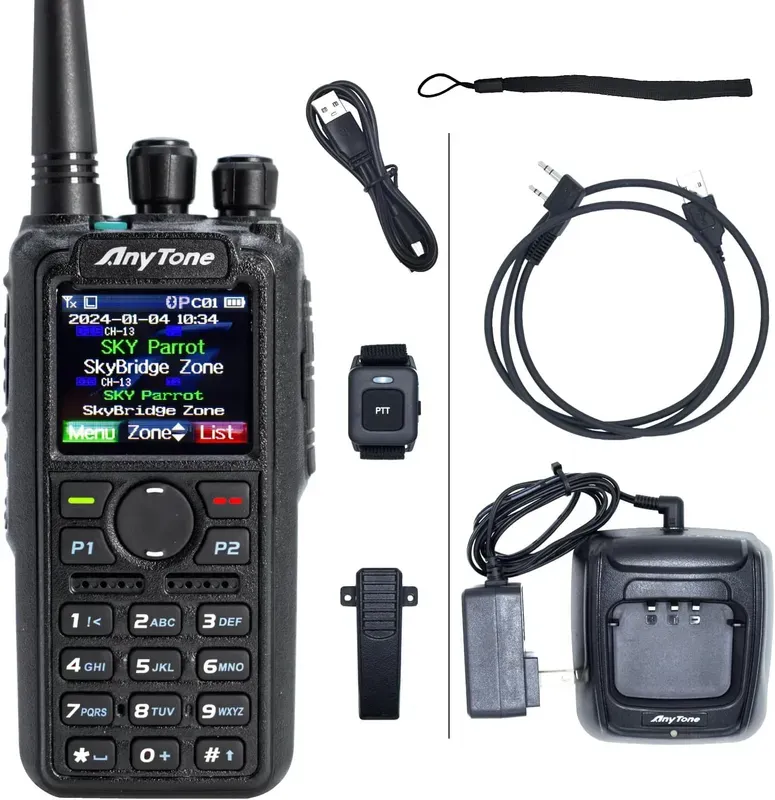
The 878 is the reason this brand has a reputation. It packs DMR Tier I and II, APRS, GPS, and Bluetooth into a dual-band handheld with 7W on high power, a 4,000-channel memory, a 3,100mAh battery, and an IP54 splash rating, all at $249.99. Its scores (overall: 83, feature: 84, value: 76) pair a full feature set with real value, a combination that almost never appears together in one radio.
Owner data is thinner than it looks: the Amazon listing this radio is sold under today is a new one for the II Plus, with 4.8 stars across just 6 ratings. The 655-rating history hams remember belongs to the retired gen-1 AT-D878UV listing, which is no longer on sale, so treat the current star rating as a sample too small to mean much. The battery draws consistent praise; one operator in a popular r/amateurradio thread reported six hours of marathon use, 70/30 receive to transmit, that moved the meter one bar. The recurring criticism is the APRS implementation, which several owners describe as clunky enough that they set it up once and stopped using it. And like every DMR radio, the codeplug learning curve is real; the beginner score (52) reflects a radio that's polished but not simple.
Who it's for: any operator who wants digital voice and is willing to spend a weekend learning DMR properly. We wrote a full AnyTone 878 review if you want the deep dive, and the 878 vs Radioddity GD-88 comparison covers the budget alternative. Who it's not for: analog-only operators, who are paying for a digital stack they'll never use.
AnyTone AT-D168UV: the budget DMR entry
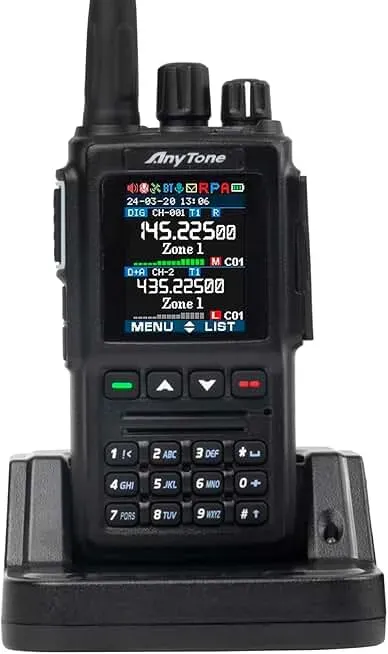
The D168UV is AnyTone's answer to the sub-$150 DMR question. For $139.99 you get DMR Tier I and II plus APRS, a 1.77-inch color TFT display, 5W of output, and the same cavernous 4,000-channel memory as the 878. Its overall score is 68 and its value score is 89. Feature-per-dollar is exactly what this radio is for.
The compromises are visible once you look. There's no GPS and no Bluetooth, the 1,800mAh battery is modest next to the 878's 3,100mAh, and the Amazon review base is thin and lukewarm at 3.7 stars across 16 ratings, a number worth watching but not yet conclusive. Like the 878 it programs through AnyTone's CPS software, not CHIRP, and DMR setup is no gentler here; the beginner score is 45.
Who it's for: a budget-minded operator who wants to try DMR and APRS without flagship money, and who can live without GPS. The D168UV vs 878 comparison lays out exactly what the extra $110 buys. It also fights in the same ring as Radioddity's budget DMR pair; our Radioddity brand guide covers that side.
AnyTone AT-D890UV: the hard sell
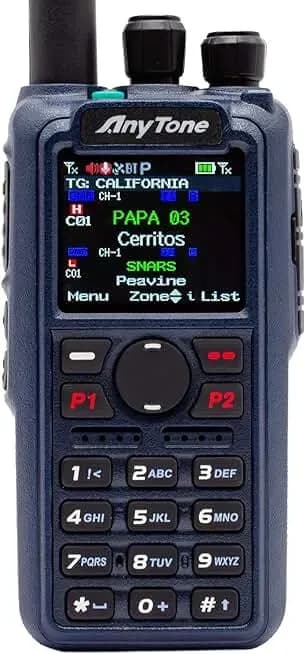
The D890UV is AnyTone's newest handheld, with an FCC grant dated January 2026, and it's the one radio in this lineup we'd tell most buyers to skip at the current price. It's a dual-band DMR handheld with a color LCD, a 3,100mAh battery, 4,000 channels, and AES256 encryption, listing at $299.00. Its overall score is 49, dragged down by its value score (29); it costs $49 more than the 878 while lacking APRS, GPS, and Bluetooth.
The encryption headline deserves a caveat: AES256 is a commercial feature aimed at business users under Part 90 rules. On amateur frequencies, encrypting message content is not permitted, so for a ham licensee that flagship spec is a feature you legally can't use. The 4.8-star Amazon rating looks shiny but sits on just 5 reviews, too few to mean anything yet.
Who it's for: honestly, commercial users who need encryption, or AnyTone loyalists who want the newest hardware and don't mind paying early-adopter prices. For everyone else the 878 vs D890UV comparison makes the case plainly, and the D168UV vs D890UV shows the budget model covering most of the same ground for $160 less. If the price drops meaningfully, this assessment changes.
AnyTone AT-D578UVIII PLUS: the DMR mobile flagship
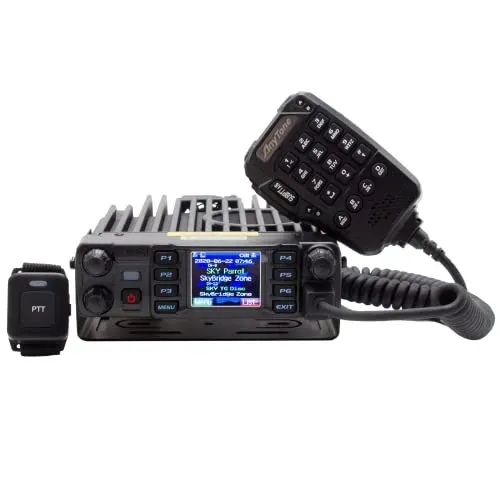
The 578UVIII PLUS is the 878's philosophy bolted into a vehicle: 50W on VHF, tri-band transmit including 1.25m, and the full digital stack of DMR, APRS, GPS, and Bluetooth. At $494.99 it's a serious purchase, with owners rating it 4.7 stars on Amazon. Its overall score is 75.
The tradeoffs mirror the handhelds. The beginner score (41) tells you the codeplug workload doesn't shrink when the radio gets bigger, and the most common owner gripe is physical: the control head doesn't detach, which complicates clean installs in modern vehicles where dash space is scarce. The value score (53) reflects a real price premium over analog alternatives; you're paying roughly $370 over a basic dual-band mobile for the digital modes and the third band.
Who it's for: a DMR operator who wants the same talkgroups in the truck that they have on their belt, or anyone doing serious mobile digital work. See how it ranks against the rest of the field in our best mobile ham radios roundup, and the 578 vs 778UV comparison covers the in-brand decision.
AnyTone AT-778UV: the simple analog mobile
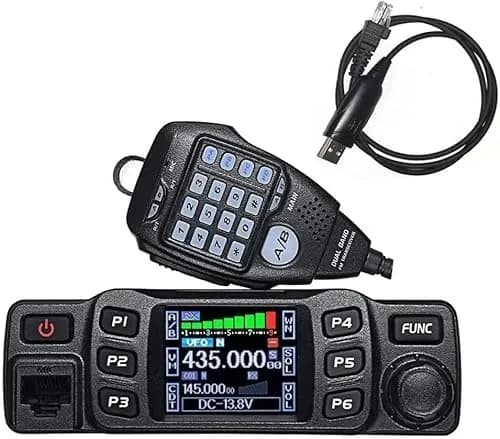
The 778UV is the odd one out in this lineup, and usefully so. It's a compact analog dual-band mobile, 25W, no digital anything, at $124.00. The feature score (29) says exactly what it is; the beginner score (89) says who it's for. It's also the only radio in this guide that plays nicely with CHIRP, because there's no DMR layer in the way; AnyTone's other analog mobiles, the AT-778UVII, AT-779UV and AT-5888UV, have CHIRP drivers too.
Owners like it for what it is; the Amazon rating sits at 4.4 stars, and the phrase that kept coming up in community threads was "good car radio." Its overall score (68) is held back because our mobile scoring engine expects 50W at this category's standard, and the 778UV's 25W and empty feature column cost it. As a first mobile for a new Technician who wants repeaters in the car without a codeplug in their life, it earns its spot.
Who it's for: new licensees, second vehicles, and anyone allergic to programming software. If that's you, skip the DMR tax entirely.
Head-to-Head: The AnyTone Lineup
The whole line side by side. The 878 anchors the handhelds, the 578 anchors the mobiles, and the D890UV's problem is visible in one row.
| Spec | D878UV | D168UV | D890UV | D578UVIII PLUS | 778UV |
|---|---|---|---|---|---|
| Type | Handheld | Handheld | Handheld | Mobile | Mobile |
| Price | $249.99 | $139.99 | $299.00 | $494.99 | $124.00 |
| Bands | VHF/UHF | VHF/UHF | VHF/UHF | VHF/1.25m/UHF | VHF/UHF |
| High power | 7W | 5W | Not listed | 50W | 25W |
| Digital modes | DMR, APRS, GPS | DMR, APRS | DMR | DMR, APRS, GPS | None |
| Bluetooth | Yes | No | No | Yes | No |
| Programming | CPS | CPS | CPS | CPS | CHIRP |
| Memory channels | 4,000 | 4,000 | 4,000 | Not listed | Not listed |
| Overall score | 83 | 68 | 49 | 75 | 68 |
| Value score | 76 | 89 | 29 | 53 | 85 |
| Amazon rating | 4.8 (6) | 3.7 (16) | 4.8 (5) | 4.7 | 4.4 |
A quick decision tree:
- Want the DMR handheld everyone else is running? The 878. It's the benchmark for a reason.
- DMR-curious on a budget? The D168UV covers DMR and APRS for $139.99.
- DMR in the vehicle? The 578UVIII PLUS, if the budget survives it.
- Just want repeaters in the car? The 778UV, and keep the extra $370.
- Tempted by the D890UV? Read its section again, then buy the 878.
AnyTone vs the Competition
Most people researching AnyTone are really deciding between it and one of three alternatives.
Versus Radioddity. This is the closest fight in budget DMR. Radioddity's GD-88 undercuts the 878 by about $100 and throws in GPS and cross-band repeat, but owners consistently report clunkier software and buggier firmware. The rule of thumb we used in the Radioddity guide holds in both directions: Radioddity wins on features per dollar, AnyTone wins on the experience of actually using the radio. If you value your time, the 878 is the smoother path; the head-to-head has the details.
Versus Baofeng. Baofeng's DMR entries like the DM-1701 cost half as much as an 878 and deliver a fraction of the polish, with community firmware doing a lot of rescue work. For a first experiment in DMR at minimum cost, that trade can make sense; our 878 vs DM-1701 comparison and best Baofeng radios guide cover it. For a radio you'll still be happy with in year three, the AnyTone premium keeps earning its keep.
Versus Yaesu, Icom, and Kenwood. The Japanese brands don't really compete in DMR handhelds; they bet on their own digital modes (C4FM, D-STAR). So the real question is which digital ecosystem your local repeaters use. If your area runs DMR, AnyTone is the safe default. If it's Fusion or D-STAR country, look at a Yaesu FT-70DR or its siblings instead, and check our best handheld ham radios roundup for the cross-brand view.
Programming: CPS, Not CHIRP
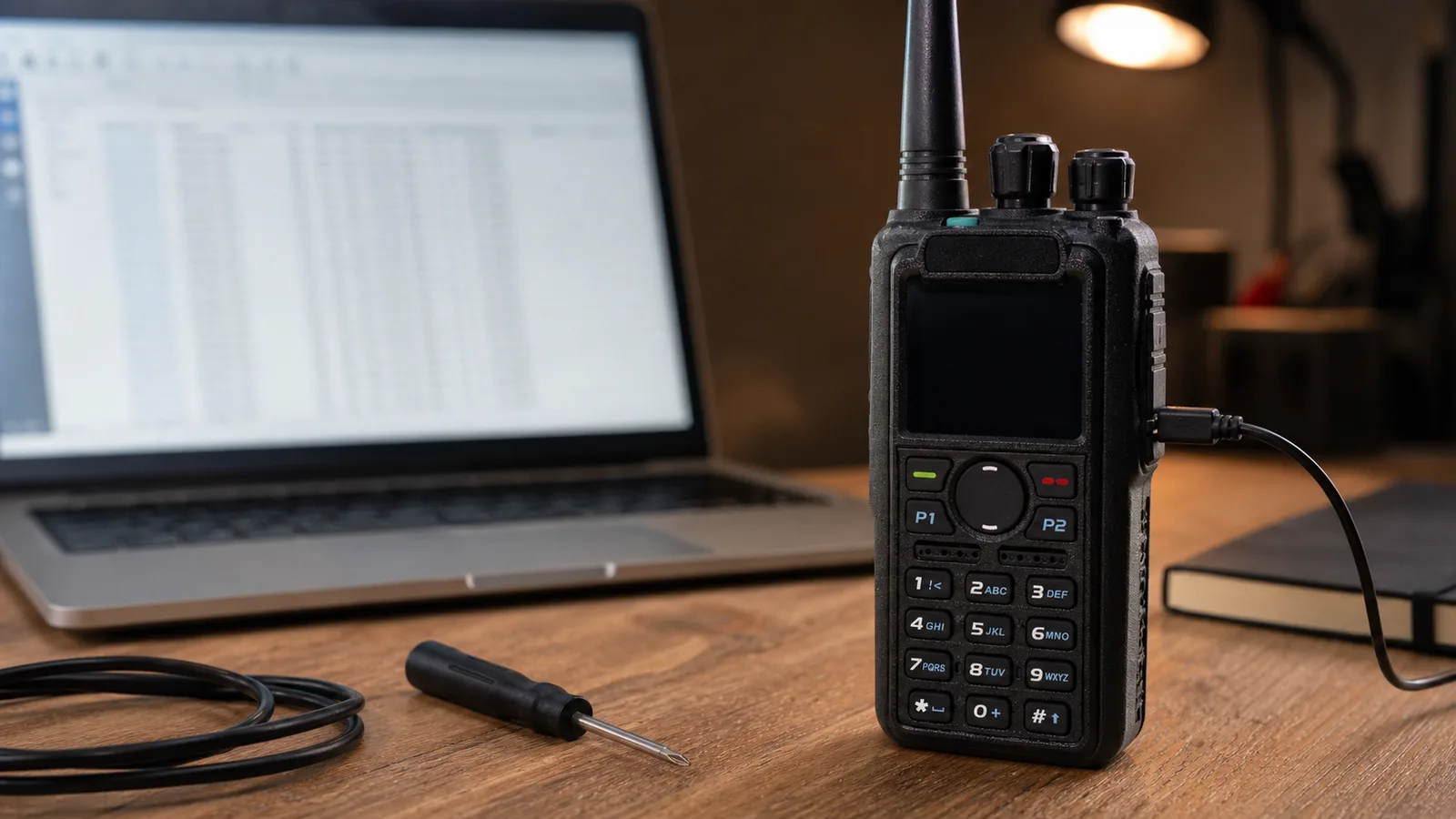
Here's the thing that surprises new AnyTone owners most: you don't program these radios with CHIRP. Every digital AnyTone, the 878, D168UV, D890UV, and 578, uses AnyTone's own CPS software, and DMR radios in general are outside CHIRP's lane. The workflow is a codeplug: a configuration file holding your channels, talkgroups, zones, and contacts list, built in CPS and written to the radio over a cable.
The honest version of the learning curve: your first codeplug is an evening of work and at least one moment of wondering why anyone does this. The saving grace is community; because the 878 is so common, downloadable codeplugs for most US metro areas are a search away, and starting from someone else's working file flattens the hill considerably. Keep backups of every revision that works; experienced DMR operators treat codeplugs like source code for a reason. If DMR is new to you entirely, our What Is DMR explainer covers talkgroups, time slots, and IDs before you buy anything.
The exceptions are AnyTone's analog mobiles, the 778UV in this guide among them, which work with CHIRP. If the previous two paragraphs sounded exhausting, that's your radio.

The FCC Paper Trail
We pull FCC equipment authorization data for every radio we track, and AnyTone's filings tell a story the marketing doesn't. All three handhelds carry Part 90 grants, the commercial land-mobile certification with stricter spurious-emissions requirements than a bare minimum amateur device needs. Independent bench tests shared by owners routinely show the 878 passing amateur spectral requirements with room to spare, which is consistent with hardware designed to clear the commercial bar.
| Model | FCC ID | Grantee | Grant date |
|---|---|---|---|
| AT-D878UVII Plus | T4KD878UVII | Qixiang Electron (T4K) | 2021-08-02 |
| AT-D168UV | T4K-D168UV | Qixiang Electron (T4K) | 2024-09-24 |
| AT-D890UV | T4K-D890UV | Qixiang Electron (T4K) | 2026-01-07 |
Those dates double as a product timeline: the 878 platform dates back to a 2018 grant for the original AT-D878UV and the II Plus has been certified since 2021, which explains both its maturity and its enormous codeplug ecosystem, while the D890UV is months old, which explains its thin review base and early-adopter pricing.
Which AnyTone Is Right for You?
- You want DMR and you want it to work: AT-D878UVII Plus. The extra spend over budget DMR alternatives buys polish you'll feel every day.
- You want to try DMR for the least money that isn't a gamble: AT-D168UV at $139.99.
- You want DMR in the vehicle: AT-D578UVIII PLUS, with eyes open about the non-detachable control head.
- You want a simple analog mobile: AT-778UV, the only CHIRP radio in this guide and its most beginner-friendly member.
- You're eyeing the D890UV: wait for a price drop, or buy the 878 instead.
For the wider field, our best handheld ham radios and best DMR radios pages rank the AnyTones against everything else we track. And if you're still pre-license, the practice quiz and band chart will get you moving; DMR is a lot more fun with your own callsign in the contacts list.
The Verdict
AnyTone is the rare budget-adjacent brand with a genuine flagship. The 878 isn't just the best AnyTone; it's the standard other DMR handhelds get measured against, and seven-plus years of firmware updates and community codeplugs have compounded that lead. Around it, the lineup is honest if uneven: the D168UV is a legitimate budget path into DMR, the 578UVIII PLUS brings the same competence to the dash, and the 778UV is a perfectly decent analog mobile hiding in a digital brand's catalog. The D890UV is the outlier, a radio whose price needs to fall before its spec sheet makes sense for hams.
The brand's real moat isn't hardware at all. It's the combination of Part 90-grade engineering, BridgeCom's US support pipeline, and a community so large that whatever problem you hit, someone has already posted the fix. In a market segment where "you get what you pay for" usually means disappointment, AnyTone is the brand where paying a little more actually buys you something.