

Search for "Midland GMRS radio" and Google hands you Midland's own store, three retailer grids, and a shopping carousel; nobody actually explains the lineup. That gap matters, because Midland's naming system quietly spans two different radio services, and buying the wrong letters means buying a radio that legally cannot do what you expected. This guide decodes every Midland family, compares all six MicroMobile GMRS mobiles we track with live pricing and owner data, and pulls the FCC registry records that Midland's marketing never mentions.
If you only remember one thing: the MXT275 is the Midland most people should buy, a 15-watt mobile with every control on the mic and a 4.7-star average across more than 2,200 Amazon ratings. And if you were about to buy an MXT115, read the MXT115P PRO section first, because Midland has quietly replaced that radio and the two are not the same.
Quick Picks
| Radio | Best for | Price | Rating | Why |
|---|---|---|---|---|
| Midland MXT275 | Most people | $199.99 | 4.7 (2,272) | Mic-mounted controls, proven install base, the line's best owner record |
| Midland MXT105 | Cheapest way in | $122.99 | 4.6 (457) | 5W simplex trail radio, zero install commitment |
| Midland MXT115P PRO | The modern 15W | $219.99 | 4.7 (27) | IP67 waterproofing, brand new hardware, tiny review base so far |
| Midland MXT115 | Clearance hunters | an unlisted price | 4.5 (1,252) | Discontinued but still sold on Amazon; only worth it under the 115P's price |
| Midland MXT575 | Maximum power | $439.99 | 4.6 (256) | 50W, split-tone repeater support, controls on the mic |
| Midland MXT500 | 50W, body controls | $439.99 | 4.5 (178) | Same power as the 575 with a traditional front panel |
Prices reflect the last figures we pulled from Amazon and move around; check the live product pages for current numbers.
How We Rank These
GMRS radios do not get the 0 to 100 score we give ham handhelds and mobiles. They are fixed-channel appliances by design, and published spec sheets are too thin to score honestly. What we rank on instead: aggregated owner ratings from the Amazon data we refresh daily, the FCC equipment authorization registry (every radio in this guide holds a verified Part 95E grant, and we pulled each one), and the spec facts that actually separate these radios, wattage, repeater support, and control layout. Where the community has a settled verdict, we say so and say where it came from.
Who Is Midland?
Midland Radio Corporation is a Kansas City, Missouri company that has been putting consumer two-way radios on American shelves since 1959, back when the product was CB. Today it is the closest thing GMRS has to a household name: the brand you see at farm supply stores, the officially licensed radio partner of Jeep, and the default answer when an overlanding forum asks "what do I put in the truck?"
That heritage shows up in a place most buyers never look: the FCC registry. Midland files equipment authorizations under grantee code MMA, a three-letter code from the era before 2013, when the FCC moved to five-character codes. Every Chinese competitor in our GMRS catalog files under a modern 2A-prefix code granted in the last decade. You can look any of these up yourself; Midland's paper trail goes back generations of products.
The trade-off, and this guide will be blunt about it, is that Midland sells simplicity at a premium. You pay more per watt than the Radioddity and Wouxun alternatives, and the entry-level radios give up repeater flexibility that the competition includes. Whether that trade is worth it depends on which Midland you buy, which is exactly what the rest of this guide is for.
Decoding Midland Model Names
Midland's catalog looks like alphabet soup, and the most important fact about it is buried: some Midland families require a GMRS license and some do not, because they are not even the same radio service. Here is the decoder.
| Family | What it is | Service | License needed? |
|---|---|---|---|
| MXT (MicroMobile) | In-vehicle GMRS mobiles, the radios in this guide | GMRS | Yes |
| GXT | Full-power GMRS handhelds (GXT1000VP4, GXT67 Pro) | GMRS | Yes |
| T2xx (T290, T295) | "High-powered" GMRS handhelds | GMRS | Yes |
| X-Talker (T10 to T75) | Family walkie-talkies | FRS | No |
| LXT | Budget family walkie-talkies | FRS | No |
| BizTalk (BR, MB) | Business radios | Part 90 business | Separate business license |
| MXR | GMRS repeater (MXR10, a 10W portable) | GMRS | Yes |
| MXPW | Portable "ammo can" base stations | GMRS | Yes |
| ER | Emergency and NOAA weather receivers | Receive only | No |
Suffixes: VP means "value pack," a bundle with chargers or headsets (GXT1000VP4 is the radio plus accessories, not a different radio). A trailing J is a Jeep-branded edition, and P or PRO marks a refreshed generation.
The numbers inside MXT names loosely encode wattage, MXT105 is 5 watts and MXT115 is 15, but do not lean on the pattern: the MXT275 is also 15 watts, and the 50-watt radios are the MXT500 and MXT575. When in doubt, use the table above.
The FRS versus GMRS split is the one that bites buyers. An X-Talker from a big-box store is an FRS radio: 2 watts, fixed antenna, legal for anyone with no license. The GXT and MXT lines are GMRS: more power, real antennas, repeater access on most models, and a legal requirement for a GMRS license, which is $35, covers your whole family for ten years, and has no exam. If the difference between the two services is new to you, our FRS vs GMRS explainer covers it properly.
The MicroMobile Lineup, Radio by Radio
We track all six current and recent MXT mobiles with daily-refreshed pricing and owner data.
Midland MXT105: the cheapest way in
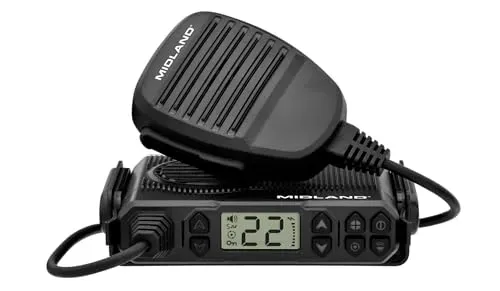
$122.99 · 5.00W
The MXT105 is the entry ticket: 5 watts, 15 GMRS channels, 142 privacy codes, NOAA weather scan with alerts, and a magnetic-mount antenna in the box. It runs off a 12-volt outlet, so it goes from cardboard box to dashboard in ten minutes with zero permanent install. Owners rate it 4.6 across 457 Amazon ratings, and the jump from a handheld to 5 watts with a roof-mounted external antenna is a bigger real-world range upgrade than the wattage number suggests.
The hard limitation: no repeater channels at all. The MXT105 is simplex only, which makes it a dead end if you ever want the extended range a local repeater network provides. Buy it for trail convoys and farm chatter where everyone is within a few miles; buy up if repeaters are anywhere in your future.
Midland MXT115: the discontinued one still on shelves
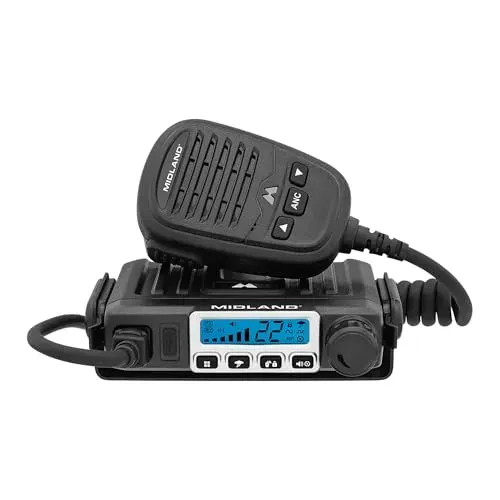
The MXT115 was Midland's entry 15-watt mobile for years: same dead-simple channel-number operation as the 105, plus 8 repeater channels and the NOAA scan. It built a 4.5-star record across more than 1,250 ratings, and its Amazon listing currently reads unavailable.
Here is what the listing does not tell you: Midland has removed the MXT115 from its own site and replaced it with the MXT115P PRO. At current prices the two are about a dollar apart, which makes the old model hard to recommend at full freight; the changeover section below walks through the differences. It stays in this guide because plenty of stock is still out there, and at a genuine clearance price it remains a competent radio with a long owner track record.
Midland MXT115P PRO: the next generation, barely broken in
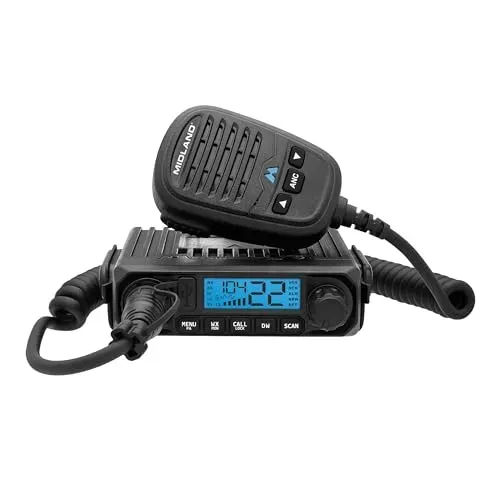
$219.99 · 15.00W
The MXT115P PRO is Midland's 2026 refresh of the 15-watt tier, and the headline change is an IP67 waterproof rating, real weatherproofing for open-cab vehicles, side-by-sides, and boats, which the old MXT115 never had. Street price runs about $201 against a $219.99 list at Midland.
The FCC registry tells an interesting story about how new this radio is. The original grant, dated July 11, 2025, covered only the 462 MHz main channels; a Class II permissive change granted June 5, 2026 added the 467 MHz repeater inputs. Translation: this hardware platform earned its repeater capability mid-life, and very early units predate it. It is also simply too new to have an owner verdict, 4.7 stars from 27 ratings is a start, not a track record. If you want the 15-watt Midland with body-mounted controls in 2026, this is the one to buy; just know you are an early adopter.
Midland MXT275: the one most people should buy
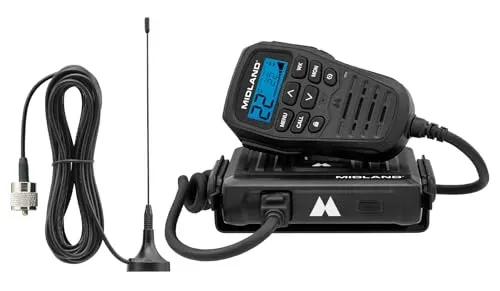
$199.99 · 15.00W
The MXT275 is Midland's bestseller for a reason that is obvious the moment you see one installed: the radio body hides behind the dash and every control lives on the handheld microphone. In a modern vehicle with no spare dash real estate, that is the difference between a clean install and no install. It pushes the same 15 watts as the MXT115 on main channels 15 to 22 (channels 1 to 7 are capped at 5 watts ERP by 47 CFR 95.1767), covers 8 repeater channels, and carries the NOAA scan and 142 privacy codes.
The owner record is the strongest in the entire Midland line: 4.7 stars across 2,272 Amazon ratings on the listing we track. The community's honest read matches ours from the GMRS mobile roundup: 15 watts is plenty for trail and simplex work once the antenna is sorted (the MXTA26 upgrade antenna is the consensus first accessory), and the 8 repeater channels support split tones on the revised version Midland's September 2021 announcement introduced, which is the one with a USB-C port for charging phones and other devices. A used unit without that port may be standard-tone only, so check before buying.
Midland MXT500: full power, traditional controls
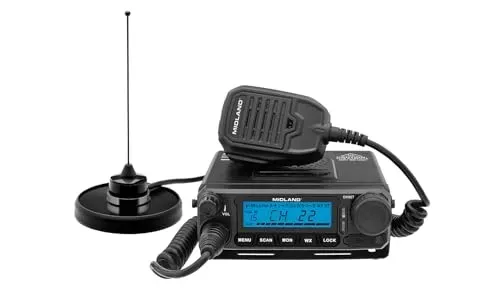
$439.99 · 50.00W
The MXT500 is one of Midland's two 50-watt flagships, and 50 watts is the legal ceiling for GMRS main channels. Its FCC grant, dated May 2021, covers the 462 MHz mains, the 462 interstitials, and the 467 MHz repeater inputs, and it supports split-tone repeater access, as the revised MXT115, the MXT115P and the revised MXT275 do. It keeps a traditional control panel on the radio body, which some operators genuinely prefer: physical knobs you can find without looking.
Owners put it at 4.5 across 178 ratings. The honest caveat applies to both 50-watt Midlands: at $439.99 this radio costs more than four MXT105s, and the range gain from 15 to 50 watts is far smaller than the marketing implies. UHF range lives and dies on antenna height and quality; buy the MXT500 for split-tone support, install headroom, and the wideband punch, not because the wattage number tripled.
Midland MXT575: the flagship, controls on the mic
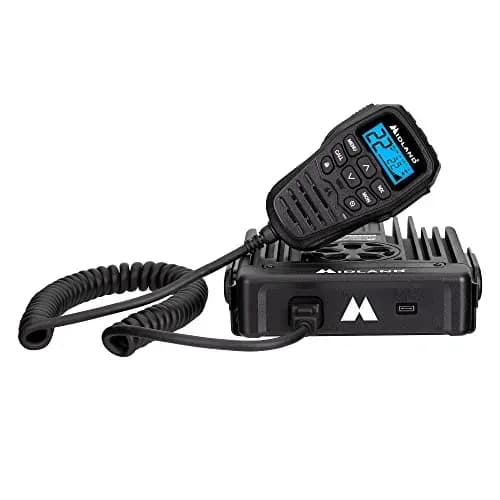
$439.99 · 50.00W
The MXT575 is the MXT500's twin with the MXT275's party trick: all 50 watts, split-tone repeater support, and every control on the handheld mic so the body can vanish behind the dash. That combination, maximum power plus the cleanest possible install, is why our GMRS mobile roundup called it the 50-watt radio to grow into. Owner data backs it: 4.6 stars across 256 ratings, and it is the Midland we see moving in real volume, with Amazon reporting 100+ bought in the past month.
At $439.99 it costs the same as the MXT500, so the choice between them is purely ergonomic: mic controls (575) versus body controls (500). If you do not have a strong preference, the 575's install flexibility wins in most modern vehicles.

MXT115 vs MXT115P PRO: the changeover
Midland's own site now leads with "Meet the Next Generation" and no longer sells the base MXT115. Amazon still does, and at nearly identical prices ($199.99 old, $200.99 new) the decision is not close:
- Weatherproofing: the 115P carries an IP67 rating; the 115 has no ingress rating. For open vehicles this alone decides it.
- Track record: the 115 has 1,250+ ratings, the 115P has 27. If you buy the P, you are trusting Midland's platform reputation rather than this specific radio's history.
- Repeater capability: both cover repeaters, with a footnote. The 115P's original July 2025 FCC grant covered only the 462 MHz mains; the 467 MHz repeater inputs arrived via a permissive change in June 2026. Very early 115P units predate that capability, so if you buy one secondhand, verify it.
- Price: a dollar apart at the time of writing. If the old 115 drops to genuine clearance pricing, say $150 or below, it becomes a rational budget buy; at parity, buy the new one.
What Owners Criticize
No brand guide is honest without the complaint list, and Midland's is consistent across the community sources we scraped for the GMRS mobile roundup.
Repeater flexibility on the entry models. The recurring one. The MXT105 has no repeater channels. The MXT115 and MXT275 cover 8 repeater channels with split tones on the revised version Midland's September 2021 announcement introduced, recognisable by its USB-C device-charging port; older units without it may be standard-tone only. The MXT115P PRO lists split privacy tones on its product page.
You pay for the badge. A Radioddity DB20-G delivers 20 marketed watts (19.5 measured, per its FCC filing), full repeater capability, and CHIRP support for $99.99. The MXT115 asks double that for 15 watts and less repeater flexibility. What Midland's premium actually buys is simplicity, US-based support, and the most idiot-proof radios in the service; whether that is worth a 2x price is a personal call, and we lay out the comparison honestly in the roundup.
Fixed-channel appliances, mostly. The MXT105, MXT115 and MXT275 are not field-programmable the way Chinese GMRS mobiles are: no CHIRP, no custom channel plans, no tinkering. The MXT500 and the MXT115P are the exceptions, with Midland programming software (MXT115P page). For the target buyer that is the entire point. For anyone who enjoys radio as a hobby rather than a tool, the appliance design chafes quickly.
Wattage marketing. Midland (like everyone in GMRS) sells the wattage number hard. The physics: UHF range is dominated by antenna height, antenna quality, and terrain, and our guide to ham radio range will show you how little a 3x power jump moves the needle. The community consensus purchase order is antenna first, watts second.
The FCC Paper Trail
Part 95E certification is what makes a radio legal to transmit on GMRS, and it is the one claim we can verify from the registry rather than take from marketing. Every Midland in this guide checks out:
| Radio | FCC ID | Granted | Notes |
|---|---|---|---|
| MXT105 | MMAMXT105 | June 2016 | Hardware revision (MMAMXT105B) filed 2021 |
| MXT115 | MMAMXT115 | Nov 2016, modified June 2021 | Carries Part 95A + 95E rule parts |
| MXT115P PRO | MMAMXT115P | July 2025 | Repeater inputs added by permissive change, June 2026 |
| MXT275 | MMAMXT275 | June 2021 | Part 95E + 95A |
| MXT500 | MMAMXT500 | May 2021 | Grant covers mains, interstitials, and 467 MHz repeater inputs |
| MXT575 | MMAMXT575 | April 2021 | Part 95E + 15B |
All six file under grantee code MMA, Midland Radio Corporation, 5900 Parretta Drive, Kansas City. You can verify any of these, or any radio you are considering from any brand, with our FCC ID lookup tool. If a GMRS radio's seller cannot point to a Part 95E grant, walk away; uncertified transmitters are the fastest way to turn a $35 license into an FCC enforcement letter.

Midland vs the Alternatives
Against Radioddity: the DB20-G at $99.99 is the community's default first mobile and the value benchmark Midland cannot touch; the newer DB35-G adds 35 watts and a detachable faceplate for $113.99. Radioddity wins on flexibility and price per watt, Midland wins on simplicity and the dealer-network warranty experience. New to mobile GMRS and comfortable with a small learning curve? Start with the DB20-G. Want the radio to work like a kitchen appliance? Midland.
Against Wouxun: the KG-1000G is what GMRS repeater regulars actually run, with the most flexible tone and channel configuration in consumer GMRS. It is also frequently out of stock on Amazon (it is offer-less on our tracked listing right now) and its interface assumes you know what you are doing. The MXT575 is the Midland answer: less flexible, far friendlier.
For handhelds: we now track both ends of Midland's GXT line, and they are not close to being the same class of radio. The GXT67 PRO is the serious one: a 2023 FCC grant certified under Part 95E, covering the 462 MHz channels and the 467 MHz repeater inputs at just under 5 watts, with IP67 sealing. Midland sells it in pairs, so budget about $220 per radio.
The GXT1000VP4 is the volume seller, more than 13,000 Amazon ratings at 4.4 stars for a rechargeable pair under $100, and it is the radio most people mean when they say "Midland walkie talkies." Two caveats we would want to be told. The "up to 36 miles" is a hilltop-to-hilltop figure, as it is on every radio sold that way. And we could not find an FCC grant filed under the GXT1000 or GXT1030 model numbers: the nearest Midland handheld filing in the registry is the GXT1050P from 2015, certified under Parts 95A and 95B at about 3 watts, naming no other models. That is not evidence of a problem, but it is why the GXT67 PRO is the one we can show paperwork for.
Among the rest, the Rocky Talkie 5 Watt still owns the rugged-outdoors niche Midland's X-Talkers gesture at, and our best GMRS radios guide covers the certified handheld field. Just remember the decoder table: an X-Talker is FRS, not GMRS. For the full picture, see how the Midland handhelds rank on transmit power and owner ratings.
Which Midland Is Right for You?
- You want a radio in the truck this weekend, minimum fuss: MXT275. Mic controls, proven, $199.99.
- Cheapest possible mobile setup for trail runs: MXT105, accepting simplex only.
- Open cab, side-by-side, boat, or weather exposure: MXT115P PRO for the IP67 rating.
- Repeaters matter and you want Midland: MXT575 (or the MXT500 if you prefer knobs on the radio body). Both support split tones, as do the MXT115P and the revised MXT115 and MXT275 (the versions with a USB-C port).
- Repeaters matter and the brand does not: the Wouxun KG-1000G or Radioddity's mobiles give you more flexibility per dollar.
- A pile of radios for a family campout: Midland's X-Talker FRS packs are fine and need no license, but that is a different product category; see FRS vs GMRS.
Whichever way you go, the license comes first: $35, no exam, ten years, covers the whole household. Using GMRS power without one risks real FCC penalties, and the license is genuinely a fifteen-minute errand.
The Verdict
Midland earned its position the way legacy brands do: by being the safe answer. The radios are simple to the point of appliance-hood, the support is domestic, the FCC paper trail is decades deep, and the owner ratings across the MXT line, 4.5 to 4.7 with thousands of reviews behind the bestsellers, say the strategy works. You accept two costs: a real price premium over the Chinese competition, and limited repeater flexibility below the $400 tier.
Our picks stand: the MXT275 for most buyers, the MXT575 when power and repeater support justify the spend, and the MXT115P PRO for anyone whose radio will live outdoors. Skip the discontinued MXT115 unless it is genuinely on clearance, and remember that whatever you mount in the dash, the antenna on the roof matters more.