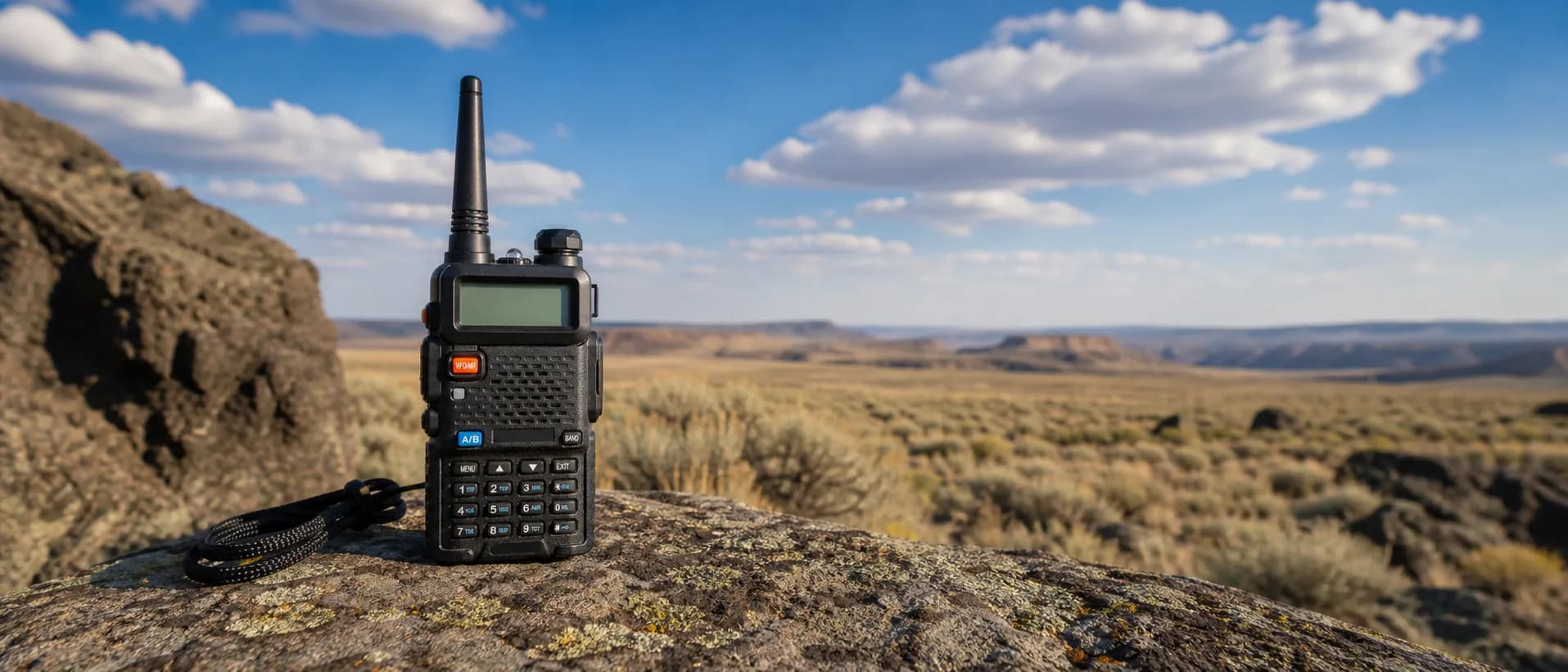

I bought my first Baofeng UV-5R in 2021 for $24. It still works. It's been programmed and reprogrammed a dozen times, dropped onto trailheads, packed into go-bags, and lent to friends who wanted to "try this radio thing" before committing to a $200 Yaesu. Eight years after Baofeng first shipped it, the UV-5R is still the cheapest way to get a working dual-band handheld onto your hip, and it's still the radio most new Technicians end up holding within a month of their license arriving.
But the market has changed. Sub-$35 alternatives from TIDRADIO and Retevis now compete on features Baofeng doesn't bother with. So the real question in 2026 isn't "is the UV-5R any good" (it is), it's "is it still the right radio for someone learning the hobby today?"
Here's what I found.
The Snapshot
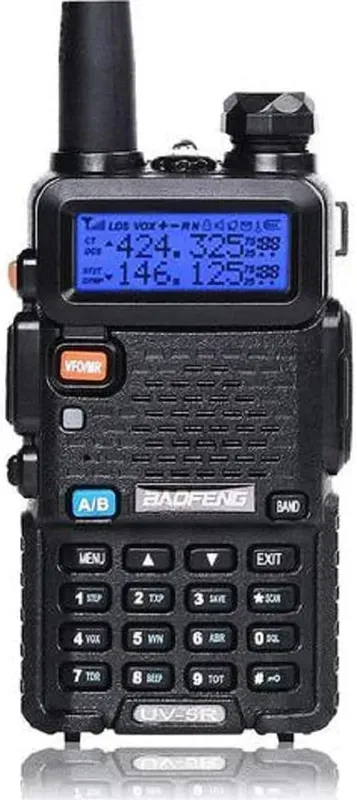
At $17.16 on Amazon, the UV-5R is the cheapest active ham radio in our database. It's a basic dual-band analog FM handheld covering the 2-meter (144 MHz) and 70-centimeter (430 MHz) ham bands, with 128 programmable memory channels, a 1,800 mAh battery, and an SMA-F antenna connector. Full CHIRP programming support. No DMR, no D-STAR, no APRS, no Bluetooth, no GPS, no IP rating.
That's the spec sheet. It also has 10,207 verified Amazon reviews and a 4.5-star average, which is a level of social proof you usually only see on kitchen appliances.
The RadioRanked scores reflect the radio's split personality:
| Dimension | Score | Why |
|---|---|---|
| Value | 95/100 | $17.16 for a working dual-band handheld is genuinely absurd |
| Beginner | 89/100 | CHIRP support + price + ubiquity = ideal first radio |
| Overall | 69/100 | Pulled down by features (18/100) and the lack of IP rating |
| Feature | 18/100 | Analog-only, no digital modes, no GPS, no nothing |
| Portability | 52/100 | 250g, pocket-sized, fine but not exceptional |
If you want the short version: it's an excellent first radio and a useful backup radio. It is not a radio you grow with. We'll get into why.
What You Get in the Box
For under twenty bucks, the box has everything you need to get on the air the day it arrives. The standard US kit includes the radio body, an 1,800 mAh lithium-ion battery (pre-attached), a desktop drop-in charger, the stock rubber duck antenna, a wrist strap, a belt clip, an earpiece/microphone combo, and a thin printed manual that you can safely throw away (the CHIRP guide will teach you more in five minutes than that manual will in fifty pages).
A few notes on what you're actually holding.
The stock antenna is the radio's weakest stock component. It's a short, soft rubber duck tuned more for the 70cm band than for 2m. If you do nothing else to the radio, swap it for a Nagoya NA-771 or a Signal Stick. You'll see immediate, measurable improvement in both receive sensitivity and effective transmit range. The aftermarket antenna costs around $15. Budget for it.
The included earpiece is a basic Kenwood-style two-pin mic. It works. The audio is thin but usable. If you're going to be talking on the radio regularly, you'll eventually want a Speaker Mic upgrade ($20–30), but the included earpiece is fine for casual repeater monitoring.
The drop-in charger is straightforward and reliable. The charging contact is on the back of the battery, which means you can drop the radio in with the battery still attached and it'll charge. A red LED on the charger turns green when full. There's no fast-charge protocol; expect 4–5 hours from empty.
The build quality is honest about what it is. The plastic chassis feels cheap because it is cheap. The buttons have a slightly mushy feel. The display is a low-resolution monochrome LCD that's perfectly legible indoors but washes out in direct sun. Nothing here will impress a Yaesu owner. Nothing here is designed to.
What it lacks is also informative. There's no included USB programming cable. You'll need to buy one separately if you want CHIRP programming (about $10–15), and you should, because programming this radio by keypad is genuinely painful.
Specs Deep Dive
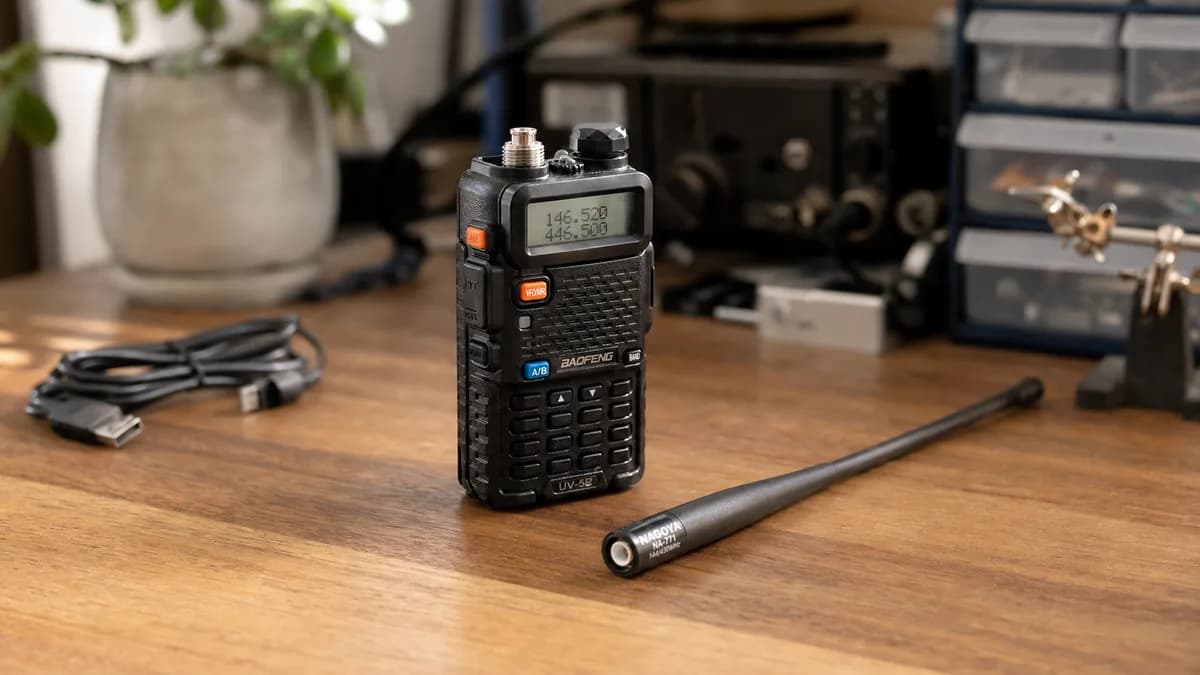
The UV-5R is an analog VHF/UHF dual-band handheld transceiver. Here's what that actually means in practice.
RF coverage. The radio receives FM broadcast (65–108 MHz), 2-meter ham (136–174 MHz), and 70-centimeter ham (400–520 MHz). It transmits on 136–174 and 400–520 MHz. The wide TX coverage is part of why "the UV-5R is illegal" comes up so often (we'll get to that). For amateur use, you'll mostly live in 144–148 MHz on 2m and 420–450 MHz on 70cm.
Transmit power. 5 watts on high, 1 watt on low. That's typical for a sub-$50 handheld. For comparison, the AnyTone AT-D878UVII Plus puts out 7W high, the Yaesu FT-65R does 5W high and 0.5W low. 5W on 2m is enough to hit most repeaters within 5–15 miles in flat-to-rolling terrain, and significantly farther if there's a clear path or you're elevated.
Memory. 128 channels. That's plenty for local repeaters, simplex calling frequencies, and a few weather stations. Programmed through CHIRP it's a five-minute job. Programmed through the keypad it's a punishment.
Battery. 1,800 mAh lithium-ion. In real-world use, expect 8–12 hours of typical receive/occasional TX use, dropping to 3–5 hours under heavy TX. The battery is the same form factor across many Baofeng models, and aftermarket high-capacity (3,800 mAh) batteries are widely available for around $20. They roughly double the runtime and add a small amount of weight.
Build. No IP rating. The radio is not rated for water exposure of any kind. It's fine in a light drizzle in a pocket; it's not fine in a downpour. The Baofeng UV-82 is the cheapest CHIRP-compatible handheld with real weather sealing, at IP54.
Size and weight. 250 grams with battery. About the size of a thick deck of cards. Pocketable, but heavy enough in a shirt pocket to drag the fabric.
What's missing that competitors have. No USB-C charging or programming (the TIDRADIO TD-H3 has both). No Bluetooth. No GPS. No APRS. No DMR or other digital modes. No NOAA weather alert. No dual-receive (you can monitor two frequencies but not simultaneously). No color display. No keypad backlight on the cheaper variants.
The point of the UV-5R has never been the feature list. The point has always been the price.
Programming With CHIRP
This is where the radio goes from "novelty" to "actually useful." The UV-5R has full CHIRP support, which means you can plug it into a laptop with a $10 cable and program all 128 memory channels in minutes from a spreadsheet-style interface instead of poking at the keypad for an hour.
Here's the workflow I run on every new UV-5R I set up:
- Buy a CHIRP-compatible programming cable. Get one with an FTDI or Silicon Labs chip; avoid clone Prolific cables. They cost $10–15.
- Download CHIRP-next from chirpmyradio.com. Free, runs on Windows, macOS, and Linux.
- Plug cable into the radio's speaker/mic jack, plug USB into the laptop, power on the radio.
- In CHIRP: Radio → Download From Radio → select model "Baofeng UV-5R" and the correct COM/serial port.
- The radio's current memory downloads to your screen as an editable table.
- Radio → Import From Data Source → RepeaterBook → enter your ZIP and a radius. CHIRP pulls every active repeater within range and dumps them straight into the channel table with frequencies, offsets, tones, and callsigns pre-filled.
- Add the 2m and 70cm simplex calling frequencies (146.520 MHz, 446.000 MHz), any local club channels, and the NOAA weather frequencies.
- Radio → Upload To Radio. Done.
The whole process takes 10 minutes once you've done it once. The RepeaterBook import alone is worth the cable.
Common gotchas: if "Error communicating with radio" comes up, it's almost always the cable (try a different USB port, check the COM port number in CHIRP matches what your OS reports, and if you bought the cheapest possible cable, just buy a better one). If the upload appears to succeed but the radio doesn't seem to remember anything, make sure you selected the exact model variant. "Baofeng UV-5R" works for the vast majority of stock units; some retailer-rebranded versions (BF-F8HP, UV-5RTP) need their specific driver.
I have an in-depth CHIRP guide if you want the full walkthrough. The short version: don't try to program this radio by keypad. It's a punishment, and CHIRP exists.
The Legal Status Question
"Is the Baofeng UV-5R legal?" is the single most-asked question about this radio, and the answer is more nuanced than either "yes" or "no."
The short version: yes, the UV-5R is legal for amateur (ham) radio use by licensed operators on ham frequencies. The radio is not Part 95 type-accepted, which means it is not legal for GMRS or FRS use, even though it can physically transmit on those frequencies. The FCC has fined sellers for marketing the UV-5R as a GMRS radio. Buying one is not illegal. Using one to transmit outside of ham bands without the right license absolutely is.
A few specifics worth knowing:
- For ham use: you need a Technician class license (or higher) to transmit on 2m and 70cm. The license costs $35 and the test is easier than you think.
- For listening: you can monitor without any license. The radio will receive FM broadcast, 2m, 70cm, NOAA weather, and most public-safety frequencies (depending on your area's encryption status) right out of the box.
- For GMRS/FRS: the UV-5R is not legal here. If you want GMRS, get a Part 95 type-accepted GMRS radio. Our FRS vs GMRS guide covers the differences.
- For business or commercial use: not legal. Part 90 type acceptance is required.
There's a longer history here, including FCC enforcement actions starting in 2013 against importers marketing the radio as a GMRS unit. Stock UV-5Rs used legally by Technicians on ham bands have never been a target. The legal grey zone exists because the radio's wide TX range means it can transmit on frequencies the radio is not certified for. Don't do that. Read our full Is the Baofeng UV-5R Legal? breakdown if you want the legal nuance in detail.
Real-World Performance

Numbers and spec sheets only get you so far. Here's how the radio actually performs after several years of carrying one as a Technician, an upgraded General, and now a POTA activator.
Range. With the stock antenna in suburban Denver, I can reliably hit any 2m repeater within about 10 miles and most within 15. With a Nagoya NA-771 swapped in, that comfortably extends to 20–25 miles to favorably-sited repeaters. Simplex (radio-to-radio) range is realistically 1–3 miles in urban and 3–5 miles in the open, with more from a ridge where the extra elevation does the work. None of this is special: it's normal 5W handheld behavior, and the same numbers hold roughly for the FT-65R and the TD-H3. The radio isn't the limiting factor at 5W; antenna and terrain are.
Audio quality. Outbound audio is acceptable. The mic is sensitive but a little hot, which sometimes earns me "you sound a little distorted, try holding the mic farther away" reports. Inbound audio out of the built-in speaker is fine in a quiet room and rough in a noisy environment. A speaker mic helps a lot. The included earpiece is usable for low-volume monitoring.
Battery life. 8–10 hours of typical use (mostly monitoring, occasional TX) is a fair expectation. I've drained it to dead in about 4 hours during a busy POTA activation with frequent transmits. The 3,800 mAh aftermarket batteries roughly double both numbers but add bulk.
Heat. Under sustained TX (think a 30-second key-down test or a long conversation), the radio's back gets noticeably warm. Not alarming, but noticeable. This is normal for 5W handhelds and not unique to the UV-5R.
Durability. Mine has been dropped onto trail rocks, fallen off a picnic table onto concrete, and survived a brief encounter with light rain in a coat pocket. It still works. The display has a small scratch. One of the function buttons has a stickier feel than the others. The antenna SMA-F threading is slightly worn. None of it has affected function. For a $16 radio, that's remarkable.
Failure modes I've seen (in mine and in radios I've loaned out): the included rubber duck antenna gets bent permanently from sitting on top of it in a pack; the belt clip plastic eventually cracks; the battery contact pads tarnish over a couple of years and benefit from a wipe with isopropyl. None of these are deal-breakers. None of them are unique to Baofeng.
Compared to the FT-65R: the Yaesu has cleaner audio, a more rigid chassis, and the IP54 rating, but it costs roughly 9× more. Compared to the TIDRADIO TD-H3: the H3 has USB-C and a slightly newer feel for the same price, but it isn't fully CHIRP-compatible, which is a real loss. Compared to the AnyTone AT-D878UVII Plus: the AnyTone is a different class of radio entirely, with DMR and APRS that the UV-5R has no answer to, but it's also 15× the price and not what someone buying their first radio needs.
Who Should Buy the UV-5R
The UV-5R is the right radio for a surprisingly specific audience:
- First-time Technicians. This is the canonical "first ham radio." If you've just passed your test and you're not sure yet what bands you'll spend time on, what modes you'll explore, or whether the hobby will stick, $16 is the right amount to spend.
- Anyone wanting a beater backup radio. Even if you've upgraded to a Yaesu or Icom, throwing a UV-5R in the truck, the go-bag, the boat, or the loaner shelf costs almost nothing.
- Field-day and club use. When you need 5 radios on a club net, buying 5 UV-5Rs makes more sense than buying 5 of anything else.
- Kids learning the hobby. Cheap enough that it doesn't matter if it gets dropped.
- Casual repeater monitoring. If you just want to listen to your local 2m repeater while you cook dinner, this is a fine and affordable receiver.
- Anyone curious about what ham radio sounds like. No license required to listen.
If you fit any of those, see our best ham radios for beginners page for the broader comparison set. The UV-5R sits at the top of the value column there.
Who Shouldn't
The UV-5R is the wrong radio for:
- Digital mode enthusiasts. No DMR, no D-STAR, no System Fusion, no APRS. If you want digital, look at the AnyTone AT-D878UVII Plus for DMR or the Yaesu FT-70DR for System Fusion. Our digital modes guide explains the tradeoffs.
- Emergency communicators who need reliability. No IP rating, basic build, no NOAA SAME alert. For prepping, you want at least the FT-65R or something with proper weather sealing. See our best ham radios for emergency list.
- POTA/SOTA activators who need IP rating or longer battery life. The lack of weather sealing matters when you're out for 6 hours and the weather turns. The FT-65R IP54 rating is the cheapest jump up.
- Anyone wanting NOAA weather alert. The UV-5R can be programmed to receive NOAA weather channels, but it doesn't have SAME alert decoding. For NOAA-aware emergency monitoring, you need a different radio class.
Alternatives to Consider in 2026
If the UV-5R isn't quite right for you, the relevant alternative set is small but distinct.
Baofeng UV-5R Plus, $20.39. A modest cosmetic and ergonomic refresh of the original. Same internals, same 128 channels, same dual-band coverage. Slightly nicer plastics. Not a meaningful functional upgrade. Buy the cheaper original unless you specifically want the newer look.
TIDRADIO TD-H3, $31.99. Newer competitor with USB-C charging and programming, a 2,500 mAh battery (vs 1,800), and 199 channels. Its big drawback is that it isn't fully CHIRP-compatible (it uses TIDRADIO's own app), which is a meaningful loss for anyone who wants the CHIRP community workflow. Better hardware, worse software story.
Yaesu FT-65R, $194.96. The "buy once, cry once" Technician's radio. IP54 weather rating, full CHIRP support, Yaesu build quality, 200 channels. Score 55 overall in our database, pulled down by value (it's expensive), but it's the cheapest CHIRP handheld with proper weather sealing. Worth considering if you're sure you're staying in the hobby.
Yaesu FT-70DR, $299.98. Adds System Fusion (Yaesu's digital voice mode) and IP54 sealing. The right radio if you want a single Yaesu-tier handheld that can do both analog and Fusion. Pricey for what you get unless Fusion specifically matters to you.
AnyTone AT-D878UVII Plus, $249.99. Different class of radio entirely. DMR + analog + APRS + GPS + Bluetooth, 4,000-channel memory, 7W output. Steep menu learning curve. If you want a do-everything handheld and you're not afraid of the configuration complexity, this is the sweet spot. Score 83 in our database.
Comparison Table
| Radio | Price | Score | DMR? | IP rating | CHIRP? | Best for |
|---|---|---|---|---|---|---|
| Baofeng UV-5R | $15.90 | 69 | No | None | Yes | First radio, backup |
| Baofeng UV-5R Plus | $33.82 | 62 | No | None | Yes | Cosmetic upgrade |
| TIDRADIO TD-H3 | $31.99 | 55 | No | None | Limited | USB-C lovers |
| Yaesu FT-65R | $144.95 | 55 | No | IP54 | Yes | Buy-once Technician |
| Yaesu FT-70DR | $309.88 | 49 | C4FM | IP54 | Yes | Fusion users |
| AnyTone AT-D878UVII Plus | $249.99 | 83 | Yes | IP54 | No | DMR + APRS |
The Verdict
The Baofeng UV-5R in 2026 is still the right radio for the situation it was always right for: you have a Technician license, you've never owned a handheld, and you want to be on the air this weekend without spending more than a tank of gas. Sixteen dollars buys you a working dual-band radio, CHIRP support, 10,000 reviews worth of community knowledge, and enough capability to hit your local 2m repeater and run a POTA contact.
What it doesn't buy you is anything past that. The feature gap to even the $35 alternatives is real (USB-C, larger battery), and the gap to the genuinely capable handhelds (DMR, APRS, IP rating) is enormous. The UV-5R is not a radio you grow into. It's a radio you start with, then keep around as a backup once you've figured out what you actually want.
So: buy one if it's your first radio, your second radio, or your kid's first radio. Add a Nagoya NA-771 antenna and a $10 CHIRP cable to your cart. Don't buy one if you already own something better and you're hoping it'll do more than it does. It won't.
For the next step, see What Is CHIRP? for the programming walkthrough, Is the UV-5R Legal? for the legal nuance, and Best Ham Radios for Beginners for the broader buying context.