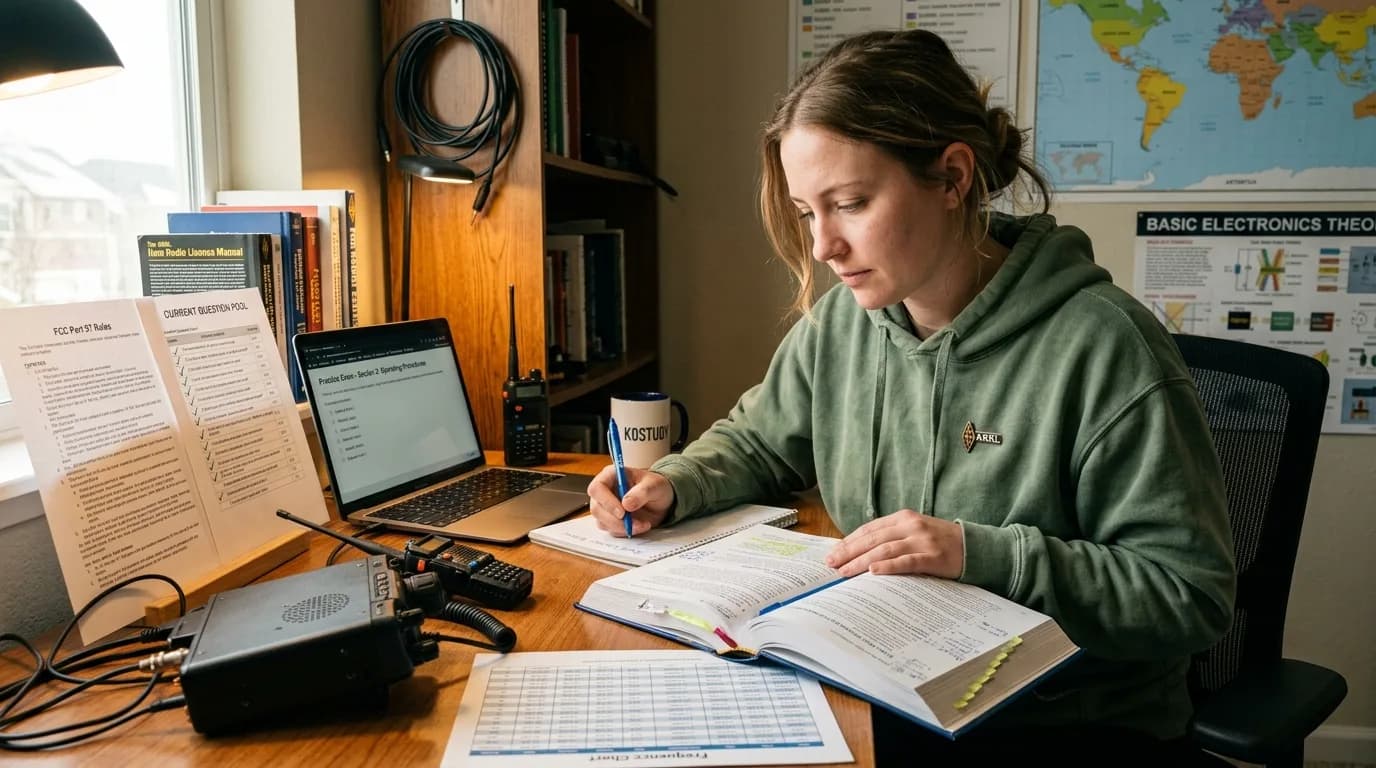

Getting a ham radio license in the United States means passing a multiple-choice exam administered by volunteer examiners. There's no age requirement, no Morse code requirement, and no waiting period. You can study, pass the test, and be on the air within a week.
This guide covers every step of the process, from understanding the license levels to finding an exam session near you.
Do You Actually Need a License?
Yes, if you want to transmit. The FCC requires a license to transmit on amateur radio frequencies. This applies to every amateur band, every mode (voice, digital, CW), and every power level. There is no exception for low power, local use, or emergencies (though the FCC does allow unlicensed transmission in genuine life-threatening situations under 47 CFR 97.403).
You do not need a license to listen. Receiving on any amateur frequency is legal for anyone, no license required. You can buy a radio, turn it on, and listen to everything from local repeater traffic to international DX contacts. You just can't press the transmit button until you're licensed.
If you've heard people using cheap handheld radios without a license, they're either using FRS radios (which are license-free but limited to specific frequencies and low power) or they're breaking the law. Amateur radio frequencies are regulated, and the FCC does enforce. If you're curious about the legal landscape around specific radios, we covered this in detail in our article on whether the Baofeng UV-5R is legal.
The Three License Levels
The FCC issues three classes of amateur license today: Technician, General and Amateur Extra. Exam credit is cumulative, you start at Technician because its exam is the only one with no prerequisite, and you can upgrade at any time by passing one more element.
| Class | Exam | Questions / to pass | What it opens up |
|---|---|---|---|
| Technician | Element 2 | 35 / 26 | Every amateur band above 50 MHz at full power, plus four narrow HF segments |
| General | Element 3 | 35 / 26 | Most of every HF band, so worldwide contacts without repeaters or internet |
| Amateur Extra | Element 4 | 50 / 37 | The remaining bottom-of-band slices on 80, 75, 40, 20 and 15 meters |
For most people the Technician license is the whole answer. It covers every handheld radio and nearly every mobile radio on the market, so upgrading to General is really a decision about whether you want an HF rig rather than a decision about your first radio.
We cover the exact frequency segments, the power limits, which class each radio in our catalog actually needs, and what an upgrade costs, in a dedicated guide: Ham radio license levels: Technician, General and Extra.
The rest of this guide is about the Technician exam and the process of getting licensed.
How Much Does It Cost?
The total cost to get your Technician license breaks down like this:
FCC application fee: $35. This is a one-time fee paid to the FCC after you pass your exam. The FCC introduced this fee in April 2022. You'll receive an email from the FCC's CORES system with payment instructions after your exam results are submitted. You have 10 days to pay before your application expires.
Exam session fee: $0-15. Most Volunteer Examiner Coordinators (VECs) charge a small fee to cover the cost of administering the exam. The ARRL charges $15 per session. Some VECs, like GLAARG and W5YI, charge $0-15 depending on the session. A few organizations offer completely free exams. The exam fee covers all elements you attempt in a single session, so if you pass Technician and immediately attempt General, you don't pay twice.
Study materials: $0-30. Completely optional. Free resources exist that are more than adequate (see the study resources section below). If you prefer a physical book, the ARRL Ham Radio License Manual runs about $30.
Total: $35-80 for your Technician license. After that, the only ongoing cost is the FCC's $35 renewal fee once every 10 years, paid through the ULS system; see our renewal guide when the time comes.
The radio is the other half of the budget, and it is smaller than most people expect: a capable dual-band handheld costs less than the licence itself, and we cover which one to get further down.
If you upgrade to General or Extra later, it's just the exam fee again ($0-15 per session) plus another $0 to the FCC for the upgrade (no additional FCC fee for upgrades).
What the Technician Exam Covers
The Technician question pool is divided into 10 sub-elements. Here's what you'll actually be tested on and what matters most:
FCC Rules and Regulations (T1). The biggest chunk of the exam. Covers license classes, operator privileges, frequency allocations, station identification requirements, prohibited transmissions, and third-party traffic rules. Know the band plan for Technician privileges. Know you must identify with your callsign every 10 minutes and at the end of your last transmission. Know what you can't do (transmit music, use obscene language, transmit on frequencies you're not authorized for).
Operating Procedures (T2). Repeater etiquette, simplex calling frequencies (146.520 on 2m, 446.000 on 70cm), how to make a CQ call, how to respond to a CQ, handling emergency traffic, and phonetic alphabet usage. Practical stuff that you'll use every time you key up.
Radio Wave Characteristics (T3). Basic propagation concepts: line of sight, ground wave, skip/skywave, tropospheric ducting. The difference between VHF/UHF propagation and HF propagation. If you've read our VHF vs UHF guide, you already know much of this.
Amateur Radio Practices (T4). Station setup, connecting a radio to an antenna, using an SWR meter, RF grounding, and basic troubleshooting. Also covers digital mode connections (radio to computer interfaces).
Electrical Principles (T5). Ohm's Law (voltage = current × resistance), power calculations, the relationship between frequency and wavelength, and basic AC/DC concepts. This is the section that intimidates people, but the math is straightforward. If you can multiply and divide, you can handle it.
Electronic Components (T6). What resistors, capacitors, inductors, diodes, transistors, and integrated circuits do. You don't need to design circuits. You need to recognize components and understand their basic function.
Station Equipment (T7). Transceivers, receivers, transmitters, antennas, feed lines, SWR, and basic test equipment. Practical knowledge about how your station works.
Modulation and Signals (T8). FM, AM, SSB, CW, and digital modes. What they are, when you'd use each one, bandwidth considerations. Also covers satellite operation basics and internet-linked systems like EchoLink and IRLP.
Antennas and Feed Lines (T9). Dipole antennas, vertical antennas, beam antennas, coaxial cable, SWR, and impedance matching at a basic level. Understanding why antenna choice matters more than transmit power.
Safety (T0). RF exposure safety, electrical safety, tower safety, lightning protection, and grounding. Important real-world knowledge.
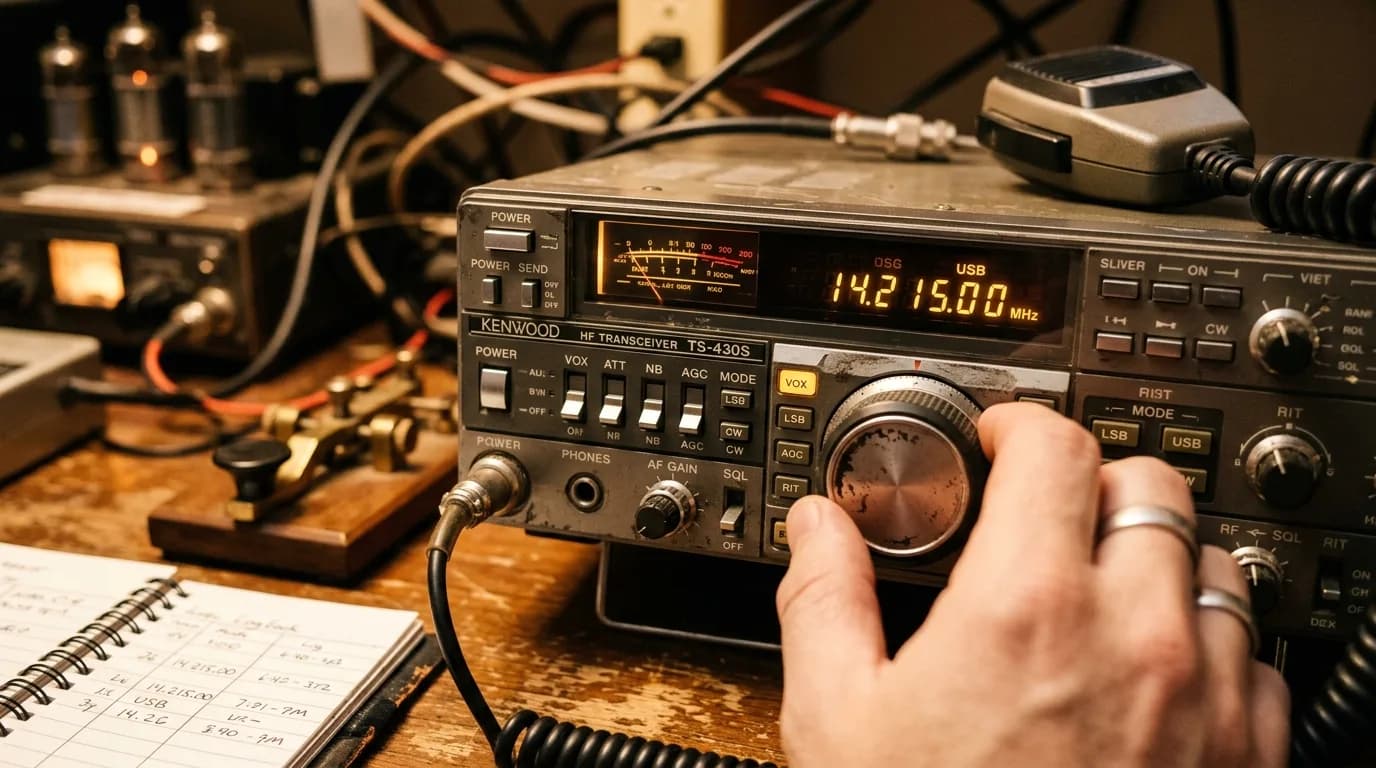
How to Study
There are several proven approaches, and the best one depends on how you learn.
Free Online Resources
HamStudy.org is the most popular free study tool. It has the complete question pool with adaptive study that focuses on your weak areas. You can take practice exams that mirror the real test format. Most people who pass the Technician exam used HamStudy as their primary or supplementary resource.
HamExam.org offers similar functionality with a slightly different interface. Full question pool, practice exams, progress tracking.
KB6NU's "No-Nonsense" Study Guides are free PDF downloads that cover each license level in a concise, readable format. Less comprehensive than the ARRL manual but more efficient for people who just want to pass the test.
Paid Resources
Ham Radio Prep offers a structured online video course with practice exams. About $30-50. Good for visual learners who prefer being walked through the material.
ARRL Ham Radio License Manual is the official study guide (~$30). Thorough, well-organized, but dense. Better as a reference than as a cover-to-cover read for most people.
Gordon West study guides have been a staple for decades. Available at ham radio retailers.
Study Strategy
Regardless of which resource you use, the most effective strategy is:
- Take a practice exam cold before studying anything. See where you stand. Many people are surprised to find they already know 40-50% of the material from general knowledge.
- Study the question pool directly. The real exam questions are drawn from a published pool. Every question you'll see on test day is available in advance, with all four answer choices. This isn't cheating. It's how the system is designed.
- Focus on your weak areas. HamStudy's adaptive mode does this automatically. Don't spend time reviewing topics you already know.
- Take practice exams until you're consistently scoring 80%+. Our practice quiz uses real exam questions. If you can reliably get 28-30 out of 35 on practice tests, you'll pass the real exam comfortably.
Most people who fail the Technician exam fail because they didn't take enough practice tests, not because the material is too hard.
Where to Take the Exam
You have two options: in-person and online.
In-Person Exams
Volunteer Examiner (VE) sessions happen regularly across the country. They're held at libraries, churches, fire stations, ham radio club meetings, hamfests, and other community locations.
To find a session near you:
- ARRL Exam Session Search at arrl.org/find-an-amateur-radio-license-exam-session is the most comprehensive listing
- HamStudy.org/sessions lists both in-person and remote sessions
- Your local ham radio club likely holds regular exam sessions. Search for clubs in your area through ARRL's club finder.
Walk-in sessions exist but pre-registration is increasingly common. Check the specific session listing for requirements. Bring a government-issued photo ID, your FCC Registration Number (FRN), and the exam fee (cash or check, some accept cards).
Online Exams
Remote exams became widespread during COVID and have remained popular. You take the test on your computer while volunteer examiners proctor you via video call.
Fully remote VECs:
- GLAARG (Greater Los Angeles Amateur Radio Group) offers free remote exams
- Anchorage VEC runs remote sessions
- W5YI VEC offers remote options
The process: sign up for a session, join a video call at the scheduled time, share your screen, show your ID on camera, and take the test while proctored. Results are immediate.
Getting Your FRN
Before you take the exam, you need an FCC Registration Number (FRN). This is a unique 10-digit number the FCC uses to track your license.
Register at the FCC's CORES system: apps.fcc.gov/cores/userLogin.do
Create an account, register for an FRN, and write down the number. You'll need it at the exam session, and you'll use it to pay the $35 application fee after passing.
What Happens After You Pass
- The VE team submits your results to the FCC, usually within a few business days.
- The FCC emails you at the address associated with your FRN with a link to pay the $35 application fee.
- You pay the fee within 10 days through the FCC's CORES system.
- Your callsign appears in the ULS database, typically within 1-2 weeks of payment. Your license is valid immediately once it appears in the database.
- You're on the air. No waiting period after your callsign is issued. Key up and make your first contact.
Your callsign will be a sequentially assigned call from your regional call district. If you want a specific callsign (a vanity call), you can apply for one after your license is issued. Vanity callsigns are free.
Is a Ham Radio License Worth It?
This comes up constantly, and the honest answer depends on what you want to do.
It's worth it if:
- You want to communicate when cell networks are down. Ham radio works when the internet, cell towers, and power grid don't. This is why ARES, RACES, and emergency management agencies rely on amateur radio operators.
- You're interested in the technical side of radio. Building antennas, experimenting with propagation, working satellites, digital modes, SDR. The license gives you legal access to a massive playground.
- You want to join a community. Ham radio has one of the most active and welcoming hobbyist communities. Local clubs, nets, field days, contests, and public service events.
- You're into outdoor activities. POTA (Parks on the Air) and SOTA (Summits on the Air) combine hiking and camping with radio operations. Fast-growing segment of the hobby.
- You want long-range communication without infrastructure. With a General license and an HF radio, you can talk to people on the other side of the planet using nothing but radio waves and the ionosphere.
It might not be worth it if:
- You just want basic family communication at short range. FRS radios (the blister-pack walkie-talkies) are license-free and work fine for this. GMRS is another option that offers more range than FRS without an exam.
- You only want to listen. No license required for receive-only use.
The exam itself takes a few hours of your time including study. The license is valid for 10 years and renewal costs $35 with no re-test. The barrier to entry is low.

How Long Is a Ham Radio License Good For?
Ten years. The FCC issues all amateur radio licenses with a 10-year term. Renewal costs $35 (the same FCC application fee, charged since April 2022) and is done online through the FCC's ULS system (wireless2.fcc.gov), starting 90 days before your license expires. There is no re-testing requirement for renewal.
If your license expires, you have a 2-year grace period during which you can renew without re-testing, but you cannot transmit during the grace period. After 2 years, the license is permanently cancelled and you'd need to take the exam again.
Can the Ham Radio Exam Be Taken Online?
Yes. Multiple VECs offer fully remote, proctored exam sessions conducted over video conferencing. You take the test on your own computer while volunteer examiners watch via webcam. This became standard practice during 2020 and has remained a permanent option.
Search for remote sessions at hamstudy.org/sessions and filter for online/remote options. GLAARG offers free remote exams and is one of the most popular remote VECs.
Will Ham Radios Work if the Grid Goes Down?
Yes. This is one of the core reasons amateur radio exists as a service. Ham radios are self-contained RF transceivers. They don't need cell towers, internet infrastructure, or a functioning power grid to operate. You need power for the radio itself (batteries, solar, a generator), an antenna, and another station within range.
During natural disasters, amateur radio operators routinely provide emergency communications when all other systems fail. Hurricane Katrina, Hurricane Maria, the Joplin tornado, and countless other disasters have relied on ham radio when commercial infrastructure was destroyed.
On VHF/UHF, your range with a handheld is limited to a few miles without a repeater (repeaters need power too, though many have battery backup). On HF, you can communicate hundreds or thousands of miles using skywave propagation, no infrastructure needed at all.
What Radio Should You Get After Passing?
You do not need to spend much, and these are the two inexpensive handhelds we would actually hand a new Technician. Prices below are live from our daily Amazon refresh.
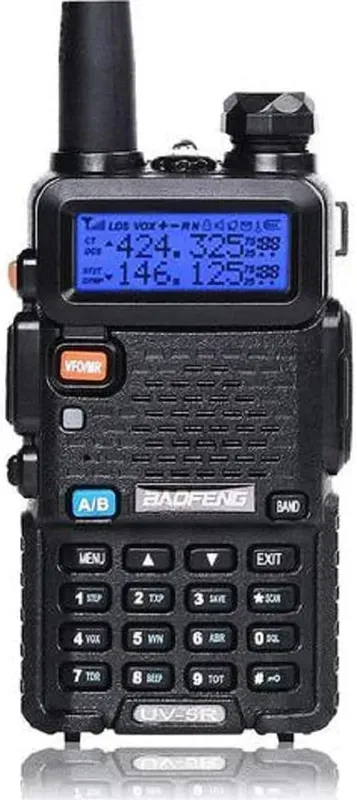
The Baofeng UV-5R is the cheapest way to get on the air. It covers both 2m and 70cm and is programmable with CHIRP. It has real limitations (receiver quality, spurious emissions on some units), but it gets you transmitting and helps you work out what you actually want from the hobby before spending more.
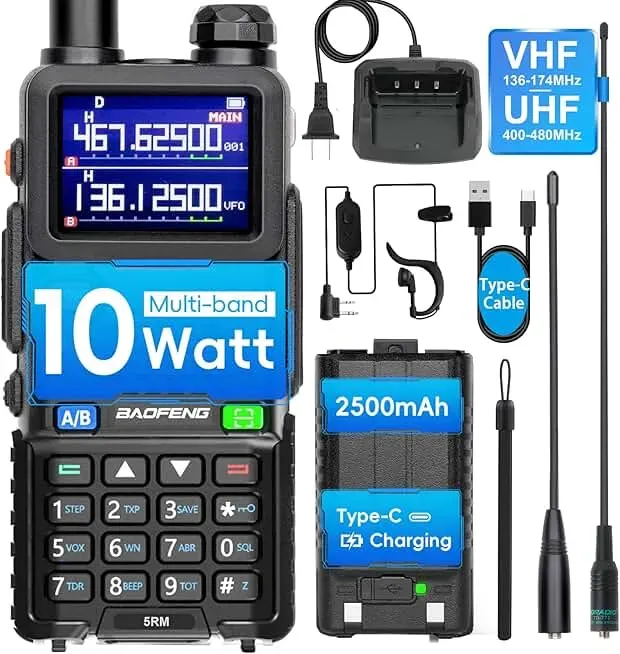
The Baofeng 5RM is the better buy for a few dollars more, and it scores higher than the UV-5R on every dimension our engine measures: a much larger battery, more output, and the highest beginner score in our database.
A note on the advice you will see elsewhere: the Yaesu FT-65R is the traditional step-up recommendation, and for years it was the right one at well under $100. It is no longer sold on Amazon by Yaesu, only through a reseller, and the current listing sits near $194.96. At that price it is beaten by radios costing a fifth as much, so we are not recommending it today. If Yaesu restocks it at its old price, that changes.
For a broader look at what's available, check our best handheld ham radios roundup, our beginner buying guide, or the best radios for beginners ranking. If you're leaning toward a Baofeng, our Baofeng lineup guide ranks every model worth buying.
The 3-3-3 Rule
You'll see this referenced in prepper and emergency communications circles. The 3-3-3 rule is a guideline for emergency radio monitoring:
- 3 minutes after a major event, switch to simplex on Channel 3 of your local repeater or a pre-agreed simplex frequency
- Listen for 3 minutes before transmitting
- 3 times a day (morning, noon, evening), check in on the agreed frequency
This isn't an FCC rule or an official protocol. It's a community convention that some emergency preparedness groups use to establish a common monitoring schedule after a disaster. Different groups define the "3s" slightly differently. The principle is simple: have a pre-agreed frequency and schedule so people know when and where to listen.
Can Ham Radio Pick Up Police Frequencies?
Most modern ham radios, including wide-band receivers like the UV-5R, can receive public safety frequencies in the VHF and UHF range. Listening to police, fire, and EMS frequencies is legal in most US states (a few states restrict scanners in vehicles; check your state's laws).
However, many law enforcement agencies have migrated to digital trunked systems (P25) or encrypted channels that a standard analog ham radio cannot decode. In urban areas especially, you may hear nothing intelligible on traditional scanner frequencies because the traffic has moved to digital systems.
Receiving is legal. Transmitting on public safety frequencies is a serious federal offense. We covered this in detail in our Baofeng UV-5R legality article.
Can a Ham Radio Transmission Be Traced?
Yes. Amateur radio transmissions are not anonymous by design. You're required to identify with your FCC-issued callsign every 10 minutes and at the end of each transmission. Your callsign is linked to your name and mailing address in the FCC's ULS database, which is public. Anyone can look up a callsign and find the licensee's information.
Beyond identification requirements, radio signals can also be traced through direction-finding techniques (known as fox hunting or T-hunting in the amateur radio world). The FCC has its own direction-finding equipment and has located and fined unlicensed or interfering operators.
If you transmit on amateur frequencies without identifying, or transmit without a license, you can be found. The amateur radio community actively monitors for unlicensed and interfering signals, and reports them to the FCC.
Can You Talk Privately on Ham Radio?
Not in the way most people mean. FCC Part 97 rules explicitly prohibit encryption and coded transmissions intended to obscure the meaning of amateur communications (47 CFR 97.113(a)(4) and 97.309(b)). This is by design: amateur radio is a public radio service, and all transmissions are expected to be accessible to anyone listening.
You can use digital modes like DMR, which use digital encoding, but the protocols are published and anyone with the right equipment can decode them. This is not encryption in any meaningful privacy sense.
If you need private communications, amateur radio is not the right tool. Use a phone, encrypted messaging app, or a commercial radio service that permits encryption.
Does the Government Monitor Ham Radio?
The FCC has the authority to monitor all amateur radio transmissions and does so selectively. The FCC's Enforcement Bureau investigates complaints about interference, unlicensed operation, and other rule violations. They have field offices with direction-finding equipment.
In practice, the FCC doesn't listen to every ham radio conversation. Most enforcement actions result from complaints filed by other operators or affected parties (like a public safety agency experiencing interference). The amateur radio community is largely self-policing, and other operators will report egregious rule violations.
Amateur radio transmissions are by definition public and unencrypted. Anyone with a receiver can listen, including government agencies. But there's no systematic monitoring program focused on ham radio conversations.