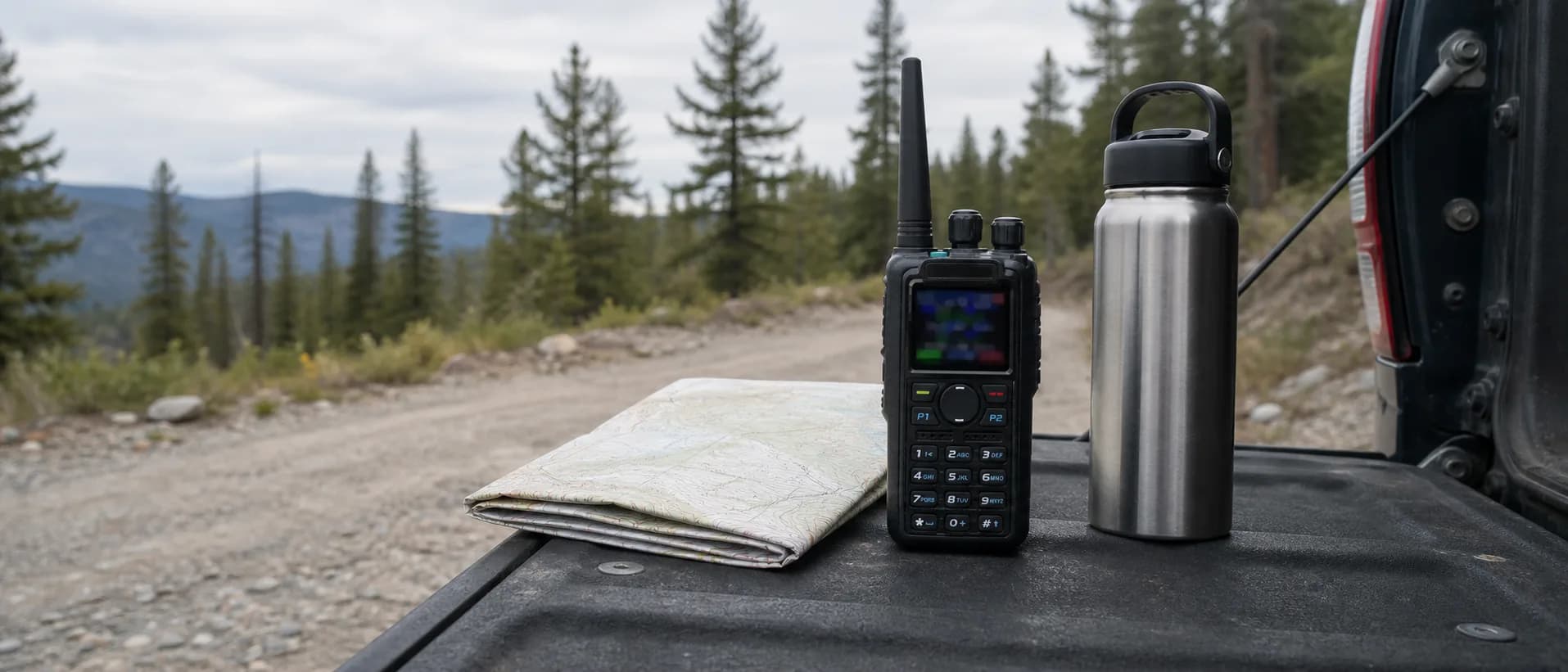

I bought my AnyTone AT-D878UVII Plus in late 2024 after a year of poking at DMR with borrowed radios and never quite committing. The local 70cm DMR repeater had been calling to me, two of my POTA buddies had switched, and the analog-only Baofeng on my hip suddenly felt like a flip phone in a smartphone world.
Two-fifty for a DMR + APRS + GPS + Bluetooth-PTT handheld with a color display and 4,000 channels of memory sounded almost suspicious. I figured I'd be fighting Chinese-radio quirks for a month and giving up. I was wrong about the timeline (a week) and about giving up (still using it daily). I was right about the quirks.
This review is what I wish I'd read before buying. It's honest about the menu system, the codeplug learning curve, and the things the AT-D878UVII Plus does worse than radios costing three times as much. It's also honest about why, despite the rough edges, it's the right radio for any ham who wants into DMR without spending Motorola money.
The Snapshot
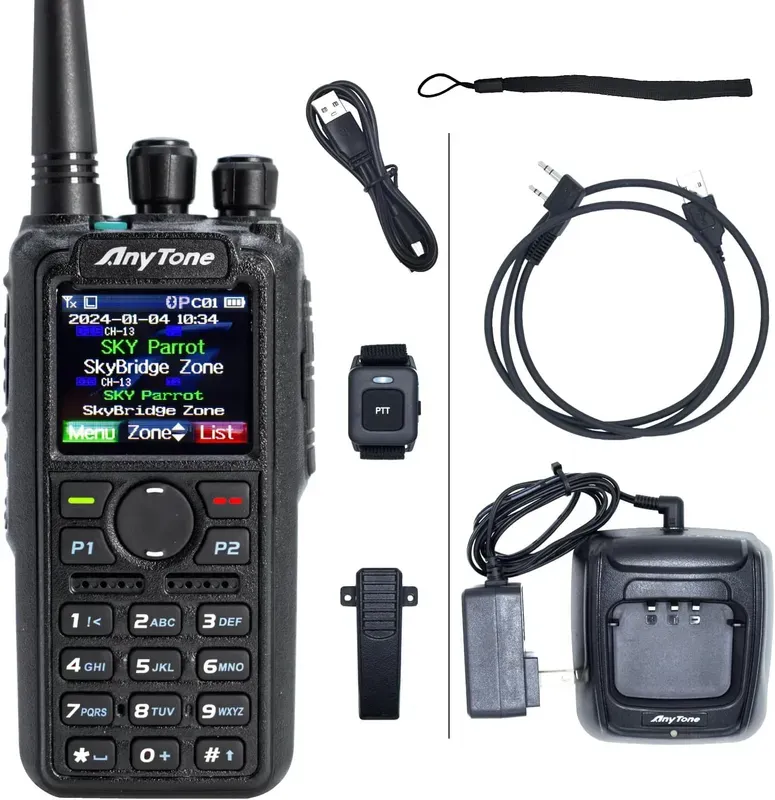
At $249.99 on Amazon, the AnyTone AT-D878UVII Plus is a Tier I and Tier II DMR-capable dual-band handheld with 7W high-power output on VHF, integrated GPS, Bluetooth-PTT support, 4,000 channels of memory, and a 128x160 color TFT display. It does conventional analog FM, DMR digital voice, and APRS over a built-in TNC. It does not do D-STAR, System Fusion, or NXDN.
The RadioRanked scores reflect a radio that's strong on features but not built for newcomers:
| Dimension | Score | Why |
|---|---|---|
| Overall | 83/100 | One of the highest scores in our handheld database |
| Feature | 84/100 | DMR + APRS + GPS + Bluetooth + 4,000 channels is a lot |
| Value | 76/100 | $249.99 for these features is genuinely good |
| Beginner | 52/100 | The menu system is the steepest curve in the hobby |
| Portability | 56/100 | 280g, larger than a UV-5R, fits comfortably on a belt |
Amazon: 4.8 stars, but across only 6 ratings. That is not a typo and it is not a quality signal either way. The II Plus is sold under a new listing; the 655-rating page hams remember was the original AT-D878UV, which Amazon no longer carries. Read the star rating as a sample too small to mean anything, and read the community instead. There, the split is predictable: experienced operators rave, newcomers struggle. That maps to what I'll tell you in the rest of this review.
What You Get in the Box
The retail package includes the radio body, a 3,100 mAh lithium-ion battery (pre-attached), a desktop drop-in charger with international plug adapter, a stock dual-band rubber-duck antenna, a wrist strap, a belt clip, a programming USB cable, and a printed manual that's a touch better than typical Chinese-radio docs but still a poor substitute for the AnyTone CPS documentation online.
A Bluetooth PTT puck is also included in most retailer kits. This was a pleasant surprise. The puck clips onto a steering wheel or shoulder strap and pairs with the radio for hands-free key-down. After a year of use, it's one of my favorite features. The pairing is reliable and the latency is low enough that it never gets in the way of a natural over. The button charges over USB rather than taking a coin cell, so it lives on the same cable as everything else in the bag.
The build quality is solid for the price. The chassis is reinforced polycarbonate with a textured grip surface on the back. The weight feels substantial without being heavy. The rotary knobs (channel and volume) have firm detents. The PTT is large and easy to find by touch. The included rubber duck is adequate; aftermarket antennas like the Diamond SRH77CA or Signal Stick noticeably improve receive sensitivity.
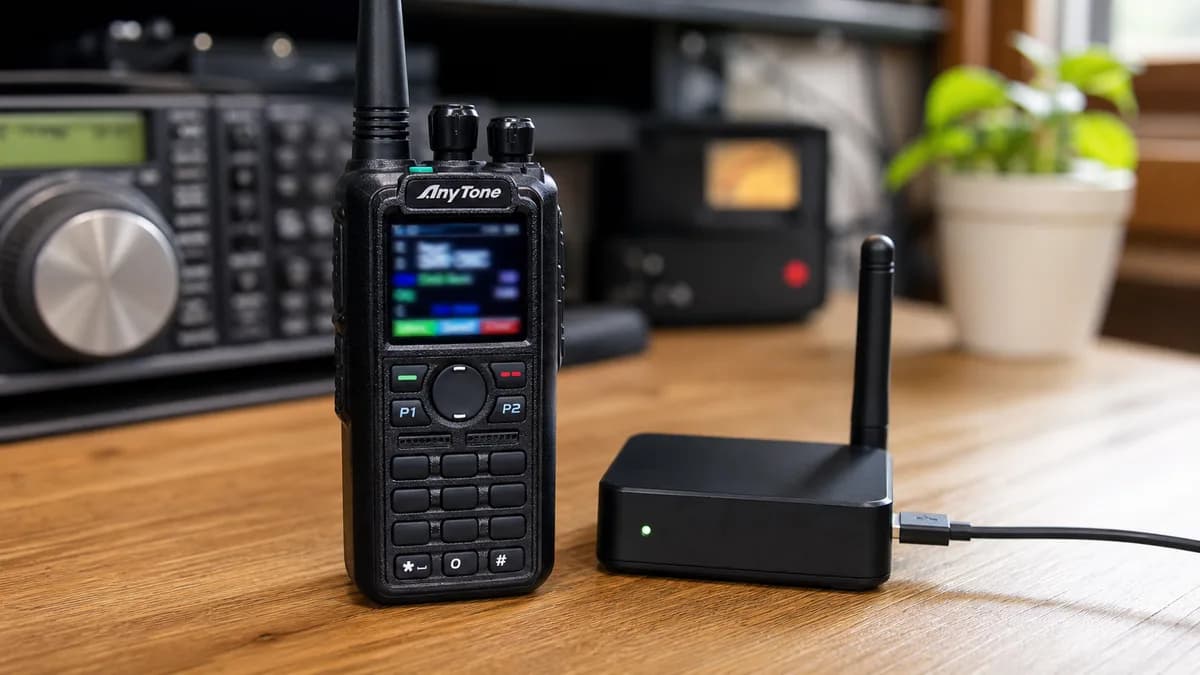
What's missing from the box: a speaker mic (AnyTone's own manual lists the QHM-024 as an optional accessory, not a supplied one, though some dealer bundles such as BridgeCom's throw one in), a hotspot (you'll buy a Pi-Star or OpenSpot separately, $80 to $200), and a quality programming cable that isn't a clone Prolific chipset. Budget another $30 to $40 in accessories if you're starting from scratch.
Specs Deep Dive
This is where the AT-D878UVII Plus starts to differentiate itself from $30 analog handhelds. Here's what the spec sheet actually means in practice.
RF performance. Receives 136 to 174 MHz on VHF and 400 to 480 MHz on UHF. Transmits the same ranges in amateur bands. 7 watts on VHF high (a meaningful step above the typical 5W handheld), 6W on UHF high, 1W on low. The extra 2 watts on 2m matters for reaching distant repeaters when you're not in line-of-sight.
Memory. 4,000 channels, 250 zones, and a contact list that holds 500,000 DMR contacts (the entire global DMR-MARC database fits with room to spare and updates regularly). For comparison, a Baofeng UV-5R has 128 channels and zero DMR contacts. The AT-D878UVII Plus's memory architecture is the right shape for DMR: contacts and channels are separate, time slots and color codes are per-channel, and zones group related channels for quick switching.
Digital modes. Tier I (license-free) and Tier II (licensed) DMR are both supported. AMBE+2 vocoder. Promiscuous mode (lets you hear all talkgroups on a time slot regardless of monitor settings) is a feature most commercial DMR radios don't expose. Built-in TNC handles APRS over analog FM. There's an Encryption setting; do not enable it for ham radio use (FCC Part 97 prohibits encryption on amateur frequencies).
GPS. Integrated GPS with cold-start fix times in the 30 to 45 second range. The GPS feeds APRS beaconing (set the interval in CPS) and DMR talker location data. Battery drain with GPS active is noticeable; expect to give up roughly 30% of runtime compared to GPS off.
Bluetooth. Supports the included Bluetooth PTT button and pairs with standard Bluetooth headsets for audio. Bluetooth audio quality is good for voice but not for music; the codec is voice-optimized.
Battery. 3,100 mAh lithium-ion, with a USB-C port on the battery itself, so you can top up from a phone charger or a power bank without carrying the drop-in cradle. In typical mixed receive and TX use with GPS off, expect 12 to 16 hours of runtime. GPS on and heavy DMR TX drops that to 6 to 8 hours. The battery is removable and a spare costs about $35. (The original AT-D878UV's batteries were drop-in charger only; USB-C came with the II Plus battery.)
Display. 128x160 color TFT. After a UV-5R's monochrome LCD, this display is genuinely useful: talkgroup names render in clear text, contacts pulled from the local database show callsigns, channel zones are visible at a glance. The display backlight is bright enough for direct sunlight (with some squinting).
Build and weather. IP54, which AnyTone's own spec sheet claims and which means dust protection and splashes from any direction. The chassis handles rain in a pocket and a wet activation; it is not a radio you take swimming, and IP54 is a long way short of the IP67 a submersible radio carries. If weather sealing matters for your use case, the Yaesu FT-70DR at $299.98 is the cheapest IP-rated alternative in the same general feature space, though it does System Fusion instead of DMR.
DMR Explained Without the Jargon
If you're new to DMR, here's the version that won't make your eyes glaze over.
DMR (Digital Mobile Radio) is a digital voice mode where your transmitter doesn't modulate a carrier wave directly. Instead, your microphone audio gets digitized, compressed, and packed into a digital data stream that's transmitted in bursts. Two of those bursts can fit on the same frequency in alternating "time slots" (this is the "Tier II" two-slot version). That's the headline efficiency win: one DMR repeater channel can host two simultaneous conversations.
A few terms worth knowing:
Talkgroups. A talkgroup is a logical channel, identified by a number, that exists across the DMR network. Talkgroup 91 is the global ham worldwide chat. Talkgroup 31xx (state codes) are regional chats in the US. You're not on a "frequency" in DMR; you're on a (frequency + time slot + talkgroup + color code) tuple.
Color codes. Like CTCSS but for DMR. A color code (CC) is a number that lets multiple DMR repeaters share a frequency without interfering. You set the CC per channel in your codeplug. It almost always matches what the repeater publishes.
Time slots. Each DMR channel has Time Slot 1 (TS1) and Time Slot 2 (TS2). Repeaters typically dedicate one slot to local/regional talkgroups and the other to national/worldwide. Hotspots usually keep both slots available.
Hotspots. A hotspot is a tiny SDR + Pi-style computer that connects to the DMR network over your home internet, then bridges that to a low-power local RF signal that your handheld picks up. Range is typically 50 to 200 meters depending on obstacles. If your area has no DMR repeater in range, a hotspot is how you get on DMR.
Codeplug. The configuration file that holds all your channels, talkgroups, contacts, zones, and settings. You build it once in CPS (Customer Programming Software), upload it to the radio, and update it over time as networks evolve.
For deeper context, our What Is DMR? article covers the technical layer in detail. The short version: DMR is what the commercial radio world has been using since the early 2010s, and the ham radio community has built a global network on top of it.
Codeplug Setup and the Learning Curve
This is where the AT-D878UVII Plus's beginner score of 52 comes from. The radio's hardware is excellent; the configuration process is genuinely difficult the first time.
The required workflow:
- Install AnyTone CPS. Windows-only. Download from a reputable AnyTone reseller (BridgeCom Systems is the standard). Verify the version number matches your radio's firmware. Mismatch causes silent failures.
- Update firmware first. Use the firmware update tool, not CPS. Get the radio to a current firmware version before doing anything else.
- Read the radio. Plug in the programming cable, open CPS, Program → Read From Radio. This downloads the factory codeplug.
- Find a starter codeplug. Don't build from scratch. Download a regional starter codeplug from sites like AmateurRadio.Digital or the regional DMR network site. These come pre-populated with local repeaters, common talkgroups, and zone layouts.
- Customize. Edit channels, add your callsign, set your DMR ID (free, request at RadioID.net), tweak zone layouts.
- Update the contact database. Tools → Import → Talker Alias. Pull the current DMR-MARC contact CSV (around 200,000 records) and import. This is what populates caller IDs on the display.
- Write to radio. Program → Write To Radio. This pushes your customized codeplug. 30 to 90 seconds.
- Test on a hotspot first. Validate your codeplug against a local hotspot before trying the wild on a repeater.
The first cycle takes 4 to 8 hours, mostly because you're learning CPS terminology while building the codeplug. The second cycle takes 30 minutes. By the fifth one you can update channels without thinking.
Common failure modes:
- Wrong color code on a channel: silent failure, no TX-out detected.
- Wrong time slot: similar silent failure on repeaters.
- DMR ID not set or invalid: repeater drops your transmission.
- Wrong codeplug version for firmware: random radio crashes during use.
- Hotspot mode confusion: the radio doesn't know whether you're on a hotspot or a repeater unless you tell it via channel config.
Compared to programming a Baofeng UV-5R with CHIRP, the AnyTone CPS workflow is in a different league of complexity. The payoff is that once it's working, you have access to a global network. The cost is that you'll spend a weekend learning the system. There is no shortcut.
Real-World Performance
After a year of daily use, here's what the AT-D878UVII Plus actually does well and where it falls short.
Audio quality is excellent. DMR's AMBE+2 vocoder produces clearer, more natural-sounding voice than most amateurs are used to from analog FM, particularly in marginal signal conditions where analog would fade into noise. The codec sounds slightly "compressed" the way a phone call does, but voices are recognizable and intelligible at signal levels where FM would be unusable.
Receive sensitivity is solid. Hearing a DMR repeater 25 miles away with the stock antenna is normal. With an aftermarket NA-771 or Signal Stick, that comfortably stretches to 30+. The radio's analog mode is just as sensitive as a UV-5R for comparable use.
TX coverage matches the spec sheet. 7W on 2m hits repeaters at distances where a 5W radio drops out. From the Denver Front Range, I can routinely hit Pikes Peak repeaters (~70 miles south) with a clear path. Mileage will vary with terrain.
Hotspot performance is the killer feature for indoor use. Paired with a Pi-Star or OpenSpot, the radio gives you access to global DMR networks (Brandmeister, TGIF, FreeStar) from your desk. Range from the hotspot is typically 50 to 200m depending on obstacles, plenty for a house or apartment.
Battery management is good. The 3,100 mAh battery handles a full day of mixed monitoring with GPS off. Heavy DMR TX with GPS on drains it faster, as expected. The drop-in charger is reliable. A spare battery in the bag is cheap insurance.
Heat. Under sustained TX at 7W, the chassis gets noticeably warm but not alarming. Long DMR transmissions (because the digital protocol is constant-power for the duration of the burst) heat the radio faster than analog SSB or FM bursts. Manageable.
Things that fall short. The native APRS messaging implementation is inconsistent; messages sometimes don't decode correctly on the receiving end, particularly with non-AnyTone radios. The analog squelch is more limited than I'd like; in noisy RF environments, the squelch threshold doesn't have enough granularity. The menu system, after a year, I navigate by muscle memory; for a new owner, it's genuinely opaque. Icom and Kenwood polish is absent.
For comparison, the AnyTone AT-D168UV at $139.99 is a budget alternative from the same manufacturer with similar DMR + APRS capability but a smaller battery (1,800 mAh) and worse user reviews on firmware stability (3.7-star Amazon average). If your budget allows the AT-D878UVII Plus's extra $110, it's worth it.
Who Should Buy It
The AT-D878UVII Plus is the right radio for a specific operator:
- Hams who want into DMR without spending Motorola money. A Motorola MOTOTRBO DM-1701 starts around $600 with no significant feature advantage over the AT-D878UVII Plus for amateur use. The price gap is real.
- APRS users who want a single handheld for everything. The integrated GPS + TNC means no external TNC, no external GPS, no patch cables.
- Operators near DMR-active repeaters or who plan to run a hotspot. Without one of these, you bought the radio for analog work, which is overkill.
- Hams who travel. Bluetooth PTT in a rental car, hotspot from a hotel room with internet, ARES/RACES-style emergency comms. The AT-D878UVII Plus is the right shape for mobile-but-not-mounted radio life.
- Operators with patience for configuration. If you genuinely don't enjoy spending a weekend reading documentation and tweaking CPS settings, this radio will frustrate you for the first month.
For the broader buying context, see our best DMR radios page.
Who Shouldn't
The AT-D878UVII Plus is the wrong radio for:
- First-time hams. Get a Baofeng UV-5R at $17.16 and learn the hobby first. The AT-D878UVII Plus expects you already know what a CTCSS tone is.
- Operators in areas with no DMR repeater coverage and no interest in hotspots. You'll be using analog mode on a radio designed for digital. The UV-5R does that better for 15× less money.
- Users who want System Fusion or D-STAR. The AT-D878UVII Plus does DMR exclusively in the digital realm. For Fusion, the Yaesu FT-70DR at $299.98 is the entry point. For D-STAR, an Icom ID-52A starts around $450.
- Hams who need submersible sealing. IP54 handles dust and splashes, not immersion. Get an IP67 radio such as the Ailunce HD1, or a Motorola, for serious wet-weather work.
- Anyone allergic to menu systems. This radio has more menus than features, and the features list is long.
Alternatives to Consider
AnyTone AT-D168UV, $139.99. Budget AnyTone alternative. DMR + APRS, 5W output, 4,000 channels, smaller 1,800 mAh battery, no GPS, no Bluetooth. Solid value at the price point but worse build quality reports and a 3.7-star Amazon average across 16 ratings. The right radio for "I want to try DMR but don't want to commit to $250."
Yaesu FT-70DR, $299.98. Different digital mode (System Fusion / C4FM) but the closest "real" Japanese-build alternative with weather sealing. IP54, CHIRP-compatible for analog programming, simpler menu system than the AnyTone. Right radio if you want digital ham radio but Fusion is your local repeater's mode.
Baofeng UV-5R, $17.16. Analog-only. Listed because it's the right "secondary" radio for any DMR operator. Cheap enough to throw in the truck, on the boat, into the go-bag. See our UV-5R review for the full breakdown.
TIDRADIO TD-H3, $31.99. Analog budget option with USB-C charging. Not a DMR competitor, but our full TD-H3 review covers what the cheap analog handheld market looks like in 2026 if DMR isn't a hard requirement.
Motorola MOTOTRBO and Hytera professional DMR handhelds exist at $500 to $900 price points. They're better-built and have slightly better RF performance, but for amateur radio use, the AT-D878UVII Plus does everything they do for half the price.
Comparison Table
| Radio | Price | Score | DMR? | APRS | GPS | IP rating | Display |
|---|---|---|---|---|---|---|---|
| AnyTone AT-D878UVII Plus | $249.99 | 83 | Yes | Yes | Yes | IP54 | Color TFT 128x160 |
| AnyTone AT-D168UV | $139.99 | 67 | Yes | Yes | No | None | Color TFT smaller |
| Yaesu FT-70DR | $309.88 | 49 | C4FM | No | No | IP54 | Mono LCD |
| Baofeng UV-5R | $15.90 | 69 | No | No | No | None | Mono LCD |
The Verdict
The AnyTone AT-D878UVII Plus is the right DMR handheld for any ham who's serious enough about digital voice to spend a weekend on configuration but not serious enough to spend $600 on a Motorola. For $250 you get a radio that does everything the commercial DMR market does, plus APRS and GPS and Bluetooth, plus enough memory to hold the entire DMR-MARC global contact database, plus 7W on 2m. The catch is that you'll fight the menus and the CPS for the first month. After that, it disappears into the background like every well-bought tool does.
Buy it if you have DMR repeater coverage or a hotspot, you're comfortable reading documentation, and $250 is a defensible spend for the hobby. Don't buy it if your first contact has not yet happened or if you're looking for an upgrade path from analog to "just better analog" (that's the FT-70DR territory).
Next steps if you're convinced: see What Is DMR? for the deeper technical layer, How to Get Your Ham Radio License if you're not licensed yet, and our best DMR radios for the broader comparison set.