

Stock, the Quansheng UV-K5 is a mediocre $25.64 dual-band handheld: garbled airband audio, a receiver that overloads near strong signals, and a speaker that sounds like it came out of a greeting card. Ten minutes with a free web flasher turns it into the most capable budget handheld ever made, with a spectrum analyzer, unlocked wide-band receive, and features you'd normally pay $500 to get. That gap between what it is out of the box and what it becomes is the whole story.
Our scoring engine gives the UV-K5(8) an overall 69/100, with a value score of 95/100. Its current listing reads $25.64. Amazon buyers rate it 4.5 stars across 686 reviews; eHam owners average 4.3/5. If you're a licensed ham who likes to tinker, buy it. If you want a radio that just works out of the box, get the TIDRADIO TD-H3 or a Baofeng UV-5R instead.
The Snapshot
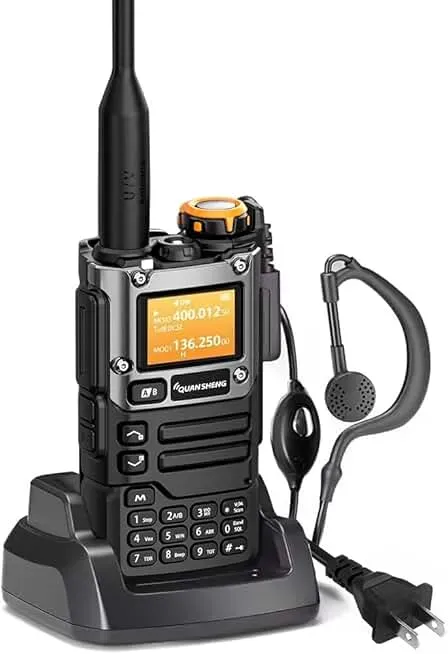
The UV-K5 is a dual-band analog FM handheld that transmits on the 2-meter and 70-centimeter ham bands at a claimed 5 watts, with wide-band receive from 50 to 600 MHz including AM airband, FM broadcast, and NOAA weather. 200 memory channels, a 1400 mAh battery (Quansheng's own spec; retail listings say 1600), USB-C charging plus a drop-in cradle, and an orange-backlit dual-frequency display. No DMR, no D-STAR, no APRS, no GPS, no Bluetooth, no IP rating.
| Dimension | Score | Why |
|---|---|---|
| Value | 95/100 | $25.64 for a moddable wide-band dual-bander is hard to argue with |
| Overall | 69/100 | Strong value, weak stock experience, no digital modes |
| Beginner | 86/100 | CHIRP support and simple controls; its best features still require flashing |
| Portability | 52/100 | 234 g and pocket-sized, standard budget-HT footprint |
| Feature | 23/100 | Analog-only TX; our score weights digital modes the K5 lacks |
A note on that feature score: RadioRanked weights digital modes (DMR, D-STAR, Fusion, APRS) heavily, and the K5 has none of them. What the score cannot capture is that this radio's feature list is software-defined. More on that below, because it's the reason you're reading about a $25.64 radio at all.
Why a Budget Radio Got Famous
When Quansheng shipped the UV-K5 in 2023, it looked like one more Baofeng clone in a market drowning in them. Then someone noticed that Quansheng had left the microprocessor unprotected. No locked bootloader, no encrypted firmware, nothing stopping you from writing your own code to it.
The community moved in fast. Within a year, hobbyist developers had reverse-engineered the radio and published open-source firmware that rewrote what the hardware could do: spectrum analyzers on the tiny display, receive coverage unlocked far beyond the stock ranges, battery percentage readouts, extra scan lists, even SSB reception with a hardware mod. All of it flashable from a browser in about five minutes.
That's what dethroned Baofeng in the tinkerer community. A UV-5R is cheap and everywhere, but it is what it is forever. The UV-K5 became the platform everyone was writing code for, the closest thing amateur radio has to a $30 development board that also happens to be a legal dual-band transceiver. The eHam and Reddit owner threads read the same way: measured shrugs about the stock radio, followed by genuine enthusiasm the moment firmware comes up. Owners with bench gear also note something the price does not suggest: transmit spectrum checks come back clean on 2m and 70cm, a real departure from the harmonic-spraying budget radios of the early UV-5R era.
Which UV-K5? The Variant Decoder
Quansheng's naming is a mess, and the SERP-wide confusion is real; even experienced reviewers slide between K5, K5(8), and K6 mid-article. Here's the actual family, with our scores and current prices.
| Model | Our score | Price | What it actually is |
|---|---|---|---|
| UV-K5(8) | 69/100 | $25.64 | The current mainline K5; the radio this review covers |
| UV-K6 | 65/100 | $31.55 | Same circuitry as the K5(8) in a restyled case |
| UV-K5(99) | not ranked | ~$26 | Same circuitry again, different case; sold under bundle listings |
| UV-K1 | 42/100 | an unlisted price | Stripped-down sibling |
| TK11 | 34/100 | $96.99 | Marketed like a successor; triple the price with a thin spec sheet |
The important fact: the UV-K5(8), UV-K6, and UV-K5(99) have essentially identical circuitry and firmware. A long-form owner test on the trainorders forum ran two copies side by side and found near-identical performance, with better unit-to-unit consistency than typical budget Chinese radios. Quansheng's own site lists them as siblings. Buy whichever case style is cheapest the day you're shopping; the firmware community treats them as one radio. Owner reports also credit the K5(8) and K6 with usable 220 MHz transmit after unlocking, which owners describe, tongue in cheek, as a $30 1.25-meter HT.
Two caveats. First, hardware revisions matter: Quansheng has shipped V1 through V3 boards, and custom firmware builds target specific revisions, so check your hardware version before flashing. Second, skip the TK11 unless you have a specific reason; it abandons the open platform that makes this family interesting, and our 34/100 score reflects a radio that costs three times as much while answering none of the K5's weaknesses. The UV-K1 is a similar story at a smaller scale. If you want the direct matchup, see our UV-K5 vs UV-K6 comparison.
Specs and Stock Performance
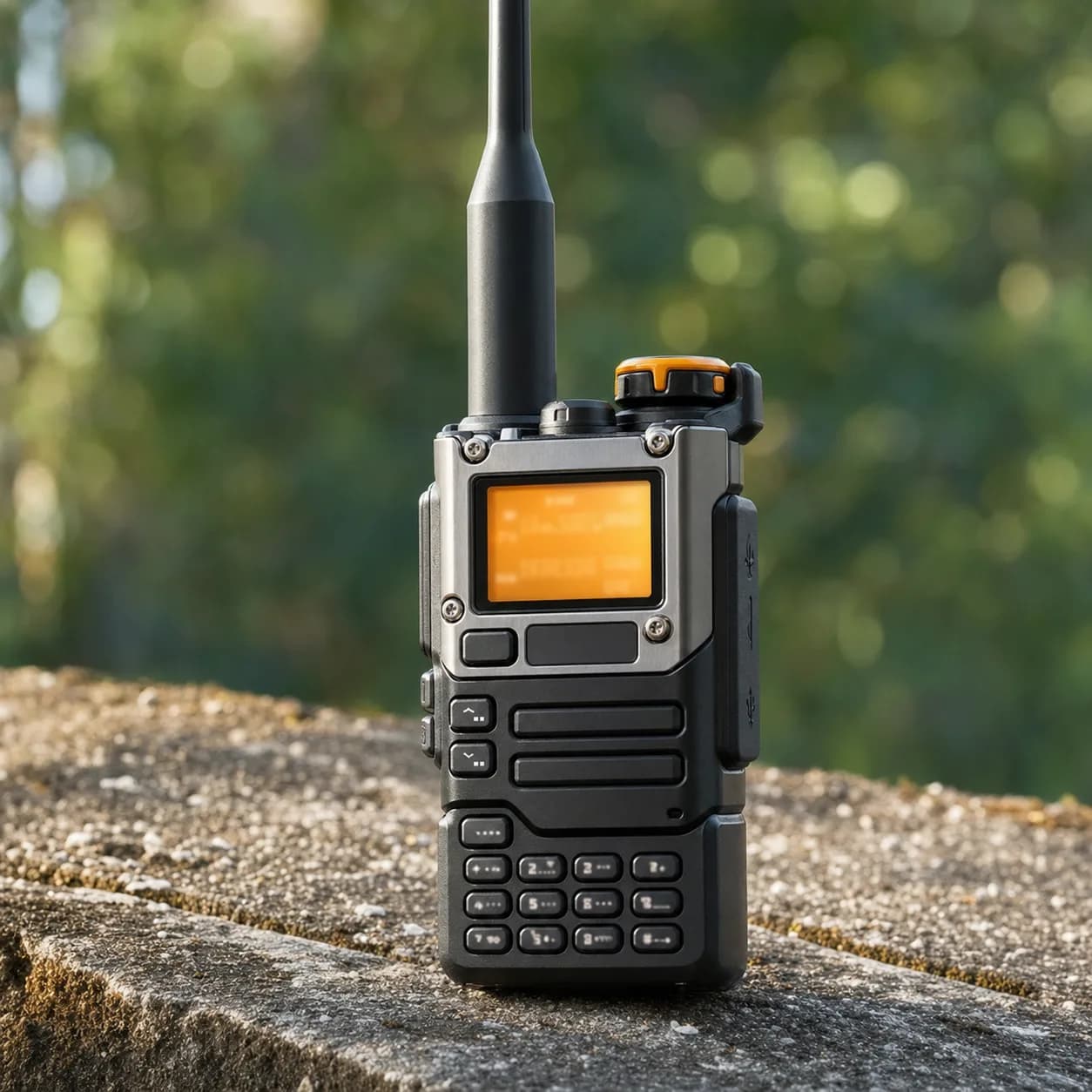
Quansheng's published numbers, from the official spec page:
| Spec | Manufacturer figure |
|---|---|
| Channels | 200 memory + 20 FM broadcast presets + 10 NOAA |
| Receive | 50 to 600 MHz across sub-bands, incl. AM airband and WFM broadcast |
| Transmit (US market) | 136 to 174 / 400 to 470 MHz, up to 5 W claimed |
| RX sensitivity (FM, 12 dB SINAD) | -121 to -123 dBm; AM airband -113 dBm |
| Battery | 1400 mAh Li-ion (Quansheng spec; listings say 1600), USB-C + cradle |
| Size / weight | 115 x 60 x 37.5 mm, 234 g |
| Frequency stability | +/- 1 ppm |
Note that EU-market units restrict transmit to 144-146 and 430-440 MHz, and some kits ship with an EU wall plug, so check the listing before you buy.
The measured reality is less flattering than the spec sheet. Independent bench testing at besthamradio.com clocked the transmitter at 3.3 watts on 2 meters and 2.2 watts on 70 centimeters against the 5-watt claim. That's normal behavior for this price class, but it means range claims built on "5 watts" deserve a discount. Frequency accuracy measured dead-on, and the stock antenna is decent by budget standards, with a resonance bump around 162 to 174 MHz that makes NOAA and public-safety listening a little better than you'd expect. One trainorders owner found a Nagoya NA-771 upgrade actually performed worse than the stock whip, which almost never happens with budget handhelds.
The receiver is the interesting half. Owners repeatedly compare its sensitivity to the Uniden BC125AT, a dedicated $100-class scanner, and it skews unusually sensitive on VHF relative to UHF, the opposite of most budget HTs. The tradeoff is a wide-open front end with no meaningful filtering: park near a strong transmitter and the K5 overloads. And the stock firmware's AM airband suffers from an AGC bug that garbles loud signals, which is exactly the kind of flaw the community firmware fixed within months. Battery life runs 8 to 12 hours of mixed monitoring, with a full charge in about 2 hours.
If you want to translate the receive ranges into bands and wavelengths, our ham radio band chart covers where everything sits.
The Custom Firmware Ecosystem
This is the reason to buy the radio, so here's the guidance every other page skips.
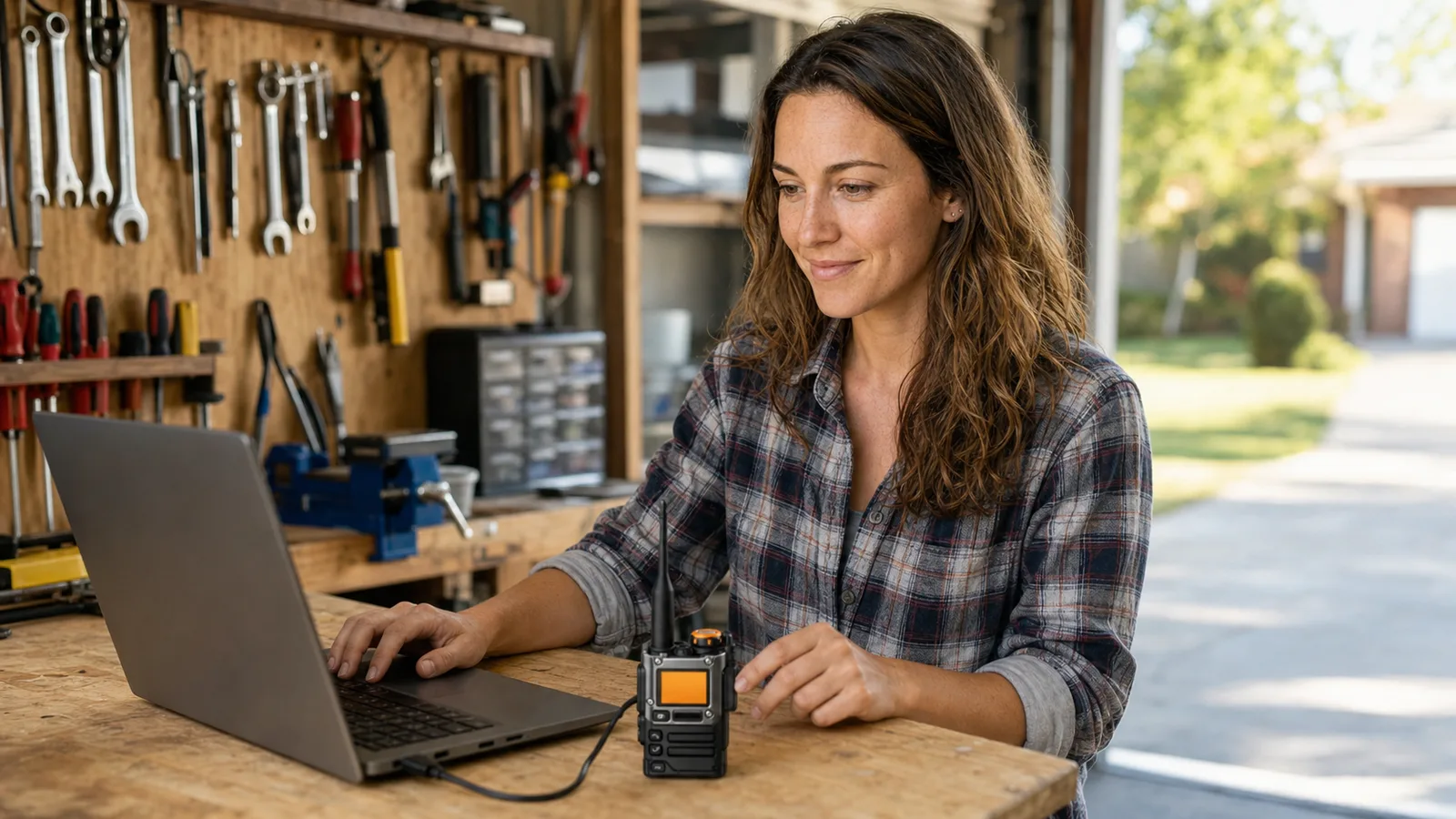
Flashing is genuinely easy: put the radio in bootloader mode (hold PTT while powering on), plug in a programming cable, open a browser-based flasher, pick a firmware file, done. Five to ten minutes the first time. You'll want a Baofeng-style two-pin programming cable; it's the same one CHIRP uses, and some Kenwood-plug cables fail on the K5.
| Firmware | Status | What it adds | Flash this if... |
|---|---|---|---|
| Egzumer | Archived, no longer developed | The classic all-rounder: menus grow from about 40 to 60 items, battery percentage, adjustable max volume, 2 scan lists, spectrum display | You're following an older tutorial; otherwise start with F4HWN |
| F4HWN | Actively maintained | Builds on Egzumer's feature set with continued fixes and refinements; the community's "surely a better version of Egzumer" | You want one answer: flash this first |
| IJV | Actively developed | Scanner-focused: 15 scan banks, RX bandwidth selection from 25 kHz down to 2 kHz, narrow AM that fixes airband audio, CHIRP-next loader support | You bought the K5 mainly to listen: airband, railroads, public safety |
| Losehu | Community namedrop | Another fork in circulation; less commonly documented in English-language guides | You've read its changelog and want something specific from it |
| CEC HF | Actively developed | Support for the SI4732 hardware mod, bringing 150 kHz to 30 MHz AM/SSB/CW receive | You've installed (or plan to install) the HF receiver board |
The short version: flash F4HWN first. It's the maintained successor to Egzumer, which is archived and no longer updated, and it gives you the features people actually buy this radio for, including the spectrum analyzer and wide receive unlock. If your use case is scanning rather than talking, IJV's scan banks and adjustable AM bandwidth make it the better fit, and it cures the stock airband garble outright.
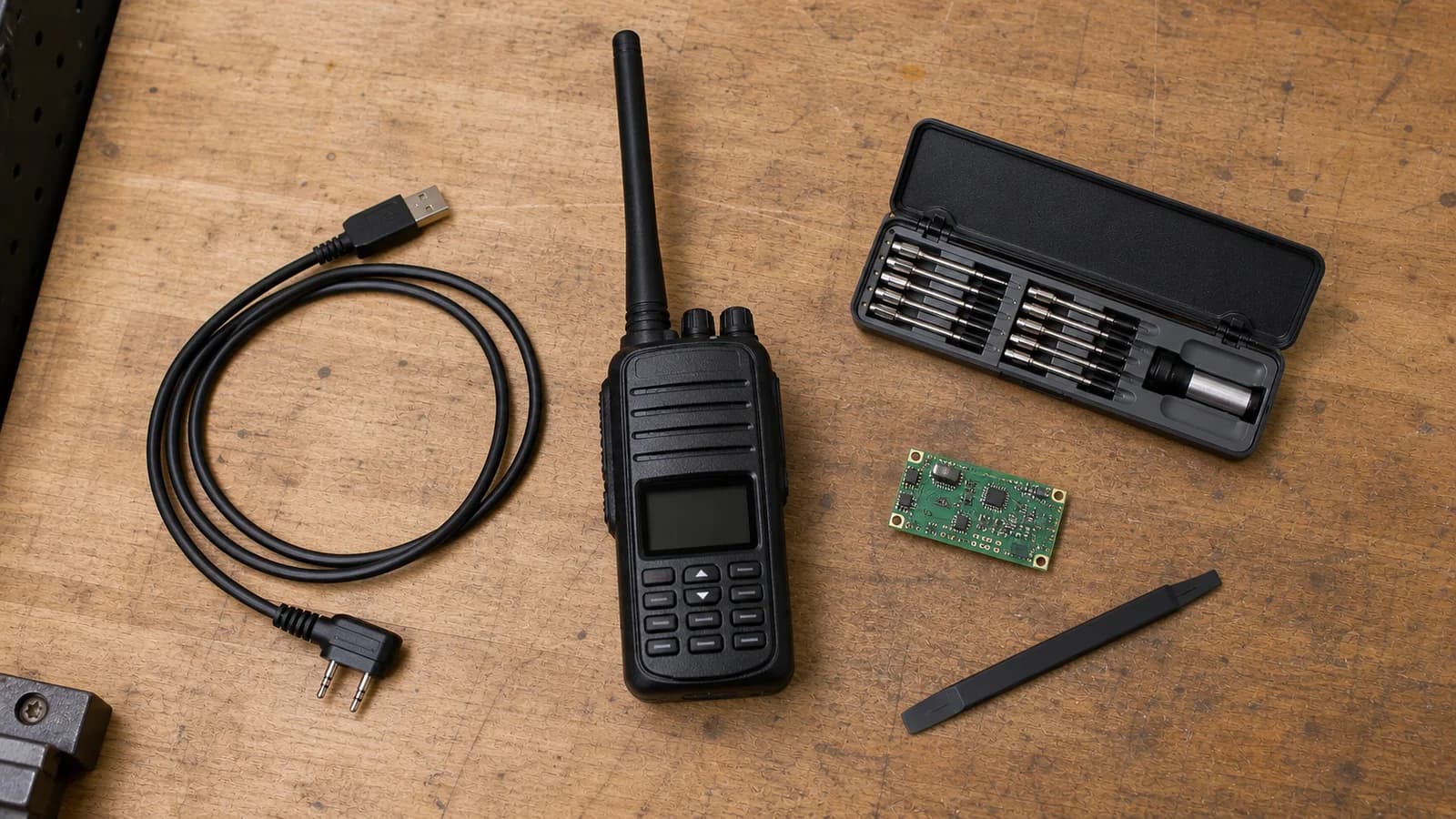
Then there's the hardware mod scene. The most famous is the SI4732 board swap: replace the K5's FM broadcast receiver chip with an SI4732 DSP receiver module, flash CEC's HF firmware, and the radio receives 150 kHz to 30 MHz in AM, SSB, and CW. That's shortwave broadcast, and 40-meter SSB nets, on a $30 handheld. One eHam owner summed it up as HF in your pocket for thirty dollars. It requires soldering and it's not for a first-time modder, but no other radio at any price near this one offers the option.
For channel programming, CHIRP-next supports the UV-K5 with the same Baofeng-type cable, and IJV ships its own CHIRP loader module. If you've never used it, our CHIRP guide covers the whole read-edit-write workflow; the K5 behaves like any other Chinese handheld once the cable is sorted. Keypad programming without CHIRP is cumbersome, which is true of this whole class.
One honest note before you flash anything: read the legality section below first. Firmware can unlock transmit far outside the ham bands. Being able to is not the same as being allowed to.
Build Quality: The Honest Cons
Owners rate this radio 4.3/5 on eHam across 18 reviews, but the recurring complaints are consistent and worth taking seriously.
The housing is glued, not screwed. Crack it open for the SI4732 mod and you're prying apart adhesive, which is an odd choice for the community-repair darling of the decade. The PTT button feels fragile compared to a Baofeng's, the speaker is thin and tinny, and at least one long-term owner reported the antenna port loosening over time. The 1400 mAh battery is on the small side next to the TD-H3's 2500 mAh, though real-world endurance is decent because the radio sips power on receive. One buyer reported the side USB-C port only charging to about 35 percent, so use the drop-in cradle for full charges if your unit misbehaves. And check the plug: some kits ship with an EU wall adapter.
None of this is disqualifying at $30.99. The consensus from owners who measure such things is that the K5 is "generally within spec, unlike the rest of the price point," and drop-and-drizzle anecdotes suggest it's tougher than it feels. But nobody should mistake it for a rugged radio. There's no IP rating and no reason to pretend otherwise.
UV-K5 vs Baofeng UV-5R vs TIDRADIO TD-H3
The three radios every budget buyer cross-shops, by the numbers:
| Radio | Our score | Price | Rating | The one-liner |
|---|---|---|---|---|
| Baofeng UV-5R | 69/100 | $17.16 | 4.5 (10,207) | The default first radio; huge ecosystem, half the price |
| Quansheng UV-K5 | 66/100 | $25.64 | 4.5 (686) | The moddable one; best receiver and best ceiling of the three |
| TIDRADIO TD-H3 | 55/100 | $31.99 | 4.4 (534) | The best stock experience: bigger battery, app programming, color screen |
The UV-5R outscores both, and that's mostly beginner-friendliness and price: at $16 with a decade of tutorials behind it, it's the easiest on-ramp in ham radio, and our UV-5R vs UV-K5 comparison breaks the matchup down line by line. But as a piece of radio hardware, the K5's receiver is more sensitive, its transmit spectrum is cleaner, and its wide-band RX embarrasses the Baofeng's.
Against the TD-H3, the community's framing is fair: the TIDRADIO is the better stock radio, with a 2500 mAh battery, cleaner airband audio out of the box, better filtering, and a phone-app programming flow that beginners genuinely like. The K5 wins on moddability and on receiver ceiling once flashed; the H3 has its own budding firmware scene (nicfw), but nothing close to the K5's ecosystem. If you'll never flash firmware, buy the H3. If flashing firmware is the appeal, nothing else is close.
There's also the "just buy a real radio" argument that comes up in every Reddit thread, usually pointing at a Yaesu. Our UV-K5 vs Yaesu FT-65R comparison covers what four times the price actually buys you.
Is It Legal? What the FCC Data Says
Here's the section nobody else in the search results covers, and the one that matters most if you're new to this. We track FCC equipment authorization data for every radio in our database. The UV-K5 platform does hold an FCC grant: Quansheng Electronics files under grantee code XBP, and FCC ID XBPUV-K5 was approved on March 9, 2023 under Part 15B, the rule part that covers a device's electronics rather than its transmitter. (An earlier version of this review reported no authorization on file; a 2026 registry re-check corrected that.)
The important part is what a Part 15B grant is not: it is not transmitter certification. Amateur radio equipment that transmits only in the ham bands does not require FCC transmitter certification; Part 97 lets licensed hams build, modify, and operate their own gear, which is why kit radios and homebrew transceivers are legal. Using a UV-K5 on 2m and 70cm with a valid amateur license is fine. If you don't have a license yet, our licensing guide and free practice quiz will get you there; receiving requires no license at all, so the K5 is legal for anyone as a scanner.
The bright lines are these. The UV-K5 holds no Part 95 certification, so it is not legal to transmit on GMRS, FRS, or MURS frequencies, ever, even though firmware will happily let you dial them in. And custom firmware that unlocks transmit across 50 to 600 MHz does not unlock any legal authority to use it: transmitting outside your amateur privileges is a violation of FCC rules regardless of what the radio is capable of, the same principle we cover in Is the Baofeng UV-5R legal?. Flash the firmware for the receiver features and the spectrum analyzer; keep your transmitter inside the ham bands your license covers. RadioRanked's position is boring and non-negotiable: wide-open receive is a feature, wide-open transmit is a liability.
Who Should Buy It, and Who Should Not
Buy the UV-K5 if you're a licensed ham who enjoys tinkering, a scanner or airband listener who wants BC125AT-class sensitivity for $31, or a budget-minded first-radio buyer who is curious enough to flash firmware and honest enough to respect the transmit rules. It's also the obvious second radio for anyone who already owns something dependable and wants a guilt-free experiment platform. For more picks in this bracket, see our best radios under $50.
Skip it if you want a radio that's excellent the day you unbox it (get the TD-H3), you need GMRS-legal gear (the K5 will never be that; see our GMRS picks), you're an appliance operator who will never open a web flasher (the UV-5R is half the price and easier for beginners), or you need digital modes, an IP rating, or anything resembling a warranty-backed ecosystem. Our best handheld roundup covers the radios that grow with you.
The Verdict
The Quansheng UV-K5 is two radios. The one in the box scores 66/100: within spec, clean on the air, hobbled by a garbled airband, a wide-open front end, and budget plastics. The one that exists ten minutes after you open a web flasher is the most interesting $31 in amateur radio, a software-defined feature list with a spectrum analyzer, serious receive performance, and a hardware mod path all the way to shortwave.
Buy it to tinker. Buy the TD-H3 to talk. Buy the UV-5R to spend $16. And whatever you flash, keep your transmitter where your license says it belongs. Full specs, live pricing, and score breakdown are on the UV-K5 product page.