

Amateur radio doesn't get one frequency; it gets a set of slices spread across the radio spectrum, from the longwave end near AM broadcast all the way up into the microwaves. Each of those slices is a "band," and each band behaves differently. Some only reach across town. Some bounce off the ionosphere and put you in contact with another continent on five watts. Knowing which band does what is the difference between buying the right radio and wondering why your brand-new handheld can't talk to anyone 200 miles away.
This guide walks through every US amateur band a new or intermediate operator actually uses, what each one is good for, which license class unlocks it, and where I'd tell a brand-new ham to start. If you only remember one thing: beginners live on 2 meters and 70 centimeters, and almost everything you buy first will be a dual-band handheld for exactly that reason.
The US Amateur Bands at a Glance
Here is the whole picture in one table. "Type" tells you the propagation family (HF bounces off the ionosphere for long distance; VHF and UHF are mostly line-of-sight). "License" shows the lowest class with meaningful access to that band.
| Band | Frequency range | Type | Best known for | License |
|---|---|---|---|---|
| 160m | 1.800–2.000 MHz | HF | Regional and "top band" DX, winter nights | General |
| 80m | 3.500–4.000 MHz | HF | Regional nets, evening ragchews | Technician (CW) / General |
| 60m | 5.3515–5.3665 MHz plus 4 channels | HF | A segment plus four channels, emergency | General |
| 40m | 7.000–7.300 MHz | HF | Daytime regional, nighttime DX | Technician (CW) / General |
| 30m | 10.100–10.150 MHz | HF | CW and digital DX (no voice) | General |
| 20m | 14.000–14.350 MHz | HF | The reliable DX workhorse | General |
| 17m | 18.068–18.168 MHz | HF | Quieter daytime DX | General |
| 15m | 21.000–21.450 MHz | HF | Daytime DX, solar dependent | Technician (CW) / General |
| 12m | 24.890–24.990 MHz | HF | Daytime DX near solar max | General |
| 10m | 28.000–29.700 MHz | HF | Local FM and worldwide DX | Technician |
| 6m | 50.000–54.000 MHz | VHF | The "magic band," surprise openings | Technician |
| 2m | 144.000–148.000 MHz | VHF | Repeaters, the beginner home base | Technician |
| 1.25m | 222.000–225.000 MHz | VHF | Quiet local FM, tri-band radios | Technician |
| 70cm | 420.000–450.000 MHz | UHF | Repeaters, digital, satellites | Technician |
There are more bands above 70cm (33cm at 902 MHz, 23cm at 1240 MHz, and a stack of microwave allocations), but they are specialist territory. Nothing you buy as a beginner will touch them, so I'm leaving them out of the detail below.
Frequency, Wavelength, and Why Bands Are Named in Meters
Bands get two names. "2 meters" and "144 MHz" describe the same band. The meter figure is the wavelength; the megahertz figure is the frequency. They are tied together by a simple relationship:
Wavelength in meters is roughly 300 divided by the frequency in megahertz. So 146 MHz works out to about 2 meters, and 14.2 MHz works out to about 21 meters, which is why we call it the 20-meter band. Our frequency and wavelength calculator does the math for any frequency you enter.
Wavelength matters because it sets antenna size. Lower frequency means longer wavelength means bigger antenna. That single fact explains most of the practical differences between bands: a 2-meter antenna is a stubby whip you screw onto a handheld, while an efficient 80-meter antenna is a wire well over 100 feet long. It also hints at why beginners start high in frequency. The antennas are small, cheap, and forgiving.
VHF and UHF: Where Almost Every New Ham Starts
If you just passed your Technician exam, this is your world. The 2-meter and 70-centimeter bands are where the local activity is, where the repeaters live, and where that first handheld you bought actually shines.
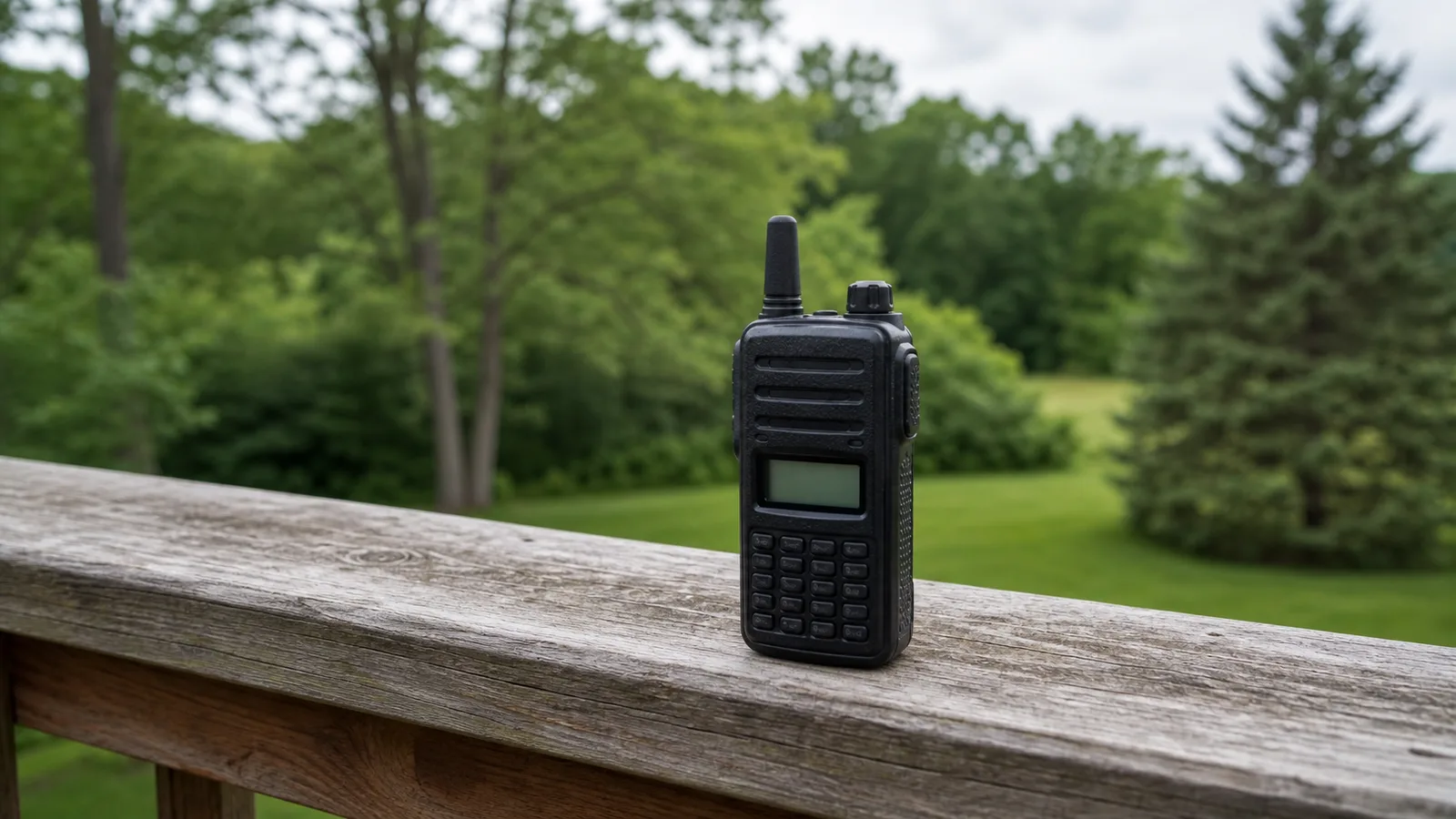
2 meters (144–148 MHz) is the busiest amateur band in most of the country. It is overwhelmingly FM: local repeaters, simplex chats, ARES and RACES emergency nets, and the national simplex calling frequency at 146.520 MHz. Range is line-of-sight, so a handheld might reach a few miles direct but cover an entire metro area through a hilltop repeater. There is also a weak-signal corner at the bottom of the band (SSB and CW around 144.1 to 144.3 MHz) that serious VHF operators use for long-distance contacts, but day to day, 2 meters means FM.
70 centimeters (420–450 MHz) is the UHF companion to 2 meters and the reason "dual-band" is the default. It penetrates buildings better than 2 meters, carries most of the digital voice traffic (DMR, D-STAR, System Fusion), and hosts plenty of repeaters of its own. Antennas are even smaller here.
1.25 meters (the 222–225 MHz segment), often just called "the 220 band," sits between them and is genuinely underused. It is quiet, which some operators love. A growing number of budget radios are tri-band and include it, which is the main reason to care about it as a beginner.
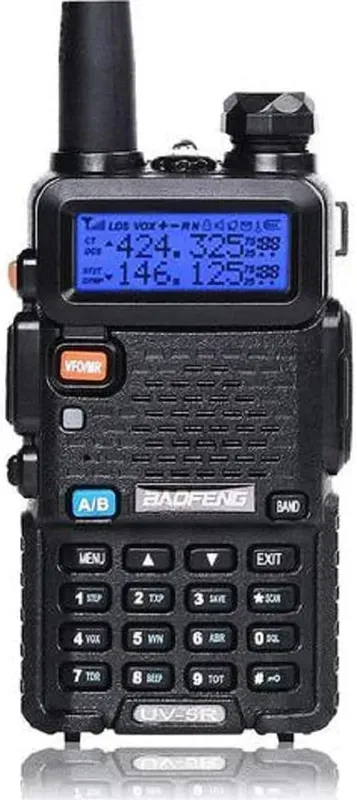
The Baofeng UV-5R is the radio that has trained more new Technicians than any other, and it does exactly this job: dual-band 2m/70cm FM for about the price of a pizza.
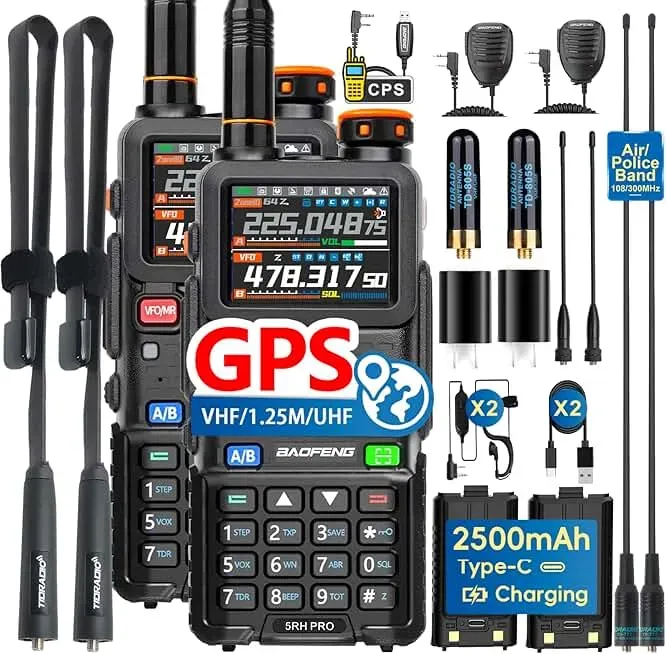
If you want tri-band coverage that adds 1.25 meters, plus ten watts of output and built-in APRS, the Baofeng BF-5RH PRO is the highest-scoring handheld in our database and still lands at $71.69.
Repeater Offsets You'll Actually Use
To use a repeater you transmit on one frequency and listen on another. The gap between them is the "offset," and it is standardized per band. Program these once and your radio handles the rest.
| Band | Standard offset | FM simplex calling |
|---|---|---|
| 2m | plus or minus 600 kHz | 146.520 MHz |
| 1.25m | minus 1.6 MHz | 223.500 MHz |
| 70cm | plus or minus 5 MHz | 446.000 MHz |
Programming software like CHIRP fills these in automatically when you import a repeater list, which is one more reason to learn it early. Our guide to CHIRP covers the workflow. For a fuller picture of how VHF and UHF differ in practice, see our VHF vs UHF breakdown.
6 Meters: The Magic Band
The 6-meter band (50–54 MHz) earned its "magic band" nickname honestly. Most of the time it behaves like a quiet VHF band: local FM around the 52.525 MHz calling frequency, some SSB and CW weak-signal work down near 50.125 MHz. Then, with no warning, it opens.
The opening usually comes from sporadic-E, a summer phenomenon where patches of the E layer of the ionosphere turn reflective and bounce 6-meter signals hundreds or even a couple thousand miles. Sporadic-E peaks roughly from late May through early August, with a smaller bump around the winter solstice. Near a solar maximum, 6 meters can also support F-layer propagation for true intercontinental contacts. It is the one band where modest VHF gear occasionally does HF-style distance, which is exactly why people get hooked on it.
Technicians get all-mode privileges on 6 meters, but most handhelds stop at 2m/70cm, so working it usually means a multi-band mobile or base radio.
HF Bands: Talking Around the World
Everything below 30 MHz is high frequency, and HF is where amateur radio earns its long-distance reputation. These bands work by refracting signals off the ionosphere, so a single hop can cover a thousand miles and multiple hops can reach the other side of the planet. The tradeoff is that propagation changes with the time of day, the season, and the 11-year solar cycle. Learning HF is partly learning to read those conditions.
Here is how the main HF bands behave. "When it's open" is a generalization; conditions vary, and that variability is half the hobby.
| Band | Frequency | Character | When it's typically open |
|---|---|---|---|
| 160m | 1.8–2.0 MHz | Long wavelength, needs big antennas | Winter nights |
| 80m | 3.5–4.0 MHz | Regional ragchews and nets | Nights |
| 40m | 7.0–7.3 MHz | Reliable all-rounder, can get crowded | Regional by day, DX at night |
| 30m | 10.1–10.15 MHz | CW and digital only, no voice | Day and night |
| 20m | 14.0–14.35 MHz | The DX workhorse | Daytime, often into the evening |
| 17m | 18.07–18.17 MHz | Quieter, well-mannered DX | Daytime |
| 15m | 21.0–21.45 MHz | Excellent DX when the sun cooperates | Daytime, solar dependent |
| 12m | 24.89–24.99 MHz | Sporadic but rewarding | Daytime near solar max |
| 10m | 28.0–29.7 MHz | Local FM plus worldwide DX | Daytime, best near solar max |
A few of these deserve a closer look:
20 meters is the band most HF operators reach for first. It is open somewhere in the world almost any daylight hour, it is not as crowded as 40, and it rewards even modest antennas. If you build one HF antenna, build it for 20.
40 meters is the dependable workhorse. During the day it covers your region through near-vertical incidence (signals that go up and come straight back down); at night it stretches out for DX. It is also one of the most crowded bands on the air, especially in the evening.
10 meters is a special case. When the solar cycle is high, ten meters opens up for spectacular long-distance contacts on low power, and it even has an FM repeater segment up around 29.6 MHz. When the sun is quiet, it can sound dead for weeks. It is also the only HF band where Technicians get a voice privilege, which makes it the natural first step toward HF.
80 and 160 meters are the night owls. The long wavelengths demand large antennas and they are quietest in winter, but they are the heart of regional nets and a favorite of operators who like working close-in and chatting.
The 30, 17, and 12 meter bands are the "WARC bands" (named for the conference that created them), and by long-standing convention contests are not run on them, which keeps them civil. The 60-meter band is unusual. Since 13 February 2026 it combines a continuous segment from 5351.5 to 5366.5 kHz with four fixed channels centered on 5332.0, 5348.0, 5373.0 and 5405.0 kHz, and everywhere on the band you are held to an effective-radiated-power limit rather than the usual wattage cap: 100 watts ERP on the four channels, and just 9.15 watts ERP inside the continuous segment. No 60-meter emission may be wider than 2.8 kHz. Note that ERP is not the number on your radio's power meter: the rule computes it as transmitter PEP multiplied by your antenna's gain relative to a half-wave dipole, so a gain antenna spends that allowance faster than a plain dipole does. The fifth channel operators used to know, 5358.5 kHz, no longer exists as a discrete channel, but that frequency is still usable because it falls inside the continuous segment.
Which License Unlocks Which Band
This is where new operators get tripped up, so it is worth being precise. There are three current US license classes: Technician, General, and Amateur Extra. You upgrade by passing the next exam; our step-by-step licensing guide covers how. Each upgrade mainly buys you access to more frequencies.
| Band group | Technician | General | Amateur Extra |
|---|---|---|---|
| 6m / 2m / 1.25m / 70cm and up | All modes | All modes | All modes |
| 10m | CW/data 28.0–28.3 plus SSB voice 28.3–28.5, capped at 200W | Full band | Full band |
| 15m / 40m / 80m | Narrow CW-only segments | Voice plus CW/data on the upper portions | Entire band, including the low DX segments |
| 20m / 17m / 12m / 30m / 60m / 160m | No access | Full access under each band's rules | Full access, plus Extra-only low-end segments |
A persistent myth says upgrading to Amateur Extra lets you run more power. It does not. In the US the legal ceiling is 1500 watts PEP, and it is set by the band and segment, not by your license class. A General and an Extra can both run the full 1500 watts where a band allows it. What the Extra upgrade actually buys is real estate: the bottom slices of 80, 40, 20, and 15 meters where the rare DX and the contest pileups concentrate. The genuine power exceptions are Technicians (200 watts on 10m and the HF CW segments), the 30-meter band (200 watts for everyone), and 60 meters (100 watts ERP on its four channels, and 9.15 watts ERP in its 5351.5 to 5366.5 kHz segment).
The practical takeaway: a Technician license gets you everything above 50 MHz plus a real foothold on 10 meters, which is plenty to stay busy for a year. General is the upgrade that opens HF properly. Extra is for operators chasing the last few kilohertz of DX spectrum.
Modes by Band: CW, SSB, FM, and Digital
Bands are not just frequencies; each one has informal "band plans" that assign segments to different modes. You won't find FM voice at the bottom of 20 meters, and you won't find SSB up in the 2-meter repeater segment. The rough pattern across HF is: CW (Morse) at the low edge of each band, then digital modes, then SSB voice higher up. On VHF and UHF, it flips toward FM and digital voice with a small weak-signal SSB/CW corner.
Digital modes deserve a mention because they have quietly taken over a lot of the activity. FT8 in particular lets you make contacts when a band is barely open and signals are too weak to hear by ear. It runs on a narrow dial frequency on each band (our FT8 guide explains how the mode works):
| Band | FT8 dial frequency (USB) |
|---|---|
| 160m | 1.840 MHz |
| 80m | 3.573 MHz |
| 40m | 7.074 MHz |
| 30m | 10.136 MHz |
| 20m | 14.074 MHz |
| 17m | 18.100 MHz |
| 15m | 21.074 MHz |
| 12m | 24.915 MHz |
| 10m | 28.074 MHz |
| 6m | 50.313 MHz |
| 2m | 144.174 MHz |
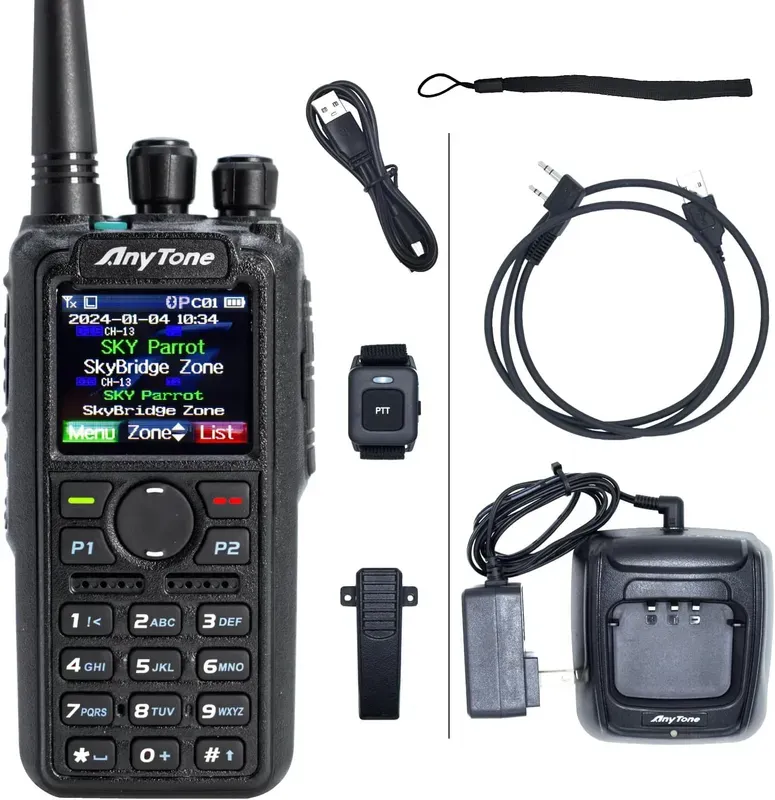
On VHF and UHF, the digital story is about voice: DMR, D-STAR, and System Fusion ride on top of the 2m and 70cm bands. If you want to get into digital voice without leaving the bands your handheld already covers, a DMR radio like the AnyTone AT-D878UVII Plus is the common starting point. Our DMR explainer and complete guide to digital modes cover how that world works, including how DMR, D-STAR, Fusion, and APRS differ.
Choosing Your First Band Based on Your Goals
Match the band to what you actually want to do, not to the spec sheet with the most numbers.
- Talk locally and reliably: 2-meter and 70cm repeaters. This is the default, and it is what a dual-band handheld is built for.
- Emergency and prepping communication: VHF/UHF simplex (memorize 146.520 MHz) plus local repeaters and nets. Reliability and a charged battery matter more than raw distance.
- Regional ragchewing: 40 meters in the daytime or 80 meters in the evening, both of which need a General license and an HF radio.
- Chasing distant countries (DX): 20 meters is the most forgiving entry point, with 15 and 10 meters joining in when the sun is active.
- Digital voice (DMR, D-STAR, Fusion): these live on 2m and 70cm, so your existing bands cover them; you just need a radio that speaks the mode.
- Weak-signal and surprise long-distance on a budget: 6 meters, when it opens.
Not sure your license-class assumptions are right? Our free practice quiz is a quick way to check where you stand before you commit to a radio.
A Quick Word on Antennas
Because antenna size scales with wavelength, the band you choose largely dictates your antenna situation.
On 2m/70cm, the rubber-duck antenna on your handheld works, but it is the weakest link in the system. A modest whip or a rooftop antenna often does more for your range than buying a more expensive radio. Our handheld antenna guide covers the upgrades worth making.
On 6 meters, you'll want a real antenna with some gain and height; the band rewards it.
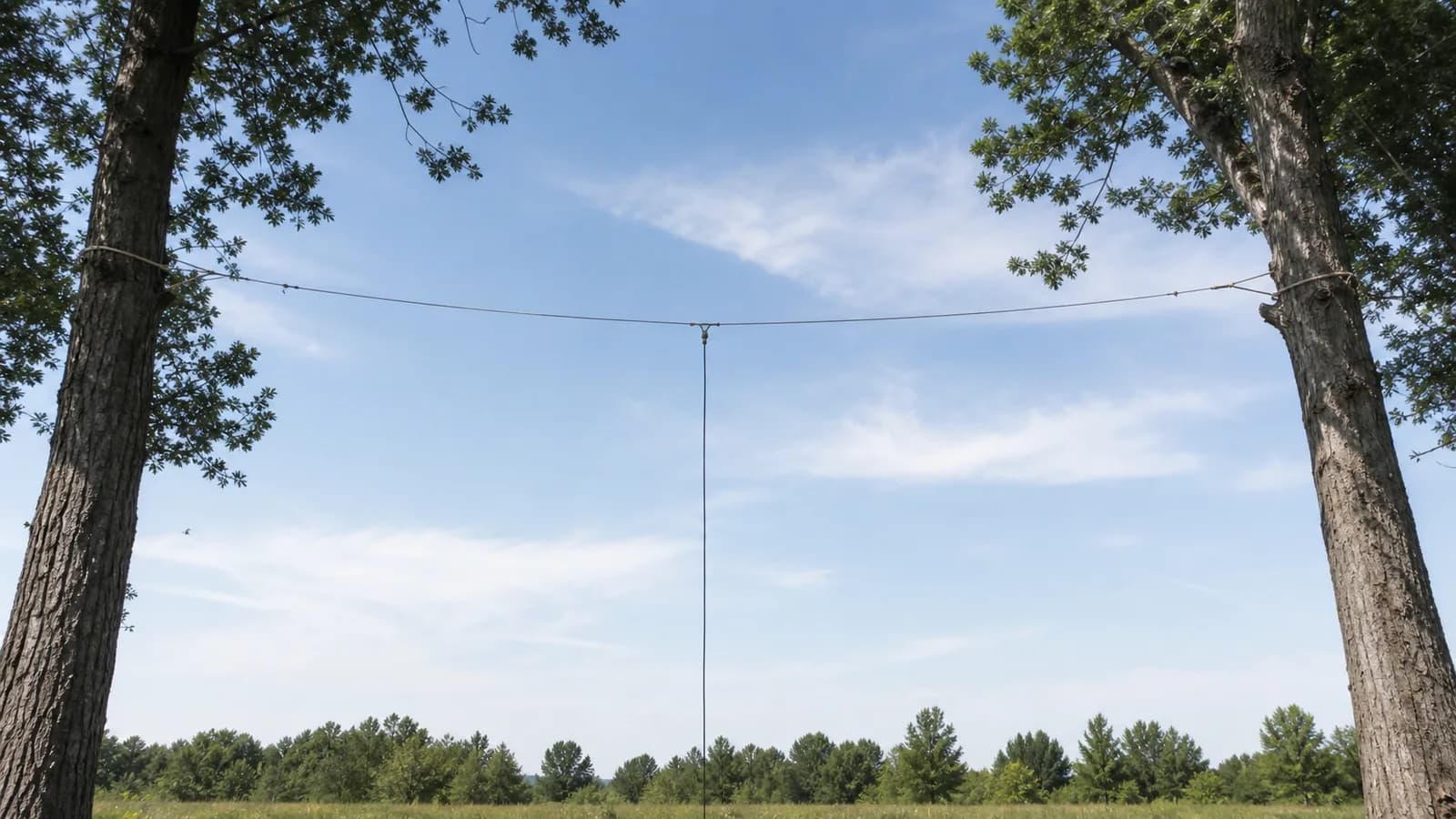
On HF, antennas get physically large. A simple dipole for 20 meters is about 33 feet of wire; for 40 meters it is roughly 66 feet. Operators with limited space use compromises like trap dipoles, end-fed wires, and verticals, all of which trade some efficiency for a smaller footprint. If you want to understand how far any of this actually reaches, our ham radio range guide digs into the real-world numbers.
Where to Start
If you are brand new, the path is well worn and it works: get your Technician license, buy a dual-band 2m/70cm handheld, program your local repeaters, and get comfortable on the air. From there, upgrade to General when you want to reach past the horizon on HF, and let your interests pull you toward whichever band matches them.
Start with the radio, not the spectrum chart. A handheld that covers 2 meters and 70 centimeters will keep you busy long enough to figure out what you actually enjoy. Browse our best radios for beginners for vetted picks, and keep the interactive band chart handy as a reference while you learn the layout.