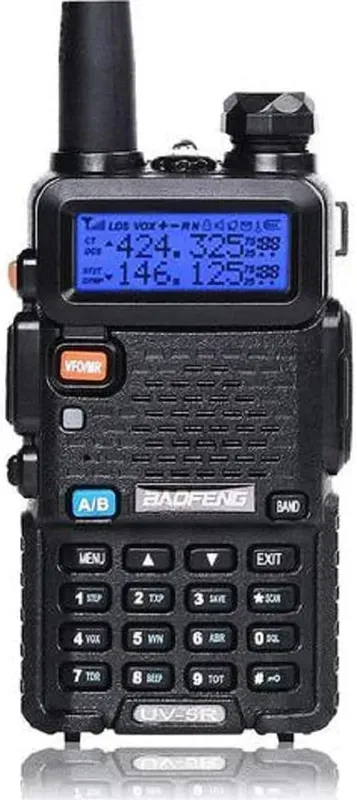

If you've spent more than ten minutes researching the Baofeng UV-5R, you've probably seen a forum post or YouTube thumbnail claiming it's been banned, made illegal, or that the FCC is coming for anyone who owns one. Most of these are wrong, or at least badly oversimplified.
The real answer depends on what you're doing with the radio, what frequencies you're transmitting on, and whether you hold a license. Here's how it actually works.
The Short Answer
If you have an FCC amateur radio license and you transmit only on amateur frequencies, the Baofeng UV-5R is legal to use. If you don't have a license, or you transmit on frequencies you're not authorized to use, it's not. That's the core of it, but the details matter, especially because the UV-5R's design makes it easy to accidentally or intentionally operate outside the law.
Why the Confusion Exists
The UV-5R has carried different FCC authorizations across its long production history, and that history is most of the confusion.
We checked the grants against the FCC equipment authorization records, and Baofeng's company, Pofung Electronic (HK), currently holds two of them for a radio called the UV-5R. One is FCC ID 2AJGM-UV5R (also written 2AJGMUV5R), granted under Part 15B as a scanning receiver, noted as amateur radio. It was approved on 2018-07-18 and changed on 2018-11-02, and it covers 136 to 174 MHz, 200 to 260 MHz and 400 to 480 MHz. The other is FCC ID 2AJGMUV-5R, where the hyphen sits inside the product code, which makes it a different ID. That one is a Part 90 transmitter certification, issued on 2020-11-03 through a change-in-identification application based on the original FCC ID ZP5BF-5RA, granted 2015-07-27. It covers 136 to 174 MHz only, and its RF exposure approval assumes work-related use in a controlled environment, which is what Part 90 radios are for.
Part 15B is worth understanding, because it is not what most people assume. It covers the radio as a digital device, meaning the unintentional emissions from its internal electronics. It is not a transmitter certification. Earlier UV-5R units sold in the US were marketed under Part 90 authorizations, which govern the Private Land Mobile Radio Service: business radios, taxi dispatchers, security companies. That is the kind of grant the FCC's 2018 enforcement action concerned, and a Part 90 UV-5R grant is still on file today: 2AJGMUV-5R, issued in 2020 on the basis of the 2015 ZP5BF-5RA authorization. Which grant a given radio carries is printed on its label, and the label is what counts.
But almost nobody buys a UV-5R to run a taxi fleet. The overwhelming majority of UV-5R buyers are amateur radio operators, or people who want a cheap radio and don't fully understand the licensing requirements. This mismatch between how the radio is certified and how it's actually used is the root of the confusion.
The UV-5R can transmit on any frequency between roughly 136–174 MHz and 400–520 MHz. That range covers far more than just amateur radio bands. It includes public safety frequencies, business band frequencies, FRS, GMRS, MURS, and marine frequencies. The radio doesn't stop you from programming and transmitting on any of them.
The FCC Enforcement Action
In August 2018, the FCC's Enforcement Bureau issued a Citation and Order (DA 18-801) against Amcrest Industries, LLC, the company importing Baofeng radios into the US under the BaofengRadio.us brand. The FCC alleged that Amcrest was illegally marketing unauthorized RF devices.
The key issue wasn't that the UV-5R existed. It was that the radio being imported at the time, despite being certified under Part 90 at a maximum of 1.78 watts on specific authorized frequencies, could transmit at 4 watts on any frequency in its range. Part 90 rules generally prohibit radios that allow the operator to use external controls to program and transmit on frequencies beyond those set by the manufacturer. The UV-5R is wide open. Any user with CHIRP or the keypad can program any frequency.
The FCC directed Amcrest to stop marketing unauthorized devices and warned of fines up to nearly $20,000 per day for non-compliance. A follow-up Public Notice (DA 18-980) in September 2018 broadened the warning to all importers and sellers of similar uncertified or improperly marketed two-way radios.
This is where the "Baofeng is illegal" narrative started. But the FCC action targeted the importer's marketing practices, not end users who already owned the radios.
Part 90 vs Part 97 vs Part 95: What Actually Matters
The FCC organizes radio services into numbered parts. Three are relevant here:
Part 90, Private Land Mobile Radio Service. Business and commercial two-way radio. Requires a license issued to an organization (not an individual). Radios must be type-certified for Part 90 and can only operate on frequencies specified in the license. A Part 90 grant for the UV-5R does exist, 2AJGMUV-5R, but it covers VHF only and applies only to units built and labelled to it. A UV-5R whose label reads 2AJGM-UV5R carries the Part 15B grant alone and is not eligible for business use at all, whatever a listing might claim. The units that did carry Part 90 authorizations had a further problem: open programming means the operator can transmit outside the frequencies the manufacturer set, which Part 90 rules generally prohibit.
Part 97, Amateur Radio Service. Ham radio. Requires an individual license (Technician, General, or Amateur Extra). Here's the critical detail: Part 97 does not require radios to be type-certified. Amateur operators are allowed to build, modify, and use any transmitting equipment as long as it meets Part 97 technical standards. This is unique to amateur radio. It's a self-regulating, experimentally-minded service, and the FCC has always given licensees more latitude with their equipment.
This means a licensed amateur can legally use a UV-5R on amateur frequencies (144-148 MHz and 420-450 MHz) regardless of what its equipment grant says. The current Part 15B grant, classed as Amateur Radio, is exactly what you would expect for a radio built for this service, and it is not a defect. You're operating under Part 97 rules, not Part 90 rules, and Part 97 doesn't require type acceptance.
Part 95, Personal Radio Services. This covers FRS, GMRS, MURS, and CB. Part 95 rules do require type certification, and the requirements are strict:
- FRS (Family Radio Service): Radios must be Part 95 certified, limited to 2 watts on most channels (0.5W on some), and must have a permanently attached antenna. The UV-5R fails on all three counts: it's not Part 95 certified, it transmits at up to 4-8 watts depending on the model, and it has a removable antenna. Using a UV-5R on FRS channels is illegal, period.
- GMRS (General Mobile Radio Service): Requires a GMRS license and a Part 95-certified radio. The UV-5R holds no Part 95 grant. Its Part 90 grant does not help either, and not only because Part 90 is a different service: it covers 136 to 174 MHz, so it does not reach the 462 to 467 MHz GMRS band at all. Do not assume the GT-5R solves this either. It is a ham radio, locked to the amateur bands, and GMRS needs a radio holding a Part 95E grant specifically. For that, see our GMRS radio picks, where we list the Part 95E grant for each one.
- MURS (Multi-Use Radio Service): License-free but requires Part 95 certification. Same story. The UV-5R doesn't qualify.
The Spurious Emissions Problem
Beyond certification, there's a technical compliance issue. The FCC sets limits on spurious emissions, unwanted signals that radios produce outside their intended frequency. Part 90 allows spurious emissions up to -20 dBc (relative to carrier power). Part 97 is stricter, requiring -40 dBc or better, which is 100 times cleaner.
Independent testing of UV-5R radios has produced mixed results. Some tested units pass both Part 90 and Part 97 limits. Others, particularly older production runs, pass Part 90 limits on VHF but fail Part 97's stricter standard on the 2-meter band. The 2nd and 3rd harmonics from 2m transmission have been measured outside FCC Part 97 limits on some units.
The good news is that newer UV-5R production runs appear to have improved front-end filtering. Testing of recent units shows compliance with Part 97 spurious emission limits with significant margin. Baofeng has also released the GT-5R, marketed specifically as an FCC-compliant version with cleaner spurious emissions.
The GT-5R is worth understanding on its own. Baofeng released it as a direct response to the 2018 enforcement action. The chassis, accessories, and ergonomics are the same as a UV-5R, but the firmware is locked: it transmits only on the amateur 2m and 70cm bands, with no path for end users to open it up to public-safety, business, or marine frequencies. Spurious emissions are cleaner, the radio carries fresh FCC certification, and it sells for roughly the same $20 to $25 as a stock UV-5R. If you want a Baofeng that is unambiguously inside Part 97 from the moment you turn it on, the GT-5R is the version to buy. The trade-off is that the wide receive range and the "let me program anything" flexibility that defines the UV-5R is gone, so legitimate receive-only listening on marine, MURS, or business frequencies is locked out too.
In practice, the FCC has never pursued an individual amateur operator for spurious emissions from a Baofeng. But it's worth knowing that not every UV-5R off the production line meets Part 97 specs, especially older units.
What's Actually Illegal
Let's be specific about what will get you in trouble:
Transmitting without a license. The UV-5R covers amateur frequencies. Transmitting on them without at least a Technician class license is a federal violation under 47 U.S.C. § 301. The FCC has issued fines and warning letters to unlicensed operators, and this is their most common enforcement action.
Transmitting on public safety frequencies. The UV-5R can be programmed to transmit on police, fire, and EMS frequencies. Doing so is a serious federal offense. In one documented case, the FCC took action against an individual who used a UV-5R on 155.190 MHz, causing interference to a county 911 dispatch system.
Using it on FRS, MURS, or GMRS. The UV-5R is not type-certified for any Part 95 service. Even if you have a GMRS license, using a non-certified radio on GMRS frequencies is technically a violation.
Importing or selling radios marketed for services they're not certified for. This is what the 2018 enforcement action addressed. If you're selling UV-5Rs and advertising them as suitable for business band, FRS, or GMRS use, you're violating FCC marketing rules.
What's Legal
Using it on amateur frequencies with a license. A Technician class license gives you full privileges on the 2-meter band (144–148 MHz) and the 70-centimeter band (420–450 MHz). These are the primary bands the UV-5R is used on, and amateur radio does not require type-certified equipment. This is the standard, uncontroversial use case.
Receiving on any frequency. The FCC does not regulate radio reception (with narrow exceptions for encrypted communications). You can listen to anything the UV-5R can pick up, including weather, public safety, aviation, and marine, without any license. Only transmitting requires authorization.
Owning one. Possession of a radio is not regulated. The FCC's enforcement actions have targeted importers, sellers, and people who transmit illegally, not people who simply own a UV-5R.
If You Accidentally Transmit Out of Band
It happens, especially to new operators. You program a memory channel slightly wrong, your scan latches onto an unfamiliar frequency, or a CHIRP import drops the wrong offset and you find yourself transmitting on a band you do not have authorization for. Most of the time, nothing comes of it. Here is what to do anyway.
Stop transmitting. The moment you realize you are off the amateur bands, release the PTT. Single key-ups of a few seconds rarely draw attention. A continuous lock-up, an extended net check-in, or repeated transmissions on the wrong frequency are what get noticed.
Figure out what happened. Check the displayed frequency, the displayed offset, and which memory channel you are on. Common causes: a CHIRP file with the wrong offset polarity on a repeater, a TX-disable flag that was supposed to be set, or accidentally tuning into VFO mode with the wrong shift. A stuck PTT on a damaged mic or accessory cable is the classic hardware version of the same problem.
Fix the channel. Either correct the programming or delete the channel entirely. Re-upload your codeplug if you are using CHIRP or manufacturer CPS. If the problem was a stuck PTT or a faulty cable, fix that first.
Do not try to explain over the air. If you transmitted into an ongoing conversation on a non-amateur service, especially a business or public-safety net, the right move is to back off and not return. Trying to explain over the air compounds the intrusion. The FCC's historic posture has been forgiving toward first-time, non-malicious mistakes when the operator self-corrects immediately; repeated or willful violations are a different conversation entirely.
If you ever receive a Notice of Violation from the FCC (extremely rare for casual operators), respond by the deadline and document the specific steps you took to correct the problem. Self-correction and good documentation are what separate a closed file from an enforcement case.
Outside the United States
The UV-5R's legal status varies significantly outside the United States, and US Part 97 reciprocity does not save you everywhere. If you travel with a Baofeng, check the destination country's rules before you key up, and ideally before you cross the border with the radio in your luggage.
Germany banned the UV-5R outright in 2019. The Bundesnetzagentur, Germany's spectrum regulator, cited inadequate spurious-emission filtering and the radio's wide-open programming capability. Possession is restricted to licensed amateurs operating within strict conditions, and importing one for resale is illegal.
Switzerland, Poland, and South Africa have similar restrictions, generally tied to type-acceptance rules that the UV-5R does not satisfy under European or African telecommunications standards.
The United Kingdom is more nuanced. Licensed amateurs can use a UV-5R on amateur bands; using it on PMR446 or business frequencies is illegal. Ofcom has issued guidance discouraging UV-5R use but has not banned the radio outright.
Canada allows licensed amateurs to operate Baofeng radios on amateur frequencies under the reciprocal CEPT/IARP system, similar to US practice. Innovation, Science and Economic Development Canada has not pursued enforcement against US-licensed visitors operating on Canadian amateur bands in good faith.
Mexico is generally permissive for visiting US amateurs holding a valid CEPT/IARP credential and operating on amateur frequencies, though local enforcement varies by region.
In every case the safe playbook is the same: bring proof of your US license, stay strictly on the amateur bands authorized by the country you are visiting, and verify before you transmit. If a country requires specific paperwork (most CEPT signatories accept your US license with no additional process; a few require a temporary operating permit), do that paperwork before you travel. Customs has occasionally confiscated unlicensed radios at borders in countries with strict rules, so a Baofeng in checked luggage is not a guaranteed save.
The Bottom Line for Licensed Hams
If you have your Technician license (or higher) and you're transmitting on 2m and 70cm, the UV-5R is legal to use. The FCC's 2018 enforcement action was about marketing and importation, not about individual hams using the radio on amateur bands. Part 97 does not require type-certified equipment, and the FCC has never taken action against a licensed amateur for simply using a Baofeng on ham frequencies.
That said, the UV-5R's wide-open frequency range is a responsibility. Program your radio correctly, stay on amateur frequencies, and don't transmit on bands you're not authorized to use. If you're not yet licensed, the Technician exam is straightforward -- our guide to getting your ham radio license covers the full process.
Looking for your first radio? The UV-5R remains the most popular entry point for new hams, and our full UV-5R review covers whether it's still the right pick in 2026. If you want something more polished, check our best handheld ham radios roundup or browse the full dual-band lineup. We also have a complete Baofeng lineup guide if you want to compare models. And if you're still getting oriented on the frequency bands the UV-5R covers, our VHF vs UHF guide breaks down what each band is actually used for.