

When the power grid goes down and the cell network is saturated, amateur radio keeps working. That is the entire reason hams show up during hurricanes, wildfires, and multi-day outages: the infrastructure everyone else depends on has a single point of failure, and a radio with a charged battery does not. This guide covers the emergency frequencies that actually matter, how amateur emergency response is organized, and what it takes to be genuinely ready instead of just owning a radio that sits in a drawer.
One thing up front, because it matters: ham radio does not replace 911. If you have a working phone and a functioning emergency line, call it. Amateur radio is a supplement and a backup. It relays messages when the phones are down, coordinates volunteers, feeds weather observations to the National Weather Service, and provides communication into and out of disaster zones when nothing else can. That is a huge role, but it is a support role.
The Emergency Frequencies, at a Glance
Here is the short list worth writing down. Most of these are receive-and-monitor or general calling frequencies rather than dedicated "911 channels," because amateur radio does not work that way. Emergency traffic in your area moves on local repeaters and nets, and those vary by region. But these national frequencies are the ones every operator should have programmed.
| Frequency | Band | Use | License needed to transmit |
|---|---|---|---|
| 146.520 MHz | 2m (VHF) | National FM simplex calling; primary emergency contact | Technician or higher |
| 446.000 MHz | 70cm (UHF) | National FM simplex calling | Technician or higher |
| 52.525 MHz | 6m | FM simplex calling | Technician or higher |
| 14.300 MHz | 20m (HF) | Maritime Mobile Service Net, intercontinental emergency | General or higher |
| 7.268 / 7.290 MHz | 40m (HF) | Regional emergency and traffic nets (LSB) | General or higher |
| 162.400 to 162.550 MHz | VHF | NOAA Weather Radio (receive only) | None (receive only) |
| 462.675 MHz | GMRS ch. 20 | Traveler assistance and emergency (GMRS) | GMRS license |
Program these into your radio now, not during the emergency. If your radio supports CHIRP, you can load the whole list in a couple of minutes; our Baofeng programming guide walks through it step by step.
146.52 MHz: The One Frequency to Remember
If you memorize a single frequency, make it 146.520 MHz. It is the national 2-meter FM simplex calling frequency, and it is the closest thing amateur radio has to a universal meeting point. "Simplex" means the two radios talk directly to each other with no repeater in between, which is exactly what you want when repeaters may be off the air.
The way it works in practice: you call on 146.52, someone answers, and then you both move to a nearby frequency to have your actual conversation and keep the calling channel clear. In an emergency, you announce the emergency plainly, state your location, and describe what is happening. There is no tone requirement, so any 2-meter radio can hit it out of the box.
The tradeoff is range. Simplex is line-of-sight, so you are typically looking at 5 to 30 miles depending on terrain, antenna height, and power. A handheld on its stock rubber-duck antenna from inside a building might only reach a few miles. That is why a repeater, when one is available, is usually the better tool: it sits on a mountaintop or tower and extends your reach dramatically. But repeaters need power and backhaul, and both can fail in a disaster. 146.52 is the fallback that does not depend on any of that. If you want to estimate how far your specific setup will actually reach, our guide to how far a ham radio reaches runs the numbers for you.
For UHF, the equivalent is 446.000 MHz, the national 70cm FM simplex calling frequency. Whether you reach farther on VHF or UHF depends on terrain and obstructions, so it is worth having both.
NOAA Weather Radio: 162.400 to 162.550 MHz
Every operator preparing for emergencies should be able to receive NOAA Weather Radio. The National Weather Service transmits continuous weather information on seven VHF frequencies:
- 162.400 MHz
- 162.425 MHz
- 162.450 MHz
- 162.475 MHz
- 162.500 MHz
- 162.525 MHz
- 162.550 MHz
Your local NWS office uses one of these, and coverage is nationwide from a network of transmitters. These are receive-only for you; the NWS transmits, you listen. Most dual-band handhelds can tune the weather band, and many have a dedicated weather-scan or weather-alert function that decodes the Specific Area Message Encoding (SAME) header broadcast ahead of tornado warnings, flash flood warnings, and other alerts, so the radio only sounds an alarm for your county.
This matters because NOAA Weather Radio is FM and short-range, which makes it reliable when it counts. When the grid is down and your phone's weather app is useless, a radio that can receive 162.55 MHz is still telling you whether a tornado is bearing down on your county.
HF Emergency and Calling Frequencies
VHF and UHF are local. When a disaster knocks out an entire region, HF is what carries traffic across state lines and beyond, because HF signals refract off the ionosphere and travel hundreds or thousands of miles. Transmitting on most of these requires a General class license or higher.
A few widely recognized HF frequencies:
- 14.300 MHz hosts the Maritime Mobile Service Net and is a long-standing intercontinental emergency and health-and-welfare frequency on 20 meters.
- 7.268 MHz and 7.290 MHz are commonly used for regional emergency and traffic nets on 40 meters (LSB voice).
- 3.985 MHz and nearby frequencies carry regional nets on 75 meters, useful at night for shorter-haul HF.
Be careful with HF specifics: emergency net frequencies are regional and change, so treat these as starting points and confirm what your ARRL section and local nets actually use. The ARRL also runs National Traffic System nets that move formal message traffic (radiograms) across the country every day, and those become critical channels for health-and-welfare messages after a disaster.
ARES and RACES: How Amateur Emergency Response Is Organized
Two programs do most of the organized work, and it helps to understand the difference.
ARES (Amateur Radio Emergency Service) is the ARRL's volunteer network. Any licensed amateur can join, membership is free, and most US regions have an ARES group. ARES is organized from the section level down to counties and local groups, each led by an Emergency Coordinator. Groups train through weekly nets and by providing communications for public events like marathons and bike races, which are low-stakes rehearsals for the real thing. When something serious happens, the Emergency Coordinator activates the group on pre-established frequencies, usually existing local repeaters carrying an ARES designation.
RACES (Radio Amateur Civil Emergency Service) is the government-affiliated counterpart, tied to county or state emergency management. It operates under a specific FCC provision (Part 97.407) and is activated by civil authorities, often to support an Emergency Operations Center. Membership frequently requires formal registration with your local emergency management agency. In many areas ARES and RACES have overlapping membership and use the same repeaters; the difference is largely who activates them and under what authority.
To get involved, find your local ARES Emergency Coordinator through the ARRL's website (arrl.org), or contact your county emergency management office about RACES. Either way, the frequencies you will actually use are local, so the single most useful thing you can do is get the frequency list from your regional group and program it in. Many groups publish a printable emergency frequency card for exactly this reason.
Skywarn: Feeding the Weather Service
Skywarn is the National Weather Service's volunteer storm-spotter program, and a large share of spotters are hams. During severe weather, a local Skywarn net activates, usually on a designated 2-meter or 70cm repeater, and trained spotters relay ground-truth observations (hail size, rotation, flooding, wind damage) directly to the NWS. This is one of the clearest examples of amateur radio's supporting role: radar cannot see a tornado on the ground, but a spotter with a radio can.
The training is free and available through the NWS, and there is no special equipment requirement beyond a radio that can reach the net. The exact Skywarn frequency varies by region, so it is another entry for your local frequency card.
FRS and GMRS: The License-Light Backup
Not everyone in your household is going to get a ham license, and that is where FRS and GMRS come in for family and neighborhood coordination. These are separate radio services from amateur radio, covered in detail in our FRS vs GMRS guide, but the emergency-relevant facts:
- FRS (Family Radio Service) uses 22 channels and requires no license at all. Channels 1 through 7 and 15 through 22 allow up to 2 watts; channels 8 through 14 are limited to half a watt. Range is modest, typically a mile or two in real terrain.
- GMRS (General Mobile Radio Service) shares those channels but allows much higher power (up to 50 watts on some channels) and repeater use. A GMRS license is $35 for 10 years, requires no exam, and covers your entire immediate family.
- 462.675 MHz (GMRS channel 20) is a traditional traveler-assistance and emergency channel, historically monitored by some highway-help groups.
FRS and GMRS are not a substitute for the reach and flexibility of amateur radio, but they are dead simple, and simple is valuable when you are handing a radio to a family member who has never keyed up before.
Emergency Operating Procedure
Knowing the frequency is half of it. Knowing how to operate on it is the other half.
Making contact. Identify yourself with your call sign, state your location, and describe the situation concisely. During a genuine emergency you can interrupt normal traffic, but be brief and be clear.
Message precedence. The National Traffic System uses four precedence levels, and using them correctly keeps a busy net functioning:
- Emergency: immediate threat to life or property.
- Priority: important messages with a specific time limit, tied to the emergency.
- Welfare: inquiries about the health and welfare of someone in the affected area.
- Routine: everything else, handled after the higher levels clear.
Net discipline. Emergency nets are usually directed, meaning a Net Control Station manages who transmits and when. You wait to be recognized, you keep transmissions short, and you avoid tying up the frequency with anything that is not essential. Identify at least every 10 minutes and at the end of your exchange, as always.
Plain language. Skip the hobby jargon and Q-codes during an actual emergency. Say what you mean in words anyone monitoring can understand.
The FCC's rules explicitly bend in a true emergency. Part 97 allows a station in distress to use any means at its disposal to attract attention and get help, including transmitting outside your normal privileges when life or property is genuinely at risk. That is a last resort, not a loophole, but it exists for a reason.
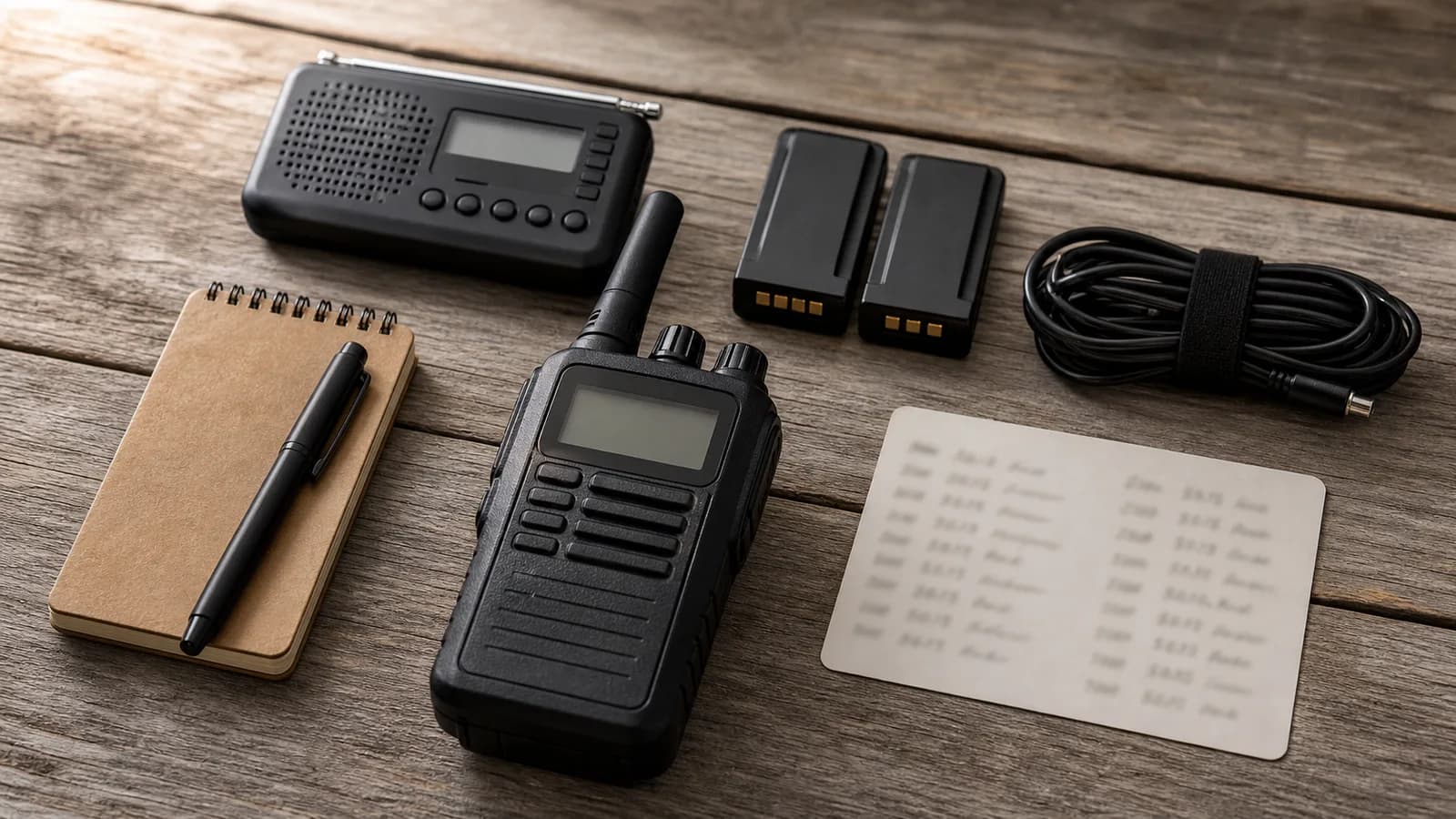
Building a Station That Is Actually Ready
Owning a radio is not the same as being prepared. Here is what separates a working emergency setup from a good intention.
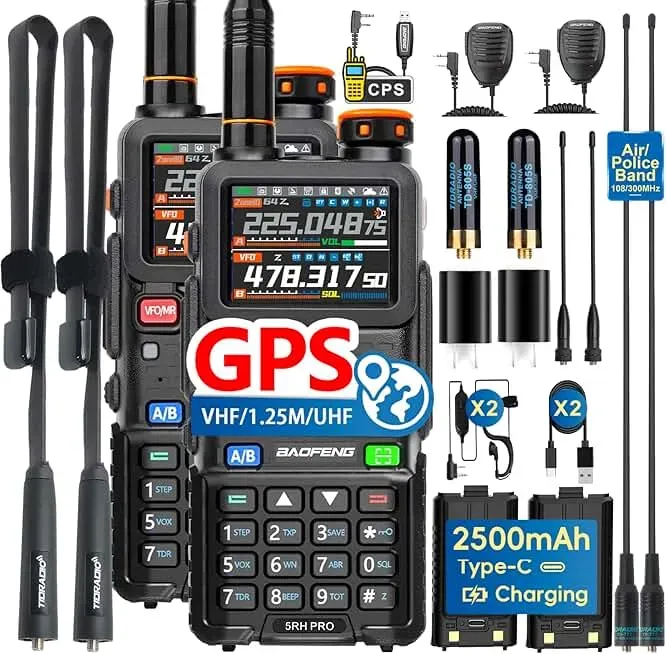
A capable handheld. This is the foundation. For emergency use I lean toward radios with higher power output, weather-band receive, and some water resistance. The Baofeng BF-5RH PRO is a strong data-backed pick here: it puts out up to 10 watts, carries an IP54 dust-and-splash rating, includes APRS and GPS, and ships as a two-radio kit, which is exactly what you want for family communication.
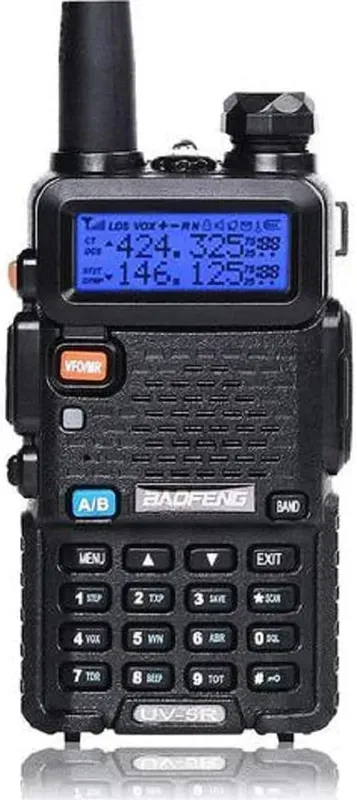
A cheap backup, or three. The single most common emergency radio in America is the Baofeng UV-5R, and for good reason. At around $17.16 it is cheap enough to stash one in every go-bag, vehicle, and kitchen drawer. It is CHIRP-programmable, so you can load your frequency list quickly, and it can scan the NOAA weather band. It only puts out 5 watts and it is not rugged, but as a redundant backup that you will not cry over if it gets wet, it is hard to beat. Read our full UV-5R review for the honest limitations.
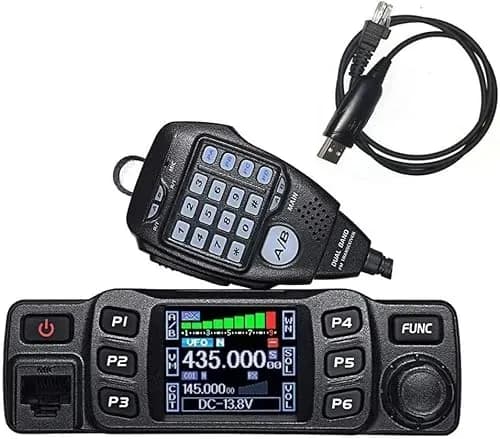
A mobile or base station. A handheld's biggest weakness is power and antenna height. A mobile radio running 25 to 50 watts into a proper antenna, whether mounted in a vehicle or on a mast at home, dramatically extends your reach and reliability during a long-duration event. The AnyTone AT-778UV is a simple, affordable way to get a 25-watt dual-band station going without a steep learning curve, which is a virtue in an emergency. If you want more power or features, our best mobile ham radios roundup and the full mobile radios category cover the 50-watt options.
Power backup. A radio is useless with a dead battery. Have spare batteries, a way to charge from your vehicle, and ideally a small solar charger or a battery bank sized for multi-day operation. This is the piece people forget.
An upgraded antenna. Swapping the stock rubber-duck for a better handheld antenna, or better yet putting up an external antenna, does more for your effective range than any amount of extra transmit power.
A printed frequency list. Print your local ARES/RACES frequencies, NOAA weather channel, section manager contact, and the national simplex frequencies. Keep copies at home, in the vehicle, and in your go-bag. When the grid is down, you are not pulling this up on a website.
If you are still choosing your first radio for this, our best radios for emergency preparedness and beginner pages rank the current options on real specs, and the emergency radio roundup goes deeper on what to prioritize.
A Reality Check
Amateur radio is a genuinely valuable emergency tool, but be honest about what it is and is not. It is not instantaneous like a phone call, it depends on other operators being on the air to relay your traffic, and it takes practice to use well under stress. The operators who are actually useful in a disaster are the ones who trained beforehand: they joined a local net, they know their equipment, and they have run the drills. A radio bought last week and never programmed is not a communication plan.
The good news is that the barrier to competence is low. Get your license, learn which bands you are allowed to use, program the frequencies above, join your local ARES net, and check in a few times. Do that, and you go from someone who owns a radio to someone who can actually help when it matters.