

Most articles about VHF vs UHF are written for facilities managers buying walkie-talkies for their warehouse. If you just got your Technician license and you're trying to figure out which frequencies to care about, those guides are nearly useless.
Here's the ham radio version.
What VHF and UHF Actually Mean
VHF stands for Very High Frequency. It covers 30–300 MHz. For ham radio operators, the band you care about within VHF is the 2-meter band, which runs from 144 to 148 MHz. It's called 2-meter because that's the approximate wavelength of a signal at that frequency. (Our antenna length calculator converts between the two.)
UHF stands for Ultra High Frequency. It covers 300 MHz to 3 GHz. The ham band you care about within UHF is the 70-centimeter band, which runs from 420 to 450 MHz in the United States. Same logic: 70cm is the wavelength at that frequency.
Technician class licensees have full operating privileges on both. If you passed your Technician exam, you can transmit on 2m and 70cm right now. See our ham radio band chart for the full frequency allocation by license class.
The 2-Meter Band (144–148 MHz)
The 2-meter band is where most new ham radio operators spend the majority of their time, and for good reason: it has the most infrastructure.
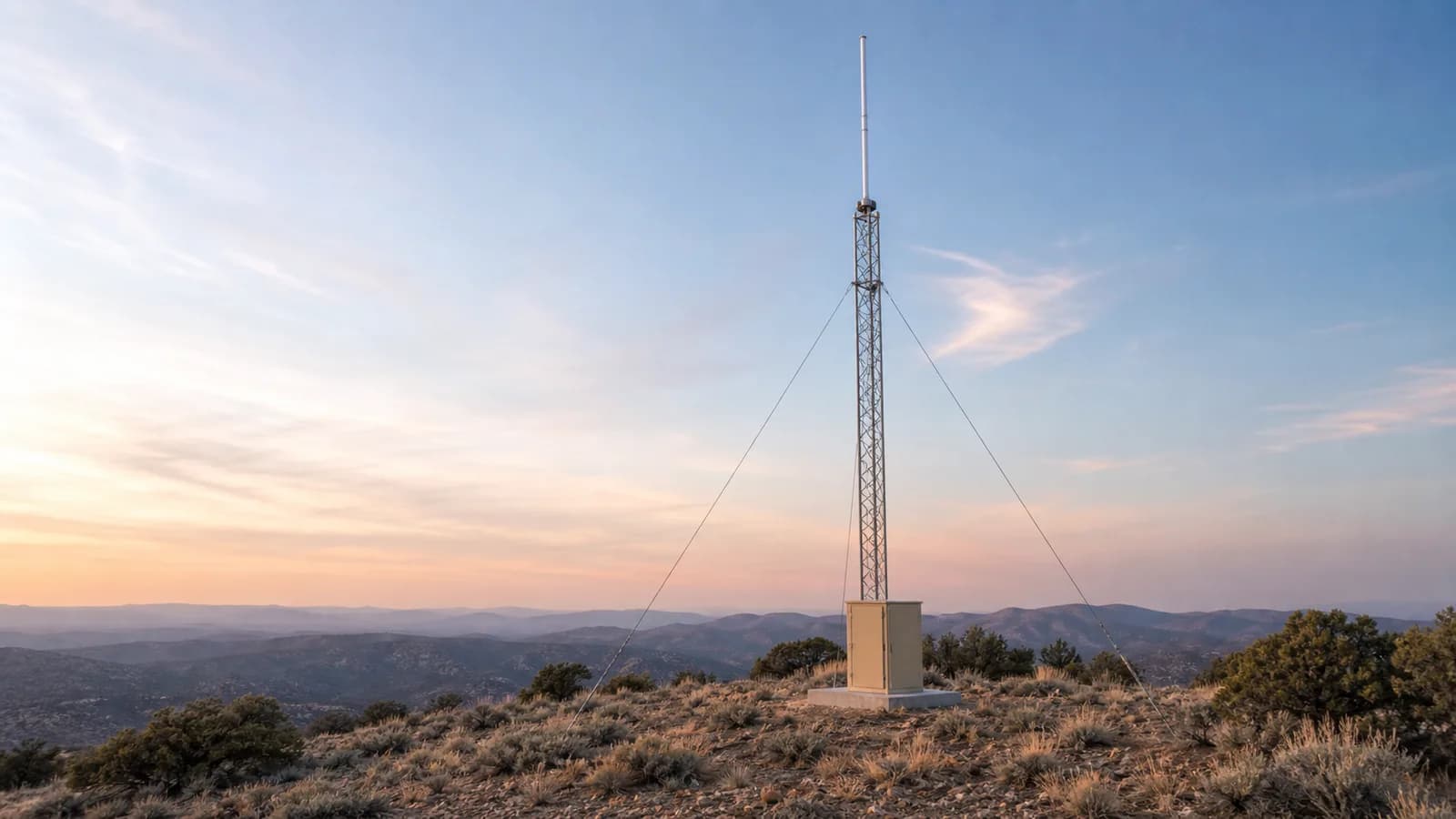
Repeaters are the backbone of local VHF activity. A repeater is a station, usually mounted on a hilltop, tower, or tall building, that receives your signal on one frequency and simultaneously retransmits it at higher power on another. A handheld radio with a few watts of power can reach a repeater from miles away, and that repeater then covers the whole region. Without a repeater, your HT might reach a few miles. Through a repeater, you can cover 30, 50, or even 100 miles depending on the repeater's elevation and power.
In most metropolitan areas, you'll find dozens of 2-meter repeaters within range. Rural areas have fewer, but 2m repeater coverage in the US is dense enough that most licensed operators can reach at least one.
146.520 MHz is the national 2-meter simplex calling frequency. Simplex means radio-to-radio, no repeater involved. When operators want to make direct contact without going through a repeater infrastructure (during a hiking trip, for example, or when repeaters are congested during an emergency), they call out on 146.520 first, then move to another simplex frequency for the actual conversation.
APRS (Automatic Packet Reporting System) also runs on VHF, specifically 144.390 MHz in North America. APRS is a digital protocol that transmits GPS position data, weather information, and short messages over radio. Many ham operators use it for vehicle tracking, hiking safety, and emergency communications. If APRS interests you, you need a radio capable of 2m.
The 70-Centimeter Band (420–450 MHz)
The 70cm band gets less beginner attention than 2m, but it's a capable and increasingly active band.
Repeaters exist on 70cm too. Many modern repeater systems are linked pairs: a club will operate both a 2m and a 70cm repeater, often with the same traffic. 446.000 MHz is the national 70cm simplex calling frequency, the UHF equivalent of 146.520.
Where 70cm pulls ahead of 2m is building penetration. Higher frequencies do a better job passing through concrete and steel. If you're trying to use a handheld radio inside a large building (a hospital, an apartment block, a shopping center), 70cm will generally outperform 2m. The tradeoff is that 70cm signals don't travel as far in open terrain.
70cm is also the band for satellite communications. Most FM amateur satellites, including the linear transponder birds like AO-73 and the FM birds that beginner operators use, operate on a combination of VHF uplink and UHF downlink, or vice versa. Working a satellite pass requires a radio that can transmit on one band and receive on another simultaneously, which means a dual-band radio is mandatory for satellite work.
Digital voice modes, including DMR, System Fusion (C4FM), and D-STAR, operate on both bands, but 70cm has substantial digital repeater infrastructure in many urban areas. If you want to explore digital voice, 70cm is where a lot of that activity lives.
Tones, Offsets, and Why Repeaters Need Both
When you hit a repeater, two pieces of programming have to be right. Get either wrong and the repeater will not retransmit you, even if it hears you cleanly.
The offset. A repeater receives on one frequency and transmits on another. For 2m the offset is almost always 600 kHz, plus or minus depending on the receive frequency. For 70cm the offset is almost always 5 MHz. Your radio needs to listen on the repeater's transmit frequency and key up on the repeater's receive frequency. Programming software like CHIRP fills these in automatically when you import a repeater from RepeaterBook.
The access tone. A CTCSS tone (also called a PL tone, after Motorola's "Private Line" branding) is a sub-audible tone your radio transmits underneath your voice. The repeater is set to ignore any signal that does not carry the correct tone, which keeps weak distant stations and adjacent-channel noise from triggering it. The other tone system you will see is DCS (Digital Code Squelch), which sends a short digital code instead. Some repeaters require one, some require the other, some require both, and a few are wide open with no tone at all.
You find out which tones a repeater uses on its RepeaterBook listing or its sponsoring club's website. If a repeater is listed as 100.0 Hz, you set 100.0 Hz as your TX tone, leave RX tone off unless you want squelch-on-receive too, and you are done. Wrong tone, no contact. Right tone, the world opens up.
A third quirk worth knowing about: bandwidth. Most 2m and 70cm ham repeaters in the US run wide-band FM (25 kHz). Some commercial-leased frequencies have moved to narrow-band (12.5 kHz). Most ham radios default to wide and you will rarely need to change it, but if a repeater sounds distorted on your end, the bandwidth setting is the first place to look.
Satellites and Cross-Band Operation
The single biggest reason new Technicians end up wanting a dual-band radio is the amateur satellite fleet. The FM "easy-sat" birds and the various Lemur-class and CAS-class satellites that pass overhead daily almost universally use 2m for one leg of the link and 70cm for the other.
A satellite pass works like a temporary, fast-moving repeater. You key up on one band and listen on the other while the satellite is in view, typically 8 to 15 minutes per pass. To work a satellite from the ground, your radio needs to transmit on one band and receive on the other at the same time. That capability, called full-duplex cross-band, is on most modern dual-band handhelds worth buying, though a few cheap radios cannot do it even when you put a 2m and a 70cm rig side by side.
The other use for cross-band is the cross-band repeat function on some mobile rigs. You leave your mobile rig parked on a hilltop with its battery on, set it to retransmit anything it hears on 2m up to your 70cm handheld and vice versa, and you have effectively turned your truck into a portable repeater for the afternoon. Cross-band repeat is the kind of feature that sells dual-band radios. Even if you never use it the first year, it is the kind of capability you cannot add later if you bought a single-band rig.
Which Band Has Better Range?
Neither band is definitively better for range. Both VHF and UHF propagate primarily by line of sight at the frequencies hams use. If there's a hill between you and the person you're trying to reach, neither frequency band solves that problem without a repeater.
That said, VHF (2m) does travel slightly further in open conditions. The lower frequency means the signal bends around terrain a little better and suffers less attenuation over distance. In a flat rural environment with no repeaters, 2m simplex will generally outrange 70cm simplex between two identical handhelds.
VHF also experiences propagation phenomena that UHF rarely does. During tropospheric ducting events (weather-related atmospheric conditions), 2m signals can travel hundreds or even thousands of miles beyond their normal range. Ham operators monitor for these openings and can make contacts across states or even internationally on 2m using just a modest station. Sporadic-E propagation, common on 6m, occasionally affects 2m as well.
For day-to-day repeater use, the difference in range between 2m and 70cm is mostly academic. You're limited by whether a repeater is within range of your handheld, not by the physics of the frequency band.

The Practical Answer: Get a Dual-Band Radio
If you're buying your first radio as a newly licensed ham, the answer to "VHF or UHF?" is: get a dual-band HT that does both.
Dual-band handhelds transmit and receive on both 2m and 70cm. They're not significantly more expensive than single-band radios, and they eliminate the decision entirely. You get access to the dense 2m repeater network and the building-penetrating performance of 70cm in one radio.
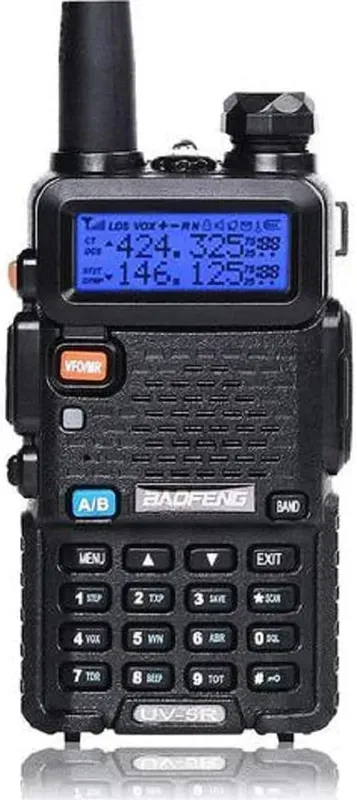
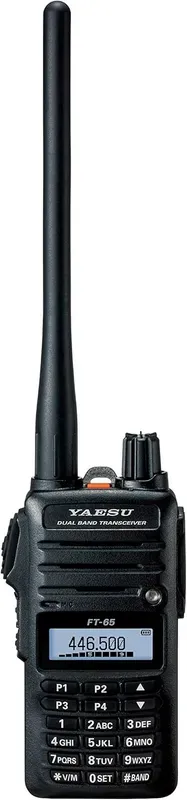
The Baofeng UV-5R is what most new Technicians buy first. It's $17.16, covers both bands, and works well enough to get you on the air and figure out what you actually want to do with ham radio before investing in more serious gear. Our full UV-5R review goes deeper on whether it's still the right first radio in 2026. The Yaesu FT-65R is a step up: more durable, better receiver, still affordable.
If you're just getting started with ham radio, check out our best handheld ham radios roundup or our best radios for beginners page where we've scored and compared the full field.
When a Single-Band Radio Makes Sense
There are situations where a single-band radio is the right call:
You're in a rural area with only 2m repeaters. In parts of the US, 70cm infrastructure is sparse or nonexistent. If every repeater within range of your home is 2m only, a 2m-only radio covers all your needs. Check RepeaterBook to see what's active in your area before buying.
You want a dedicated APRS tracker. Purpose-built APRS trackers and digipeaters are single-band 2m devices. If that's your specific project, a 2m-only device is the right tool.
You're building a base station for a specific purpose. A home station for local emergency communications nets, club nets, or a linked repeater system might be band-specific. But for a first radio? Go dual-band.