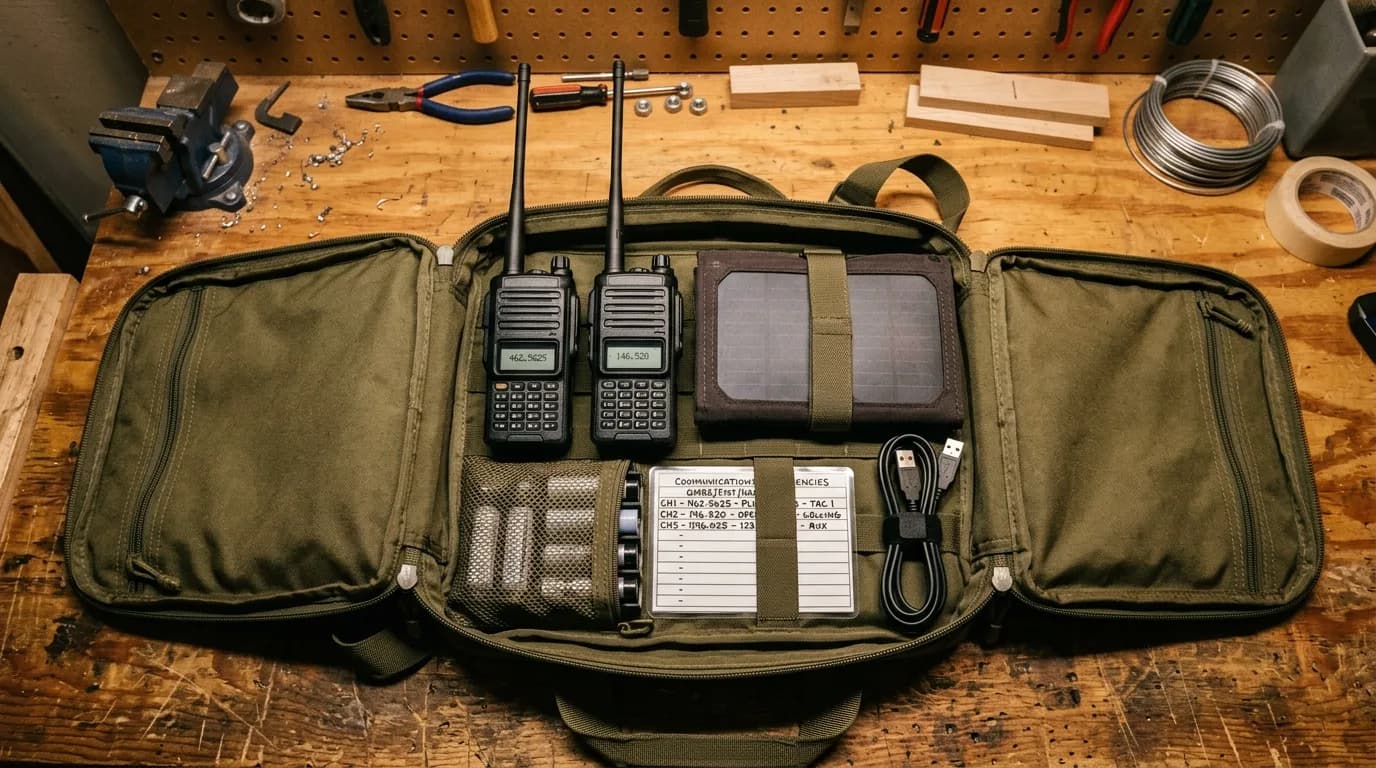

Quick answer: The Baofeng BF-5RH PRO ($70) tops our emergency picks for 2026: 10 watts of output, a 2,500 mAh battery, and IP54 weather resistance. The Ailunce HD1 ($97) is the most rugged option with IP67 sealing and DMR capability. For budget redundancy, stock multiple Baofeng UV-5Rs ($16 each) so a broken or lost unit isn't a single point of failure. All six picks scored on battery longevity, build quality, and simplicity under stress.
When the power goes out and cell towers go silent, a ham radio is one of the few communication tools that still works. No infrastructure required, no monthly subscription, no internet connection. Just a charged battery, a clear frequency, and someone listening on the other end.
But not every ham radio is suited for emergencies. The features that matter for casual weekend use (color display, Bluetooth, GPS logging) are not the same features that matter when you need reliable communication during a multi-day power outage or evacuation. For emergency use, three things matter above everything else: battery longevity, build quality, and simplicity under stress.
I tested and scored every handheld in our database against those criteria. Here are the six that belong in an emergency kit.
Quick Picks
| Radio | Price | Score | Battery | IP Rating | Best For |
|---|---|---|---|---|---|
| Baofeng BF-5RH PRO | $71.69 | 86/100 | 2,500 mAh | IP54 | Best overall for emergency |
| Ailunce HD1 | an unlisted price | 81/100 | 3,200 mAh | IP67 | Most rugged |
| Baofeng UV-25 | $63.99 | 76/100 | 5,200 mAh | -- | Longest battery life |
| Baofeng GT-5R | $19.99 | 69/100 | 3,800 mAh | -- | Budget backup |
| Baofeng UV-5R | $17.16 | 69/100 | 1,800 mAh | -- | Redundancy (buy multiples) |
| Yaesu FT-65R | $194.96 | 57/100 | 1,950 mAh | IP54 | Premium build quality |
How We Scored These
RadioRanked scores every radio on a 0-100 scale across five dimensions: value, features, beginner-friendliness, portability, and an overall composite. The scores come from manufacturer specs, not subjective impressions. For this article, I weighted battery capacity, IP rating, power output, and ease of use more heavily when selecting picks. A radio that scores well overall but has a 1,600 mAh battery and no water resistance didn't make the cut.
Full methodology is on every product page.
Best Overall: Baofeng BF-5RH PRO
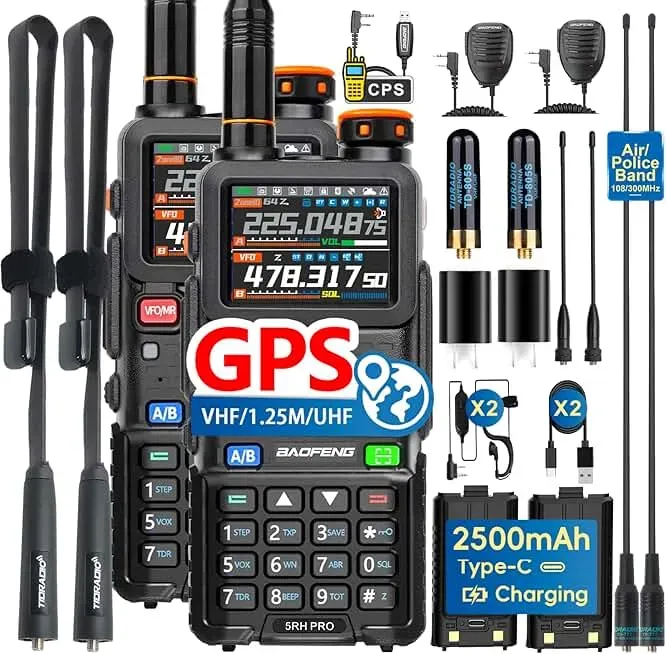
Price: $71.69 | Score: 86/100 | Battery: 2,500 mAh | Power: 10W | IP Rating: IP54
The BF-5RH PRO is the highest-scoring radio in our entire database, and it earns that spot with a combination of features that line up perfectly for emergency use. 10 watts of output power gives you meaningfully better range than the standard 5W handhelds. IP54 means it handles dust and rain splashes without issue. Tri-band coverage (VHF, UHF, and 1.25m) means you can access more repeaters and simplex frequencies than a standard dual-band radio.
It scores 94 for beginner-friendliness, which matters more than you might think. During an emergency, you do not want to be scrolling through submenus to change a frequency. The BF-5RH PRO's interface is straightforward enough that a family member who has never touched a radio can be walked through basic operation in minutes.
The 2,500 mAh battery is solid, though not exceptional. On 10W transmit, expect around 6-8 hours of intermittent use (roughly a 90/5/5 standby/receive/transmit duty cycle). For extended outages, pair it with a USB power bank. The radio charges over USB-C.
CHIRP compatible, so you can pre-program your emergency frequencies, local repeaters, and simplex calling channels from a computer. Do this before you need it.
Who it's for: Anyone building their first emergency radio kit. It does everything well and nothing poorly. If you only buy one radio for preparedness, this is the one.
Tradeoff: The battery isn't the biggest. If multi-day runtime without external power is your priority, look at the UV-25 below.
Most Rugged: Ailunce HD1
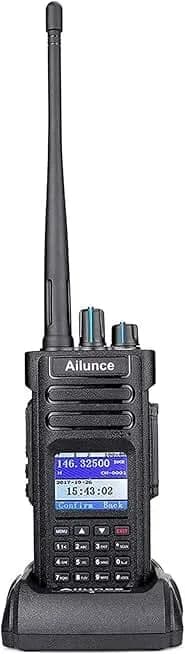
Price: an unlisted price | Score: 81/100 | Battery: 3,200 mAh | IP Rating: IP67
If your emergency scenario involves rain, mud, river crossings, or the general chaos of an evacuation, the Ailunce HD1 is the radio that can take the abuse. IP67 means it can survive full submersion in one meter of water for 30 minutes. That's not just rain resistance; that's "dropped in a puddle, fished it out, kept talking" territory.
The 3,200 mAh battery is the second-largest among our IP-rated picks, giving you roughly 10-12 hours of intermittent use. It also has DMR capability, which means you can access digital repeater networks if analog repeaters in your area go down. During Hurricane Maria and similar disasters, DMR networks running through internet-connected hotspots provided communication links when traditional repeater infrastructure failed.
The HD1 scores 54 for beginner-friendliness, which is lower than the budget picks. DMR configuration requires more setup, and the menu system has a steeper learning curve. This is not the radio to hand to someone who has never programmed a channel. But if you're willing to invest the time to set it up properly before an emergency, the combination of ruggedness, battery life, and digital capability is hard to beat at under $100.
Who it's for: Preppers who take field durability seriously. If you're building a kit for outdoor emergencies, wildfire evacuations, or severe weather, the IP67 rating justifies the price over budget options.
Tradeoff: Not CHIRP compatible. Programming requires the Ailunce CPS software. DMR setup has a learning curve. Lower beginner score means this isn't a hand-it-to-anyone radio.
Longest Battery Life: Baofeng UV-25
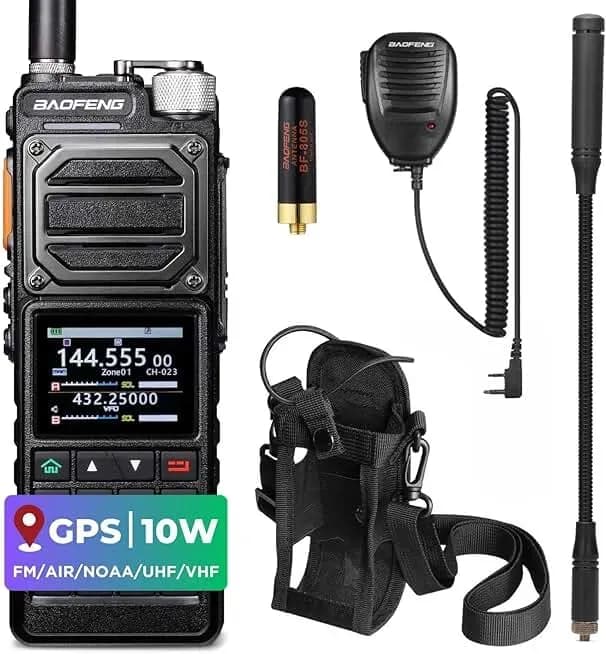
Price: $63.99 | Score: 76/100 | Battery: 5,200 mAh | Power: 10W
The UV-25 ships with a 5,200 mAh battery, the largest of any handheld in our database. For context, that's nearly three times the capacity of a standard UV-5R battery. On a 90/5/5 duty cycle, you're looking at roughly 18-24 hours of use before needing a charge. Drop the power to low and stretch your transmissions, and you can push that toward two days.
For a multi-day power outage, where you're rationing power and checking in on a local net twice a day, the UV-25 can run for the better part of a week on a single charge. No radio in our database comes close.
It's also tri-band (VHF, UHF, and 1.25m), outputs 10 watts, and is CHIRP compatible. The beginner score of 85 means it's approachable for less experienced operators. At $63.99, you could buy two of these for less than the price of one premium radio, which is exactly the kind of redundancy that emergency planning demands.
The trade-off is build quality. There's no IP rating, and the chassis is standard Baofeng-grade plastic. It won't survive being dropped in a creek. But if you keep it in a protective case and prioritize runtime above all else, nothing in this price range competes.
Who it's for: Extended outage planners. If your scenario is "the power's been out for three days and my only communication link is this radio," the UV-25 is the right tool.
Tradeoff: No water or dust resistance rating. Build quality is typical Baofeng; functional but not rugged. Protect it in a case.
Best Budget Backup: Baofeng GT-5R
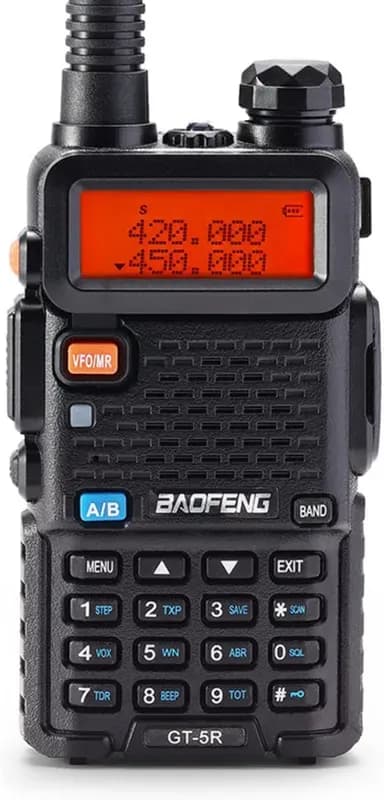
Price: $19.99 | Score: 69/100 | Battery: 3,800 mAh | Power: 6W
At $19.99, the GT-5R is the best value emergency radio you can buy, and it's not even close. The stock battery is 3,800 mAh, which is larger than radios costing four times as much. Six watts of output power puts it above the standard 5W handhelds. CHIRP compatible. 4.4-star rating from over 1,100 Amazon reviews.
The math on this radio makes the strongest case for the most important principle in emergency communications: redundancy. For the price of one Ailunce HD1, you can buy five GT-5Rs. Hand one to each family member, pre-program them all with the same simplex frequencies and local repeaters, and now you have a distributed communication network that doesn't rely on any single point of failure.
The GT-5R has no IP rating and no water resistance. The build quality is entry-level Baofeng. If you drop it in a river, it's gone. But at $19.99, you replace it and move on. The disposability is a feature, not a bug, when you're planning for worst-case scenarios.
Who it's for: Budget-conscious preppers, families who need multiple radios, and anyone who wants a dedicated radio for their go-bag that they can afford to lose. Also excellent as a backup to a more capable primary radio.
Tradeoff: No water resistance. Basic feature set. Menu system is less intuitive than the BF-5RH PRO. But the battery-to-price ratio is unmatched.
The Redundancy Play: Baofeng UV-5R
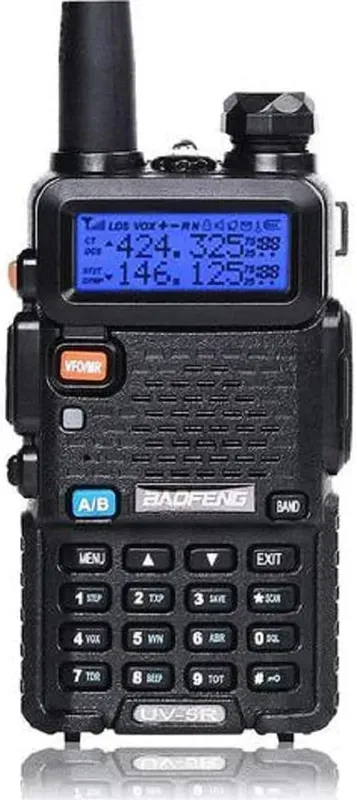
Price: $17.16 | Score: 69/100 | Battery: 1,800 mAh | Power: 5W
The UV-5R is the best-selling ham radio in history, with over 10,000 Amazon reviews and millions sold worldwide. Every ham club, every ARES group, every emergency communications volunteer has either used one or knows someone who has. That ubiquity is its own kind of reliability.
The stock 1,800 mAh battery is the weakest in this lineup, but the UV-5R has the largest aftermarket ecosystem of any handheld radio. Extended 3,800 mAh batteries run $12-15. Battery eliminators that run the radio from a car's 12V outlet cost $10. USB charging cables, speaker-mics, and upgraded antennas are all available for a few dollars each.
For emergency use, the UV-5R's greatest strength is that it's a known quantity. If you're coordinating with other operators during an emergency, chances are good that at least some of them are carrying UV-5Rs. If you need to share a programming cable, swap a battery, or walk someone through a menu setting over the air, the UV-5R's near-universal familiarity makes that possible.
Is the Baofeng UV-5R legal? Yes, on amateur frequencies with a license. Read our full breakdown if you want the details.
Who it's for: Operators who want the most well-understood, most widely supported radio with the deepest aftermarket ecosystem. Buy a few, program them identically, stash one in your car, one in your go-bag, and one at home.
Tradeoff: The smallest stock battery in this roundup. You'll want to buy an extended battery separately, which adds $12-15 to the cost. No IP rating.
Premium Reliability: Yaesu FT-65R
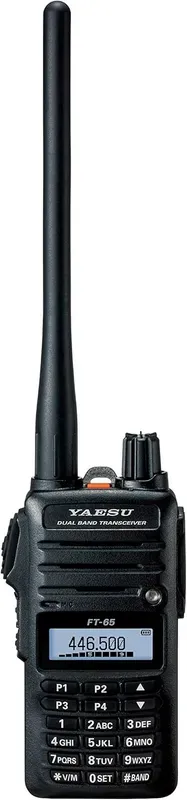
Price: $194.96 | Score: 57/100 | Battery: 1,950 mAh | IP Rating: IP54
The Yaesu FT-65R's RadioRanked score of 57 doesn't tell the full story. Our scoring algorithm weights value heavily, and at $194.96 for a radio with 5W output and 1,950 mAh battery, the specs-per-dollar ratio doesn't compete with Baofeng. But specs-per-dollar is not the only thing that matters when your communication plan is your last line of defense.
Yaesu has been building ham radios since 1956. The FT-65R's receiver is noticeably cleaner than budget alternatives, rejecting intermod and adjacent-channel interference that can make a Baofeng unusable in RF-dense environments. The squelch is tighter. The audio is louder and clearer. The buttons have a tactile click that inspires more confidence than the mushy pads on budget radios.
IP54 protection handles dust and rain. The 4.6-star Amazon rating from 461 reviews reflects the kind of satisfaction you see from operators who've used their radios in the field, not just unboxed them. CHIRP compatible. Simple, clean menu system.
If you're building a kit and you want one radio you trust with your life, the FT-65R is the one experienced operators reach for. It won't win a spec sheet comparison against a $70 Baofeng, but it will work flawlessly every time you turn it on.
Who it's for: Experienced operators who value build quality and receiver performance over raw specs. ARES and RACES volunteers. Anyone who wants the "buy once, trust forever" option.
Tradeoff: The price. You're paying a meaningful premium over Baofeng for build quality and brand trust, not for more features or more power. The 1,950 mAh battery is modest; budget for an extended battery or external power.
What Makes an Emergency Radio Different
A radio that's great for weekend POTA activations or local repeater nets isn't necessarily great for emergency use. The priorities shift.
Battery Life Is Everything
During a normal day of ham radio, you can charge whenever you want. During an emergency, the grid may be down for days. A radio with a 1,800 mAh battery running at 5W will give you roughly 5-8 hours of intermittent use. A 5,200 mAh battery stretches that to nearly a full day. The difference between those two numbers can be the difference between staying in contact and going silent.
Plan for the worst case: assume no charging for 72 hours. That means either a large-capacity battery, a backup power source (USB power bank, solar panel, car adapter), or multiple radios you can rotate through.
Durability Over Features
A color TFT display, Bluetooth audio, and GPS logging are nice features. They also drain the battery faster and add points of failure. For emergency use, simpler is better. A monochrome display uses less power. Fewer features mean fewer things that can break. An IP54 or IP67 rating means the radio survives conditions that would kill an unrated one.
You don't need DMR, APRS, or digital modes for basic emergency communication. A radio that does FM well, on VHF and UHF, with access to local repeaters and standard simplex frequencies, covers 90% of emergency scenarios.
Ease of Use Under Stress
If you're evacuating your home in the dark, you need a radio you can operate without thinking. That means pre-programmed channels (not manual VFO tuning), a large PTT button you can find by feel, and a menu system you've practiced with. High beginner scores in our database correlate directly with intuitive interfaces.
This is also why your emergency radio should be the same radio you practice with. Don't buy a radio, program it, and stash it in a drawer for five years. Use it on local nets. Take it on hikes. Build the muscle memory so that when stress is high and time is short, operating the radio is automatic.
Building Your Emergency Radio Kit
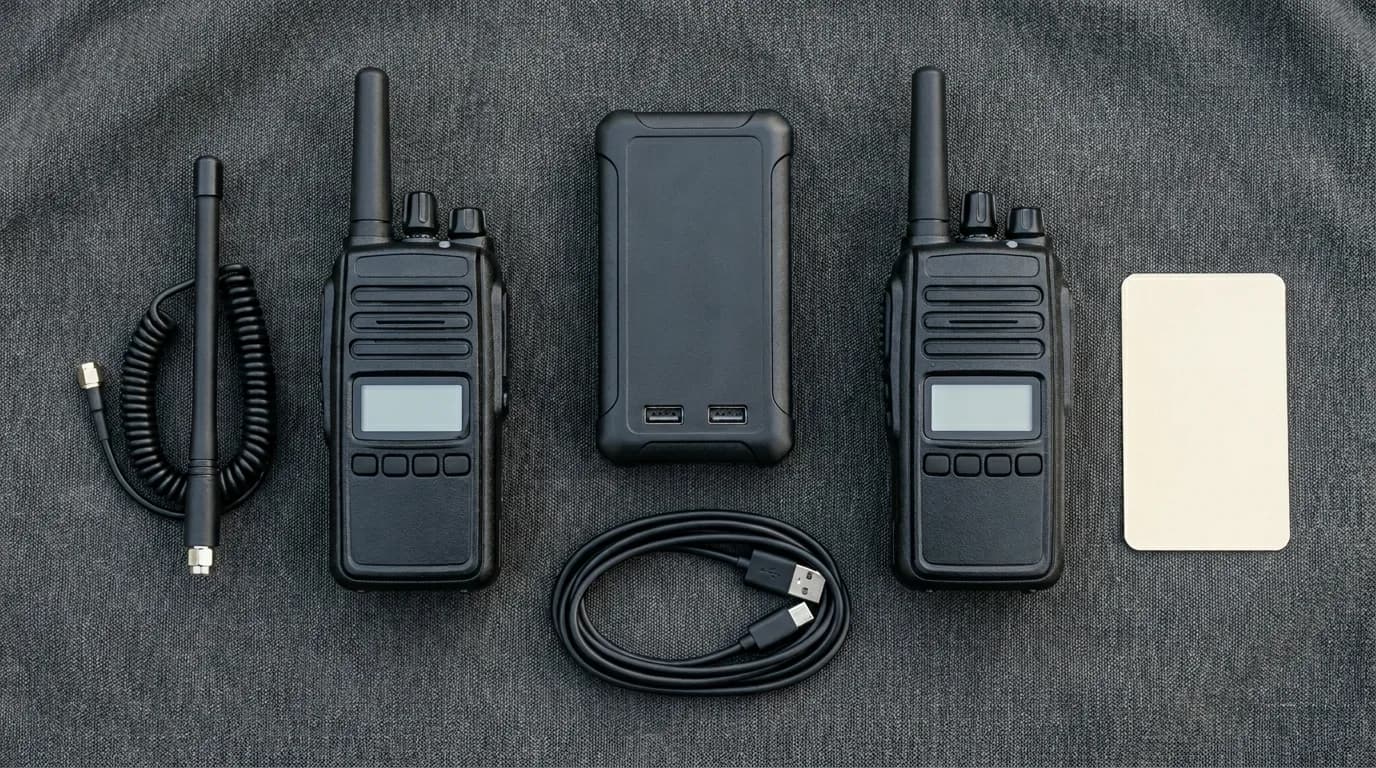
A radio alone isn't an emergency communication plan. Here's what a complete kit looks like.
Power Strategy
Primary: Fully charged radio battery. For the UV-25's 5,200 mAh, this gives you roughly 18-24 hours.
Secondary: USB power bank (20,000 mAh, $20-30). Most modern handhelds charge over USB-C. A 20,000 mAh power bank can recharge a 2,500 mAh radio battery about six times, giving you a week of intermittent use.
Tertiary: Foldable solar panel ($40-60, 20W minimum). Recharges the power bank in 4-6 hours of direct sun. In an extended grid-down scenario, solar is your path to indefinite operation.
Vehicle backup: 12V car adapter or battery eliminator ($10-15). Run the radio directly from your vehicle's battery. Effectively unlimited runtime while you have fuel.
Antenna Upgrade
Stock antennas on budget radios are a compromise. A Nagoya NA-771 ($15-20, SMA-Female for Baofeng) adds 2-3 inches of length and typically improves range by 20-30%. Keep one in your kit. For the Yaesu FT-65R, look for the SMA-Male version.
Frequency Card
Print a laminated card with your local repeater frequencies, offsets, and CTCSS tones. Include the national simplex calling frequencies: 146.520 MHz (2m) and 446.000 MHz (70cm). Add NOAA weather frequencies for your region. Tape one inside your go-bag and one inside your radio's carrying case.
You can pull all of this data from RepeaterBook and program it into your radio with CHIRP. But the printed card is your backup for when the computer isn't available.
The Minimum Kit
At minimum, an emergency radio kit should contain:
- One programmed radio with a full charge
- One spare battery or power bank
- One printed frequency card
- One upgraded antenna (if your radio has a removable connector)
Total cost with a Baofeng GT-5R: under $60. With a BF-5RH PRO: under $120.
Emergency Communication Strategy
Having the gear is half the equation. The other half is knowing how to use it.
Get Licensed First
You need an FCC amateur radio license to transmit on ham frequencies. The Technician class license covers everything in this article: 2-meter and 70cm bands, local repeaters, simplex communication. The exam is 35 multiple-choice questions, costs $35, and most people pass after a week of study. Our complete licensing guide walks through every step.
Yes, in a life-threatening emergency, FCC rules allow anyone to transmit on any frequency. But "life-threatening emergency" is a narrow legal standard, and you don't want your first time using a radio to be during a crisis. Get licensed, practice, and be ready.
Program Before You Need It
Every radio in this roundup should be pre-programmed with:
- Local repeater frequencies for your area (and any area you might evacuate to)
- National simplex calling frequencies (146.520 MHz VHF, 446.000 MHz UHF)
- NOAA weather frequencies (162.400-162.550 MHz, receive-only)
- Any local emergency nets your area operates
Use CHIRP to program them all at once. Save the file so you can reload it if you reset the radio or buy a replacement.
Practice Regularly
Check into a local repeater net at least once a month. This accomplishes three things: it confirms your radio works, it keeps your operating skills fresh, and it builds relationships with local operators who may be your communication partners during an emergency.
If you have family members who will carry radios, run a simplex test. Walk to opposite ends of your neighborhood and confirm you can communicate on the frequencies you've programmed. Adjust power levels, try different channels, and figure out your effective range before you need to depend on it.
Redundancy
The most reliable emergency communication plan is the one with backup layers:
- Two radios minimum (different models, in case one has a defect)
- Two power sources (battery plus power bank or solar)
- Two information sources (programmed memories plus printed frequency card)
- Two operators (you and at least one family member who knows the basics)
The best radios for long battery life page can help you filter by runtime, and our emergency radio picks show everything in the database sorted by emergency-relevant criteria.
Comparing the Picks
| BF-5RH PRO | Ailunce HD1 | UV-25 | GT-5R | UV-5R | FT-65R | |
|---|---|---|---|---|---|---|
| Price | $70 | $97 | $51 | $18 | $16 | $119 |
| Score | 86 | 81 | 76 | 69 | 69 | 57 |
| Battery | 2,500 mAh | 3,200 mAh | 5,200 mAh | 3,800 mAh | 1,800 mAh | 1,950 mAh |
| Power | 10W | N/A | 10W | 6W | 5W | 5W |
| IP Rating | IP54 | IP67 | -- | -- | -- | IP54 |
| DMR | No | Yes | No | No | No | No |
| CHIRP | Yes | No | Yes | Yes | Yes | Yes |
| Beginner | 94 | 54 | 85 | 86 | 88 | 78 |
How to Choose
Buying one radio: Get the BF-5RH PRO. Best all-around for emergency use.
Buying two radios: BF-5RH PRO as your primary, GT-5R as your backup. Total: $88.
Maximizing battery life: UV-25 as your primary. Nothing else comes close to 5,200 mAh.
Maximizing durability: Ailunce HD1. IP67 is the highest water resistance in our handheld database.
Building a family kit (4 radios): Four GT-5Rs for $72 total, all programmed identically. Or two BF-5RH PROs and two GT-5Rs for $176.
Money is no object: BF-5RH PRO as primary, Yaesu FT-65R as backup, GT-5R in each family member's go-bag.