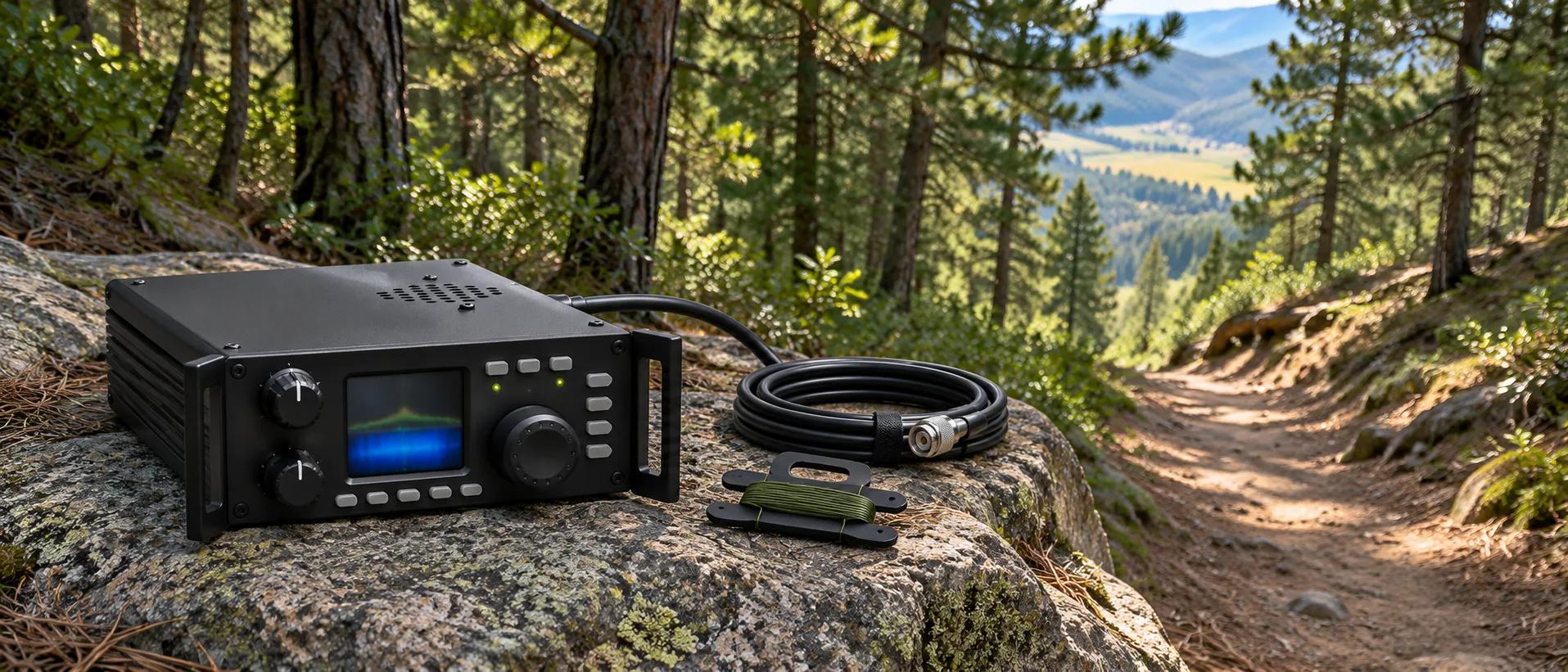

The Xiegu G90 is the radio most people mean when they say "cheap way onto HF": 20 watts, a built-in antenna tuner, a small waterfall display, and a price of well under that of a 100 watt rig. It scores 76 overall in our HF rankings, mostly on value.
Almost everything written about it online is a store page or an owner's opinion. This review is built from the measurements instead: the ARRL Lab's test for QST, Rob Sherwood's receiver table, Xiegu's own manual, the FCC record, and what owners report after years of use. We have not bench-tested the G90 ourselves, and every number below says where it came from.
The Snapshot
| Price | unavailable |
| Our score | 76 overall |
| Owner rating | 4.5 stars across 426 Amazon ratings |
| Transmit | 160 to 10 meters including 60 meters; no 6 meters |
| Power | 20 W rated; the ARRL Lab measured 1.4 to 19 W |
| Receiver | Zero-IF direct conversion SDR, 0.5 to 30 MHz |
| Antenna tuner | Built in, rated to 5:1 SWR |
| Weight | 1.63 kg (3.6 lb), no internal battery |
| Digital modes | Needs an external audio interface |
| Latest firmware | V1.81, August 2025 |
What the ARRL Lab Measured
QST reviewed the G90 in March 2020 and the ARRL Lab's figures are still the most complete independent measurements of it. Set beside the specification sheet, they show a radio that is honest about power and pessimistic about current.
| What | Xiegu's specification | ARRL Lab measurement |
|---|---|---|
| Power output, SSB and CW | 20 W | 1.4 to 19 W at 13.8 V |
| Transmit current | 8 A maximum | 4.4 A typical at full power |
| Receive current | 500 mA maximum | 558 mA at full volume and backlight |
| Harmonic and spurious output | 45 dB down | 68 dB typical, 55 dB worst case (160 meters) |
| 60 meter transmit | Not broken out | 5.3305 to 5.405 MHz |
| Weight | Varies by seller | 3.6 lb |
Two of those rows matter for buying decisions.
Current draw is far lower than the spec suggests. Sellers quote 6 or 8 amps on transmit. The lab measured 4.4 amps at full power, and Sherwood's test recorded 3.5 amps at 20 watts. That is why owners run this radio for an afternoon on a small lithium pack, and why a modest power supply is enough at home. Radioddity's own G90 FAQ recommends a supply of 6 amps or more.
The transmitter is clean enough, with one warning. Harmonics and spurious signals beat the FCC requirement comfortably. Close to the carrier it is less tidy: the lab found transmit intermodulation and close-in phase noise "higher than we would like to see", and for those reasons QST did not recommend using a power amplifier with the G90. If your plan is a G90 now and an amplifier later, that advice is worth reading before you buy.
On receive, the lab measured a noise floor of about -138 dBm on 20 meters with the preamp on, 108 dB of blocking dynamic range at 2 kHz spacing, and 84 dB of reciprocal mixing dynamic range at 2 kHz. QST called the last figure "reasonable" for a portable. Sherwood Engineering tested a G90 in March 2021 and recorded 76 dB of dynamic range at 2 kHz spacing, limited by phase noise, with the comment that this is unlikely to matter for portable operating. In plain terms: fine for a park activation or casual operating, and not the radio for a contest weekend with strong signals on every side.
It Is an SDR, but Not a Direct-Sampling One
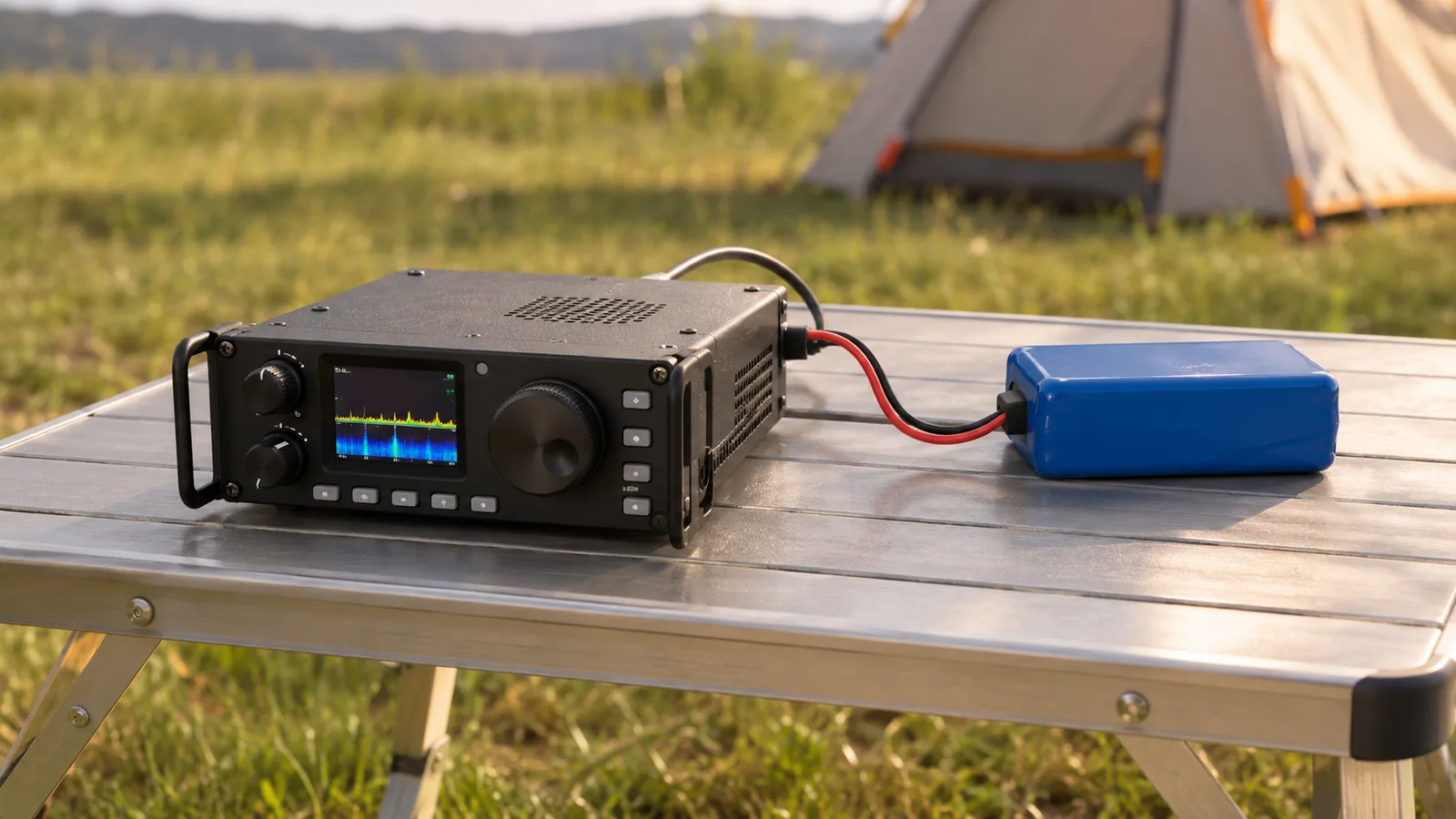
The G90 is sold as an SDR, and it is one. It is often described as a direct-sampling SDR, which it is not, and we had it recorded that way in our own catalogue until this review. We have corrected it.
Xiegu's manual lists the receiver circuit type as "ZIF", zero intermediate frequency, with a 24-bit converter sampling at 48 kHz. QST describes the same thing: the signal is mixed straight down to baseband, where the processing happens, making it "a direct conversion transceiver". Sherwood lists it as direct conversion too.
The difference is practical. A direct-sampling radio such as the Icom IC-7300 digitizes a wide slice of spectrum at the antenna. The G90 mixes first and digitizes a narrow slice, which is cheaper and explains two things owners notice: the spectrum display is 48 kHz wide, and the receiver's close-in performance is set by the purity of its local oscillator. That is the phase noise in the measurements above.
The 20 Watt Question
Twenty watts against the usual 100 is a difference of 7 dB, a little over one S-unit at the other end. It is roughly the gap between a "59" report and a "58", and on a marginal path it is the gap between being heard and not.
How much that costs you depends on the mode. On SSB voice in poor conditions, you will notice. On CW and FT8 the gap largely closes, because those modes work at signal levels voice cannot. Our QRP article runs the numbers on low-power operating, and What Is FT8 covers the mode that makes 20 watts feel like plenty.
The more useful way to see it: the G90 is four times the usual 5 watt QRP level, in a radio with a tuner, for less than most QRP rigs with a display like this. Owners who activate parks describe it as the power level where SSB contacts stop being a struggle. The step up from there is a 100 watt radio and a bigger power source, not a small adjustment.
The Tuner Is the Reason to Buy It
Every source agrees on this, including the measurements. Radioddity's FAQ rates the built-in tuner for an SWR of up to 5:1. The ARRL Lab found it matched loads up to 400 ohms, an 8:1 mismatch, with under 5% loss on 160 through 40 meters, and negligible loss up to 200 ohms on 20 through 10 meters. It would not match an open or a short circuit, which nothing should.
Owners put it more colorfully: several describe it as tuning nearly anything. The honest caveat comes from the same threads. A tuner makes the radio happy, not the antenna efficient. One owner in an r/HamRadio thread tuned a 40 meter dipole on 80 meters without trouble and never completed a contact on it.
For a first HF station with a compromise wire antenna, a tuner this forgiving removes the most common reason a new operator cannot get on the air. Our dipole calculator gives you cut lengths for a resonant antenna when you are ready for one.
FT8 Needs One More Purchase
The G90 has no built-in USB sound card. The cable in the box is a serial cable for rig control and firmware updates; it carries no audio. QST's review says the same: for digital modes you build or buy an interface for the eight-pin accessory jack.
The options:
- Xiegu CE-19, a breakout board that exposes the accessory jack's audio and PTT lines. It is not a sound card, so you still need one.
- Xiegu DE-19, a USB adapter that carries audio and PTT to the computer.
- A third-party interface such as a Digirig, which several owners prefer.
Budget for one of these if FT8 is the plan, and note Xiegu's own firmware V1.81 guidance to keep the ALC reading at 50 or below in digital modes. FT8 is also where the heat complaints come from, which is covered below.
What the FCC ID on the Listing Covers
The Amazon listing for the G90 states "FCC ID: 2BGMW-G90". The ID is real. The grant was issued on 29 April 2025 to Dongguan Weisheng Communication Technology, and its equipment class is "Scanning Receiver" under Part 15B, covering 0.5 to 30 MHz. It lists no transmit power and no emission types.
That is not a defect, and it is not an approval to transmit either. Amateur transmitters do not need FCC certification, because Part 97 licenses the operator and not the radio. The grant covers the receiver side only, which is the part the FCC does regulate on a radio like this. So an FCC ID on an HF transceiver's listing tells you the receiver was tested for unwanted emissions. It says nothing about the transmitter, and you still need a General class license or higher to use most of what this radio transmits on. Our license levels guide explains which bands each class opens.
You can look the record up with our FCC ID lookup.
What Owners Complain About
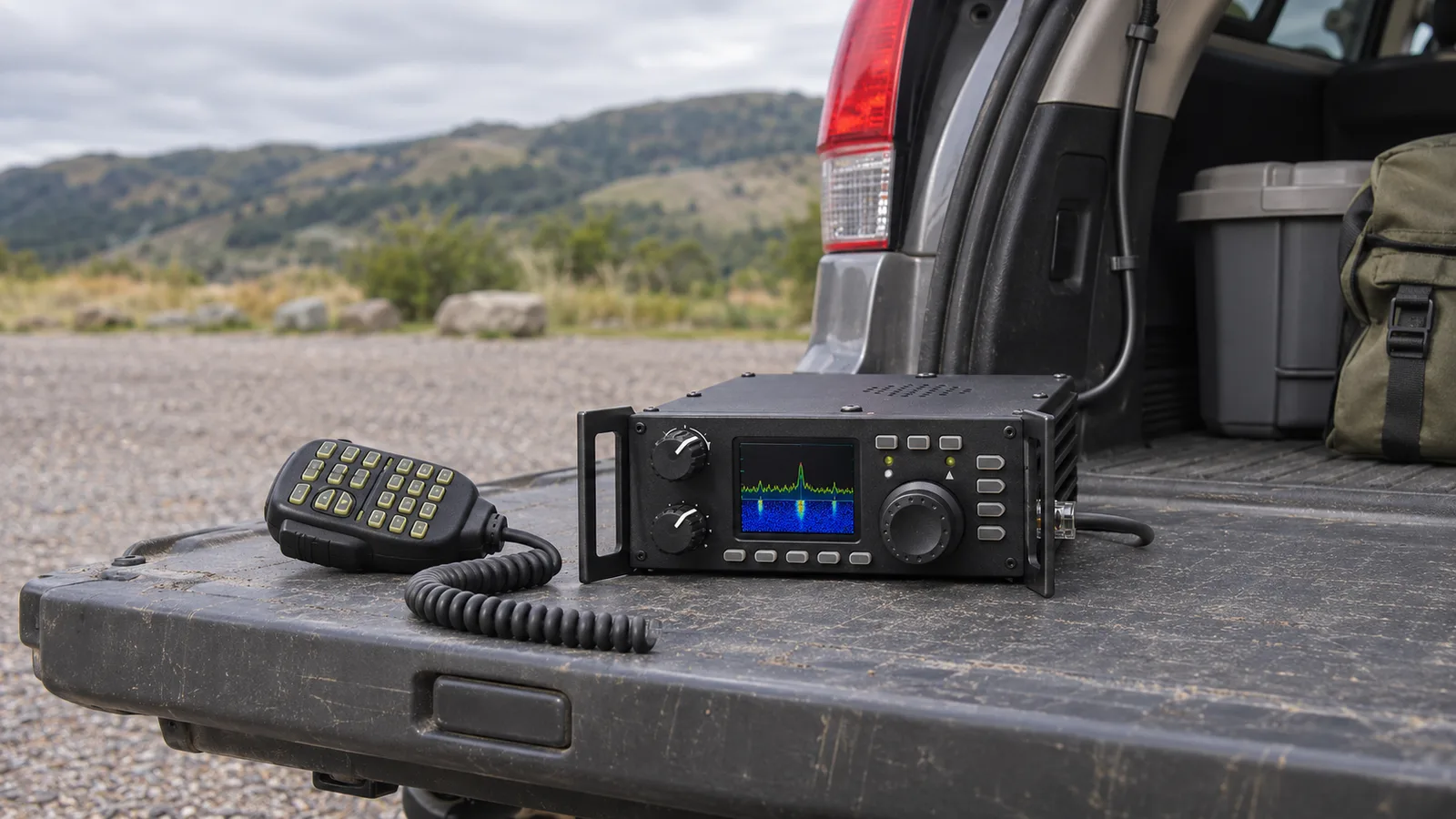
The Amazon rating is 4.5 stars from 426 ratings, with 83% at five stars and 8% at one or two. The long-term threads fill in what the stars do not. Each of these comes from owners, not from our testing.
- Heat. The G90 has no internal fan, and owners consistently report it running hot on long transmissions, FT8 especially. Radioddity sells a fan stand. One owner reports the stand's speed controller adds radio noise of its own.
- A small screen and small button labels, with most buttons doing double duty.
- A weak internal speaker. Sherwood calls it out, owners agree, and Radioddity's FAQ confirms the headphone jack will not drive a passive external speaker.
- Strong-signal overload. One owner 15 miles from an AM broadcast station could not use the receiver until adding a broadcast-band filter.
- No noise reduction and limited filtering compared with the radios people upgrade to. Several owners in these threads moved to a 100 watt radio for the DSP as much as the power.
- Weight. At 1.63 kg with no internal battery, it is heavier in a pack than "portable" suggests once a battery is added.
Reports of failed output transistors exist, but only as anecdote. We found no documented failure rate and are not going to imply one.
What owners praise is just as consistent: the tuner, the value, low receive current on battery power, the detachable front panel, and free firmware updates that are still arriving six years after launch.
Seller Specs That Disagree With Each Other
The G90's dealers publish spec tables that do not match, which is worth knowing before you compare numbers across listings.
| Spec | What sellers say | What the primary sources say |
|---|---|---|
| Weight | "Around 1 kg" on one dealer page | 1.63 kg in Xiegu's manual; 3.6 lb on the ARRL Lab's scale |
| Transmit current | 6 A or 8 A, depending on the page | 4.4 A measured by the ARRL Lab |
| AM power | 20 W on one page | 5 W carrier in Xiegu's manual |
| FM | Listed as NFM on current product pages | The original manual says FM needs the GSOC controller; Radioddity's FAQ says the G90 has no FM mode |
| Latest firmware | V1.80 on one dealer page | V1.81, per Xiegu and Radioddity |
The FM row is the one to check if it matters to you. Xiegu's European distributor ties NFM to the "latest hardware" revision, so an older or used G90 may not have it. On HF that affects 10 meter FM and little else.
G90 or G90S?
They are the same radio. Radioddity's FAQ states that the hardware is identical: the G90S is the original model for the Chinese market, the G90 is the export model, and the difference is the set of transmit frequencies enabled for the sales region. A US-market G90 is the one you want.
How It Compares
| Radio | Price | Our score | Power | Tuner | Why pick it |
|---|---|---|---|---|---|
| Xiegu G90 | unavailable | 76 | 20 W | Yes | The cheapest complete HF station with a tuner |
| Xiegu G106 | $249.00 | 67 | 5 W | No | Half the price if 5 watts and no tuner is enough |
| Xiegu X6100 | $595.00 | 83 | 10 W | Yes | Built-in battery and sound card, half the weight |
| Yaesu FT-891 | $809.95 | 68 | 100 W | No | Full power and Yaesu's noise reduction, tuner extra |
| Icom IC-7300 | $1199.95 | 79 | 100 W | Yes | The home-station standard: direct sampling, 6 meters |
The decision most buyers face is the G90 against the FT-891: 20 watts with a tuner and a waterfall, or 100 watts with better noise reduction and neither of those. If you operate mostly from a pack, the G90 against the X6100 is the closer call, and the X6100's built-in battery and USB audio settle it for many people. For a station that stays on a desk, read our base station guide before spending G90 money, and the HF radio rankings for the full field.
Who Should Buy It
Buy it if you want a first HF radio that works with an imperfect antenna, you operate from parks or a vehicle as much as from home, and you would rather spend the difference on antennas than on watts. Our POTA guide covers the kind of operating it suits best.
Do not buy it if you want 6 meters, plan to add an amplifier, live close to a strong AM broadcast station, or want FT8 working out of the box with one USB cable.
Consider a 100 watt radio instead if this will be a home station and SSB voice is your main interest. The power gap is one you cannot fix later without replacing the radio.