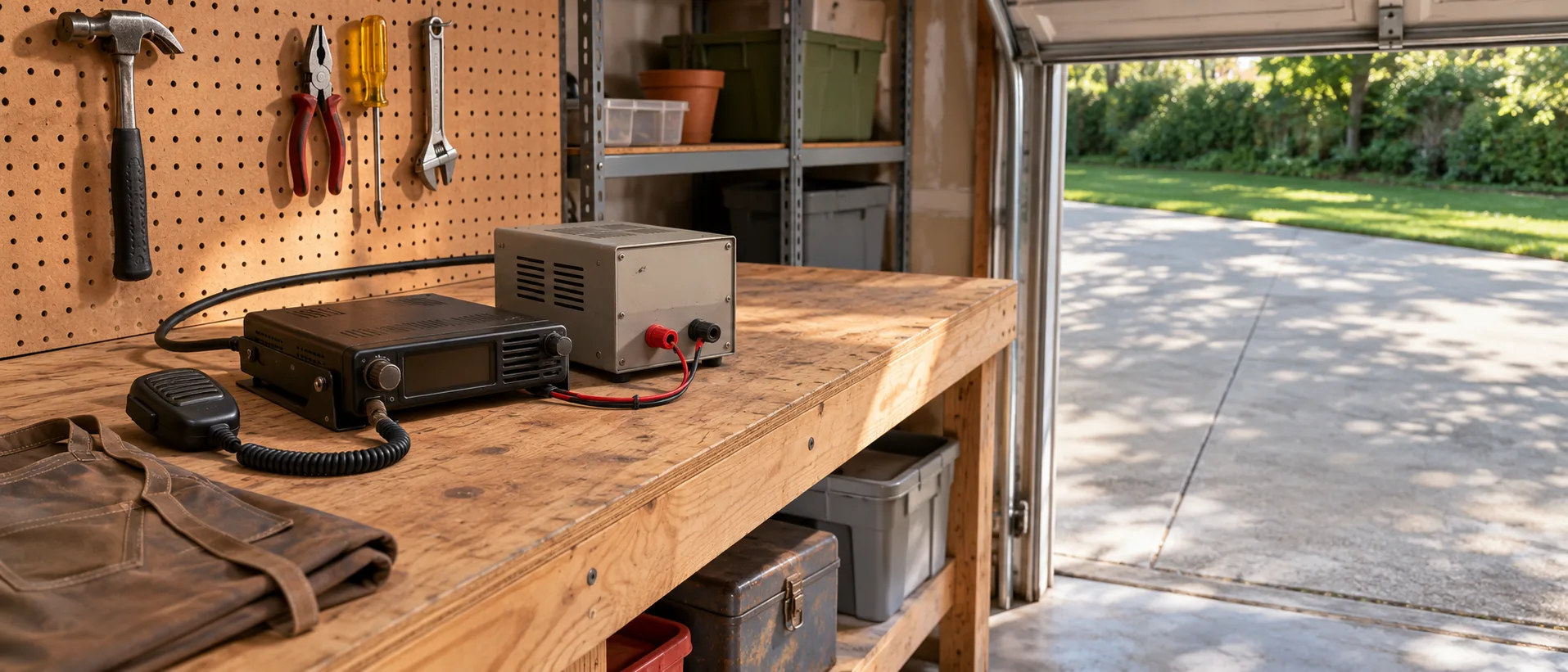

There is no such thing as a GMRS base station radio you can buy off a shelf. Owners on the myGMRS forum say it plainly, and the store pages that rank for the term confirm it: every "base station" on them is a mobile radio. A GMRS base station is something you assemble from four parts: a GMRS mobile radio, a 12 volt power supply, a run of coax, and an antenna mounted as high as you can get it.
This guide covers what each part needs to be, what the FCC rules say about a station at a fixed address, and where the money is best spent. It is built from the rules, manufacturer documents and what owners report. We have not built these stations ourselves, and each figure says where it came from.
The Short Version
| Part | What to buy | What it needs to do |
|---|---|---|
| Radio | A Part 95E certified GMRS mobile, 15 to 50 watts | Wideband capability and flexible repeater channels if you use repeaters |
| Power supply | A regulated 13.8 volt DC supply | Deliver more than the radio's maximum transmit current, continuously |
| Coax | Low-loss cable such as LMR-400 for anything over a short run | Lose as little of your signal as possible at 462 to 467 MHz |
| Antenna | A GMRS-tuned antenna, outdoors and high, or in the attic | Height matters more than gain, and gain matters more than watts |
Radios we list that suit the job:
| Radio | Price | Power | Why pick it for a base |
|---|---|---|---|
| Radioddity DB20-G | $84.99 | 20 W | Cheapest sensible start; wide and narrow selectable |
| Midland MXT275 | $199.99 | 15 W | Simplest to use; needs only a 5 amp supply |
| Radioddity DB40-G | $179.99 | 40 W | More power without the 50 watt price |
| Midland MXT500 | $439.99 | 50 W | Front-panel controls suit a desk; wide and narrow band |
| Midland MXT575 | $439.99 | 50 W | Same power with all controls on the microphone |
Our GMRS mobile radio guide compares these in detail. The rest of this article is about everything around the radio, which is where a base station succeeds or fails.
What the FCC Calls a Base Station
The rules define the term, and the definition has a consequence most guides miss. From 47 CFR 95.303:
- A base station is "a station at a fixed location that communicates directly with mobile stations and other base stations."
- A control station is "a station at a fixed location that communicates with mobile stations and other control stations through repeater stations."
So in the FCC's vocabulary, your radio at home is a base station when it talks to other radios directly, and a control station when it talks through a repeater. The channel rules in 47 CFR 95.1763 then say which station types may use which channels:
| Channels | Who may transmit | Power limit |
|---|---|---|
| 462 MHz main (channels 15 to 22) | Mobile, handheld, repeater, base and fixed stations | 50 W transmitter output; 15 W for fixed stations |
| 462 MHz interstitial (channels 1 to 7) | Mobile, handheld and base stations | 5 W ERP |
| 467 MHz main (repeater inputs) | Mobile, handheld, control and fixed stations | 50 W for mobiles, 15 W for fixed stations; mobile, handheld and control stations only through a repeater or for brief tests |
| 467 MHz interstitial (channels 8 to 14) | Handheld units only | 0.5 W ERP |
Three practical points follow from that table and the power rule, 47 CFR 95.1767:
- Fifty watts is the ceiling for a base, mobile or repeater station, and it applies to the transmitter's output, not to what the antenna radiates. A gain antenna on a 50 watt radio is allowed on the main channels. The 15 watt figure is for a "fixed station", which the rules define as one that talks only to other fixed stations; a home radio talking to handhelds and vehicles is not one.
- Channels 1 to 7 are capped at 5 watts ERP even for a base station, and that figure does include the antenna. Use channels 15 to 22 for base-to-mobile work.
- Channels 8 to 14 are off limits to anything but a handheld. This is why GMRS mobiles do not transmit there.
The radio itself must be certified for GMRS under 47 CFR 95.1761, and you need a GMRS license, which covers your immediate family. Our GMRS license guide covers the application.
The Radio: A Mobile With the Right Features
Any certified GMRS mobile will work on a desk. Two features decide how well it works there.
Wide and narrow band. GMRS main channels are 20 kHz wide by rule, and repeaters use that full width. Midland's own explanation of narrow and wide band states that most FRS and GMRS radios are narrow band only, names the MXT500 and MXT575 as supporting both, and says repeaters operate on wide band. A narrowband radio into a wideband repeater sounds quiet. If repeaters are the plan, confirm the radio does wide band before buying. Radioddity's DB20-G manual lists wide and narrow as selectable.
Repeater channel flexibility. A base station usually exists to reach a repeater from home. Radios with eight fixed repeater channels let you set one tone per frequency pair, which is a problem if two repeaters near you share a pair. Radios that let you build your own channels do not have that limit. Our repeater guide explains tones and pairs.
A few products are sold with "base station" in the name. The ones we could identify are still mobiles: Retevis lists a 40 watt mobile as a "radio base station", and Midland sells an ammo-can enclosure with a battery that a mobile radio mounts into.
The Power Supply
A mobile radio expects a vehicle's electrical system: about 13.8 volts DC. At home you need a regulated power supply that turns wall power into that. How big depends on the radio, and Midland publishes the numbers in its mobile radio FAQ:
| Radio | Power | Transmit current, maximum | Transmit current, typical | Fuse |
|---|---|---|---|---|
| Midland MXT275 | 15 W | 3.2 A | 2.9 A | 5 A |
| Midland MXT500 | 50 W | 10 A | 8.5 A | 15 A |
| Midland MXT575 | 50 W | 10 A | 8.5 A | 15 A |
Radioddity's DB20-G manual asks for a 12 to 14 volt supply of 10 amps or more.
The rule of thumb that follows: pick a supply whose continuous rating is comfortably above the radio's maximum transmit current. For a 15 watt radio that is a small 5 to 10 amp supply. For a 50 watt radio, owners in the threads we read typically run a 25 or 30 amp supply, which leaves headroom and stays cool. Look at the continuous rating, not the peak rating printed largest on the box.
We do not list power supplies, so there is nothing for us to link here. Any regulated 13.8 volt supply of the right size will do.
The Coax
Coax is where base stations quietly lose their signal. At GMRS frequencies thin cable is very lossy, and the loss applies in both directions: it weakens what you transmit and what you hear.
| Cable | Loss per 100 ft at 462 MHz | Power reaching the antenna after 50 ft |
|---|---|---|
| RG-58 | 9.1 dB | About 35% |
| RG-8X | 7.2 dB | About 44% |
| RG-213 | 4.6 dB | About 59% |
| LMR-400 | 2.7 dB | About 73% |
These are the manufacturers' datasheet figures: Belden's for the three RG cables and Times Microwave's for LMR-400. Another maker's RG-58 can differ by a decibel or more, so check the datasheet for the cable you buy. Our coax loss calculator works out your own cable, length and frequency.
Read the right-hand column as watts. Fifty feet of RG-58 turns a 50 watt radio into roughly a 17 watt one at the antenna. The same run of LMR-400 delivers about 36 watts. Spending on cable is usually a cheaper way to gain signal than spending on a more powerful radio, and unlike transmitter power it improves reception too.
Keep the run as short as the installation allows, and do not coil up spare length.
The Antenna
Every source we read agrees on the order of importance: height first, then the antenna, then power. GMRS is UHF, and UHF travels by line of sight. An antenna that clears the surrounding roofs and trees sees farther than one that does not, whatever the radio behind it. Our GMRS range guide explains the horizon math, and the range calculator will run it for your antenna height.
Three ways to do it, from least to most effort:
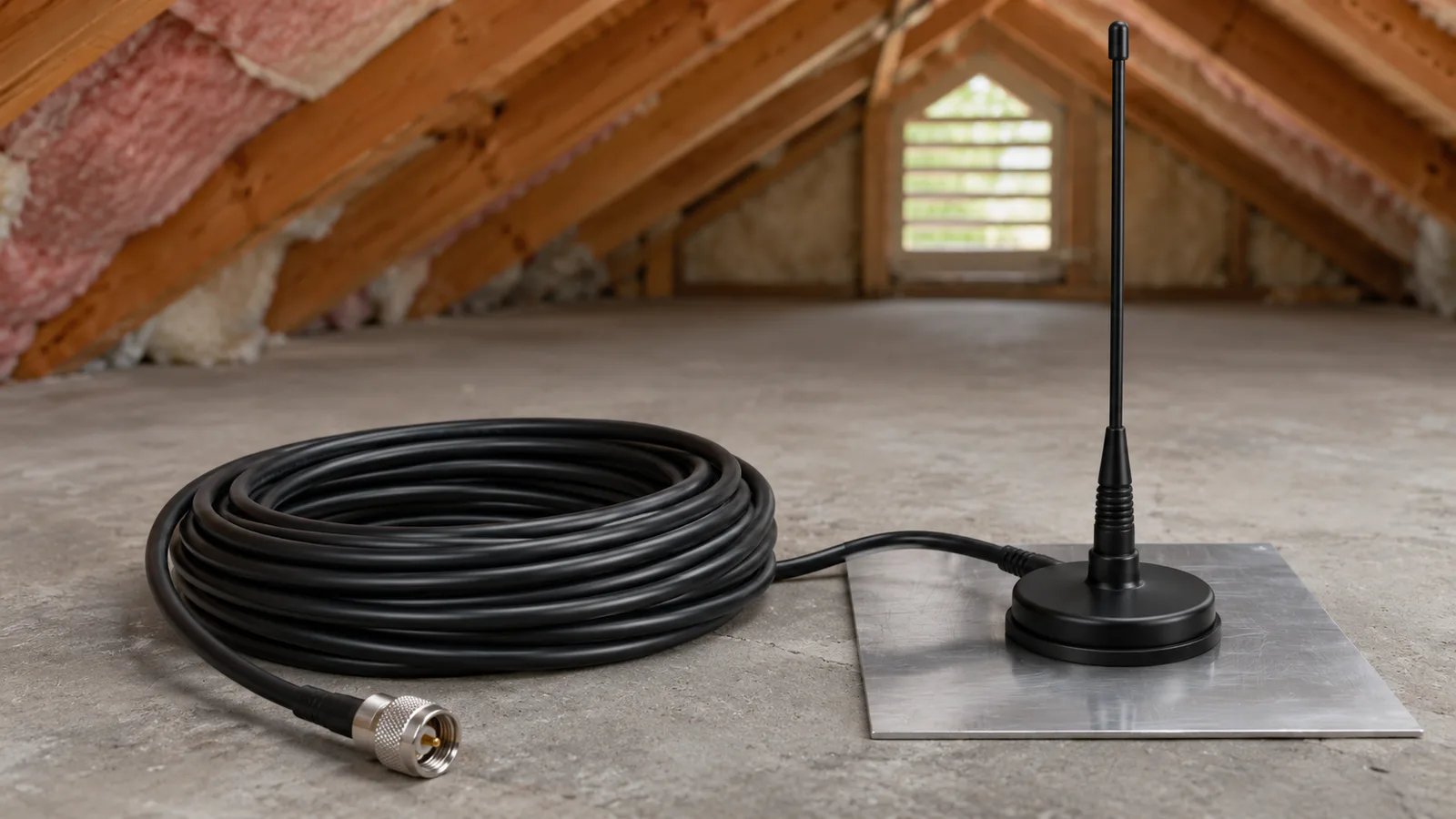
A mobile antenna on a ground plane. A vehicle antenna such as the Midland MXTA26 or the Retevis fiberglass GMRS antenna on an NMO magnetic mount works indoors if it sits on metal. Midland's FAQ puts the ground plane at about 12 inches across, steel or aluminum. Owners put these on a metal sheet in the attic or on ductwork. It is the cheapest way to start and it uses parts we list.
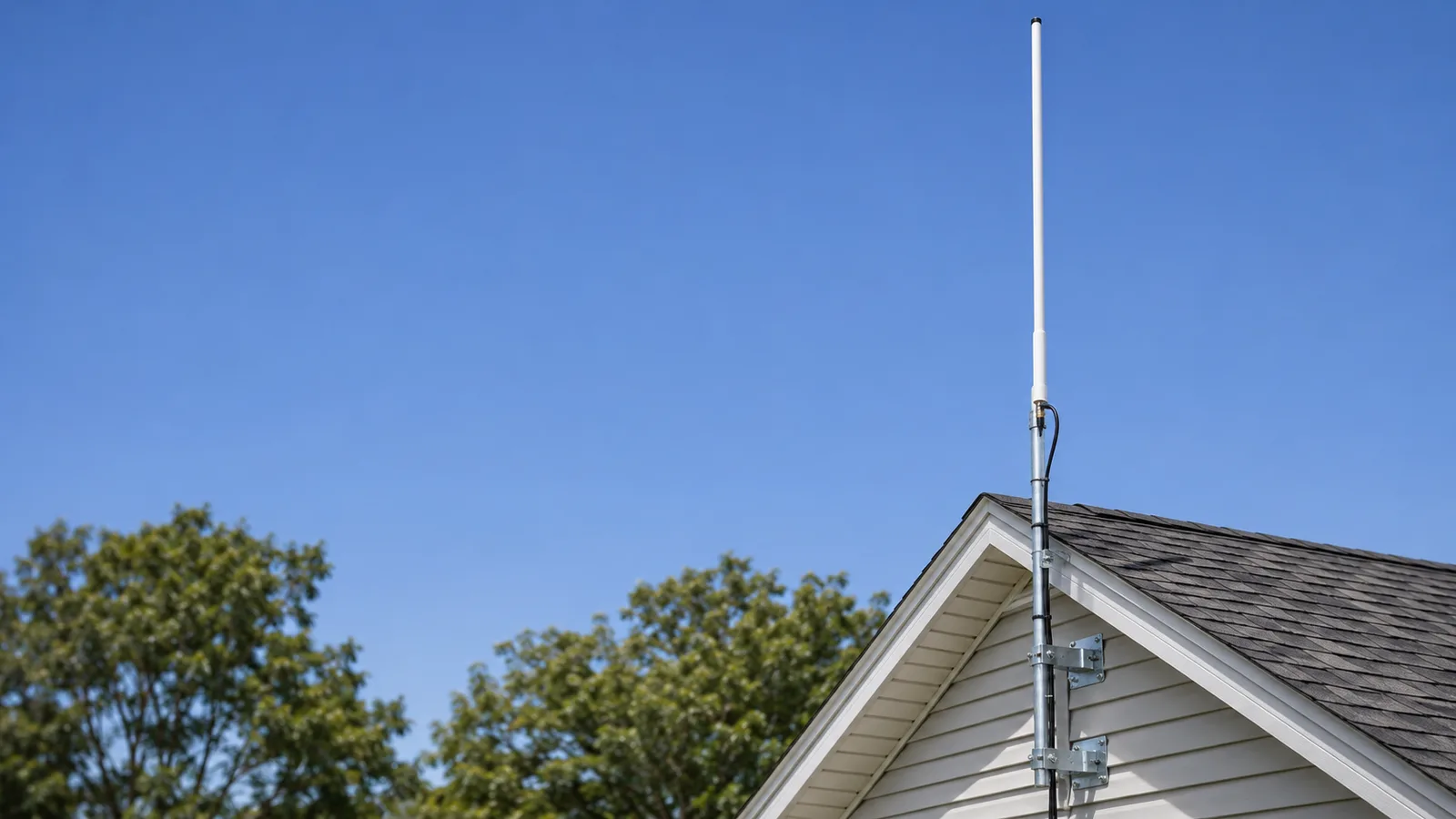
A GMRS-tuned base antenna. These are fiberglass verticals made for 460 to 470 MHz, mounted on a mast outdoors. An example is the Comet CA-712EFC, which DX Engineering lists at 460 to 470 MHz, 9 dBi and about 10.4 feet long with a Type N connector. We do not currently list a GMRS-tuned base antenna in our catalogue.
A ham dual-band vertical, with caution. Antennas such as the Diamond X50A are designed for 435 to 450 MHz on UHF, and GMRS sits above that, so the match gets worse as you go up the band. We found no reliable measurement of one on GMRS. Diamond makes a variant closer to this range, the X50C2, which its instruction sheet lists for 450 to 465 MHz. That covers the 462 MHz channels and stops short of the 467 MHz repeater inputs, and a measurement shows the same thing: an owner on the myGMRS forum measured an SWR of 1.2 at 462 MHz, rising to just under 2.0 at 468 MHz. If you already own a ham vertical, measure it before transmitting on it. If you are buying, buy an antenna made for GMRS. Our SWR calculator shows what a given reading costs you.
One caution from the owner threads: a very high gain antenna flattens its pattern toward the horizon, which helps on flat ground and can hurt if the stations you want are well above or below you.
How High Can the Antenna Go?
There is no GMRS-specific antenna height limit in the current rules. What applies is the general Personal Radio Service rule, 47 CFR 95.317:
- A structure more than 200 feet above ground may need FAA notification and FCC registration. No home installation gets near that.
- Near a military or public-use airport, an antenna structure more than 20 feet high may face additional restrictions, on a slope of one meter of height per hundred meters of distance from the nearest runway.
Local zoning and homeowner association rules are separate from the FCC's and are often the real limit. Check them before buying a mast.
Grounding and Lightning
An outdoor antenna on a mast needs to be grounded and bonded, and this is the part of the job where guessing is dangerous. We are not going to give wiring instructions. What the sources say:
- The FCC rules we read contain no grounding requirement. The requirement comes from the electrical code where you live.
- Owners who do this professionally describe a lightning arrester where the coax enters the house and a ground rod bonded to the home's main electrical ground. Several warn that a separate ground rod that is not bonded to the main ground is a hazard in itself.
- The reference owners point to is the ARRL's grounding guidance and its book on grounding and bonding.
If that is unfamiliar territory, an attic antenna avoids most of it, and an electrician can do the outdoor version properly. Keep masts well away from power lines when raising them.
Three Example Stations
| Station | Radio | Supply | Coax | Antenna |
|---|---|---|---|---|
| Starter, attic | Radioddity DB20-G | 10 A or more | Short run of RG-8X | Mobile antenna on a mag mount and a metal sheet |
| Simple, family use | Midland MXT275 | 5 to 10 A | LMR-400 | GMRS-tuned vertical at the roofline |
| Full power, repeater | Midland MXT500 | 25 to 30 A | LMR-400 | GMRS-tuned vertical on a mast above the roof |
The starter station is close to what owners describe building first. The upgrade most of them report making is not a bigger radio but better coax and a higher antenna.
Mistakes Owners Warn About
- Thin coax on a long run. The most common regret in the threads we read.
- An antenna that is too low. Fifteen feet with trees in the way is not a base station antenna location.
- Buying for watts first. A 50 watt radio on a poor antenna loses to a 20 watt radio on a good one.
- A narrowband radio for repeater use, which sounds quiet through a wideband repeater.
- Fixed repeater channels when two local repeaters share a frequency pair.
- An unbonded ground rod, which owners with electrical backgrounds call dangerous.