

The most common question from new ham operators is some version of "how far can this thing reach?" The honest answer is: it depends. A $15 handheld on 2 meters can reach half a mile in downtown Denver or 25 miles from a mountain peak. Same radio, same power, same antenna, completely different results. Range in ham radio is not about the radio; it's about physics.
This guide covers what actually determines how far your signal travels, what realistic expectations look like for different setups, and how to maximize the range you get from whatever gear you own.
The Short Answer
Handheld to handheld (simplex): 1 to 5 miles in typical conditions. Less in urban areas, more in open terrain or from elevation.
Handheld to repeater: 10 to 50+ miles, depending on the repeater's antenna height and your line of sight to it.
Mobile radio (in vehicle): 5 to 15 miles simplex, 30 to 60+ miles via repeater.
HF base station: Hundreds to thousands of miles via ionospheric skip. Completely different equipment and technique.
If someone tells you their handheld reaches 50 miles, they're either using a repeater (which is doing the heavy lifting) or standing on a mountaintop. Those marketing claims of "36-mile range" on Amazon listings are theoretical maximums under perfect conditions that essentially never exist in practice.
Understanding Line-of-Sight
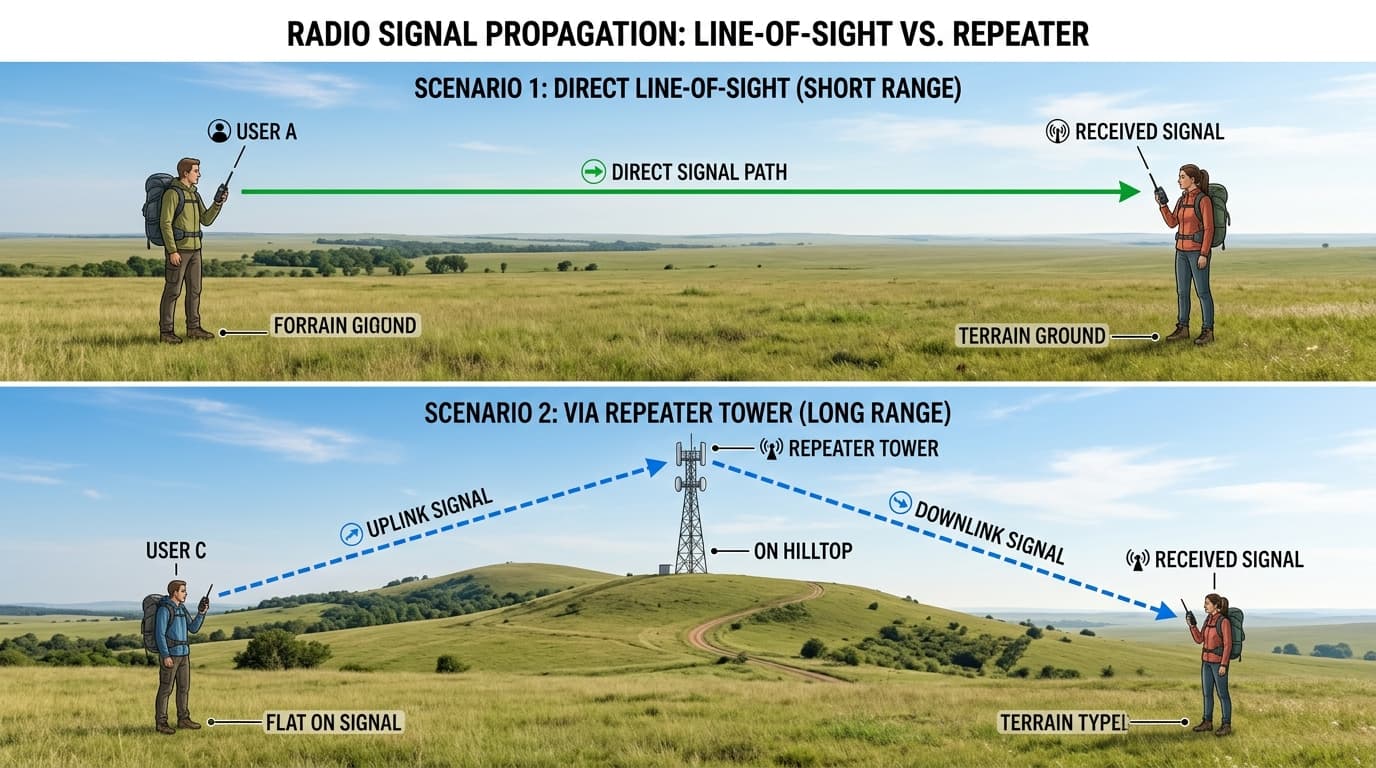
VHF and UHF signals, the frequencies that handheld ham radios use, travel in straight lines. They don't bend around hills, bounce off the atmosphere (under normal conditions), or pass through mountains. If there's a physical obstruction between your antenna and the other station's antenna, your signal either gets absorbed or reflected. This is the line-of-sight constraint, and it's the single most important factor in your range.
Think of it like a flashlight beam. If you can see the other person's antenna (hypothetically, with binoculars), your signal can probably reach it. If a hill, building, or dense forest is in the way, you're blocked or severely attenuated.
This is why elevation matters so much. Standing on a hill, a rooftop, or a mountain summit gives your signal a clear path over obstacles. The Earth's curvature itself limits line-of-sight to roughly 3 to 5 miles at ground level. Get 100 feet up and that extends to about 12 miles. Get 1,000 feet up and you're looking at 35+ miles of radio horizon.
The formula is approximate: radio horizon in miles is roughly 1.41 times the square root of your antenna height in feet. Try our range calculator to estimate your radio horizon from any elevation. A 6-foot-tall person holding a radio (antenna at ~7 feet) has a radio horizon of about 3.7 miles. Put that same person on a 500-foot hill and the horizon jumps to about 32 miles.
This is why a 5-watt radio from a POTA summit can outperform a 50-watt mobile in a valley. Height beats power, almost every time.
Power Output and What It Actually Buys You
More watts means a stronger signal, but the relationship isn't linear. Doubling your power output doesn't double your range. In free space, you need to quadruple your power to double your distance. In the real world, with terrain, buildings, and vegetation absorbing signal, the gains are even more modest.
Here's what different power levels actually deliver in practice:
Low Power: 1 to 5 Watts
This is where the Baofeng UV-5R ($15, 5W) and the Yaesu FT-65R ($119, 5W) live. Most basic handheld radios operate in this range.
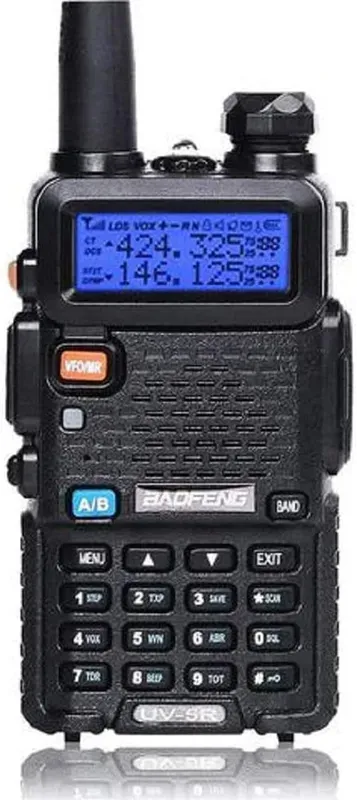
Realistic simplex range:
- Urban: 0.5 to 2 miles
- Suburban: 1 to 3 miles
- Open terrain: 2 to 5 miles
- From elevation (500+ ft advantage): 10 to 25 miles
At 5 watts, you're fully dependent on line-of-sight and repeater access. This is enough for local repeater nets, nearby simplex contacts, and learning the basics. Most new hams spend their first year at this power level and it's sufficient for everything except long-distance simplex.
Mid Power: 8 to 10 Watts
The Baofeng BF-5RH PRO ($70, 10W) and similar modern handhelds live here.
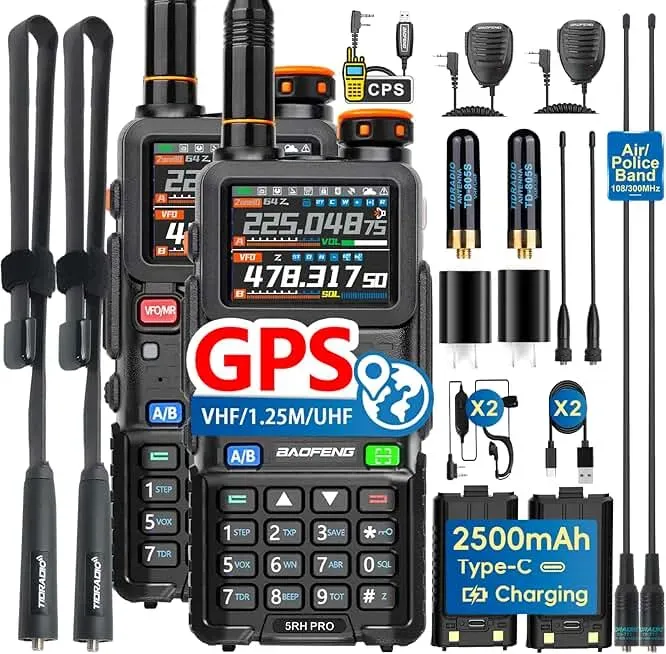
Realistic simplex range:
- Urban: 1 to 3 miles
- Suburban: 2 to 5 miles
- Open terrain: 3 to 8 miles
- From elevation: 15 to 35 miles
The jump from 5W to 10W adds roughly 1 to 2 miles in most conditions. That's noticeable but not transformative. Where higher power helps most is reaching marginal repeaters, stations that are right at the edge of your coverage. That extra 3 dB can make the difference between a scratchy contact and a solid one.
The tradeoff: Higher power drains your battery faster. A 10W radio on high power will eat through a 2,500 mAh battery noticeably faster than the same radio on 5W.
High Power: 25 to 50+ Watts
This is mobile and base station territory. Handheld radios rarely exceed 10W; mobile rigs mounted in vehicles typically run 25 to 50W.
Realistic simplex range:
- Urban: 3 to 8 miles
- Suburban: 5 to 15 miles
- Open terrain: 10 to 25 miles
- From elevation: 30 to 60+ miles
Mobile stations have two advantages: more power and better antennas. A magnetic-mount antenna on a car roof at 5 feet of elevation with a proper ground plane outperforms a rubber duck antenna in your hand, even at the same power level.
The Antenna Advantage
Your antenna is the single easiest upgrade that will improve your range. A $15 to $20 aftermarket antenna can double or triple your effective range compared to the stock rubber duck that ships with most budget handhelds.
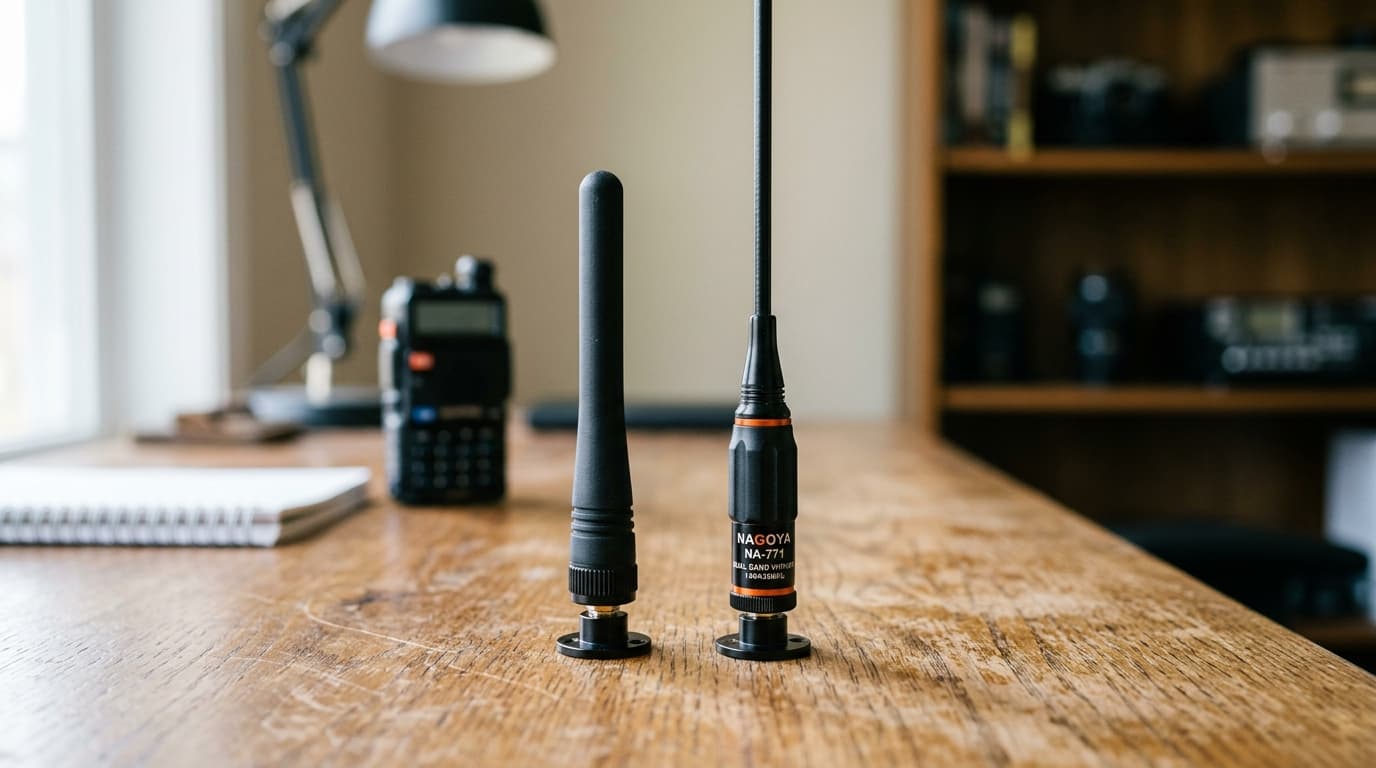
Why stock antennas are bad: Most rubber duck antennas are electrically compromised. They're short (for portability), which means they're not resonant at VHF frequencies. A proper quarter-wave antenna for 2 meters is about 19 inches long. Our dipole antenna calculator can help you size an antenna for any band. Most stock ducks are 4 to 6 inches. That mismatch means a significant portion of your transmitted power reflects back into the radio instead of radiating into the air.
The Nagoya NA-771 effect: The most commonly recommended upgrade is a Nagoya NA-771 (or similar ~15-inch whip antenna). It's roughly a quarter-wave on 2 meters and a half-wave on 70 centimeters. In practical testing, this antenna typically adds 2 to 4 miles of simplex range compared to a stock duck. On a $15 UV-5R, that's a bigger improvement than upgrading to a $200 radio with the same stock antenna.
Antenna height matters more than antenna quality. Even a mediocre antenna mounted on a car roof (5 feet elevation, metal ground plane) outperforms an excellent handheld antenna held at waist level. If you can get your antenna higher, whether on an extendable mast, a rooftop, or simply by holding it above your head, you'll see immediate improvement.
The priority order for maximizing range: antenna quality first, then antenna height, then power output. Most new hams get this backwards and chase higher-wattage radios when a $15 antenna would do more.
Frequency Band Effects
The two main bands for handheld ham radio are VHF (2 meters, 144 to 148 MHz) and UHF (70 centimeters, 420 to 450 MHz). They behave differently:
VHF (2 meters) travels slightly farther in open conditions. The longer wavelength bends around obstacles marginally better and suffers less attenuation over distance. For simplex range, 2 meters typically outperforms 70 centimeters by 10 to 30% in the same conditions. Most long-range repeaters operate on 2 meters.
UHF (70 centimeters) penetrates buildings better. If you're trying to communicate from inside a concrete building, 70cm often works when 2m doesn't. Urban environments with lots of buildings tend to equalize or even favor UHF because of this.
For maximizing range specifically, transmit on 2 meters when you can. Every radio on our best handheld list is dual-band, so you always have the option.

Repeaters: The Range Multiplier
A repeater is a radio station, usually installed on a hilltop, tall building, or communications tower, that receives your signal on one frequency and retransmits it on another at high power from its elevated position. Repeaters are why a 5-watt handheld can have a practical range of 50+ miles.
Here's how it works: you transmit on the repeater's input frequency. The repeater's antenna, which might be 2,000 feet above you on a mountain, hears your 5-watt signal. It then retransmits your audio on its output frequency at 50 to 100 watts from that elevated position. Anyone within line-of-sight of the repeater's antenna (which, from 2,000 feet of elevation, is a huge area) hears you clearly.
Finding repeaters: RepeaterBook is the standard directory. Enter your location and see every repeater within range, with frequencies, offsets, and tone information. Our band chart helps you understand which frequencies you're licensed to use.
Programming repeaters: You need the repeater's input frequency, the offset direction (positive or negative), and usually a CTCSS tone. CHIRP makes this trivial: import your local repeaters from RepeaterBook directly into your radio in five minutes.
The catch: You need to be within simplex range of the repeater to use it. If the repeater is 30 miles away on a mountaintop and you're in a valley, your 5 watts may not reach it. Get to higher ground, use a better antenna, or try a closer repeater.
Maximizing Your Range: Priority Order
If you want the most range from your setup, invest in this order:
- Better antenna. A Nagoya NA-771 or Signal Stick for $15 to $20 is the highest-impact upgrade per dollar. Do this first.
- Get higher. Elevation beats everything. Operate from a hilltop, rooftop, or upper floor when possible. Even standing on a picnic table helps.
- Use repeaters. Program your local repeaters and learn which ones give you the best coverage. This is free range.
- Choose 2 meters for distance. When simplex range matters, VHF outperforms UHF.
- More power (last). Going from 5W to 10W helps at the margins. Going from 10W to 50W requires a mobile rig and different antenna setup. Don't chase watts until you've optimized everything above.
A Baofeng BF-5RH PRO at 10 watts with an aftermarket antenna, programmed with local repeaters and operated from a modest hill, will outperform a 50-watt mobile rig in a valley with a stock antenna. Setup and situation matter more than the spec sheet.
HF: A Different World
Everything above applies to VHF and UHF, the bands that handheld ham radios use. HF (high frequency, 3 to 30 MHz) is a completely different game. HF signals bounce off the ionosphere and can travel hundreds or thousands of miles in a single hop. This is how ham operators talk to people on the other side of the planet.
HF requires different equipment (base station transceivers, large antennas, power supplies), a General or Extra class license for most bands, and knowledge of ionospheric propagation. It's not a beginner topic, and it's not a handheld topic. But it's worth knowing that if you want true long-distance communication, the capability exists within amateur radio.
If your interest is long-range communication on a handheld, your best bet is maximizing VHF repeater access, not chasing HF. A well-positioned 2-meter repeater gives you practical range that HF can't match for local and regional contacts.
Bottom Line
Your handheld ham radio will realistically reach 1 to 5 miles on simplex and 10 to 50+ miles via repeater. The biggest factors are elevation, antenna quality, and repeater access, not the price tag on your radio.
Start with whatever radio you have, upgrade the antenna for $15, program your local repeaters with CHIRP, and find the highest ground you can. You'll be surprised how far a budget radio can reach when the conditions are right.
For radio recommendations at different power levels, check our best handheld ham radios roundup, the best Baofeng lineup, or browse radios for beginners.