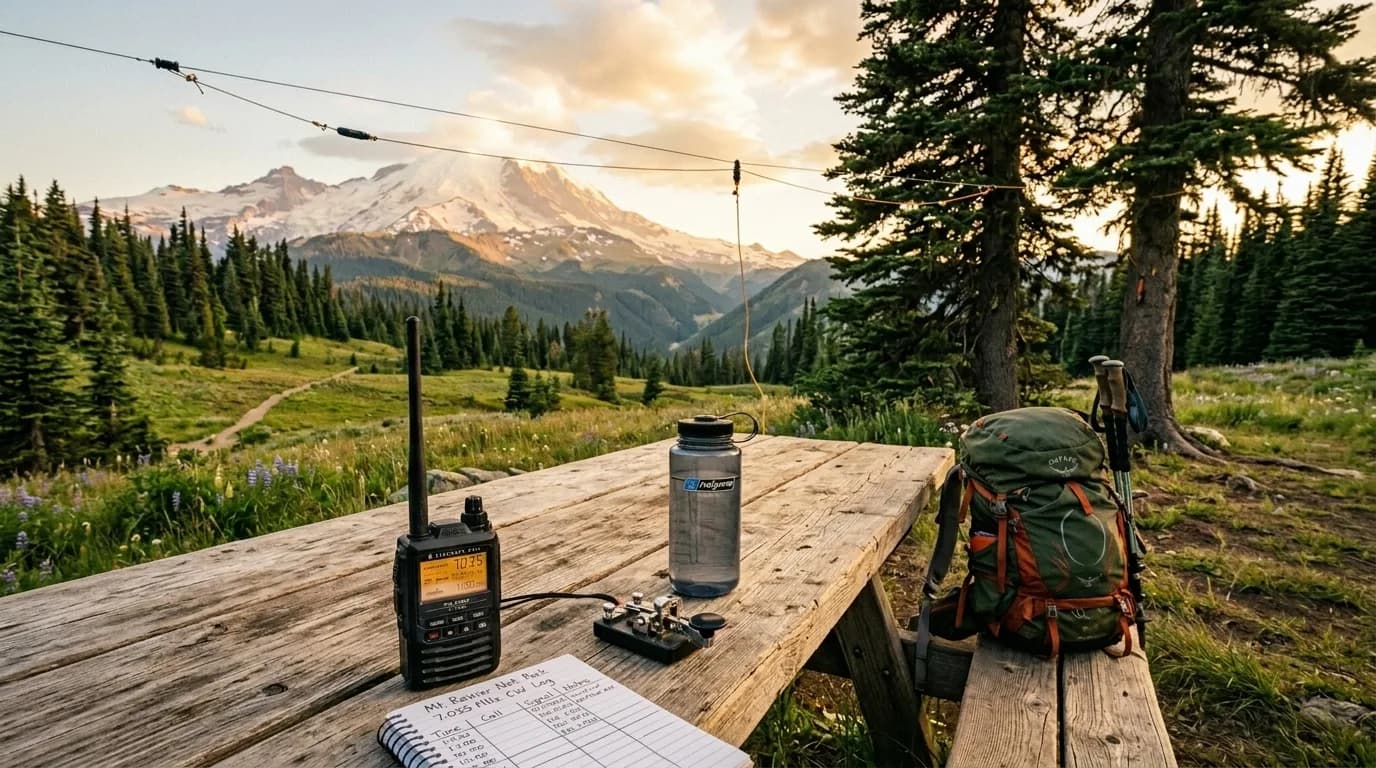

Parks on the Air is the best reason I've found to carry a radio into the woods. I've activated over a dozen parks across Colorado, and the gear question comes up every time someone tags along for their first activation: which radio should I bring? The answer depends on how often you plan to activate, how far you're willing to hike, and whether you're ready to invest in a proper antenna setup.
After scoring every handheld in our database on portability, battery life, features, and value, here are the six radios that make the most sense for POTA activators in 2026.
Quick Picks
| Radio | Price | Score | Battery | Best For |
|---|---|---|---|---|
| Baofeng BF-5RH PRO | $71.69 | 86 | 2,500 mAh | Best overall POTA value |
| Baofeng UV-25 | $63.99 | 73 | 5,200 mAh | Longest battery life |
| Baofeng UV-5R | $17.16 | 69 | 1,800 mAh | Ultralight starter |
| Ailunce HD1 | an unlisted price | 78 | 3,200 mAh | Weatherproof mid-range |
| AnyTone AT-D878UVII Plus | $249.99 | 83 | 3,100 mAh | Premium DMR + APRS |
| BTECH DMR-6X2 PRO | $249.89 | 85 | 3,100 mAh | Feature flagship |
The table follows the order of the article: the three budget picks first, then the mid-range one, then the two premium radios. It is not a score ranking. By score the order is the BF-5RH PRO at 86, the BTECH DMR-6X2 PRO at 85, the AnyTone AT-D878UVII Plus at 83, the Ailunce HD1 at 78, the UV-25 at 73, and the UV-5R at 69.
What Is Parks on the Air?
If you haven't heard of POTA, the concept is simple: licensed ham operators set up portable stations in national and state parks, make radio contacts, and log them through the POTA program. The person operating from the park is the "activator." People making contact with them from home or the field are "hunters."
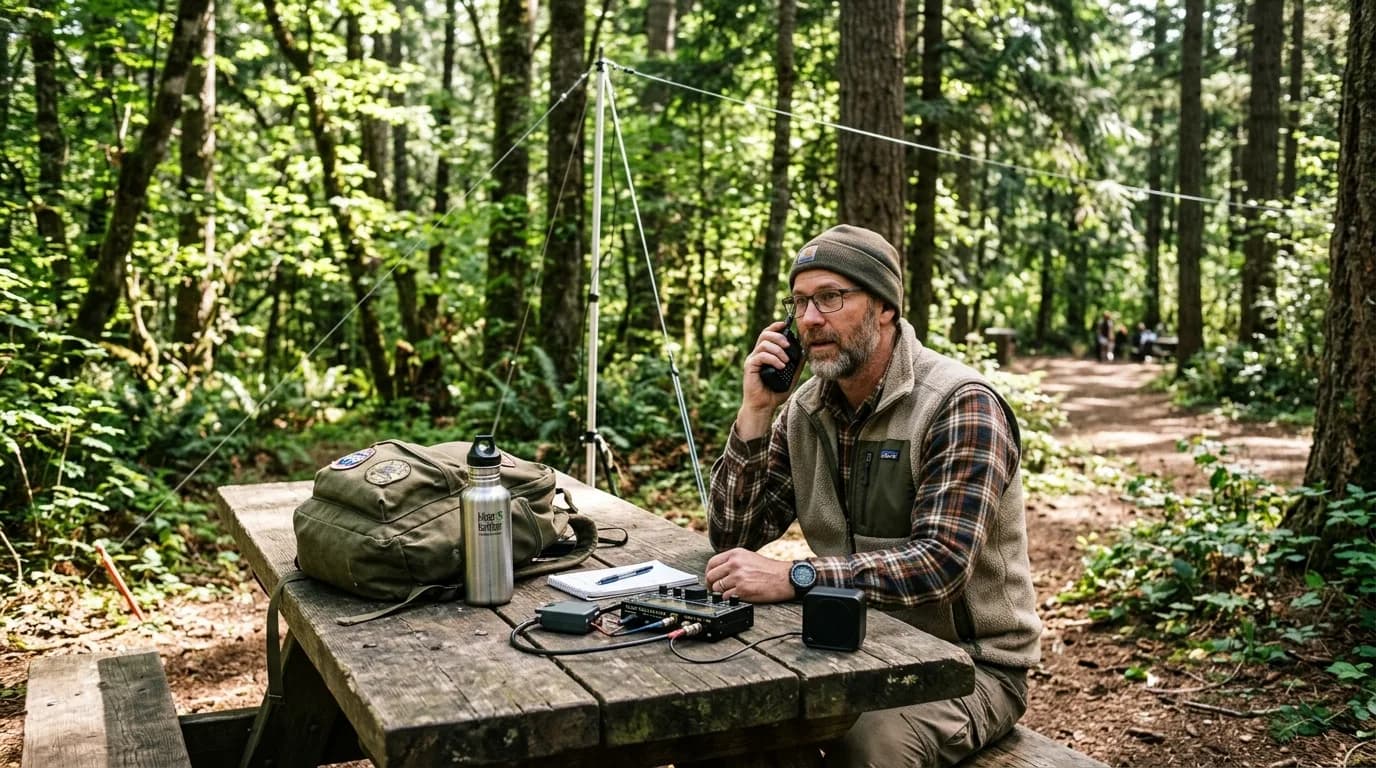
A typical activation runs 2 to 4 hours. You hike in, deploy an antenna, call CQ, and work as many contacts as you can. Ten contacts in a single UTC day counts as a valid activation. Those contacts have to be direct: POTA's rules state that "contacts made via land repeaters are not permitted," so on 2 meters you are calling simplex. The convention is to call on 146.52 MHz, the national calling frequency, then move the activation to something like 146.55 or 146.58. On HF with a wire antenna, 50 to 150 contacts in an afternoon is realistic. On a VHF handheld, ten is the target.
The program has exploded since 2020, with over 50,000 participants worldwide. Parks range from remote backcountry to roadside picnic areas, so "portable" means different things depending on the activation. Some activators drive up to a shelter and set up on a picnic table. Others hike 5 miles to a summit. The radio you need depends on which camp you fall into.
What Makes a Good POTA Radio?
POTA priorities differ from general ham radio use. You're not looking for the most powerful radio or the most features. You're optimizing for a different set of constraints entirely.
Battery life matters more than power output. A 3-hour activation on a 1,800 mAh battery is cutting it close if you're transmitting frequently. Most POTA activators prefer 2,500 mAh minimum, with 3,000+ mAh providing comfortable all-day runtime. Carrying a spare battery adds margin without much weight.
Weight and size matter. If you're hiking to your park, every ounce counts. A 200-gram radio plus battery, cable, and antenna adds up. The lightest handhelds in our database come in under 250 grams. The heaviest push past 300 grams before you add an extended battery.
Antenna flexibility is non-negotiable. This is the single biggest factor in POTA success. A stock rubber duck antenna on a handheld gives you 2 to 5 miles of range. Swap to a portable wire dipole or end-fed antenna and that jumps to 10 to 20+ miles. Every POTA radio worth considering has a removable SMA connector that accepts aftermarket antennas. More on antenna strategy below.
Weather resistance helps. You're outdoors. It might rain. An IP67 rating means the radio survives a downpour or an accidental drop in a creek. IP54 handles splashes. No rating means you're carrying a Ziploc bag.
CHIRP compatibility saves time. Programming frequencies through the radio's keypad is painful. CHIRP lets you program everything from a laptop in minutes. For POTA you want the national calling frequency and a handful of simplex channels, because those are the ones you can actually log, plus your local repeaters for announcing the activation and testing the radio before you start.
How We Scored These Radios
Every RadioRanked score comes from a weighted algorithm based on manufacturer specs, not subjective impressions. For this roundup, we weighted portability and battery life most heavily, followed by value and features. Products with IP ratings, APRS, and GPS earned additional points for field utility. Check our best POTA radios page for the full filtered ranking, or browse our complete radio database to compare specs yourself.
Budget POTA Radios: Get Activating Under $75
You don't need to spend $250 to start activating parks. The budget tier has gotten remarkably capable, and for most VHF/UHF POTA work, a $55 to $70 radio paired with a good antenna will outperform an expensive radio with a stock rubber duck every time.
Baofeng BF-5RH PRO: Best Budget POTA Radio
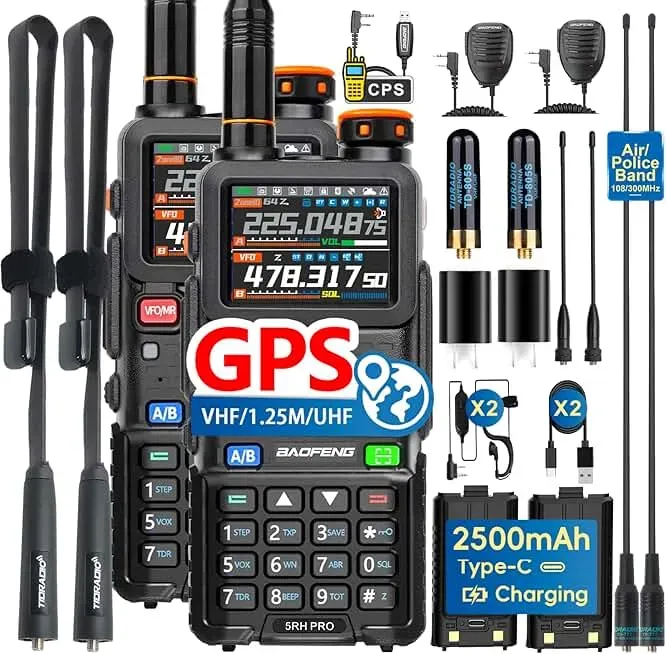
The BF-5RH PRO scores 86 overall, the highest of any radio under $100 in our database, a single point clear of the TIDRADIO TD-H9 at 85. At $71.69 it ships as a two-radio kit, which is almost unfair value for POTA operators. Take both radios to the park: one for your activation, one as a backup or for a friend trying their first activation.
The spec sheet reads like a mid-range radio. Tri-band coverage (VHF, UHF, 1.25m) gives you flexibility across repeaters and simplex. Built-in APRS with GPS means you can beacon your location during activations, which is useful for hunters trying to find you and for your own logging. IP54 splash resistance handles light rain. CHIRP compatibility means quick programming. And 10 watts of output gives you reach when you need it, though for POTA activations, 5 watts on a good antenna is usually plenty.
The 2,500 mAh battery is adequate for a 3-hour activation with moderate transmit time. For longer sessions, having two radios means two batteries. Swap when the first runs low.
Who it's for: POTA activators who want the best feature-to-dollar ratio. The two-radio kit means you always have a backup in your pack.
Tradeoff: The menu system isn't as intuitive as a Yaesu, and the 2,500 mAh battery is smaller than some competitors. But at this price, those are minor complaints.
Baofeng UV-25: Battery Champion
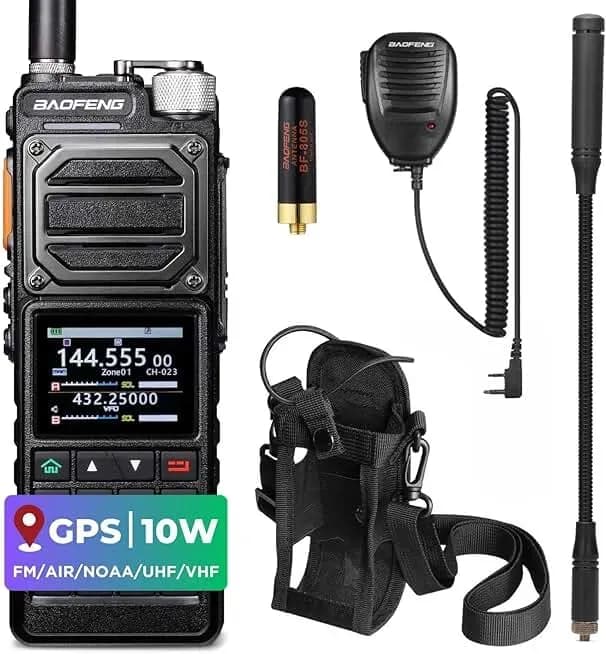
If battery life is your top priority, the UV-25's 5,200 mAh pack is the largest in our handheld database. That's nearly three times the capacity of a UV-5R. For POTA, this means all-day activations without carrying spare batteries or a power bank.
The UV-25 also packs tri-band coverage with GPS and CHIRP support at $63.99, scoring 73 overall. Ten watts of output on VHF and UHF give you solid reach. The radio is heavier than a UV-5R due to that massive battery, but the tradeoff is worth it for operators who plan multi-hour sessions or back-to-back park activations on a road trip.
Who it's for: Activators who prioritize runtime over minimum weight. If you're driving to parks rather than hiking miles in, the extra weight is irrelevant and the battery advantage is significant.
Tradeoff: No IP rating, and fewer reviews (89) than established models. The large battery adds bulk compared to standard handhelds.
Baofeng UV-5R: Ultralight Starter
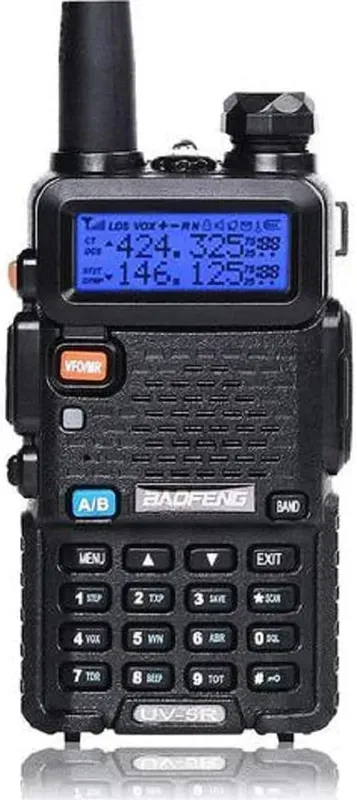
At $17.16, the UV-5R removes every financial barrier to trying POTA. It's 250 grams, fits in a cargo pocket, and has been used by more first-time activators than any other radio. CHIRP compatible, dual-band, and proven across millions of units worldwide.
I did my first three POTA activations with a UV-5R and a $25 roll-up J-pole antenna, from ridges above the Front Range suburbs, and cleared ten contacts on 2-meter simplex every time. The radio is not the bottleneck; the antenna and the horizon are. At this price, you can spend the savings on a proper portable antenna and come out ahead of someone who bought a $200 radio and kept the stock rubber duck.
The catch: 1,800 mAh gives you roughly 2 to 3 hours of active use. Plan accordingly. Carry a spare battery ($8) or keep activations under 3 hours.
Who it's for: First-time POTA activators, hikers who want minimum weight, anyone who wants to test whether they enjoy park activations before investing more.
Tradeoff: Short battery life, no IP rating, basic display. You'll outgrow it if POTA becomes a regular hobby, but you'll never regret having one as a backup.
For more budget options, check our best radios under $50 and best radios under $100 pages.
Mid-Range POTA Radio: Built for the Field
Ailunce HD1: Weatherproof Workhorse
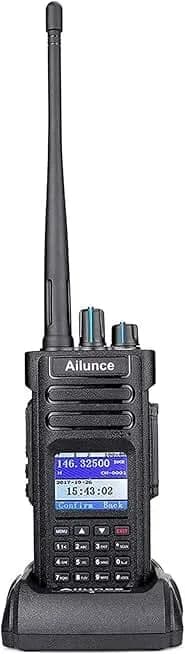
The Ailunce HD1 hits a rare combination for POTA: IP67 waterproofing, DMR capability, APRS with GPS, and a 3,200 mAh battery. It scores 78 overall, with strong marks in features (68) and value (91). The catch is the price, which has climbed to $149.99 and pushed this radio well clear of the budget tier.
IP67 is the standout spec for field use. That means submersible to 1 meter for 30 minutes. In practical terms: rain, mud, creek crossings, or dropping the radio in wet grass won't kill it. I've activated parks in Colorado thunderstorms (not recommended, but it happens) and IP67 removes one worry from the equation.
The 3,200 mAh battery provides comfortable 4-hour activations with frequent transmitting. DMR adds digital voice capability for the drive home and for DMR simplex, though repeater contacts never count toward an activation, and the built-in APRS with GPS lets you beacon your location. At 280 grams (estimated with battery), it's slightly heavier than a UV-5R but still very packable.
Who it's for: Regular POTA activators who want a radio they won't baby in the field, and who specifically want IP67. That is the whole case for it now. If you do not need submersible, the BF-5RH PRO scores 8 points higher for less than half the money.
Tradeoff: Not CHIRP compatible, so you'll need the Ailunce CPS software for programming. The learning curve is steeper than a Baofeng, especially if you want to configure DMR talkgroups. The beginner score of 52 reflects this. It now lists at no current price, well above where it sat when we first ranked it, which is why its value score has slipped to 91 and the overall to 78.
Premium POTA Radios: Peak Field Performance
Premium handhelds make sense for dedicated activators who are out multiple times per month. The feature set (Bluetooth, full APRS, advanced DMR) and build quality justify the price if you're logging hundreds of activations per year.
AnyTone AT-D878UVII Plus: The DMR Reference
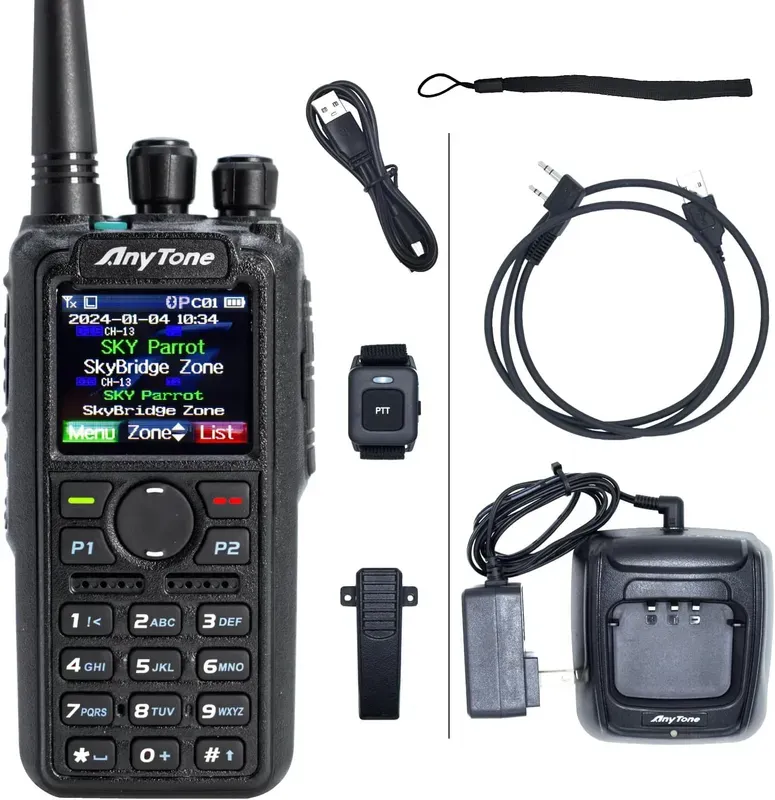
The AT-D878UVII Plus has been the default recommendation in the DMR community for years, and that reputation carries into POTA. It scores 83 overall with top marks in features (84) and a value score of 76. At $249.99, it packs DMR Tier I and II, full APRS with GPS, and a 3,100 mAh battery into a 280-gram package.
For POTA, the practical advantage is versatility. Work analog simplex for your activation, then switch to a DMR repeater if one is in range. The APRS beacon shows hunters exactly where you are. Bluetooth connectivity lets you program the radio from your phone in the field if you need to add a frequency. The 878 community support and accessories ecosystem is mature, which matters more here than the star rating: the II Plus is sold under a new Amazon listing with only 6 ratings on it.
Who it's for: POTA activators who also use DMR regularly and want one radio that handles everything. The AT-D878UVII Plus is the Swiss Army knife of handhelds.
Tradeoff: Not CHIRP compatible. The AnyTone CPS is capable but complex. The beginner score of 52 reflects the learning curve. If you only do analog FM for POTA, you're paying for DMR features you won't use in the park.
BTECH DMR-6X2 PRO: Feature Flagship
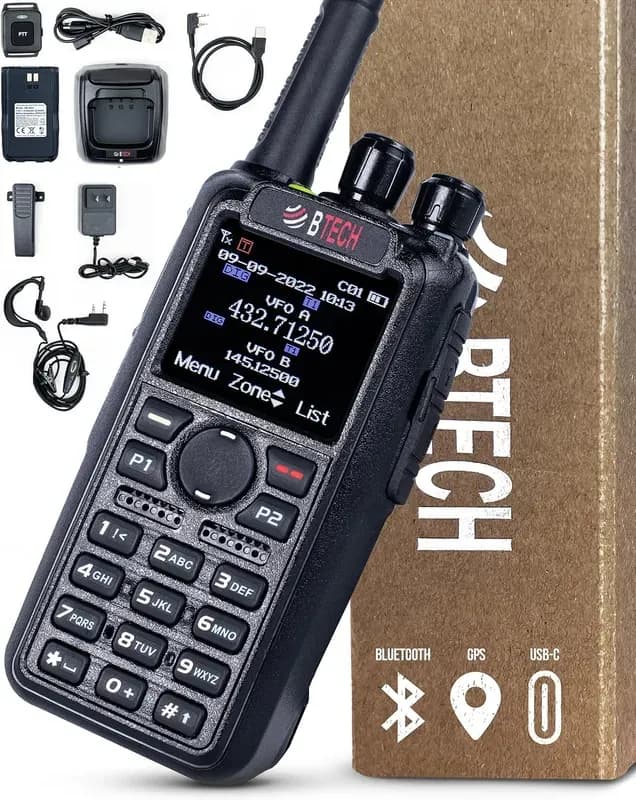
The DMR-6X2 PRO edges out the AnyTone in our scoring at 85 overall against 83, largely on value. DMR, APRS, GPS, and Bluetooth are all included. The 3,100 mAh battery matches the AT-D878UVII Plus, and at $249.89, the price is essentially identical.
The practical difference comes down to ecosystem preference. BTECH (a Baofeng subsidiary) offers strong US-based support and documentation. The radio handles dual-band DMR and analog simultaneously, which means you can monitor a DMR talkgroup while working your POTA activation on analog simplex.
Who it's for: Feature-focused operators who want the highest-scoring premium handheld with full digital and analog capability.
Tradeoff: Also not CHIRP compatible, and at 7 watts maximum output, slightly more power-hungry than 5-watt alternatives. The extra features add menu complexity that you may not need on a simple VHF/UHF activation.
For a deeper comparison of DMR-capable handhelds, see our best DMR radios roundup.
Portable Antenna Strategy
This is the section that matters most. I cannot stress this enough: your antenna choice will have a bigger impact on your activation success than your radio choice. A $16 UV-5R connected to a $25 portable dipole will outperform a $250 AnyTone with a stock rubber duck, every single time.
Stock rubber duck: Included with every radio. Range of 2 to 5 miles depending on terrain. Use it for quick contacts or as a backup. It's the worst antenna option for POTA, but it's instant and weighs nothing.
Roll-up J-pole (2M/70cm): $25 to $50. Hang it from a tree branch or attach to a telescoping mast. 10 to 15 miles typical range. This is what I recommend for your first antenna upgrade. Setup takes 5 minutes, and the performance improvement over a rubber duck is dramatic. It rolls up to the size of a burrito and weighs a few ounces.
End-fed half-wave wire: $15 to $30. The lightest packable option. Throw one end over a tree branch, connect the other to your radio. 10 to 20+ miles range. Excellent for hikers who need minimum weight. The tradeoff is that you need trees (or a mast) tall enough to suspend the wire.
Portable dipole: $20 to $40. Slightly more setup than a J-pole, but offers excellent performance. Unfold, attach to a mast, secure with guy lines. 10 to 15 miles range. Best when you have a clear area to spread the elements.
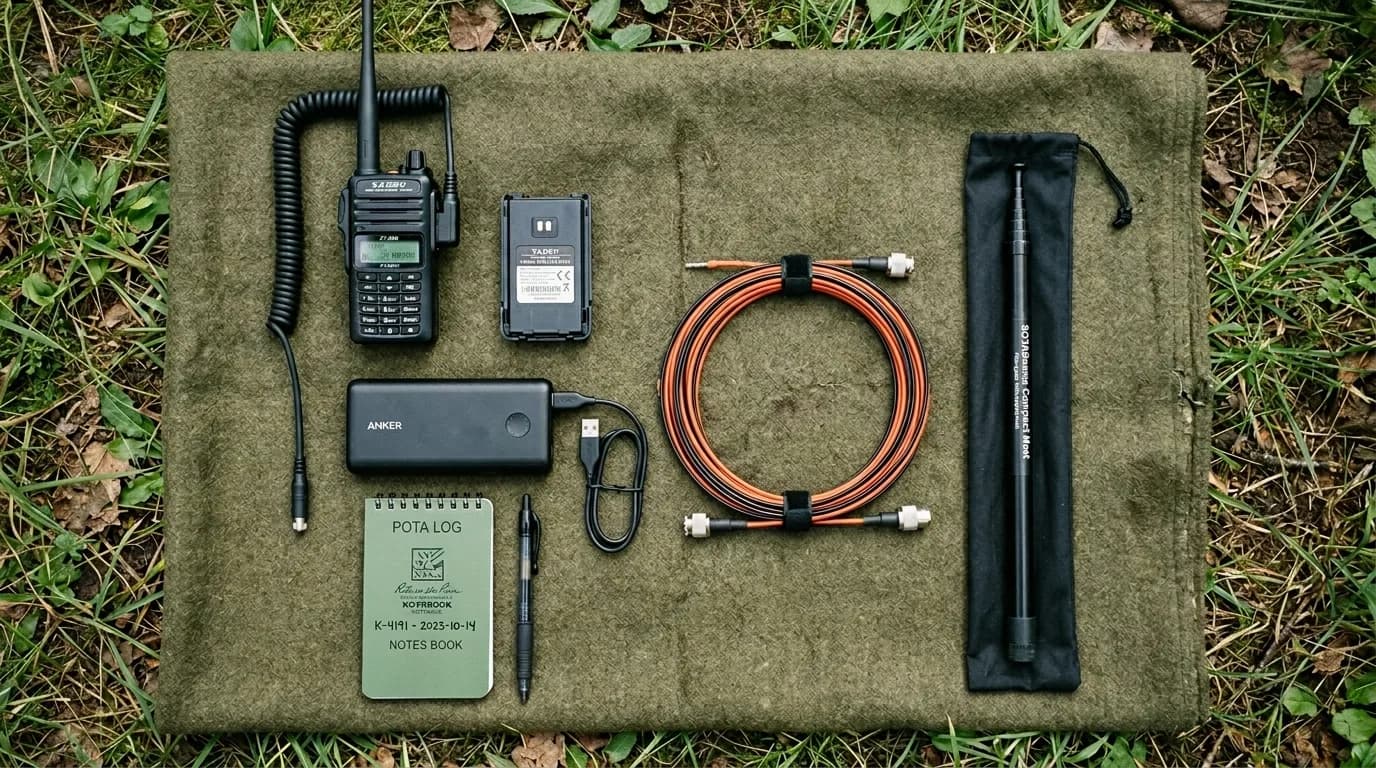
My POTA antenna kit: I carry a roll-up J-pole as my primary and a 20-foot wire end-fed as backup. Total weight including feedline: about 1 pound. The J-pole goes up in 3 minutes on a telescoping fiberglass mast. If I'm hiking light, I leave the mast and just hang the J-pole from a tree.
The math: on a 3-hour 2-meter simplex activation with a rubber duck, I have failed to reach ten contacts more than once. With the J-pole up a mast from the same spots, ten to twenty is the normal result and I have never missed the threshold. The antenna is the difference between a valid activation and a wasted drive. Contact counts in the fifties and above belong to HF, not to a handheld on simplex.
For a deeper look at how antenna choice affects range, read our ham radio range guide.
Battery and Power Strategy
Battery management is the second most important field decision after antenna choice. Here's how to plan:
Stock battery (1,800 to 2,500 mAh): Good for activations under 3 hours with moderate transmit time. Most radios ship with this size. The UV-5R's 1,800 mAh is the floor; the BF-5RH PRO's 2,500 mAh provides a comfortable margin.
Large stock battery (3,000 to 5,200 mAh): The Ailunce HD1's 3,200 mAh and the UV-25's 5,200 mAh handle 4 to 8 hours of active use. If you plan full-day activations or multiple parks in a day, start here.
Spare batteries: The cheapest way to extend runtime. A spare UV-5R battery weighs 70 grams, costs about $8, and adds 2 to 3 hours. For the BF-5RH PRO kit with two radios, you effectively have two batteries already.
USB power banks: Some newer radios (including the UV-25) support USB-C charging during operation. A 10,000 mAh power bank ($20 to $30) gives you effectively unlimited runtime. The tradeoff is cable management in the field.
My approach: I carry the radio's stock battery plus one spare. That gives me 5 to 7 hours of runtime depending on the radio, which covers any activation I'd realistically do. The spare battery fits in a jacket pocket and weighs almost nothing.
Quick Setup Checklist
A smooth activation starts at home. Here's the workflow I follow:
Before you leave:
- Charge all batteries fully
- Program key frequencies: 146.52 MHz (2M national calling), a few working simplex channels such as 146.55 and 146.58, and your local repeaters for announcing. Use CHIRP or your radio's CPS software.
- Pack your antenna kit (antenna, feedline, mast or throw line)
- Check your ham radio license is current (Technician class minimum for VHF/UHF POTA)
- Look up your park's POTA reference number at pota.app
At the park:
- Find a spot with some elevation if possible (hilltop, ridge, clearing)
- Deploy your antenna (5 to 10 minutes for a J-pole or wire)
- Test with a local repeater to confirm the radio and antenna work, and announce there that you are activating
- Tune to 146.52 MHz or your planned simplex frequency and spot yourself on pota.app
- Call: "CQ POTA, CQ POTA, this is [your callsign] activating [park reference]"
Operating tips:
- Keep exchanges brief: callsign and park reference is all you need
- Log contacts in a notebook or phone app as you go
- 10 simplex contacts minimum for a valid activation; repeater QSOs do not count
- Monitor your battery level; switch to low power (1 to 2 watts) if you're running low
Comparing POTA Radios Side by Side
| Spec | BF-5RH PRO | UV-25 | UV-5R | Ailunce HD1 | AT-D878UVII Plus | DMR-6X2 PRO |
|---|---|---|---|---|---|---|
| Price | $70.51 | $54.39 | $15.90 | $149.99 | $249.99 | $249.89 |
| Score | 86 | 73 | 69 | 78 | 83 | 85 |
| Battery | 2,500 mAh | 5,200 mAh | 1,800 mAh | 3,200 mAh | 3,100 mAh | 3,100 mAh |
| Max Power | 10W | 10W | 5W | N/A | 7W | 7W |
| Bands | VHF/UHF/1.25m | VHF/UHF/1.25m | VHF/UHF | VHF/UHF | VHF/UHF | VHF/UHF |
| DMR | No | No | No | Yes | Yes | Yes |
| APRS | Yes | No | No | Yes | Yes | Yes |
| IP Rating | IP54 | None | None | IP67 | IP54 | IP54 |
| CHIRP | Yes | Yes | Yes | No | No | No |
| Amazon Rating | 4.5 (293) | 4.3 (89) | 4.5 (10,207) | 4.2 (268) | 4.8 (6) | 4.5 (658) |
What Should You Actually Buy?
Starting out? Get the UV-5R and a roll-up J-pole antenna. Total investment: about $40. Try a few activations. If you enjoy it, upgrade the radio later. You already have the antenna, which is the part that matters most.
Regular activator? The BF-5RH PRO is the sweet spot. Two radios, APRS, GPS, tri-band, and CHIRP for about $71.69. Pair it with a J-pole and a spare battery, and your total kit is under $110.
All-day or multi-park activator? The UV-25 or Ailunce HD1. The UV-25's 5,200 mAh battery eliminates power anxiety for $63.99. The HD1's IP67 rating eliminates weather anxiety, but it now costs an unlisted price, nearly three times as much, so buy it only if you genuinely operate in weather that would kill a Baofeng.
Committed POTA and DMR operator? The AnyTone AT-D878UVII Plus or BTECH DMR-6X2 PRO. Both score 83 or better and handle analog, DMR, and APRS in a single unit. The price is justified if you're activating weekly.
Complete POTA Kit Cost
| Component | Budget Kit | Mid-Range Kit | Premium Kit |
|---|---|---|---|
| Radio | UV-5R ($16) | BF-5RH PRO ($71) | AT-D878UVII Plus ($250) |
| Portable antenna | Roll-up J-pole ($25) | Roll-up J-pole ($25) | Portable dipole ($35) |
| Spare battery | UV-5R battery ($8) | Included (2nd radio) | Extended battery ($30) |
| Mast/throw line | Paracord ($5) | Telescoping mast ($15) | Telescoping mast ($15) |
| Total | $54 | $111 | $330 |
POTA Community and Getting Started
If you're new to POTA, the barrier to entry is low. You need a ham radio license (Technician class covers VHF/UHF operations), a radio, and an antenna. That's it.
The POTA Hunter app shows active activations in real time and helps you find parks near you. Most areas have local ham clubs that organize group activations, which are a great way to learn the workflow without figuring everything out alone.
Activation season peaks in spring and fall when the weather cooperates. Summer works too, but popular parks get noisy (RF and otherwise). Winter activations are quieter and rewarding if you can handle the cold.
If you're still studying for your license, our ham radio practice quiz covers the material, and the ham radio band chart shows which frequencies you'll have access to at each license class.