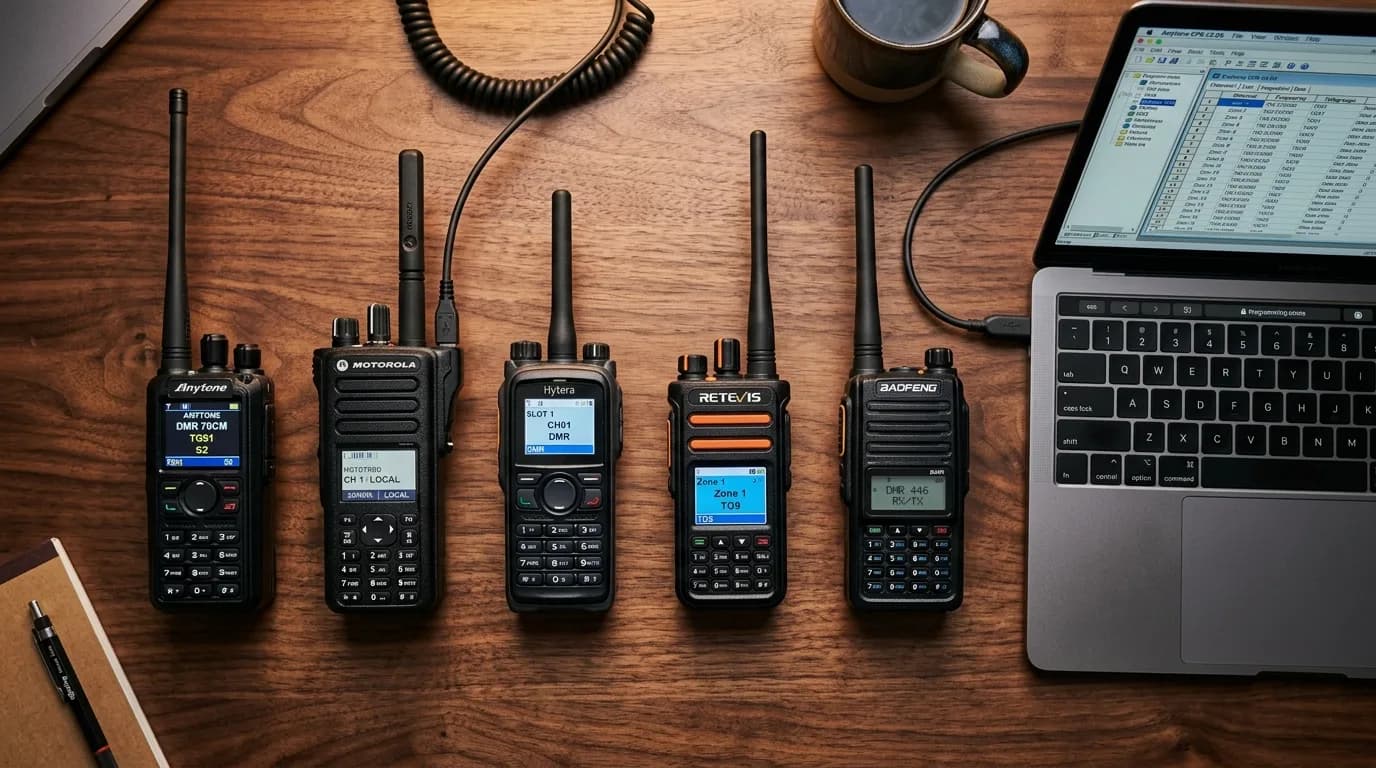

DMR (Digital Mobile Radio) is the most accessible digital mode in amateur radio. It gives you clearer audio than analog FM, access to regional and worldwide talkgroup networks, and features like text messaging and GPS position reporting. But it also adds real complexity: codeplug programming, talkgroup configuration, and a steeper learning curve than picking up a Baofeng and hitting a local repeater.
I bought my first DMR radio about two years into the hobby, after I'd gotten comfortable with analog FM and wanted to see what the digital side looked like. The short version: DMR opened up a layer of ham radio I didn't know existed. The longer version: my first codeplug took an entire Saturday afternoon. If you're considering DMR, this guide will help you pick the right radio and know what you're getting into.
We scored every DMR-capable handheld in our database across value, features, beginner-friendliness, and portability. Here are the six that earned their spot.
Quick Picks
| Radio | Score | Price | Best For |
|---|---|---|---|
| BTECH DMR-6X2 PRO | 85 | $249.89 | Best overall |
| AnyTone AT-D878UVII Plus | 83 | $249.99 | Best for power users |
| Baofeng DM32 | 83 | $49.99 | Best budget |
| Ailunce HD1 | 78 | unavailable | Best for field use |
| Radtel RT-4D DMR | 76 | an unlisted price | Biggest battery + GPS |
| Radioddity GD-88 | 68 | $149.99 | Mid-range with APRS |
How We Scored These
Every radio on RadioRanked gets a score from 0 to 100 based on manufacturer specs, not subjective impressions. The overall score is a weighted composite of four dimensions: feature set, value (capability per dollar), beginner-friendliness, and portability. For DMR radios specifically, the feature score matters most since it captures digital mode support, GPS, APRS, Bluetooth, and memory channel capacity. Check our scoring methodology for the full breakdown.
What Is DMR? (Quick Version)
DMR stands for Digital Mobile Radio. Instead of transmitting analog FM audio, DMR compresses voice digitally using the AMBE codec and sends it in time-division multiplexed slots, meaning two conversations can share a single frequency simultaneously. That efficiency is why DMR networks have scaled to thousands of repeaters worldwide.
The practical difference: you pick a "talkgroup" on your radio (think of it like a channel, but digital and network-routed), and your transmission reaches every repeater linked to that talkgroup. A 5-watt handheld on a local repeater can connect you to operators across the state or across the world, depending on the network configuration.
The tradeoff is setup complexity. Every DMR radio needs a "codeplug," a configuration file that maps repeaters, frequencies, talkgroups, and zones. It's not hard once you've done it, but the first time takes real effort.
For a deeper explanation, read our full What Is DMR? guide.
Is DMR Right for You?
Before spending money, answer these questions honestly.
DMR makes sense if you:
- Live near a metro area with active DMR repeaters (check RepeaterBook)
- Want access to regional or nationwide networks like Brandmeister or DMR-MARC
- Are interested in emergency communications (many ARES/RACES groups use DMR)
- Have been licensed for at least a year and are comfortable with analog FM
- Enjoy the technical side of radio configuration
Stick with analog FM if you:
- Live in a rural area with zero DMR repeaters nearby
- Are new to ham radio (master FM first, then consider digital)
- Prefer simplicity over features
- Want to spend under $30 on a radio
The hybrid approach: Most DMR radios also transmit and receive analog FM. You don't have to choose one or the other. Buy a dual-mode DMR radio and use FM for local repeaters while exploring DMR talkgroups on the side.
Not licensed yet? Start with our ham radio license guide.
The 6 Best DMR Radios
1. BTECH DMR-6X2 PRO: Best Overall
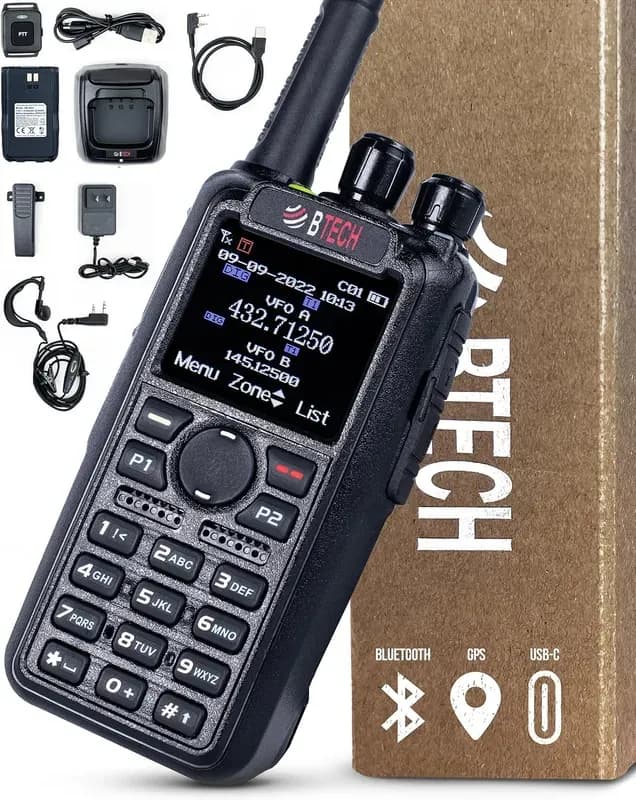
Score: 85 | Price: $249.89 | Bands: VHF/UHF | Power: 7W | Battery: 3,100 mAh
The DMR-6X2 PRO packs the most complete feature set of any DMR handheld at this price point. You get DMR Tier I and II, APRS, GPS, Bluetooth, a color TFT display, and 4,000 memory channels. The Bluetooth connectivity lets you pair a wireless headset or use a smartphone app for programming, which is a genuine convenience that most DMR radios skip.
The feature score of 84 is tied for the highest among DMR handhelds in our database, and the value score of 80 reflects the fact that you're getting premium features at a mid-tier price. The 3,100 mAh battery holds up reasonably well, though GPS and Bluetooth together will pull it down faster.
Who it's for: Operators who want one DMR radio that does everything. If you're setting up for ARES/RACES work, APRS tracking, or you simply want the most capable handheld without crossing $300, this is the one.
The tradeoff: Beginner score of 52 means this is not a starter radio. The menu system has depth, and configuring APRS alongside DMR codeplugs requires patience. If you're new to DMR, expect a learning curve.
For a premium comparison, see how it stacks up against the AnyTone AT-D878UVII Plus.
2. AnyTone AT-D878UVII Plus: Best for Power Users
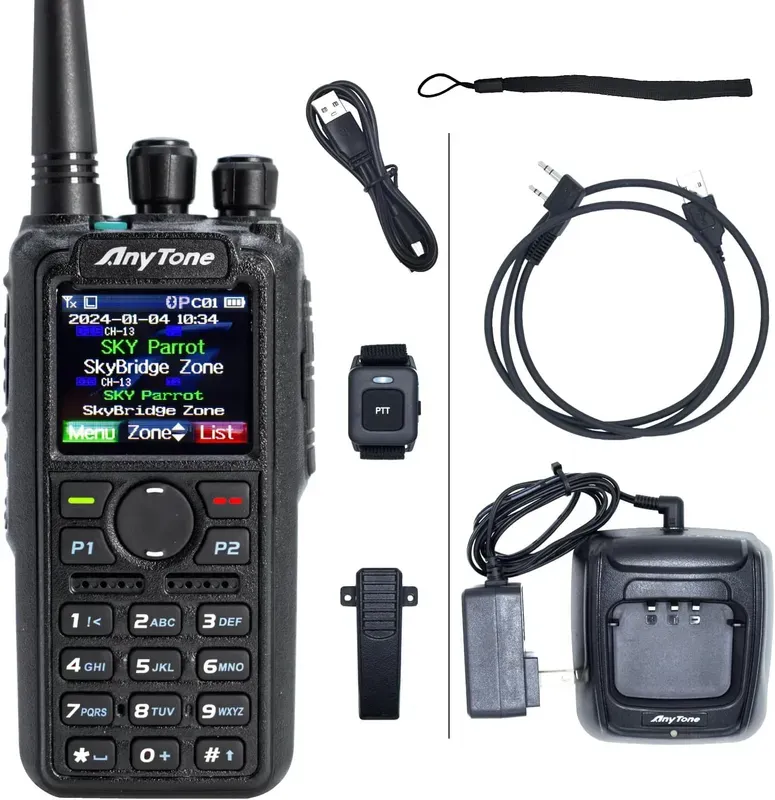
Score: 83 | Price: $249.99 | Bands: VHF/UHF | Power: 7W (high) / 1W (low) | Battery: 3,100 mAh
The AT-D878UVII Plus has been the default recommendation in DMR forums for years, and for good reason. The color TFT display is the most readable in this roundup. The CPS (Customer Programming Software) is better documented than most competitors. GPS, APRS, Bluetooth, and 4,000 memory channels round out a feature set that matches the BTECH DMR-6X2 PRO almost spec for spec.
One note on the naming: the original AT-D878UV is no longer sold on Amazon, so this pick is the AT-D878UVII Plus revision at $249.99. Same CPS software and the same codeplug ecosystem; the II Plus adds Bluetooth PTT, a USB-C battery and a 500,000-entry contact list.
Where the AnyTone pulls ahead is in community support. The AT-D878UVII Plus has one of the largest user communities in the DMR world. Codeplug templates, YouTube walkthroughs, and Discord servers exist for nearly every major metro area. When you're stuck on a codeplug issue at 11 PM, that community support matters more than any spec sheet number.
Who it's for: Experienced operators who prioritize software quality and community resources. If you've already done DMR before and want the best user experience, or if you're joining an ARES group that standardizes on AnyTone, this is the safe choice.
The tradeoff: At $249.99, you're paying almost exactly what the BTECH DMR-6X2 PRO costs ($249.89) for a very similar spec sheet. The AnyTone's advantage is in software polish and community, not hardware. The 280g weight is lighter than most competitors, which is a small but real comfort during long field operations.

3. Baofeng DM32: Best Budget
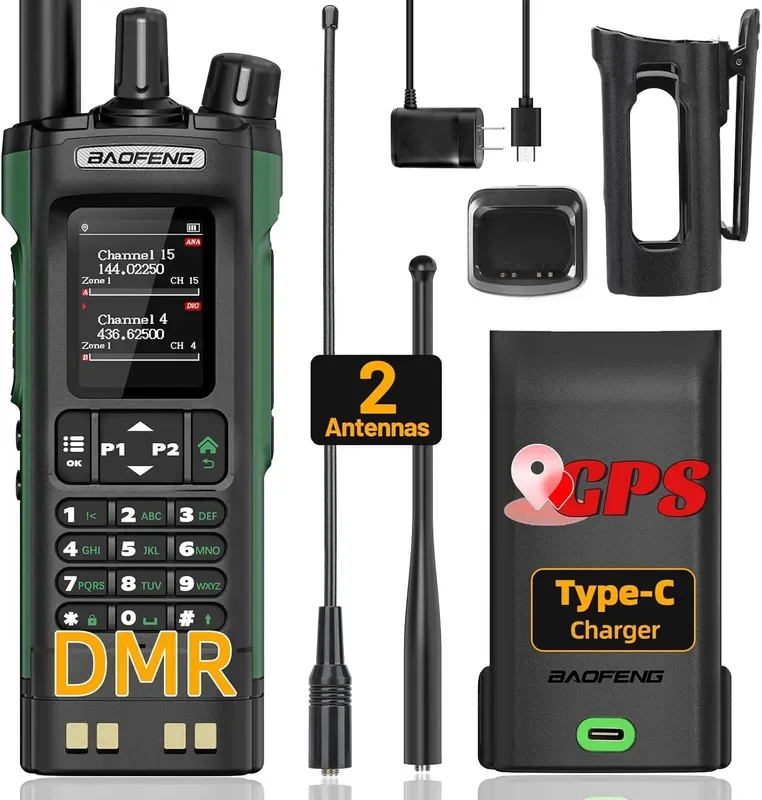
Score: 83 | Price: $49.99 | Bands: VHF/UHF | Power: 8W | Battery: 2,500 mAh
The DM32 is the most surprising radio in this list. At $49.99, it delivers DMR Tier II, APRS, GPS, and 4,000 memory channels. The value score of 95 is the highest in our entire DMR lineup, and it earned an overall score of 83, just two points behind the radios costing nearly five times as much.
It's also the only budget DMR radio in our database with confirmed CHIRP compatibility, which makes initial analog channel programming significantly easier. For DMR-specific configuration you'll still need Baofeng's CPS software, but having CHIRP for the FM side is a genuine advantage.
Who it's for: Operators who want to try DMR without committing $200 or more. The DM32 is an excellent second radio for digital experimentation, and at this price, it's practically disposable if DMR turns out not to be your thing.
The tradeoff: The LCD display isn't as readable as the color TFTs on premium models. Build quality is Baofeng-grade, meaning functional but not refined. Amazon reviewers (4.5 stars, 196 reviews) report occasional firmware quirks. Baofeng also sells several DM-32 variants (DM-32UV, DM-32UV Pro, DM-32UV GPS APRS) with minor differences in power output and bundled accessories; the base DM32 is the best value of the bunch.
Curious how it compares to analog Baofengs? Check our Best Baofeng Radios roundup.
4. Ailunce HD1: Best for Field Use
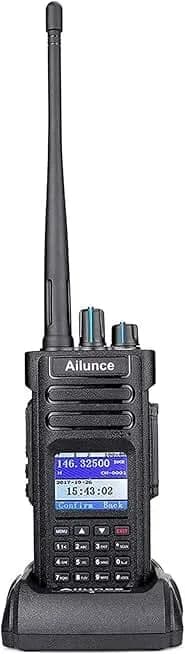
Score: 78 | Price: unavailable | Bands: VHF/UHF | IP Rating: IP67 | Battery: 3,200 mAh
The HD1 is the only DMR handheld in our top tier with IP67 waterproofing. That means it's rated for submersion in up to 1 meter of water for 30 minutes. If you're doing POTA activations, trail work, or any kind of outdoor operation where weather is a factor, this is the radio that won't flinch when it starts raining.
The HD1 has gone in and out of stock on Amazon. Its listing currently reads unavailable. When it is in stock, it sits closer to premium territory than the budget Baofengs. The 3,200 mAh battery is the second-largest in this roundup, behind the RT-4D's 3,500 mAh. GPS and APRS are built in, and the color LCD display is functional if not flashy.
Who it's for: Outdoor operators, POTA activators, emergency communicators, and anyone who needs a DMR radio that can take a beating. Also a strong choice for a second DMR radio to keep in a go-bag, once it's back in stock.
The tradeoff: Amazon reviews (4.2 stars, 268 reviews) are solid but note that the CPS software is less polished than AnyTone's. The menu system is functional but dated. No Bluetooth, no CHIRP support.
See how it compares head-to-head: Ailunce HD1 vs AnyTone AT-D878UVII Plus.
5. Radtel RT-4D DMR: Big Battery, Feature-Rich Budget Pick
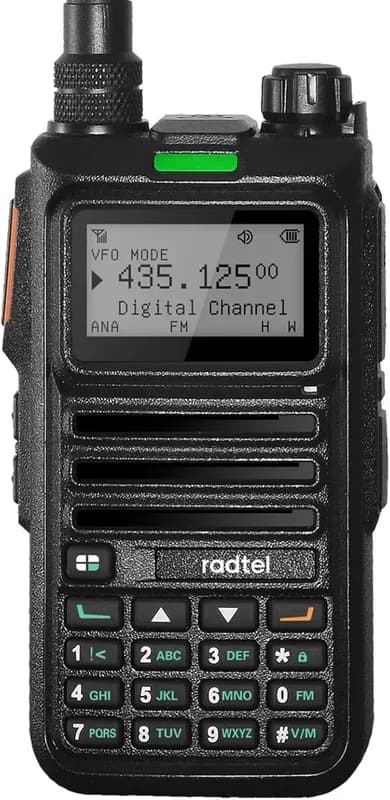
Score: 76 | Price: an unlisted price | Bands: VHF/UHF | Power: 5W | Battery: 3,500 mAh
The RT-4D is no longer the cheapest DMR radio in our database, the Baofeng DM32 now undercuts it, but it still packs in more than you'd expect at its price. You get dual-band VHF/UHF, GPS, Bluetooth, 1,024 memory channels, and a 3,500 mAh battery (the largest in this roundup by capacity). The portability score of 66 is the highest here, thanks to its 198g weight.
The catch is that this is a stripped-down DMR experience. No APRS, no color display, and the 1,024 channel limit is tight if you're programming multiple metro areas. Both radios have GPS. If the bigger battery and Bluetooth matter more to you than shaving off the last few dollars, it's still a reasonable pick over the cheaper DM32.
Who it's for: Operators who are DMR-curious but not ready to invest. Students. Preppers who want a budget digital option. Anyone who wants a second DMR radio for a specific use case.
The tradeoff: No APRS support limits its utility for position reporting. The Radtel brand has a smaller community than Baofeng or AnyTone, so finding codeplug templates and troubleshooting help is harder. 5W max power (vs. 7-10W on competitors) means slightly less reach to distant repeaters.
6. Radioddity GD-88: Mid-Range Alternative
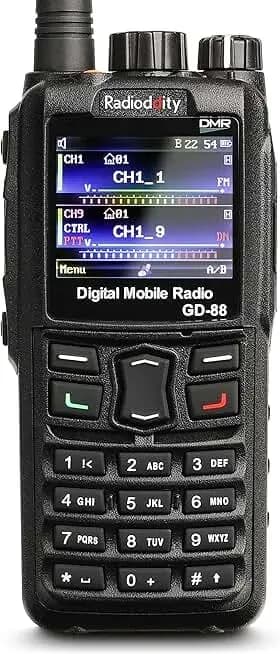
Score: 68 | Price: $149.99 | Bands: VHF/UHF | Battery: N/A | Channels: 200
The GD-88 lands in the middle of the price range with DMR, APRS, and GPS included. Radioddity has a solid reputation in the DMR community, partly due to their older GD-77 model which was one of the first budget DMR radios to gain a serious following. The GD-88 continues that lineage with built-in APRS and GPS.
However, the numbers tell the story: a 68 overall score, only 200 memory channels (compared with 1,024 to 4,000 on the other five radios), and a 3.9-star Amazon rating from 92 reviews. The feature score of 58 is the lowest in this roundup.
Who it's for: Radioddity loyalists upgrading from the GD-77. Operators who want a mid-range DMR radio with APRS from a brand with established community support and custom firmware options.
The tradeoff: At $149.99, the Ailunce HD1 nominally offers more radio for about $5 less, with IP67 waterproofing and 3,000 channels. But the HD1 is currently unavailable on Amazon, which makes the GD-88 the buyable choice today despite the lower score. The GD-88 is still hard to recommend on pure specs, but the Radioddity community and firmware ecosystem add intangible value that doesn't show up in our scoring algorithm.
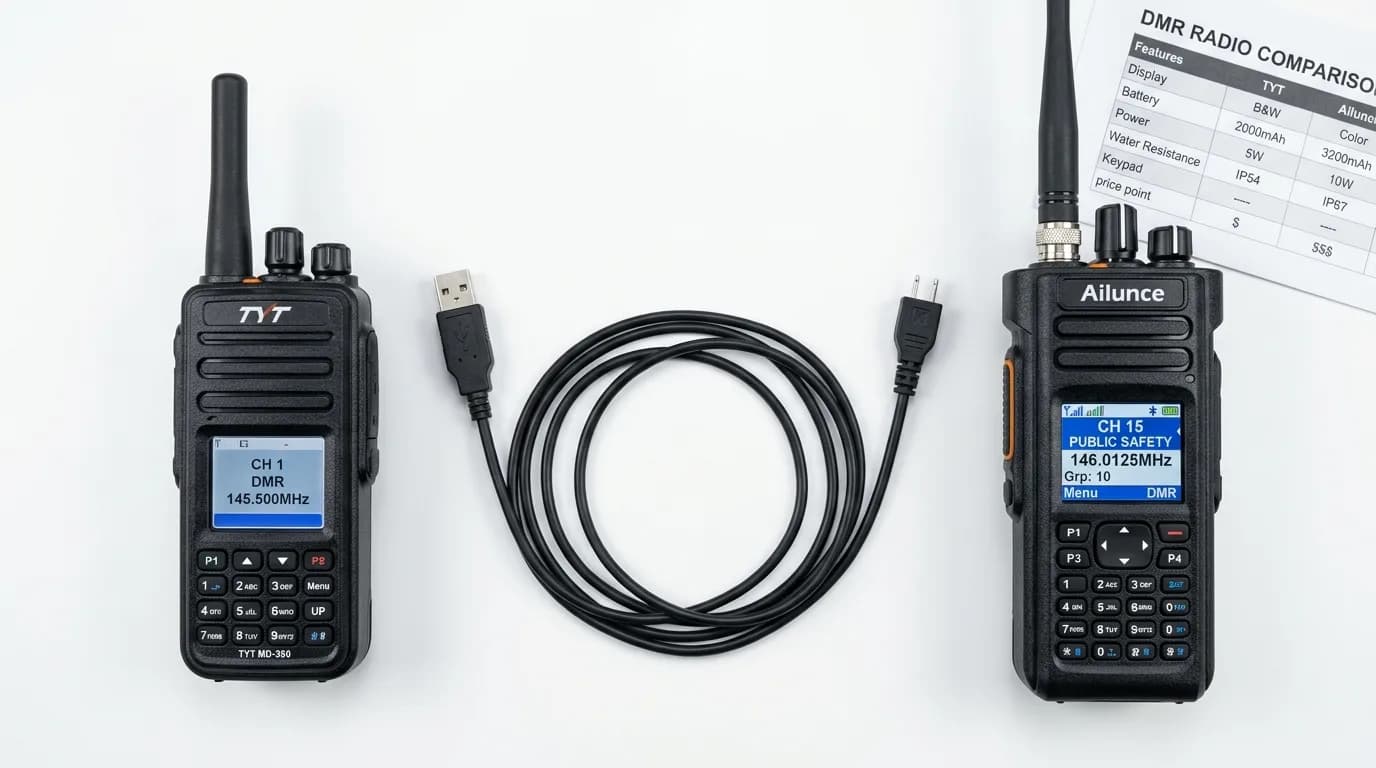
Cheapest DMR Radios
If you just want to try DMR without spending much, three representative picks cover the entry level. We group the DM-32UV GPS APRS with the DM32 family rather than treating it as a separate pick.
The Baofeng DM32 is the cheapest CHIRP-compatible DMR radio we track, at $49.99. The Baofeng DM-1701 undercuts it, but it cannot be programmed with CHIRP. It still includes DMR Tier II, APRS, GPS, and 4,000 memory channels, which is why its value score of 95 is the highest in our lineup.
The Radtel RT-4D DMR costs more, at an unlisted price, and trades APRS for a bigger 3,500 mAh battery and Bluetooth; both radios have GPS. It's the pick if battery life matters more to you than shaving off the last few dollars.
Step up to the Baofeng DM-32UV Pro at $63.99 and you get 10W of output instead of 8W, along with the same core feature set as the base DM32.
What you give up at any of these prices: codeplug quality is rougher than on the AnyTone or BTECH radios, community support and template availability are thinner, and receiver performance won't match a $250 flagship. For casual DMR experimentation or a second radio in a go-bag, that's an easy trade. If you plan to make DMR your primary mode, budget for one of the higher-scoring radios above instead.
DMR Comparison Table
| Radio | Price | Score | Power | GPS | APRS | Bluetooth | IP Rating | Channels | Amazon Rating |
|---|---|---|---|---|---|---|---|---|---|
| BTECH DMR-6X2 PRO | $249.89 | 85 | 7W | Yes | Yes | Yes | IP54 | 4,000 | 4.5 (658) |
| AnyTone AT-D878UVII Plus | $249.99 | 83 | 7W | Yes | Yes | Yes | IP54 | 4,000 | 4.8 (6) |
| Baofeng DM32 | $49.99 | 83 | 8W | Yes | Yes | No | -- | 4,000 | 4.5 (196) |
| Ailunce HD1 | unavailable | 78 | N/A | Yes | Yes | No | IP67 | 3,000 | 4.2 (268) |
| Radtel RT-4D DMR | an unlisted price | 76 | 5W | Yes | No | Yes | -- | 1,024 | 4.2 (112) |
| Radioddity GD-88 | $149.99 | 68 | N/A | Yes | Yes | No | IP54 | 200 | 3.9 (92) |
Setting Up DMR: The Codeplug Reality
The biggest difference between buying a DMR radio and buying an analog FM radio is what happens after unboxing. An FM radio needs frequencies and tones. A DMR radio needs a codeplug.
A codeplug is a configuration file that tells your radio which repeaters to use, which talkgroups to monitor, what time slots to transmit on, and how to organize it all into scannable zones. Think of it as programming a hundred repeaters, each with multiple "sub-channels" (talkgroups), organized by geography and purpose.
How to build your first codeplug:
- Find local DMR repeaters. Use RepeaterBook, filter by "Digital (DMR)." If you see zero results within 50 miles, DMR may not be worth it in your area yet.
- Download a codeplug template. Most state and regional DMR groups publish pre-built codeplugs. Search "[your state] DMR codeplug" or check Brandmeister's community resources.
- Install the CPS software. Each radio brand has its own Customer Programming Software. AnyTone's CPS is the most polished. Baofeng's works but is less intuitive. Download from the manufacturer's website.
- Edit and upload. Load the template, customize for your local repeaters, and write it to the radio via USB cable.
Time investment: First codeplug setup takes 2-4 hours, including research. After that, updates take 20-30 minutes. It's front-loaded effort that pays off once you're on the air.
For analog channel programming on radios that support it (like the Baofeng DM32), CHIRP can handle the FM side while you use the manufacturer's CPS for DMR configuration.
DMR Networks: Brandmeister vs. DMR-MARC
Two major networks connect DMR repeaters across North America and beyond.
Brandmeister is the larger and more open network. It's community-driven, free to join, and connects thousands of repeaters worldwide. Most amateur DMR operators end up on Brandmeister. The network supports talkgroups ranging from hyper-local (your city) to worldwide (talk to anyone on the network globally).
DMR-MARC (Motorola Amateur Radio Club) is the original DMR amateur network. It's more structured, with a formal registration process. Coverage is strong in urban areas. Some regions have both Brandmeister and DMR-MARC repeaters; others have only one.
Which network matters when buying? It doesn't, really. All six radios in this roundup work on both networks. The network choice comes down to which repeaters are available near you. Check RepeaterBook before buying to see what's active in your area.
DMR vs. Other Digital Modes
DMR isn't the only digital mode in amateur radio, but it's the most practical for most operators.
| Mode | Network Size | Cost | Openness | Best For |
|---|---|---|---|---|
| DMR | Largest | $55-$250 | Open standard | General digital use |
| D-STAR | Moderate | $200+ | Icom proprietary | Icom ecosystem users |
| C4FM/Fusion | Moderate | $200+ | Yaesu proprietary | Yaesu ecosystem users |
| P25 | Small (ham) | $300+ | Open standard | Public safety crossover |
DMR has the widest repeater coverage, the lowest entry price, and the most active amateur community. D-STAR and C4FM (Yaesu System Fusion) are solid alternatives if you're already invested in the Icom or Yaesu ecosystem, but their repeater networks are smaller. P25 is primarily a public safety standard with limited amateur adoption.
For a broader look at digital vs. analog, our VHF vs UHF guide covers frequency band basics, and our ham radio range guide explains how digital modes affect real-world coverage.
Which DMR Radio Should You Buy?
Here's the decision tree:
Budget under $60? The Baofeng DM32 at $49.99 is the clear winner. CHIRP-compatible, GPS, APRS, 8W output. It is the cheapest option and the only one under $60 with CHIRP.
Want the biggest battery on a budget? The Radtel RT-4D DMR at an unlisted price trades away APRS and community support for a 3,500 mAh battery and Bluetooth. Both have GPS.
Need waterproofing for field use? The Baofeng DM-32UV Pro is the available IP67 option at $63.99. The Ailunce HD1 is also IP67 and the stronger radio for POTA, hiking, or go-bag duty, and it lists at no current Amazon price.
Want the best overall package? The BTECH DMR-6X2 PRO at $249.89 has every feature you'd want. GPS, APRS, Bluetooth, color display, 4,000 channels.
Prioritize community support and software? The AnyTone AT-D878UVII Plus at $249.99 has the most codeplug templates, tutorials, and active user forums.
Zero DMR repeaters near you? Skip DMR entirely. Get an analog FM handheld instead. Our best handheld ham radios and best radios for beginners roundups cover FM options from $25 to $200.
Browse all DMR handhelds ranked by score on our Best DMR Radios page, or use the FCC lookup tool to verify equipment authorization status before you buy.