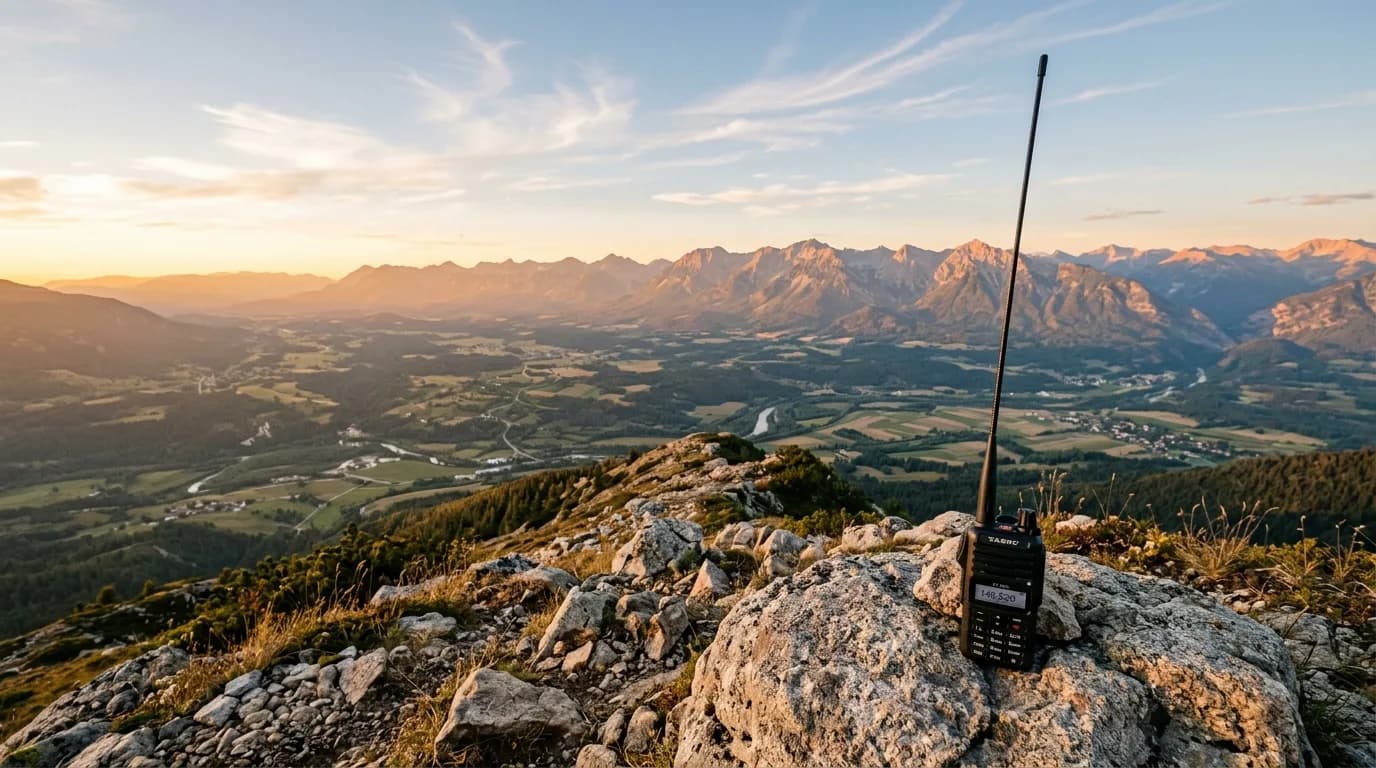

Quick answer: The Baofeng BF-5RH PRO ($70) with 10 watts of output is our top handheld pick for maximum range. But power matters less than people think: an upgraded antenna alone can double your range, and accessing a repeater multiplies it tenfold. A handheld covers 2 to 5 miles direct simplex, 15 to 30 miles from elevation with a good antenna, and 20 to 60+ miles via repeater. Antenna and location beat watts every time.
I'll be honest: the first time I bought a ham radio specifically for "long range," I expected 50-mile simplex contacts out of a 5-watt handheld. Physics had other plans. That experience taught me what actually matters for long-distance communication on VHF and UHF, and it's not what most people assume.
The radio you buy matters less than how you use it. An upgraded antenna doubles your range. A hilltop triples it. A repeater extends it tenfold. The best long-distance ham radio is one paired with the right strategy, not just the one with the highest wattage on the spec sheet.
Here are the handhelds that give you the best foundation for maximizing range, along with the strategies that actually move the needle.
Quick Picks
| Radio | Price | Score | Power | Best For |
|---|---|---|---|---|
| Baofeng BF-5RH PRO | $71.69 | 86 | 10W | Best overall for range |
| Baofeng UV-5R | $17.16 | 69 | 5W | Budget baseline |
| Baofeng UV-5RM Pro | an unlisted price | 77 | 10W | Power + APRS |
| Ailunce HD1 | an unlisted price | 81 | N/A | DMR repeater access |
| AnyTone AT-D878UVII Plus | $249.99 | 83 | 7W | Premium all-rounder |
What "Long Distance" Actually Means
Before spending money, you need to understand what's physically possible. "Long distance" means different things depending on your equipment category, and the gap between expectations and reality is where most frustration lives.
VHF/UHF handheld (the radios in this article):
- Direct simplex with stock antenna: 2 to 5 miles (flat terrain)
- Direct simplex with upgraded antenna: 5 to 15 miles
- Direct simplex from elevation with good antenna: 15 to 30 miles
- Via repeater: 20 to 60+ miles
VHF/UHF mobile (25 to 50 watts, roof-mounted antenna):
- Direct simplex: 15 to 40 miles
- Via repeater: 40 to 80+ miles
HF base station (100 watts, external antenna):
- Via ionospheric propagation: 100 to 10,000+ miles
These are three completely different equipment categories with three different price points and skill requirements. This article focuses on handhelds because that's what RadioRanked tracks, but I'll cover when and why you should consider the other paths.
The critical insight: on VHF/UHF, antenna and elevation matter more than power. Doubling your power from 5 watts to 10 watts adds roughly 1.4x range (about 40% more). Swapping from a rubber duck to a quality aftermarket antenna adds 2 to 3x range. Climbing a hill adds 3 to 5x range. And hitting a repeater adds 5 to 10x range. If your goal is maximum distance, the radio is the least important variable.
For a deep dive on the physics of range, read our ham radio range guide.
How We Scored These Radios
Every RadioRanked score comes from a weighted algorithm based on manufacturer specs. For this roundup, we prioritized power output, antenna connector quality, feature depth (DMR and APRS extend your communication options), and value. Browse our best long-range radios page for the full filtered ranking.
Best Handhelds for Maximum Range
Baofeng BF-5RH PRO: Best Overall for Long Distance
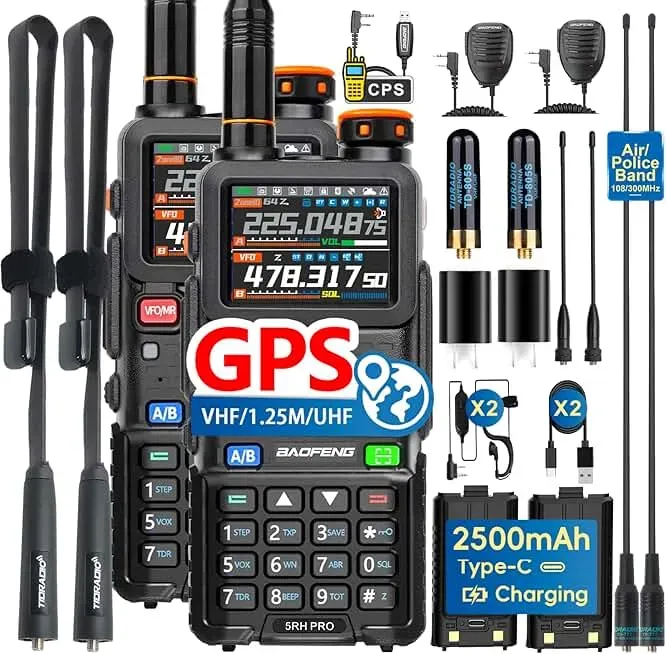
The BF-5RH PRO leads our picks at score 86 with 10 watts of output across three bands (VHF, UHF, 1.25 meter). At $71.69 for a two-radio kit, it also ships with two antennas, two batteries, and two sets of accessories, giving you a primary and a backup in a single purchase.
For long-distance use, the key specs are 10 watts on VHF (the band with better propagation for distance), a standard SMA connector that accepts aftermarket antennas, and built-in APRS with GPS. APRS is particularly useful for long-range operations because it lets you beacon your position, which helps other operators track where you are and confirm that your signal is reaching the network.
The radio's tri-band coverage means you can access 2-meter repeaters (the most common for long-distance relaying), 70-centimeter repeaters (denser in urban areas), and the less-crowded 1.25-meter band where it's available. CHIRP compatibility makes programming all those repeaters straightforward.
Realistic range: 3 to 8 miles with stock antenna on flat ground. 8 to 15 miles with an aftermarket whip. 15 to 25 miles from elevation with a good antenna. 30 to 60+ miles via repeater.
Tradeoff: 10 watts drains the 2,500 mAh battery faster than 5-watt operation. Drop to 5 watts for casual use and save the full 10 for when you need the reach.
Baofeng UV-5R: Budget Baseline
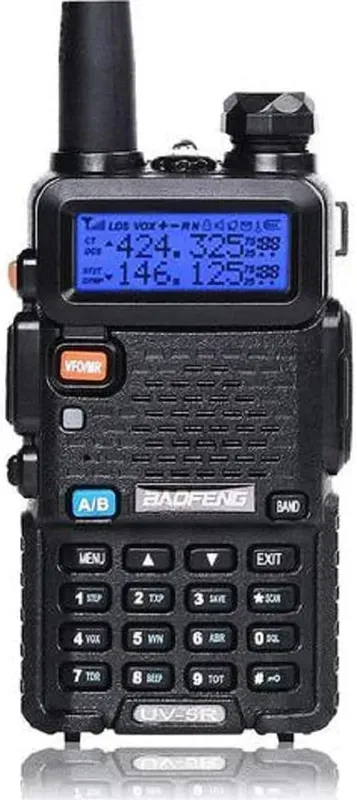
I'm including the UV-5R at $17.16 not because it's a long-range radio, but because it proves a point: the radio matters less than you think. A UV-5R with a $15 Nagoya NA-771 antenna will outrange a $200 radio with a stock rubber duck. Every time.
The UV-5R outputs 5 watts on VHF and UHF, has a standard SMA connector, and is CHIRP compatible for easy repeater programming. At 250 grams, it's one of the lightest handhelds in our database. With 10,158 Amazon reviews and a 4.5-star average, the community support and accessories ecosystem is unmatched.
For long-distance work, the UV-5R serves two roles. First, it's the cheapest way to test whether your long-range strategy works before investing in a better radio. Spend $17.16 on the radio and $15 on an antenna, program your local repeaters, and test your actual range. Second, it's an excellent backup radio. At this price, carrying two is a reasonable strategy for any communications plan.
Realistic range: 2 to 4 miles stock. 5 to 10 miles with aftermarket antenna. 10 to 20 miles from elevation. 25 to 50+ miles via repeater.
Tradeoff: 5 watts maximum, 1,800 mAh battery (2 to 3 hours active), no IP rating. It's a $17.16 radio. Manage expectations accordingly, and spend the savings on a good antenna.
Baofeng UV-5RM Pro: Power Plus APRS
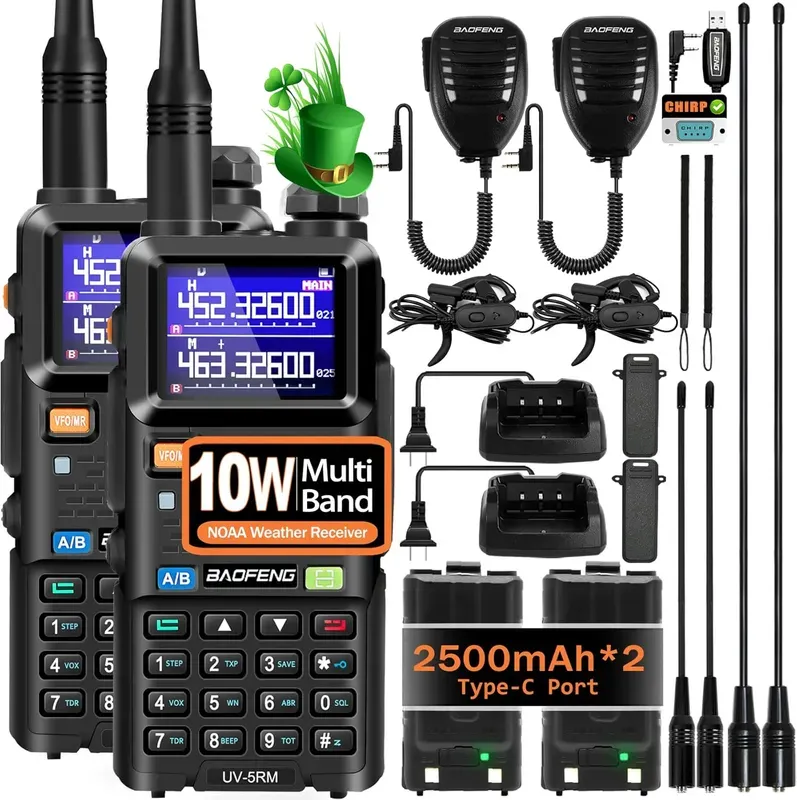
The UV-5RM Pro bridges the gap between the budget UV-5R and the premium options. At an unlisted price with 10 watts and built-in APRS with GPS, it offers meaningful range advantages over 5-watt radios while adding position reporting capability.
For long-distance operators, APRS is more than a convenience feature. It lets you transmit your GPS coordinates over the APRS network, which extends much farther than voice thanks to digipeaters (automated relay stations that forward APRS packets). Even if your voice can't reach a distant station, your APRS beacon might. This is useful for emergency situations, remote hiking, and coordinating with other operators who can see your position on a map.
The 640-channel memory and 10-watt output on both VHF and UHF give you flexibility across repeater networks. At 301 grams with the battery, it's slightly heavier than a UV-5R but still pocketable. The 388 Amazon reviews at 4.5 stars confirm it's a proven platform.
Realistic range: 3 to 8 miles stock. 8 to 15 miles with aftermarket antenna. 15 to 25 miles from elevation. 30 to 60+ miles via repeater.
Tradeoff: Not CHIRP compatible, so you'll need the Baofeng CPS for programming. No IP rating. The 2,500 mAh battery at 10 watts gives you shorter runtime than at 5 watts; budget for a spare.
Ailunce HD1: Mid-Range with Digital Repeater Access
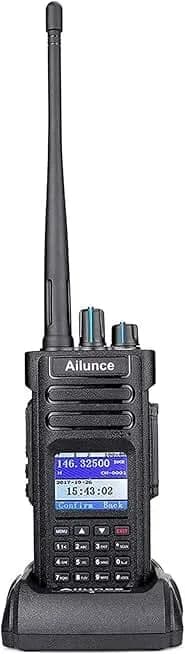
The Ailunce HD1 at an unlisted price adds a critical capability for long-distance operators: DMR. Digital Mobile Radio lets you access DMR repeaters, which are connected to worldwide networks like Brandmeister and TGIF. Through these networks, a single DMR repeater in your area can connect you to operators across the country or around the world, not through ionospheric propagation, but through internet-linked repeater infrastructure.
For practical long-distance communication, DMR repeater access is arguably the most reliable path to consistent 100+ mile contacts using a handheld radio. You're limited to DMR repeater coverage in your area, but in most metro regions and along major highways, that coverage is extensive.
The HD1 also includes APRS with GPS and IP67 waterproofing (submersible to 1 meter), which matters if your long-range strategy involves outdoor operation from elevated positions where weather is unpredictable. The 3,200 mAh battery provides comfortable 4-hour sessions.
Realistic range: Similar to other handhelds for analog simplex (5 to 15 miles depending on antenna/terrain). Via DMR repeater: effectively unlimited through internet-linked networks.
Tradeoff: Not CHIRP compatible. DMR programming requires understanding talkgroups, color codes, and time slots, which adds learning curve. The beginner score of 54 reflects this. If you're new to radio, learn analog first.
AnyTone AT-D878UVII Plus: Premium All-Rounder
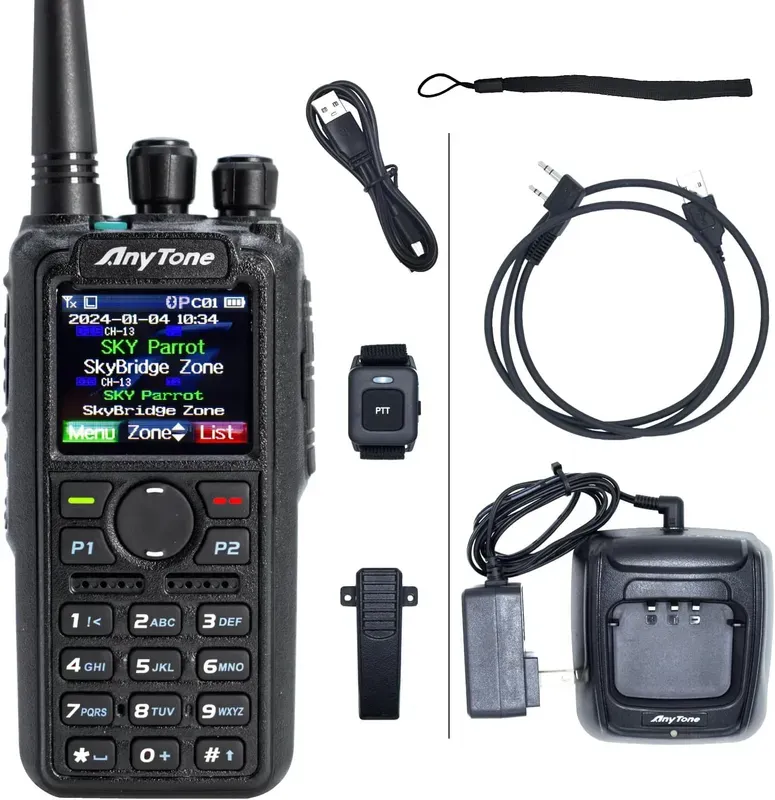
The AT-D878UVII Plus at $249.99 is the premium pick for operators who want every available tool for long-distance communication. DMR Tier I and II, full APRS with GPS, Bluetooth, 7 watts, and a 3,100 mAh battery. It scores 83 overall, with a feature score of 84 that ties the highest in our database.
For long-distance, the AT-D878UVII Plus's advantage is versatility. Work analog repeaters on 2-meter for regional communication. Switch to DMR for internet-linked contacts across the country. Use APRS to beacon your position. Connect via Bluetooth to configure on the fly. The accessories market is mature, including high-gain antenna options, extended batteries, and speaker-mics. Its Amazon listing is new and carries only 6 ratings, so the star average there is not yet a signal.
If you're building a serious long-distance communication capability and want a single handheld that handles every scenario, this is it.
Realistic range: 4 to 10 miles stock simplex. 10 to 20 miles with aftermarket antenna from elevation. Via analog repeater: 30 to 60+ miles. Via DMR network: effectively unlimited.
Tradeoff: At $249.99, it's many times the price of a UV-5R. Not CHIRP compatible. The AnyTone CPS is powerful but complex. If your long-distance needs are occasional, the BF-5RH PRO at $71.69 gets you most of the capability for a fraction of the price.
For more on DMR-capable radios, see our best DMR radios roundup.
The Antenna Advantage: More Important Than Your Radio
This is the most important section in this article. If you take one thing away, let it be this: your antenna choice has a larger impact on range than your radio choice.
Here's why. Radio power follows the inverse-square law. Doubling your power from 5 watts to 10 watts increases range by roughly 40% (the square root of the power ratio). That's going from, say, 5 miles to 7 miles. Meaningful, but not transformative.
An antenna upgrade, by contrast, improves both transmit and receive efficiency. A quality aftermarket whip antenna typically provides 2 to 3 dB of gain over a stock rubber duck, which translates to a 50 to 100% range improvement. And unlike power (which drains your battery faster), antenna gain is free, no additional current draw.
Handheld Antenna Upgrades by Performance
| Antenna | Cost | Typical Range Improvement | Notes |
|---|---|---|---|
| Stock rubber duck | Included | Baseline (1x) | Compact but poor performance |
| Nagoya NA-771 | $12 to $15 | 1.5x | Most popular first upgrade |
| Diamond SRH77CA | $25 to $35 | 1.7x | Better build quality |
| Signal Stick | $20 to $25 | 1.6x | Flexible, durable |
| Whip on counterpoise | $30 to $50 | 2 to 2.5x | Best handheld option, less portable |
The Nagoya NA-771 is the single best bang-for-buck upgrade in ham radio. For $12 to $15, you get roughly 50% more range on every transmission and reception. I've recommended it to dozens of new hams and the reaction is always the same: "Why didn't I buy this first?"
For maximum handheld range, a quarter-wave whip (about 19 inches for 2-meter) on a ground plane or counterpoise gives the best performance. It's less portable than a flexible antenna, but for a fixed operating position on a hilltop, it's hard to beat.
The real test: I measured my own range to a local repeater with three antenna setups on the same UV-5R, from the same location:
- Stock rubber duck: hit the repeater at 4 miles (weak, noisy)
- Nagoya NA-771: hit the repeater at 7 miles (solid copy)
- Whip on PVC mast: hit the repeater at 12 miles (full quieting)
Same radio, same power, same location. The antenna was the only variable. For more on how range works, see our VHF vs UHF guide and the ham radio band chart.

The Repeater Advantage: VHF/UHF's Long-Distance Solution
If your goal is reliable communication beyond 15 to 20 miles on VHF/UHF, repeaters are the answer. Not more power, not a bigger antenna. Repeaters.
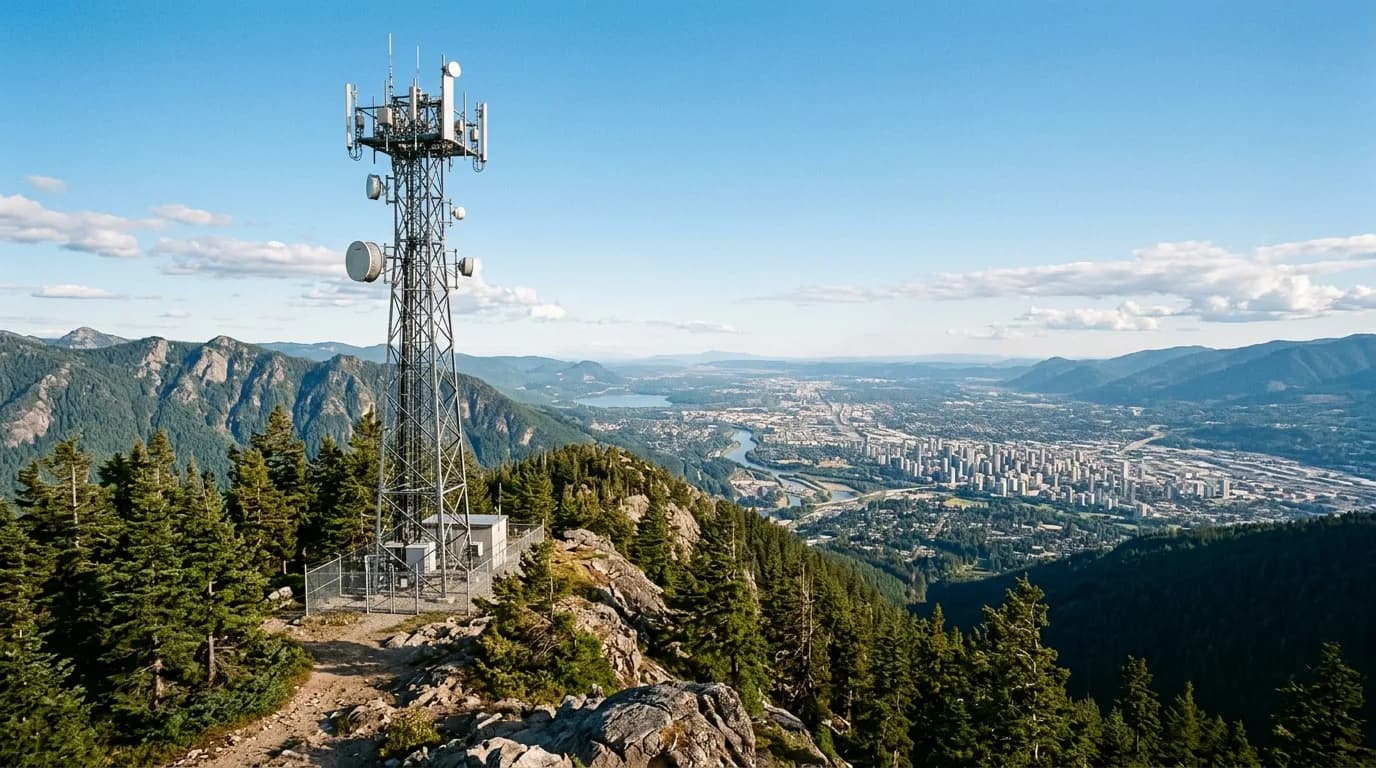
A repeater is a radio station, typically installed on a hilltop, tall building, or tower, that receives your signal on one frequency and retransmits it on another at much higher power and from a much better antenna position than you could achieve with a handheld. The repeater does the heavy lifting. Your 5-watt handheld only needs to reach the repeater; the repeater's 50 to 100 watts and elevated antenna handle the rest.
How Repeaters Multiply Range
| Setup | Typical Reliable Range |
|---|---|
| 5W handheld, stock antenna, simplex | 2 to 5 miles |
| 5W handheld, upgraded antenna, simplex | 5 to 15 miles |
| 5W handheld, stock antenna, via repeater | 20 to 40 miles |
| 5W handheld, upgraded antenna, via repeater | 30 to 60+ miles |
| 10W handheld, upgraded antenna, via repeater | 40 to 70+ miles |
The same $16 UV-5R that barely reaches 5 miles on simplex can communicate 50+ miles through a repeater. The repeater's coverage area becomes your coverage area.
Finding and Programming Repeaters
To use repeaters for long-distance communication:
- Find local repeaters at RepeaterBook.com. Search by your location and note the frequency, offset, and CTCSS/DCS tone for each repeater.
- Program them into your radio using CHIRP or your radio's CPS software. You need: the receive frequency, the transmit offset (usually +/- 600 kHz for 2-meter, +/- 5 MHz for 70cm), and the access tone.
- Test from home to confirm you can hit each repeater reliably.
- Map your coverage by noting which repeaters you can reach from different locations. This tells you your actual long-distance capability.
For 2-meter repeaters (the most common), the standard offset is 600 kHz. For 70-centimeter repeaters, it's 5 MHz. Most repeaters require a CTCSS tone (also called PL tone) to access. CHIRP's RepeaterBook import fills all of this in automatically.
DMR Repeater Networks: Worldwide Reach from a Handheld
DMR repeaters connected to networks like Brandmeister or TGIF add another dimension. These repeaters are linked via the internet, so keying up on a DMR repeater in Denver can put you in a talkgroup with operators in London, Tokyo, or Sydney. It's not traditional radio propagation; it's repeater infrastructure. But for practical long-distance communication, it works.
If you have an Ailunce HD1 or AnyTone AT-D878UVII Plus, DMR repeater access is one of the strongest arguments for the price premium over analog-only radios. Check our What is DMR guide for a full explanation.
Beyond Handhelds: When to Step Up
RadioRanked's database focuses on handheld radios, and for most operators, a handheld with a good antenna and repeater access covers the vast majority of long-distance needs. But there are two paths beyond handhelds worth understanding.
Mobile Radios (25 to 50 Watts)
A mobile radio mounted in your vehicle with a roof-mounted antenna provides a major step up from a handheld. The combination of 5 to 10 times more power (25 to 50 watts versus 5 watts) and a permanently mounted, properly grounded antenna at roof height produces reliable 20 to 40 mile simplex range and 50 to 80+ miles via repeater.
Mobile installation requires a 12-volt power source (vehicle battery), an antenna mount (NMO or magnetic), and coaxial cable. Budget $150 to $400 for the radio and $50 to $150 for antenna and installation hardware. Popular models include the Yaesu FT-2980R (VHF, 80W), Kenwood TM-V71A (dual-band, 50W), and Icom IC-2730A (dual-band, 50W).
When to go mobile: If you need reliable communication beyond 20 miles without depending on repeaters, or if your location has poor repeater coverage.
HF Base Station (True Long Distance)
HF (high frequency) radio operates on frequencies between 3 and 30 MHz, where signals bounce off the ionosphere and travel hundreds or thousands of miles. This is "real" long-distance radio, the kind where you can talk to someone on another continent with no internet infrastructure involved.
HF requires a different radio ($300 to $2,000+), an external antenna (wire dipole, end-fed, or vertical, $50 to $500), a power supply, and usually a General-class ham license (for most HF bands). The learning curve is steeper: you need to understand band conditions, propagation, and antenna tuning.
When to go HF: If you want reliable communication beyond 100 miles without any repeater or internet infrastructure, or if contacting operators worldwide is the goal. HF is a commitment, but it's the only path to truly independent long-distance communication.
For most people asking "how do I talk farther?", the answer is: upgrade your handheld antenna, learn your local repeater network, and consider a mobile radio for your vehicle. HF is for when VHF/UHF, even with repeaters, isn't enough.
Comparing Your Long-Distance Options
| Strategy | Equipment Cost | Typical Range | Skill Required | Best For |
|---|---|---|---|---|
| Handheld + stock antenna | $16 to $70 | 2 to 5 miles | Low | Getting started |
| Handheld + upgraded antenna | $30 to $85 | 5 to 15 miles | Low | Casual use |
| Handheld + antenna + elevation | $30 to $85 | 15 to 30 miles | Low | Outdoor/field |
| Handheld via analog repeater | $30 to $250 | 20 to 60+ miles | Medium | Most operators |
| Handheld via DMR repeater | $97 to $250 | Effectively unlimited | Medium-High | Digital operators |
| Mobile radio + roof antenna | $200 to $550 | 20 to 40 miles simplex | Medium | Vehicle-based |
| Mobile via repeater | $200 to $550 | 50 to 80+ miles | Medium | Serious range |
| HF base station | $500 to $3,000+ | 100 to 10,000+ miles | High | DX, emergency |
What Should You Actually Buy?
"I just want to talk farther with what I have." Buy an aftermarket antenna ($12 to $25). This is the single best return on investment in ham radio. A Nagoya NA-771 on your existing radio will likely add 50% to your range overnight.
"I need reliable 20 to 50 mile communication." Any radio in this roundup plus repeater programming. The BF-5RH PRO at $71.69 with your local repeaters programmed via CHIRP gives you 30 to 60+ mile range through repeaters for under $100 total.
"I want maximum range from a handheld, no compromises." The AnyTone AT-D878UVII Plus with DMR and analog capability. Program both analog and DMR repeaters. With DMR network access, you can communicate worldwide from a handheld, as long as you're within range of a DMR repeater.
"I need long distance without any infrastructure." Consider a mobile radio for your vehicle ($200 to $400 total installed) or start exploring HF. Handheld VHF/UHF maxes out at 15 to 30 miles direct without repeaters, regardless of which radio you buy.
Testing Your Long-Distance Range
Before trusting your long-range setup for anything important, test it.
- Program your repeaters. Use CHIRP or RepeaterBook to load all local repeaters. Include both 2-meter and 70-centimeter repeaters.
- Find a partner. A friend, club member, or net participant who can confirm your signal quality at various distances.
- Test simplex first. Start at 5 miles, then 10, then 15. Note where your signal breaks up. This is your reliable simplex range.
- Test via repeater. Note which repeaters you can hit from home, from your car, and from elevated positions. Map your actual coverage.
- Compare antenna setups. Test the same route with your stock antenna, then your aftermarket upgrade. Document the difference. The numbers will surprise you.
- Log everything. Radio model, antenna, power setting, location, distance, signal quality. This data tells you what works and where your limits are.
For the technically curious, our antenna length calculator shows how wavelength relates to antenna length, which explains why VHF antennas are larger but often perform better for distance than UHF.