
Two meters is where nearly every new ham starts, and it is also the band most likely to disappoint them. You pass the Technician exam, buy a handheld, key up on 146.52, and hear nothing.
That is almost never the radio's fault. It is the antenna, and the reason is arithmetic rather than opinion: 2 meters is the band where every handheld antenna ever made is electrically too short. The good news is that the fix costs about ten dollars.
What "2 Meters" Actually Means
The band runs from 144 to 148 MHz in the United States, and the name comes from the wavelength. A radio wave's length in metres is 299.8 divided by the frequency in MHz, so at 146 MHz a full wave measures 2,053 mm, a shade over two metres. Every band in amateur radio is named this way, which is why 70 centimetres and 2 meters sit next to each other on the same dual-band handheld.
A Technician licence, the entry-level US amateur licence, grants full privileges across the whole band: all modes, all 4 MHz of it, up to 1,500 watts. There is nothing on 2 meters you need to upgrade to reach. If you have not sat the exam yet, our licence guide covers what it takes, and the band chart shows how 2 meters fits alongside everything else.
Worth knowing early: amateur radios carry no FCC equipment certification, and that is correct rather than a gap. Part 97 licenses the operator, not the hardware, and it explicitly allows you to build and modify your own transmitter. If you have shopped for GMRS radios you will have seen the opposite, because that service certifies the radio itself.
What You Can Do on 2 Meters
Most 2 meter activity is FM voice, and it splits into two halves.
Simplex means talking directly to another station on a single frequency. The national FM calling frequency is 146.52 MHz, and it is the closest thing the band has to a front door: monitor it, call on it, then move off to another frequency to have the conversation. Simplex range between two handhelds is modest, for reasons the next section makes concrete.
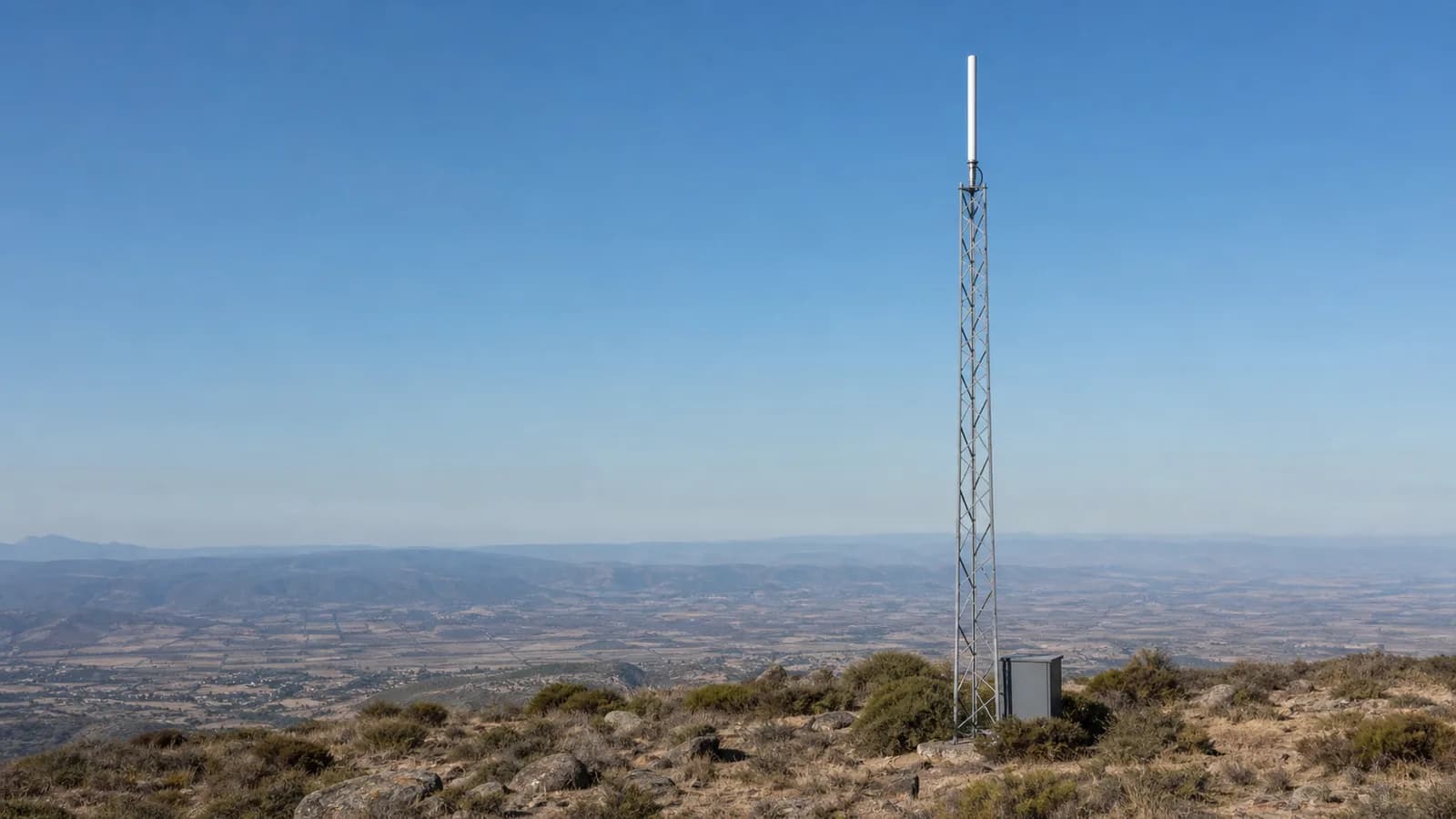
Repeaters are the other half, and they are what makes 2 meters genuinely useful. A repeater sits on a hill or a tall building, listens on one frequency and retransmits on another, and lends you its height. A handheld that struggles to reach three miles direct will work a repeater twenty or thirty miles away without complaint. Repeater pairs are regional, so find what is active near you rather than trusting any list you read online. Our repeater guide explains offsets and tones.
Below the FM portion, the bottom of the band is a different world. Roughly 144.0 to 144.1 MHz is CW, and 144.1 to about 144.3 is SSB. This is weak-signal territory, worked with horizontal beam antennas and a lot of patience, and it is where people make 2 meter contacts of several hundred miles under the right atmospheric conditions. It is also where nets, satellite work and packet live at various points across the band.
If you want the full frequency table across every amateur band, our bands explainer has it. This article is about what the band does and what to buy for it.
How Far It Actually Reaches
VHF at 144 MHz behaves broadly like light. It travels in straight lines and the first limit it meets is the horizon, which depends on antenna height and nothing else.
The radio horizon in miles is roughly the square root of twice the antenna height in feet, which is the model behind our range calculator.
| Antenna height | Horizon |
|---|---|
| 6 ft (handheld in hand) | 3.5 miles |
| 12 ft (roof rack) | 4.9 miles |
| 30 ft (roof mast) | 7.7 miles |
| 100 ft (small hill) | 14 miles |
| 500 ft (repeater site) | 32 miles |
Each station sees its own horizon, so two handhelds at head height on flat ground can theoretically reach about 7 miles between them. Treat that as a planning number and not a wall: signals do reach past the horizon by bending in the atmosphere and diffracting around obstacles, so on a good day you will hear someone further out. In practice, buildings, trees and terrain pull the real figure well under the geometry, and a mile or two between handhelds in a suburb is a normal result.
Which is why the repeater on the hill matters more than the watts in your hand. A repeater 500 feet up sees 32 miles; add your own 3.5 and the pair of you are working 35 miles apart on a five-watt radio.
Why 2 Meters Disappoints People
Here is the part almost nobody explains, and it is the real answer to why a new handheld feels flat on 2 meters and fine on 70 centimetres.
An antenna radiates according to its length measured in wavelengths. Below about a fifth of a wavelength it is electrically short and genuinely lossy, no matter what the packaging claims. Around half a wavelength it stops needing a ground plane, which matters enormously on a handheld, because your hand and the radio body are a poor substitute for one.
A full wave on 2 meters is 2,053 mm. Now look at what people actually screw onto their radios.
| Antenna | Length | On 2 meters | Class |
|---|---|---|---|
| Stock rubber duck | ~155 mm | 0.08 λ | electrically short |
| Nagoya NA-701 | 203 mm | 0.10 λ | electrically short |
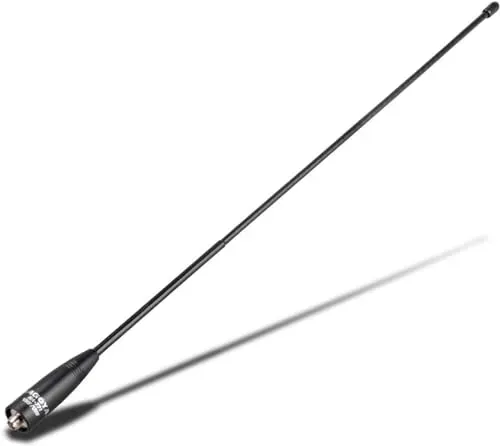
| Nagoya NA-771 (the usual upgrade) | 396 mm | 0.19 λ | electrically short |
| Comet SMA-24 | 450 mm | 0.22 λ | quarter wave |
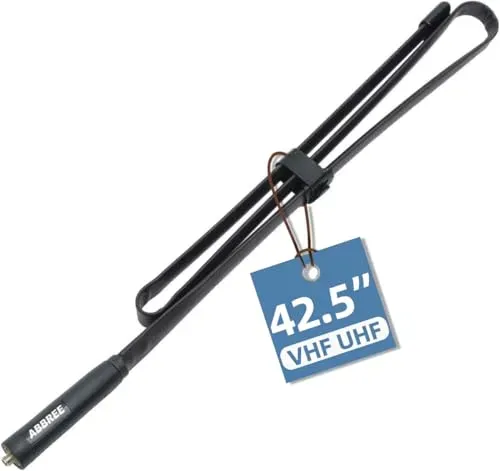
| Abbree AR-152 folding | 1,080 mm | 0.53 λ | half wave |
| ABBREE 48.8-inch folding | 1,240 mm | 0.60 λ | 5/8 wave |
Every stock antenna and every popular short upgrade is electrically short on this band. The NA-771 that every forum recommends, and which more new hams buy than any other antenna, is still only 0.19 of a wavelength on 2 meters. It is not a bad antenna. It is a very good 70 centimetre antenna, where its 396 mm works out at 0.58 of a wavelength, and that is exactly why the same whip feels strong on UHF and weak on VHF.
The antennas that are genuinely resonant on 2 meters are the long folding whips, and the gap is around 3.5 dB from the NA-771 to the AR-152. That is not a transformation, but it is the single largest improvement available to a handheld on this band, and it costs less than lunch.
We publish this figure for every antenna we track, computed the same way, on our antenna listings.
If You Are Hearing Nothing
Most people who conclude 2 meters is dead have made one of five fixable mistakes, and they are worth ruling out in this order.
You are monitoring 146.52 and expecting traffic. This is by far the most common one. The national calling frequency is a place to make contact, not a place people sit and chat, and in most of the country it is quiet for hours at a stretch. Silence there tells you almost nothing about the band. Find a local repeater and listen to that instead.
You have the repeater programmed but not the tone. Nearly every repeater requires a CTCSS tone on your transmit audio before it will open up. You will hear the repeater fine and it will simply ignore you. If you can hear other people through it but nobody answers you, this is almost certainly why.
You have the offset wrong. A repeater listens on a different frequency than it transmits on. Program the output frequency plus the correct offset, or use your radio's repeater mode, and check the direction: 2 meter repeaters in the US are usually minus offset below 147 MHz and plus above it.
You are indoors. A handheld inside a building with a short antenna is close to the worst case for this band. Walk outside, or at least to a window, before drawing conclusions. The difference is often dramatic.
Your antenna is a stock duck and you are on 2 meters. Which brings us back to the previous section. It is not a fault, it is the physics, and the folding whip fixes it for ten dollars.
The Radio Barely Matters, The Antenna Does
Handhelds on this band cluster between 5 and 10 watts. The step from 5 to 10 is 3 dB, which is real but small, and it does not move your horizon at all. Height sets the horizon; watts only fill in the path you already have.
So the order of operations for 2 meters is:
- Get the antenna higher. Standing up, walking to a window, or driving to a hilltop beats any hardware purchase.
- Use a repeater. The only reliable way past ten miles on this band.
- Fit a longer antenna. A half-wave whip is about 3.5 dB over the standard upgrade, and the standard upgrade is itself a large jump over stock.
- Then think about watts. Last, not first.
If you are on the fence about which handheld, the honest answer is that any of the current 10-watt tri-banders will do, and you should spend the difference on the antenna and the licence study guide.
What to Buy
A capable handheld under seventy dollars, with tri-band coverage and APRS built in. It scores 87 overall and 94 on beginner-friendliness, which is the highest combination in our handheld catalogue.
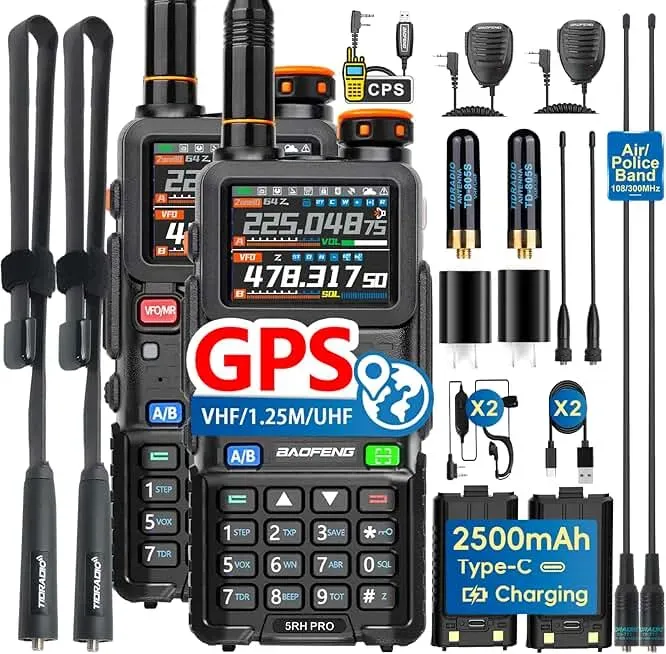
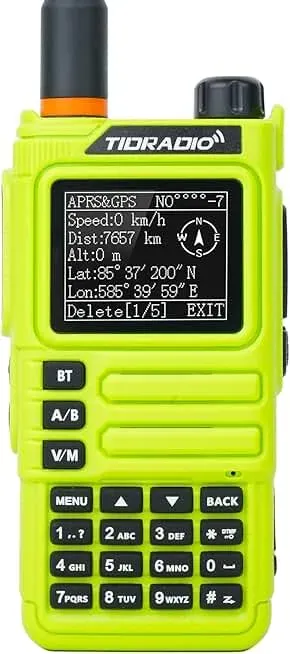
If that one is out of stock or you want the same specification from a different brand, this is the closest equivalent: same 10 watts, same tri-band coverage, same APRS and GPS, and a larger review base at 450 ratings.
Now the part that actually fixes 2 meters. At 1,080 mm this folding whip is a genuine half wave on the band, which no short antenna can be, and it costs ten dollars. It is long and it catches on things, which is the trade you are making. Fold it for carrying and extend it when you need the range.
For completeness, the antenna most people buy. It is a real improvement over a stock duck and it is the right answer if you mostly work 70 centimetres or want something you can wear on a belt. Just do not expect it to transform 2 meters, because at 0.19 of a wavelength it cannot.
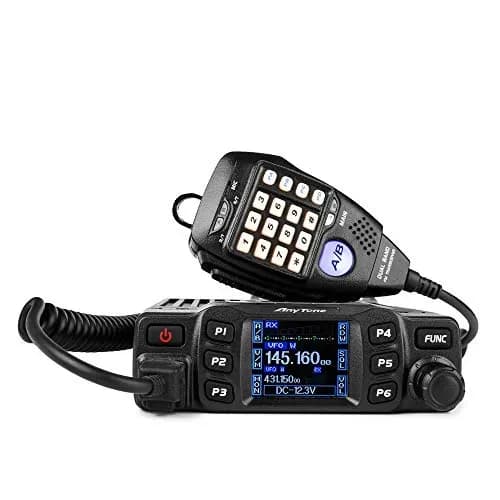
If you want reliable range rather than portability, the step up is a mobile radio with the antenna on a vehicle roof. The roof gives it both a couple of feet of height and a proper ground plane, and that combination does more than any handheld upgrade. Twenty-five watts, and about a hundred and twenty dollars.
Anyone planning to move into digital voice later should look at the DMR options before committing, since the three digital systems cannot talk to each other. The full field is on our handheld rankings and mobile rankings.