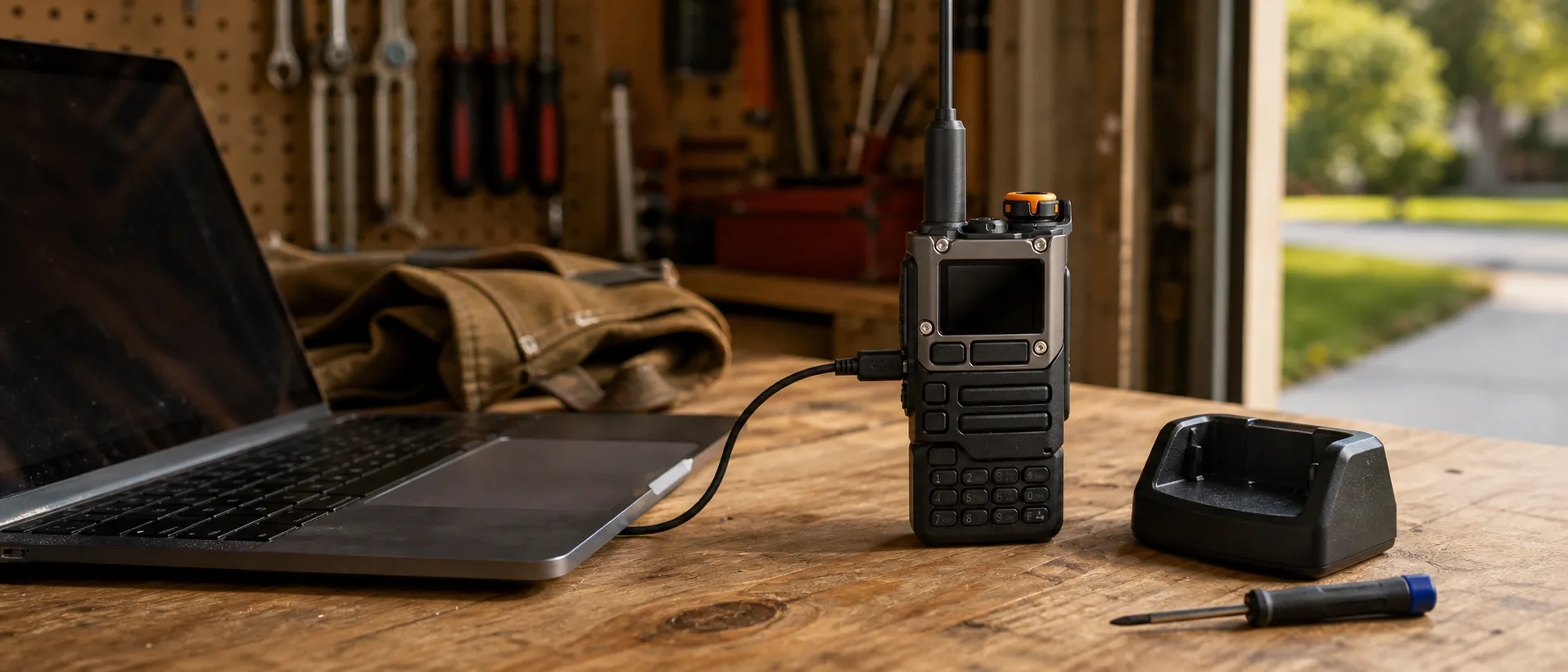

Search for the Quansheng UV-K6 and Google serves you two Amazon listings, an eBay auction, three forum threads, and one blog review from 2024. Nobody tells you the two things a buyer actually needs to know: the UV-K6 is the same radio as the UV-K5(8) wearing a different case, and the reason to buy either one is a firmware community that turns a $31 handheld into the most capable cheap receiver in amateur radio.
Here is how our scoring engine rates the UV-K6 (overall: 64/100, value: 95/100 at its current $31.55). Amazon buyers rate this listing 4.4 stars across 398 ratings. The short version: if you are a licensed ham who enjoys tinkering, it is a fantastic bargain. If you want a radio that works well out of the box, the same money buys a Baofeng UV-5R with a much longer track record, and we will show you exactly where that line falls.
The Snapshot
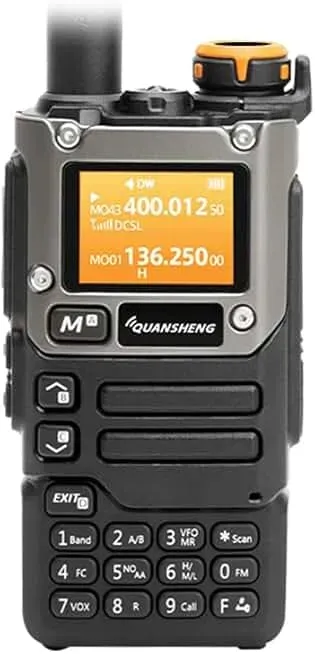
The UV-K6 is a dual-band analog FM handheld transmitting on 2 meters and 70 centimeters at a claimed 5 watts, with wide-band receive from 50 to 600 MHz including AM airband (108 to 136 MHz), FM broadcast, and 10 NOAA weather channels. You get 200 memory channels, a 1,400 mAh battery (Quansheng's own spec sheet; retail listings routinely say 1,600), USB-C charging plus a desktop cradle, a flashlight, and a 234-gram body with an SMA-male antenna connector. No DMR, no D-STAR, no APRS, no GPS, no Bluetooth, no IP rating.
| Dimension | Score | Why |
|---|---|---|
| Value | 95 | $31.55 for 5W, wide-band RX, and USB-C; the math barely computes |
| Beginner | 81 | Channel operation is simple; the menus and modding are not |
| Portability | 50 | Average HT bulk; 234 g with a 1,400 mAh pack |
| Features | 19 | Analog FM only; every digital-mode box unchecked |
| Overall | 64 | A specialist's bargain, not an all-rounder |
Prices and ratings reflect our last daily Amazon refresh; the live numbers are on the product page.
What the UV-K6 Actually Is
Quansheng's naming has confused every corner of the internet, including the retailers selling it: the Amazon listing for this radio literally titles itself "UV-K6 UV-K5(8)." RigPix, the community's reference spec site, heads its page "Quansheng UV-K6, also referred to as UV-K5(8)." Both are telling you the truth. The UV-K6 is the UV-K5(8) circuit board in a restyled shell, and the firmware community treats the K5, K5(8), and K6 as one platform.
That is good news, not a complaint. It means everything written about the K5(8), every firmware build, every mod guide, every owner report, applies to the K6. We keep a full variant decoder in our UV-K5 review, and the direct UV-K5 vs UV-K6 comparison runs the numbers side by side. The one-line summary: buy whichever case style is cheaper the day you shop. Today that is usually the K5(8) at $30.99 versus the K6 at $31.55, a difference of about two coffees per decade of ownership.
One practical caveat carried over from the K5: Quansheng has shipped multiple hardware revisions of this platform, and custom firmware builds target specific board versions. Check your hardware revision before you flash anything.
Specs That Matter
On paper the UV-K6 reads like any $30 Chinese dual-bander, but three items on the spec sheet explain its cult following.
The receiver range. Factory firmware already listens from 50 to 600 MHz across seven band segments, with AM demodulation on the 108 to 136 MHz airband. That is aircraft, marine VHF, weather, FM broadcast, and both ham bands in a $31 package. The receive chip itself is capable of far more, which is where the firmware story picks up.
USB-C plus a cradle. Like the rest of the K5 family, it charges over USB-C from any phone charger or power bank, and Quansheng still includes a desktop drop-in cradle. Most budget radios make you choose.
A frequency copy function. The stock firmware can sniff a transmitting radio nearby and clone its frequency and tone settings over the air, which is genuinely useful for meeting up with a group whose channel plan you do not know.
The trade-offs are the same ones we documented on the UV-K5(8): a receiver that overloads near strong transmitters, a small tinny speaker, and stock airband audio that owners describe as barely usable until the firmware community fixes it in software.
The Firmware Story
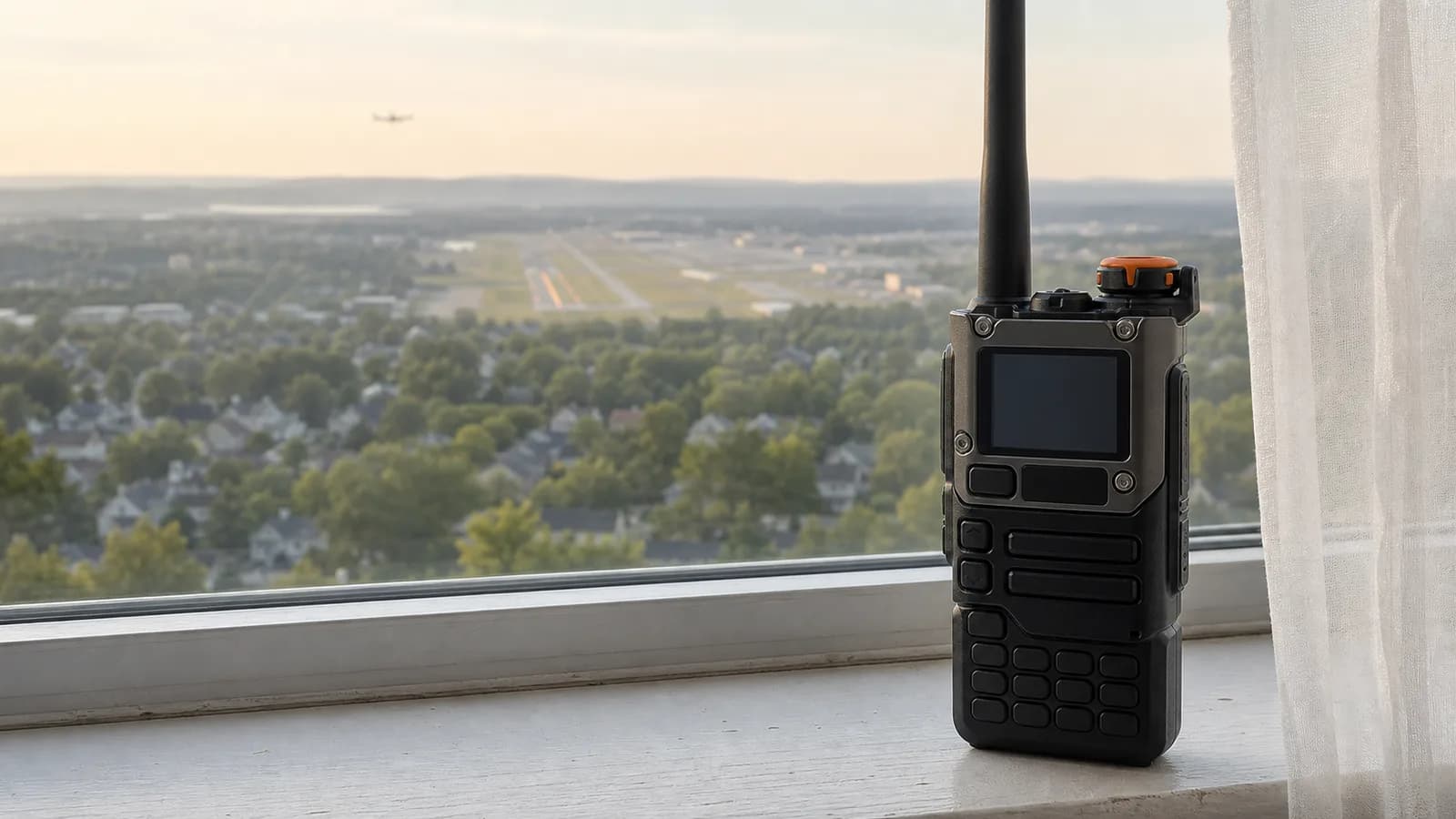
Nobody buys a UV-K6 for the stock experience. The BK4819 receiver chip inside supports far more than the factory firmware exposes, and because Quansheng made the platform easy to flash over a simple USB cable, an open-source community formed around it. Egzumer's firmware is the best-known build: it adds a spectrum analyzer, finer squelch control, extended receive coverage, and dozens of quality-of-life fixes, all flashable from a web page in about ten minutes.
The community's own advice, repeated in every thread including the r/amateurradio discussion that ranks on this radio's search results: save your factory configuration before you flash anything. A bad flash can brick the radio, and the factory image is your way back. The other consistent report is about expectations: flashed as a wide-band scanner, it is a fun and surprisingly capable toy, "not as good as a dedicated receiver, but it works ok" in one owner's words. As an SSB or AM listening post it is an experiment, not an Icom.
If you want the deep dive on what the firmware ecosystem does and which builds matter, our UV-K5 review covers it in full; every word applies to the K6.
Is It Legal? The Registry Answer
We track FCC equipment authorization for every radio in our database, and this is where we can add something no other page on this search result can. The UV-K6 does hold an FCC grant, and understanding what kind tells you exactly what is and is not legal.
Quansheng Electronics files with the FCC under grantee code XBP, and the K5 platform's grant, FCC ID XBPUV-K5, was approved on March 9, 2023 under Part 15B, the rule part covering a device's electronics, not its transmitter. There is no separate K6 grant; the K6 sells under the platform's UV-K5 grant, which matches what we see on device labels and is the same shared-grant pattern budget manufacturers use across cosmetic variants. You can look it up yourself.
What that means in practice:
- Transmitting on ham bands: legal with a license. Amateur gear does not require FCC transmitter certification; Part 97 lets licensed hams operate the UV-K6 on 2m and 70cm. No license yet? Our licensing guide and practice quiz will get you there.
- Receiving: legal for everyone. As a scanner, the UV-K6 needs no license at all.
- FRS, GMRS, MURS: not legal, ever. The UV-K6 holds no Part 95 certification, so transmitting on those services is prohibited even though firmware will happily tune them. This question comes up in every K6 thread, and the registry answer is unambiguous. If you want those frequencies legally, buy a certified GMRS radio.
- Unlocked wide-band transmit: illegal and pointless. Firmware can open transmit far outside the ham bands, and doing so breaks FCC rules while producing milliwatts of power buried in harmonics. The one editorial review that ranks for this radio measured it on a spectrum analyzer and reached the same conclusion we did on the K5: flash for the receiver, keep your transmitter inside your license privileges.
Note for US buyers: the American market version transmits on 144 to 148 and 420 to 450 MHz, the actual US ham allocations, while general-market units cover wider TX ranges. Either way, your license, not the radio, defines what is legal.
UV-K6 vs UV-K5(8) vs Baofeng UV-5R
| Radio | Price | Our score | Amazon rating | Buy it for |
|---|---|---|---|---|
| UV-K6 | $31.55 | 64 | 4.4 (398) | The K5 platform in the newer shell |
| UV-K5(8) | $27.99 | 67 | 4.5 (686) | Same platform, bigger owner base |
| Baofeng UV-5R | $17.16 | 69 | 4.5 (10,207) | Just working, at half the price |
Against its own sibling, the choice is cosmetic; the K5(8) currently edges it on price and carries a larger review base, which is why, as of October 2026, it scores slightly higher. Against the UV-5R, the question is what you want from a $30 radio. The Baofeng is the safe, boring, endlessly documented default with CHIRP support and fifteen years of accessories; the Quansheng is the better receiver and the vastly better modding platform. A first radio for a new Technician who wants to hit local repeaters: UV-5R. A second radio for someone who thinks a web-flashable spectrum analyzer sounds like a good weekend: UV-K6.
The rest of the Quansheng lineup is easier to dismiss. The UV-K1 is a stripped-down sibling that, as of October 2026, scores far below the K6, and the TK11 charges $96.99 while abandoning the open platform that makes this family worth discussing; it scores about as low.
What Owners Say
Our tracked Amazon listing, which is also the top organic result for this radio, holds 4.4 stars across 398 ratings, a solid figure that sits just below the K5(8)'s 4.5 across 686. The rating histogram skews strongly positive with the usual budget-radio tail of quality-control complaints.
The qualitative picture from the community threads is remarkably consistent. Owners buy it as a project radio and a scanner: flash Egzumer, listen to airband, experiment with SSB reception, keep a UV-5R or something nicer for actual transmitting. The recurring warnings are the two we have already covered: save the factory config before flashing, and do not let the unlocked transmit range tempt you into out-of-band transmissions that are equal parts illegal and ineffective.
Who Should Buy It, and Who Should Not
Buy the UV-K6 if you are a licensed ham who enjoys firmware tinkering, you want the cheapest genuinely wide-band receiver that fits in a pocket, or you are collecting a project radio for experiments you would never risk on a $200 handheld.
Buy the UV-K5(8) instead if it is cheaper on the day you shop; it is the same radio with a larger owner base.
Buy something else entirely if you want a first radio that works well out of the box (UV-5R or see our best Baofeng roundup), you need GMRS legality (certified GMRS radios start at $43), or you need digital modes, which this platform will never do.
The Verdict
The UV-K6 earns its overall score (64/100) the specialist's way: a high value score (95) dragged down by a feature list that ends at analog FM. As a general-purpose first handheld it is outclassed by cheaper, better-documented radios. As a budget wide-band receiver with the best firmware community in budget radio, it has no real competition except its own twin, the UV-K5(8). Know which of those radios you are buying, and you will be happy with it.